Solution:
Concept: For a polygon whose vertices (x1,y1),(x2,y2),…,(xn,yn) are taken in order round it, the area is
21∣(x1y2−x2y1)+(x2y3−x3y2)+⋯+(xny1−x1yn)∣
This is the triangle formula extended: write the vertices in a column, repeat the first one at the end, and add the "down-right" products minus the "up-right" products.
(i) A(1,1), B(7,−3), C(12,2), D(7,21)
Step 1 — Check the order of the vertices. The figure shows that A, B, C, D go round the quadrilateral in order (anticlockwise), so the formula can be used as it stands.
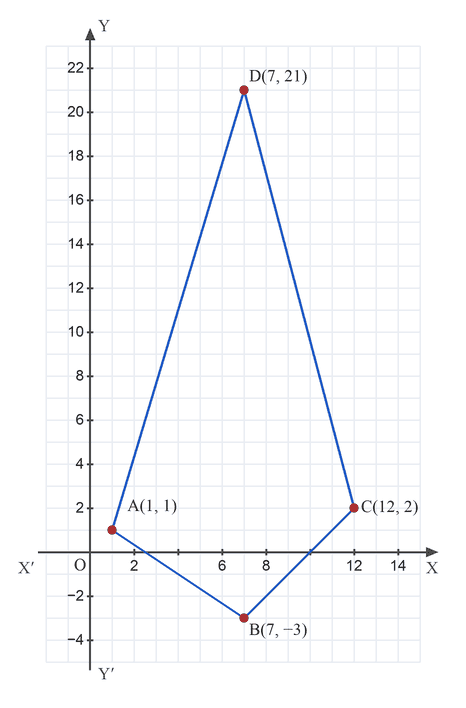
Step 2 — Work out the cross products. We take the vertices in order and return to A:
x1y2−x2y1=1(−3)−7(1)=−10
x2y3−x3y2=7(2)−12(−3)=50
x3y4−x4y3=12(21)−7(2)=238
x4y1−x1y4=7(1)−1(21)=−14
Step 3 — Add and halve. We add the four products and take half:
Area=21∣−10+50+238−14∣=21(264)=132
Step 4 — Check by triangles. The diagonal AC splits the quadrilateral into triangles ABC (area 25) and ACD (area 107), and 25+107=132.
Area =132 sq. units.
(ii) A(1,1), B(3,4), C(5,−2), D(4,−7)
Step 1 — Check the order of the vertices. The figure shows A, B, C, D going round the quadrilateral in order (clockwise).
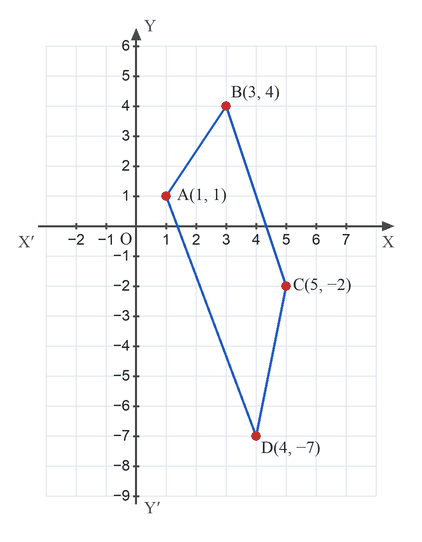
Step 2 — Work out the cross products. We take the vertices in order and return to A:
x1y2−x2y1=1(4)−3(1)=1
x2y3−x3y2=3(−2)−5(4)=−26
x3y4−x4y3=5(−7)−4(−2)=−27
x4y1−x1y4=4(1)−1(−7)=11
Step 3 — Add and halve. We add the four products and take the numerical value of half the sum:
21(1−26−27+11)=21(−41)=−241
The negative sign only shows the clockwise order, so the area is 241.
Area =241 sq. units.
Watch out: The vertices must be taken in order round the figure; taking them in a crossing order gives a wrong value.
Therefore, the areas are (i) 132 sq. units and (ii) 241 sq. units.
