Solution:
Concept: The area of the triangle with vertices (x1,y1), (x2,y2), (x3,y3) is
Δ=21[x1(y2−y3)+x2(y3−y1)+x3(y1−y2)]
The bracket comes out positive when the vertices are taken anticlockwise and negative when they are taken clockwise, so the area is its numerical (absolute) value.
(i) (4,2), (4,5), (−2,2)
Step 1 — Substitute in the formula. We take (x1,y1)=(4,2), (x2,y2)=(4,5), (x3,y3)=(−2,2):
Δ=21[4(5−2)+4(2−2)+(−2)(2−5)]=21[12+0+6]=9
Step 2 — Check with base and height. The figure shows a right triangle: the side from (−2,2) to (4,2) is 6 long and the side from (4,2) to (4,5) is 3 long, so the area is 21×6×3=9.
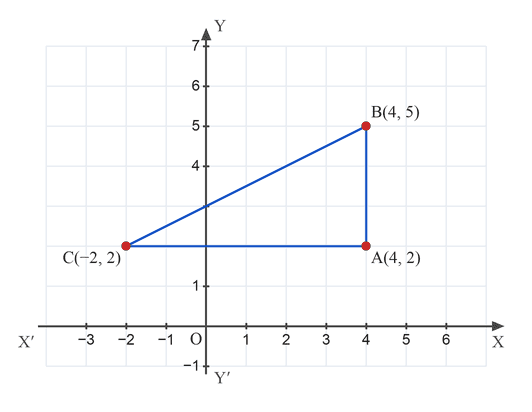
Area =9 sq. units.
(ii) (0,0), (−2,3), (10,7)
Step 1 — Use the formula with one vertex at the origin. Since (x1,y1)=(0,0), the formula reduces to 21(x2y3−x3y2):
Δ=21[(−2)(7)−(10)(3)]=21(−14−30)=−22
Step 2 — Take the numerical value. The negative sign only shows that the vertices were taken clockwise (see the figure), so the area is 22.

Area =22 sq. units.
(iii) (a,0), (0,b), (x,y)
Step 1 — Substitute in the formula. We take (x1,y1)=(a,0), (x2,y2)=(0,b), (x3,y3)=(x,y):
Δ=21[a(b−y)+0(y−0)+x(0−b)]=21(ab−ay−bx)
Step 2 — Take the numerical value. The area is the size of this expression, which we write as
Δ=21∣bx+ay−ab∣
When (x,y) is on the far side of the line through (a,0) and (0,b) from the origin (with a,b>0), bx+ay−ab is positive and the area is 21(bx+ay−ab).
Area =21(bx+ay−ab) sq. units (its numerical value).
Therefore, the areas are (i) 9 sq. units, (ii) 22 sq. units, (iii) 21(bx+ay−ab) sq. units, taken numerically.
