Solution:
Concept: For a polygon whose vertices (x1,y1),(x2,y2),…,(xn,yn) are taken in order round it, the area is
21∣(x1y2−x2y1)+(x2y3−x3y2)+⋯+(xny1−x1yn)∣
This is the triangle formula extended: write the vertices in a column, repeat the first one at the end, and add the "down-right" products minus the "up-right" products.
Step 1 — Work out the cross products. We take A(1,2), B(−5,6), C(7,−4), D(−2,k) in order and return to A:
x1y2−x2y1=1(6)−(−5)(2)=16
x2y3−x3y2=(−5)(−4)−7(6)=−22
x3y4−x4y3=7k−(−2)(−4)=7k−8
x4y1−x1y4=(−2)(2)−1(k)=−4−k
Step 2 — Add the products. We add the four results:
16−22+7k−8−4−k=6k−18
Step 3 — Set the area to zero. The area is 21∣6k−18∣, and this is zero when
6k−18=0
k=3
Step 4 — Understand the zero value. We put k=3 and split the quadrilateral along AC into triangles ABC and ACD:
△ABC=21[1(6+4)+(−5)(−4−2)+7(2−6)]=6
△ACD=21[1(−4−3)+7(3−2)+(−2)(2+4)]=−6
These signed values cancel because B and D lie on the same side of AC: the path A→B→C→D→A crosses itself (sides BC and DA meet at (−1,38), the small dark dot in the figure). The four points do not lie on one line.
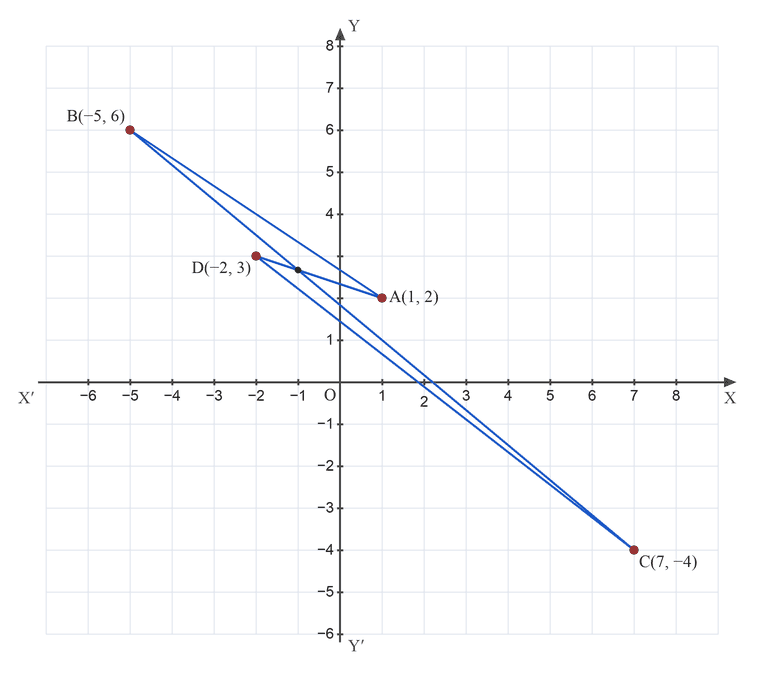
Therefore, k=3.
