
Opening your dashboard
Class 11 Maths Chapter 12 Basic Concepts of Points and Their Coordinates: Competency-Based Questions (CBQ)
40 questions on Chapter 12, each worked through on its own page with the AI tutor. Class 11 Maths, ICSE 2026-27.
40 questions
1–5 marks · Mixed difficulty
- 13 marks
Question 1
Competency: Application
A game designer works with a game window that is pixels wide and pixels tall. The game engine gives every pixel a position measured from the top-left corner of the window: is counted to the right and is counted downwards. For the maths of the game, the designer uses ordinary coordinate axes with the origin at the centre of the window, the -axis pointing right and the -axis pointing up, with unit equal to pixel. Three sprites sit at the pixel positions , and . (Hypothetical data.)
(a) Show that the pixel at has maths coordinates and .
(b) Find the maths coordinates of , and , and state the quadrant, or the axis, on which each one lies.
(c) Describe, using and , the part of the window that lies in the second quadrant of the maths axes.
- 21 mark
Question 2
Competency: Application
A drone takes off from a point in a flat field. Its controller uses as the origin, with the -axis pointing east and the -axis pointing north, and distances in metres. The drone flies m due west, then m due south, then m due east, and then hovers. (Hypothetical data.)
Where is the drone now, and where does that point lie?
- 31 mark
Question 3
Competency: Analysis
A stage lighting panel has one LED at every point with integer coordinates such that and ; the centre LED is at the origin. For one scene, the operator switches on only the LEDs that lie in the second quadrant. (Hypothetical data.)
How many LEDs are switched on?
- 44 marks
Question 4
Competency: Application & Evaluation
Two villages and lie on opposite sides of a straight river. On a map with the river along the -axis and unit km, is at and is at . There are two bridges, at and , as shown in the figure. A bus goes in a straight line from to a bridge, crosses it, and then goes in a straight line to . Treat the river as a line. (Hypothetical data.)

(a) Find the length of the route through the bridge at .
(b) Find the length of the route through the bridge at , correct to two decimal places.
(c) Show that , and are collinear, and find the ratio in which divides . Hence explain why no route that crosses the river at any point can be shorter than the route through .
- 51 mark
Question 5
Competency: Analysis & Evaluation
A ladder m long leans against a vertical wall, with its foot on level ground. Take the corner where the wall meets the ground as the origin , the ground as the -axis and the wall as the -axis. At any moment the foot of the ladder is at and its top is at , where and . The ladder slowly slides down the wall. Let be the mid-point of the ladder. (Hypothetical data.)
Assertion (A): As the ladder slides, its mid-point always stays at a distance of m from .
Reason (R): The mid-point is , and for every position of the ladder.
- 61 mark
Question 6
Competency: Application
Riya draws a rough sketch map on graph paper. To make it fit the page, she uses cm for km in the east–west direction but cm for km in the north–south direction. On her sketch, with the -axis pointing east, the -axis pointing north and lengths in cm, the school is at and the library is at . (Hypothetical data.)
What is the actual straight-line distance between the school and the library?
- 71 mark
Question 7
Competency: Application
A city's emergency map uses a grid with unit km, the -axis pointing east and the -axis pointing north. An accident is reported at . Ambulances are parked at three stations: , and . The control room sends the ambulance from the station that is nearest to in a straight line. (Hypothetical data.)
Which station is chosen, and what is its straight-line distance from ?
- 84 marks
Question 8
Competency: Application
In a warehouse, crates stand on a large flat floor. Positions are measured in metres from one corner of the floor, with the - and -axes along two walls. For two loads, of mass at and mass at , the balance point (centre of mass) lies on and divides it internally in the ratio . Two loads may then be treated as one load of their total mass placed at their balance point. A kg crate stands at and a kg crate at . (Hypothetical data.)
(a) Find the balance point of these two crates.
(b) A kg crate is placed at . Find the balance point of all three crates.
(c) Where must a fourth crate of mass kg be placed so that the balance point of all four crates is at ?
- 91 mark
Question 9
Competency: Analysis & Evaluation
In a side view of an adventure park, a zip-line cable runs in a straight line from the top platform to the landing platform , with distances in metres ( measured along the ground and the height above it). A rest bar is fixed on the cable at the point that divides internally in the ratio . (Hypothetical data.)
Assertion (A): The rest bar is at the point .
Reason (R): If a point divides internally in the ratio , then .
- 104 marks
Question 10
Competency: Application & Analysis
The figure shows a side view of a street at night, with distances in metres. The ground is the -axis and a lamp post stands along the -axis with its lamp at . A girl m tall stands upright at , so her head is at . The light from that just passes her head meets the ground at the tip of her shadow, so , and are collinear and lies between and . (Hypothetical data.)
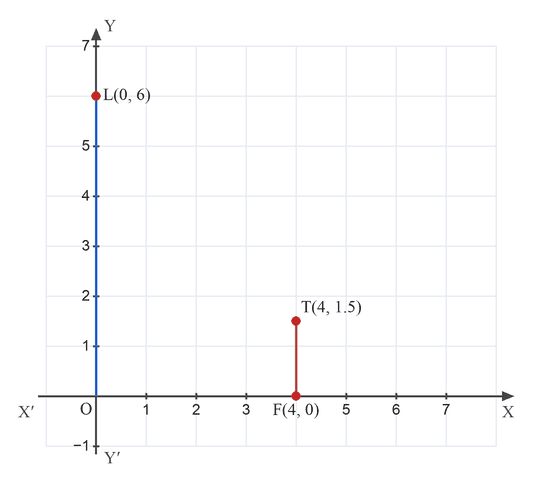
(a) The point lies on produced beyond , so divides externally. Using the section formula for external division and the fact that is on the ground, show that the ratio is .
(b) Find the coordinates of and the length of her shadow .
(c) How far from the lamp post should she stand for her shadow to be m long?
- 111 mark
Question 11
Competency: Application
Two teams dig a straight tunnel through a hill, one from each end. On the site plan, in metres, the ends are and . The team at digs m per day and the team at digs m per day. They start on the same day and work every day until they meet. (Hypothetical data.)
At which point of the plan do the two teams meet?
- 124 marks
Question 12
Competency: Application
A triangular park has a straight path along each of its three sides. On the plan, in metres, its corners are , and . The gardener wants the largest circular pond that touches all three paths. Its centre must be equally far from the three sides, so it is the incentre of triangle , and its radius is , where is the area of the triangle and is half its perimeter. (Hypothetical data.)
(a) Find the lengths of the three sides of the park.
(b) Find the incentre , using , where , , are , , and , , .
(c) Find the radius of the pond, and check that it equals the distance of from the path .
- 131 mark
Question 13
Competency: Analysis & Evaluation
A flower bed in the corner of a garden is a right-angled triangle with corners , and , in metres. A circular bird bath is to be placed in the bed so that it touches all three edges of the bed. (Hypothetical data.)
Assertion (A): The centre of the largest such bird bath is the point .
Reason (R): The incentre of a triangle is equidistant from its three vertices.
- 144 marks
Question 14
Competency: Application & Analysis
A metalworker cuts a uniform triangular steel plate with corners , and , measured in cm. The balance point of the plate is the centroid of triangle . The metalworker then saws off the corner at along the straight line joining , the mid-point of , to , the mid-point of . (Hypothetical data.)
(a) Find the balance point of the whole plate.
(b) Find , and the centroid of the cut-off triangle .
(c) Show that , and lie on one straight line, and find the ratio .
- 151 mark
Question 15
Competency: Analysis & Evaluation
Three friends stand at , and on a sports ground, in metres. They decide to meet at the centroid of triangle . (Hypothetical data.)
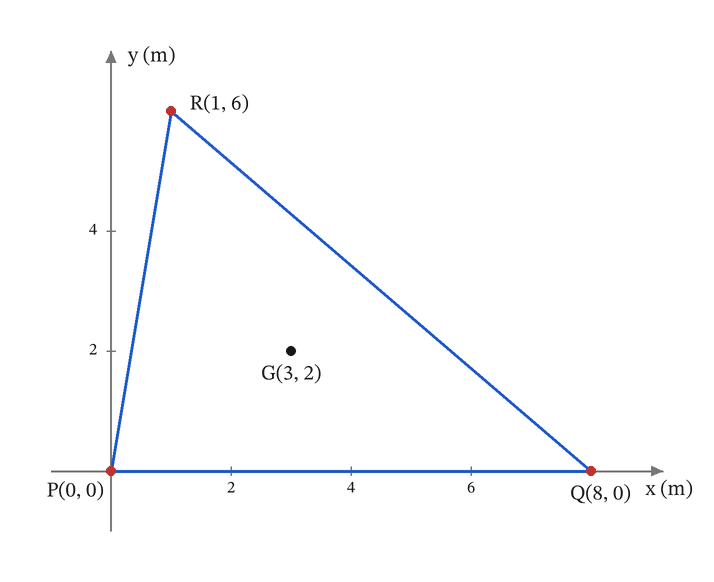
Assertion (A): The meeting point is equally far from all three friends.
Reason (R): The centroid of a triangle divides each median in the ratio , measured from the vertex.
- 161 mark
Question 16
Competency: Application
A phone takes three GPS fixes of a parked car within a few seconds. In a local grid, in metres, the fixes are , and . The app reports the average of the three fixes as its best estimate of the car's position. (Hypothetical data.)
Which statement about the reported point is correct?
- 174 marks
Question 17
Competency: Application & Analysis
A surveyor marks the five corners of a field on a plan, in metres: , , , and , as shown in the figure. (Hypothetical data.)

(a) The diagonals and split the field into the triangles , and . Find the area of each triangle.
(b) Hence find the area of the field.
(c) The owner wants a straight fence from to a point on the side that divides the field into two parts of equal area. Find the ratio and the coordinates of .
- 181 mark
Question 18
Competency: Analysis & Evaluation
A surveyor records the corners of a triangular plot as , and , in metres, walking round the plot in the order . She substitutes them in that order into the expression . (Hypothetical data.)
Assertion (A): The area of the plot is m².
Reason (R): The value of the expression is negative when the vertices are taken in the clockwise sense.
- 191 mark
Question 19
Competency: Analysis
A rectangular field has corners , , and , in metres. To find its area, an assistant uses the formula
but types the corners in the order , , , . (Hypothetical data.)
What value does the formula give for this order?
- 201 mark
Question 20
Competency: Analysis & Evaluation
A triangular plot has corners , and , in metres. (Hypothetical data.)
Assertion (A): The area of the plot is m².
Reason (R): The area of a triangle found with the absolute value in the area formula does not change when its vertices are listed in a different order.
- 213 marks
Question 21
Competency: Application & Analysis
A photographer's camera is fixed at on a plan of a street corner, in metres. A lamp post stands at . A cyclist rides due east along a straight road, the line , at a steady m/s; seconds after she passes the point , her position is . The post hides the cyclist from the camera at the moment when , and are collinear with between and . (Hypothetical data.)
(a) Using the condition for three points to be collinear, write an equation for .
(b) Find and the position of the cyclist at that moment.
(c) Show that lies between and , and find the ratio .
- 221 mark
Question 22
Competency: Analysis & Evaluation
Three fence poles are fixed at , and on a farm plan, in metres. (Hypothetical data.)
Assertion (A): The three poles stand in one straight line.
Reason (R): Exactly one straight line can be drawn through any two distinct points.
- 234 marks
Question 23
Competency: Application & Analysis
A town map uses the railway station as the origin, with the -axis pointing east, the -axis pointing north and unit km. The town planners decide to use the new bus terminal as the origin instead, keeping the axes parallel to the old ones. (Hypothetical data.)
(a) The hospital is at in the old system. Find its coordinates in the new system.
(b) A new metro stop is at in the new system. Find its coordinates in the old system.
(c) Describe all the points that lie in the first quadrant of the old system and also in the second quadrant of the new system.
- 241 mark
Question 24
Competency: Analysis & Evaluation
In a graphing app, a student first moves the origin to the point , keeping the axes parallel. Then, reading coordinates in this new system, she moves the origin again, to the point of the new system, with the axes still parallel. (Hypothetical data.)
Assertion (A): The two moves together have the same effect as a single shift of the origin to the point of the original system.
Reason (R): When the origin is shifted to with the axes kept parallel, the old coordinates and the new coordinates of any point satisfy and .
- 251 mark
Question 25
Competency: Application
In a 2D game, every object has fixed world coordinates. The screen shows the world through a camera: the camera's position is the origin of the screen coordinates and the axes stay parallel to the world axes, so an object's screen coordinates are its world coordinates minus the camera's world coordinates. When the camera is at , a coin appears on the screen at . The player then moves, and the camera moves to . The coin does not move. (Hypothetical data.)
Where does the coin appear on the screen now?
- 261 mark
Question 26
Competency: Analysis
At a school fair, the organisers' map uses the main gate as the origin, with the -axis pointing east, the -axis pointing north and unit m. Five food stalls stand at , , , and . The organisers then decide to use the information desk as the origin instead, keeping the new axes parallel to the old ones. (Hypothetical data.)
How many of the five stalls lie in a different quadrant in the new system from the one they lay in before?
- 271 mark
Question 27
Competency: Application & Analysis
A delivery drone flies in a straight line at a steady speed from a warehouse to a customer's home . On the delivery map, unit km, the -axis points east and the -axis points north. The drone leaves at 10:00 a.m. and reaches at 10:24 a.m. On the way, it passes directly over a park at . (Hypothetical data.)
At what time does the drone pass over the park?
- 281 mark
Question 28
Competency: Analysis
A surveyor marks the corners of a triangular plot at , and , in metres, and plans a well at the centroid of the plot. A re-check shows that the corner was marked wrongly: the true corner is m east and m north of the marked point. The corners and are correct. (Hypothetical data.)
How far must the planned position of the well be moved?
- 291 mark
Question 29
Competency: Analysis & Evaluation
A geometry app has a tool called "Divide externally". The user picks two points and and a ratio , with and positive, and the app marks the point on the line , outside the segment , for which . Seema tries the ratio with many different segments.
Assertion (A): For the ratio , the app cannot mark any point, whatever segment is chosen.
Reason (R): In the formula for external division, , the denominator is zero when .
- 301 mark
Question 30
Competency: Analysis & Evaluation
A pegboard has holes at all the points with whole-number coordinates, in cm. Ria hangs triangular frames on it, with the three corners of each frame on pegs in holes. She would like to add one more peg at the centroid of each frame, to support it at its balance point. (Hypothetical data.)
Assertion (A): Whenever the three corners of a frame are at holes, its centroid is also at a hole.
Reason (R): The coordinates of the centroid are and , the averages of the coordinates of the three vertices.
- 311 mark
Question 31
Competency: Application & Analysis
A forest department map is drawn to the scale cm m. On the map, with the axes along two edges of the sheet and lengths in cm, a triangular patch of forest has its corners at , and . The department plans to plant saplings over the whole patch. (Hypothetical data.)
What is the actual area of the patch? (Take hectare m².)
- 322 marks
Question 32
Competency: Evaluation
A carpenter makes the top of a small table. On his plan, with lengths in decimetres ( dm cm), the corners of the top are , , and . He measures each of the four sides as cm and says, "All four sides are equal, so the top is a square." (Hypothetical data.)
Use the distance formula to check his claim.
- 332 marks
Question 33
Competency: Application & Analysis
On the plan of a garden, the corner tap is the origin, the -axis runs east along a hedge and the -axis runs north along a path, with lengths in metres. A buried water valve lies in the second quadrant. Its distance from the path is twice its distance from the hedge, and it is m from the tap. (Hypothetical data.)
Find the coordinates of the valve.
- 342 marks
Question 34
Competency: Application
For the sports-day march-past, a school makes large triangular flags. On the cutting pattern, with lengths in decimetres, each flag has its corners at , and . The cloth costs ₹ 180 per square metre, and none of it is wasted. (Hypothetical data.)
Find the cost of the cloth for all the flags.
- 352 marks
Question 35
Competency: Understanding
A shopkeeper compares this month's sales record with last month's. She plots each item at the point , where is the percentage change in its price and is the percentage change in the number of units sold. A rise counts as positive and a fall as negative. (Hypothetical data.)
(a) Tea is plotted at . Describe in words what happened to the price of tea and to its sales.
(b) In which quadrant does she find the items whose price went up but whose sales went down? Where does she plot the items whose price did not change?
- 363 marks
Question 36
Competency: Analysis & Evaluation
A patrol boat on a large lake reports its position from time to time. On the patrol map, unit km. The log reads as follows.
Time 9:00 a.m. 9:20 a.m. 10:00 a.m. Position (Hypothetical data.)
(a) Show that the three positions lie on one straight line, with between and .
(b) Is the log consistent with the boat moving along this line at a steady speed? If so, find the speed.
- 373 marks
Question 37
Competency: Creativity & Application
A park designer wants a triangular flower bed with its three corners at grid pegs. On her plan, with lengths in metres, the pegs are at all the points with whole-number coordinates. The bed must have its centroid at the fountain , so that the fountain is at its balance point, and its area must be exactly m². (Hypothetical data.)
Design one such bed: give the coordinates of its three corners, and show that your bed meets both conditions.
- 383 marks
Question 38
Competency: Application & Analysis
In a planned city, the roads form a square grid: they run east–west and north–south along every line on which or is a whole number, with unit km. A cloud kitchen stands at the road crossing . A delivery taxi must follow the roads, so its shortest route from to is km long. A delivery drone flies in a straight line. (Hypothetical data.)
(a) Two homes are at and . For each home, find the length of the taxi route from and the length of the drone's flight from .
(b) For the drone saves no distance. Explain why, and describe all the homes for which the drone saves no distance.
- 395 marks
Question 39
Competency: Analysis & Evaluation
A school has a plot of land shaped like a quadrilateral . The table gives its corners on the site plan, in metres. (Hypothetical data.)
Corner Coordinates The gardener marks the mid-points , , and of the sides , , and , and makes a flower bed in the shape of the quadrilateral . (A quadrilateral whose diagonals bisect each other is a parallelogram.)
(a) Find the area of the plot .
(b) Find , , and , and show that the flower bed is a parallelogram.
(c) The gardener says that the flower bed covers exactly half of the plot. Check his claim.
- 405 marks
Question 40
Competency: Analysis & Evaluation
An artist has chalked a small triangular logo on a wall and wants to paint an enlarged copy. She fixes a nail at and, for each corner, stretches a string from through that corner and marks the new corner three times as far from as the old one, on the same side of . On her plan, in decimetres, the nail is at and the corners are , and , as shown in the figure. (Hypothetical data.)

(a) The new corner lies on produced beyond , with . Show that divides externally in the ratio , and find the coordinates of .
(b) Find the new corners and in the same way.
(c) She buys paint for three times the area of the small logo, saying, "The copy is three times as big." Find the areas of both triangles, and decide whether she has bought enough paint.