
Opening your dashboard
Class 11 Chemistry Chapter 4: Chemical Bonding and Molecular Structure Solutions
240 textbook questions with step-by-step answers, free to read, for ISC 2026-27.
Get talked through Ch 4, not just shown the answer
Reading a finished solution is not the same as being able to do it. The AI tutor takes one question at a time and works it with you, in your own words, until you can.
- Ask it out loud, in your own words
- It gives you the next step, not the answer
- Stuck on part (ii)? Start there
240 questions with solutions
1–5 marks · Mixed difficulty
The first 32 solutions are on this page. This chapter is a long one, so the rest open on their own page to keep this one quick to load.
- 11 mark
Question 1
A diatomic molecule has a dipole moment equal to 1.2 D. If its bond distance is 1.0 Å, what fraction of an electronic charge exists in each atom?
Solve with AIAnswer
(A) 12%
(B) 18%
- Correct
(C) 25%
(D) 29%
Answer: (C) 25%
Key idea: The dipole moment of a bond is the charge on each end multiplied by the distance between the charges, . Here is the dipole moment, is the partial charge on each atom and is the bond length. If one full electronic charge sat on each atom, the dipole moment would be . So the fraction of an electronic charge on each atom is .
Step 1 — Write the data in one set of units (CGS). We convert everything to esu and cm, because 1 debye is defined in these units: 1 D is esu cm and 1 Å is cm.
Step 2 — Find the dipole moment for a full electronic charge. We multiply the electronic charge by the bond length, which gives the dipole moment the molecule would have if the bond were 100% ionic.
Step 3 — Divide the real dipole moment by this value. The ratio tells us what fraction of a full charge is really present on each atom.
Step 4 — Turn the fraction into a percentage. We multiply by 100.
The SI route gives the same result. Here 1 D is C m, is C and is m:
Why the other options are wrong:
- (A) 12% is about half of the correct value. It would be the answer only if the bond were about 2.0 Å long.
- (B) 18% does not follow from the data. It would need a full-charge dipole of about 6.7 D, not 4.8 D.
- (D) 29% would need a full-charge dipole of about 4.1 D, which means a bond of about 0.86 Å, not 1.0 Å.
Note: the book's printed key, 12%, is a slip; the correct value from the data is 25%.
Therefore, each atom carries 25% of an electronic charge.
- 21 mark
Question 2
Which of the following molecules is polar?
Solve with AIAnswer
(A)
- Correct
(B)
(C)
(D) All are polar
Answer: (B)
Key idea: A molecule is polar (has a net dipole moment) when its bond dipoles do not cancel. Bond dipoles cancel in symmetrical shapes (linear, trigonal planar, tetrahedral, octahedral with identical atoms) and do not cancel in bent or pyramidal shapes.
Step 1 — Find the shape of . Sulphur has two bonded O atoms and one lone pair, so by VSEPR the molecule is bent (V-shaped), with an angle of about 119°.
Step 2 — Check whether the bond dipoles cancel. In a bent molecule the two S–O bond dipoles point at an angle, so they add to give a resultant. has a dipole moment of about 1.6 D, so it is polar.
Why the other options are wrong:
- (A) is trigonal planar with three equal S–O bonds at 120°, so the three bond dipoles cancel and the dipole moment is zero.
- (C) is octahedral; each S–F dipole is cancelled by the one directly opposite it, so the molecule is non-polar.
- (D) Since and are non-polar, "all are polar" is false.
Therefore, is the polar molecule.
- 31 mark
Question 3
has measurable dipole moment while has zero dipole moment, because:
Solve with AIAnswer
(A) The N – H bond is polar but B—F bond is non-polar.
- Correct
(B) has planar symmetrical structure but has a pyramidal structure.
(C) is a base while is a Lewis acid.
(D) has a planar symmetrical structure but has a pyramidal structure.
Answer: (B) has a planar symmetrical structure but has a pyramidal structure.
Key idea: The dipole moment of a molecule is the vector sum of its bond dipoles. Even very polar bonds give zero total dipole if the shape is symmetrical, because the bond dipoles cancel.
Step 1 — Look at . Boron has three bond pairs and no lone pair, so is trigonal planar with F–B–F angles of 120°. The three equal B–F dipoles point outwards at 120° to each other and cancel exactly, so the dipole moment is zero.
Step 2 — Look at . Nitrogen has three bond pairs and one lone pair, so is pyramidal. The three N–H dipoles all lean towards the top of the pyramid, so they add up, and the lone pair adds to the same direction. The result is a measurable dipole moment of about 1.47 D.
Step 3 — Conclude. The difference comes from the shapes, which is what option (B) states.
Why the other options are wrong:
- (A) The B–F bond is in fact strongly polar (electronegativity of F 4.0, of B 2.0). The dipoles cancel because of the shape, not because the bond is non-polar.
- (C) Both parts of the sentence are true ( is a Lewis base, a Lewis acid), but acid–base behaviour does not decide the dipole moment.
- (D) It reverses the shapes: is pyramidal and is planar.
Note: the book's key gives the first two options; the first option is false (the B–F bond is polar), so only (B) is correct.
Therefore, has zero dipole moment because its planar symmetrical shape cancels its bond dipoles, while pyramidal does not.
- 41 mark
Question 4
Which of the following has the highest dipole moment?
Solve with AIAnswer
- Correct
(A)
(B)
(C)
(D)
Answer: (A)
Key idea: All four hydrides are pyramidal, so their dipole moments depend on how polar the E–H bonds are (E = the central atom) and on the lone pair. The bigger the electronegativity difference between E and H, the larger the dipole moment.
Step 1 — Compare electronegativities. On the Pauling scale N is 3.0, while P, As and Sb are about 2.1, 2.0 and 1.9, very close to H (2.1).
Step 2 — Apply this to the bonds. Only the N–H bond is strongly polar, with N the negative end. In the N–H dipoles and the lone pair point the same way, so they add.
Step 3 — Compare the values. about 1.47 D, about 0.58 D, about 0.20 D and about 0.12 D.
Why the other options are wrong:
- (B) P is almost as electronegative as H, so the P–H bonds are hardly polar and has a small dipole moment.
- (C) Sb is the largest and least electronegative of the four central atoms, so has the smallest dipole moment.
- (D) As–H bonds are nearly non-polar too, so has a very small dipole moment.
Therefore, has the highest dipole moment.
- 51 mark
Question 5
The molecules that will have dipole moment are:
(a) 2, 2-dimethyl propane
(b) trans-2-pentene
(c) cis-3-hexene
(d) 2, 2, 3, 3-tetra methyl butane
Solve with AIWritten solution
Solution:
Key idea: A hydrocarbon has a dipole moment only if its small C–H and C–C bond dipoles do not cancel. Highly symmetrical molecules (every group balanced by an identical group on the opposite side) have zero dipole moment.
Step 1 — Molecule (a), 2,2-dimethylpropane. Its formula is : four identical methyl groups arranged tetrahedrally around the central carbon. The four C–C bond dipoles cancel exactly, so the dipole moment is zero.
Step 2 — Molecule (b), trans-2-pentene. Its formula is , with the methyl and ethyl groups on opposite sides of the double bond. Because the two groups are different (methyl and ethyl), their small bond dipoles do not cancel exactly, so there is a small dipole moment.
Step 3 — Molecule (c), cis-3-hexene. Its formula is with both ethyl groups on the same side of the double bond. Their bond dipoles point to the same side and add, so the molecule has a dipole moment.
Step 4 — Molecule (d), 2,2,3,3-tetramethylbutane. Its formula is , two identical halves joined back to back. Each half cancels the other, so the dipole moment is zero.
Watch out: a trans-alkene has zero dipole moment only when the two groups are identical (trans-2-butene); with different groups (trans-2-pentene) a small dipole remains.
Note: two printed options are correct (the book's key gives both (b) and (c)), so this question is answered as a short-answer item. The printed name "trans-2-propane" is a misprint (propane has no double bond); the book means trans-2-pentene.
Therefore, (b) trans-2-pentene and (c) cis-3-hexene have a dipole moment.
- 61 mark
Question 6
Which of the following factors produces covalent character in ionic bond in a molecule?
Solve with AIAnswer
(A) Small charge on ions
(B) Noble gas electronic configuration
(C) Large ionic radius
- Correct
(D) High degree of polarisation
Answer: (D) High degree of polarisation
Key idea: Fajans' rules: a cation pulls the electron cloud of a nearby anion towards itself (this is polarisation). When the anion's cloud is distorted a lot, electrons are partly shared between the two ions, and the ionic bond gains covalent character.
Step 1 — Say what covalent character means here. In a purely ionic bond the electron is completely transferred. Covalent character appears when the anion's electron cloud is drawn back into the region between the two nuclei.
Step 2 — Name the cause. That drawing-in of the electron cloud is exactly polarisation. So the greater the degree of polarisation, the greater the covalent character.
Step 3 — Recall what increases polarisation. A small, highly charged cation; a large, highly charged anion; and a cation with an 18-electron (pseudo-noble gas) shell. All of these act through polarisation, which is option (D).
Why the other options are wrong:
- (A) A small charge on the ions lowers the polarising power of the cation and the polarisability of the anion, so it favours ionic character.
- (B) A cation with a noble gas configuration polarises less than an 18-electron cation of the same size and charge (compare with ), so it favours ionic character.
- (C) Size works in opposite ways for the two ions: a large cation lowers covalent character, while only a large anion raises it. "Large ionic radius" alone does not decide; in both cases the real factor is polarisation.
Therefore, a high degree of polarisation produces covalent character in an ionic bond.
- 71 mark
Question 7
The correct order of the ionic character of , , and is:
Solve with AIAnswer
- Correct
(A) > > >
(B) > > >
(C) < < <
(D) < > >
Answer: (A) > > >
Key idea: By Fajans' rules, for the same cation, the larger the anion, the more easily its electron cloud is distorted (polarised). More polarisation means more covalent character and therefore less ionic character.
Step 1 — Note what stays the same. All four compounds have the same cation, , so only the anion changes.
Step 2 — Arrange the anions by size. Size increases down group 17:
Step 3 — Turn size into ionic character. The small ion is hardly polarised, so is the most ionic. The large ion is polarised the most, so is the most covalent. Ionic character therefore falls from fluoride to iodide.
Why the other options are wrong:
- (B) It puts above , but is larger and more polarisable than , so is less ionic.
- (C) This is the order of covalent character, the exact reverse of ionic character.
- (D) It places below , but is the smallest anion, so is the most ionic of all.
Therefore, the ionic character order is > > > .
- 81 mark
Question 8
Which of the following will be the least soluble in water?
Solve with AIAnswer
(A) NaCl
(B)
(C)
- Correct
(D) MgS
Answer: (D) MgS
Key idea: An ionic solid dissolves when the hydration enthalpy released by the ions is enough to overcome its lattice enthalpy. Lattice enthalpy rises steeply with the charges on the ions (it depends on the product of the charges), so a solid made of two doubly charged ions holds together very strongly.
Step 1 — Look at the charges. NaCl is (charges 1 and 1), is with , is with , and MgS is (charges 2 and 2).
Step 2 — Compare lattice enthalpies. The product of the charges is 4 for MgS but only 1 or 2 for the others, and is also a small ion. So MgS has by far the highest lattice enthalpy.
Step 3 — Conclude. Hydration cannot pay back such a large lattice enthalpy, so MgS is the least soluble.
Watch out: in real water MgS does not simply stay undissolved; it slowly reacts (hydrolyses) to give and . The question tests the lattice-enthalpy idea.
Why the other options are wrong:
- (A) NaCl has singly charged ions, a moderate lattice enthalpy, and dissolves easily (about 36 g in 100 g of water).
- (B) contains singly charged ions, which are strongly hydrated, and it is freely soluble in water.
- (C) has a large lattice enthalpy, but the very small ion has a huge hydration enthalpy, so is very soluble.
Therefore, MgS is the least soluble in water.
- 91 mark
Question 9
Among the halides namely, NaF, NaCl, NaBr and NaI, NaF has the highest melting point, because NaF has:
Solve with AIAnswer
(A) minimum ionic character
- Correct
(B) maximum ionic character
(C) highest oxidising power
(D) lowest valency
Answer: (B) maximum ionic character
Key idea: Ionic solids have high melting points because strong electrostatic forces hold the ions in the lattice. The more ionic the compound and the smaller its ions, the stronger the lattice and the higher the melting point.
Step 1 — Compare the anions. The cation is the same in all four halides. is the smallest halide ion, so it is the least polarised by .
Step 2 — Link this to ionic character. Little polarisation means little covalent character, so NaF has the maximum ionic character of the four.
Step 3 — Link this to melting point. A fully ionic lattice of small ions has the strongest attractions, so the most energy is needed to break it. Melting points: NaF 993 °C, NaCl 801 °C, NaBr 747 °C, NaI 661 °C.
Why the other options are wrong:
- (A) It is the opposite: NaF has the maximum ionic character, not the minimum.
- (C) Oxidising power has nothing to do with melting point, and NaF is not an oxidising agent at all.
- (D) All four halides have the same valency (Na 1, halogen 1), so valency cannot explain the difference.
Therefore, NaF has the highest melting point because it has the maximum ionic character.
- 101 mark
Question 10
Which of the following exists?
Solve with AIAnswer
- Correct
(A)
(B)
(C)
(D)
Answer: (A)
Key idea: A hydrogen bond forms when an H atom bonded to a small, highly electronegative atom is attracted to a lone pair on another such atom. Fluorine is the most electronegative and smallest halogen, so it forms the strongest hydrogen bonds.
Step 1 — Picture the anion. In (the hydrogen difluoride or bifluoride ion) an HF molecule is held to a fluoride ion by a hydrogen bond:
Step 2 — Judge its strength. This F–H···F hydrogen bond is very strong (about 160 kJ mol⁻¹), so the ion is stable and forms a solid salt with , potassium hydrogen difluoride, .
Step 3 — Compare the other halogens. Cl, Br and I are larger and less electronegative, so their hydrogen bonds are far too weak to hold an ion together in a potassium salt.
Why the other options are wrong:
- (B) Chlorine is larger and less electronegative than F, so Cl–H···Cl hydrogen bonding is too weak to give a stable .
- (C) Bromine is larger still, so does not exist.
- (D) Iodine is the largest and least electronegative halogen, so does not exist.
Therefore, exists.
- 111 mark
Question 11
The hydrogen bond is the strongest in:
Solve with AIAnswer
(A)
(B)
- Correct
(C)
(D)
Answer: (C)
Key idea: In a hydrogen bond , X is the atom the hydrogen is bonded to and Y is the atom whose lone pair attracts the hydrogen. At this level the strength is ranked by the electronegativity (and small size) of X and Y: the more electronegative both atoms are, the stronger the hydrogen bond.
Step 1 — Rank the atoms. Electronegativity: F (4.0) > O (3.5) > S (2.5).
Step 2 — Find the pair with the most electronegative atoms on both sides. Only has fluorine, the most electronegative element, as both X and Y. The F–H bond is very polar, giving H a large positive charge, and the small F atom attracts it strongly.
Step 3 — Support with a fact. The hydrogen bond in the ion (about 160 kJ mol⁻¹) is the strongest hydrogen bond known.
Why the other options are wrong:
- (A) The acceptor S is large and only moderately electronegative, so it attracts the H weakly.
- (B) The S–H bond is only slightly polar, so the H carries a small positive charge and forms a weak hydrogen bond.
- (D) The acceptor here is O, which is less electronegative than F; on the electronegativity rule used at this level ranks below .
Therefore, the hydrogen bond is strongest in .
- 121 mark
Question 12
has much higher boiling point than because
Solve with AIAnswer
(A) has larger molecular weight
(B) undergoes umbrella inversion
- Correct
(C) forms hydrogen bond
(D) contains ionic bonds whereas contains covalent bonds.
Answer: (C) forms hydrogen bond
Key idea: The boiling point of a molecular substance depends on the forces between its molecules. Hydrogen bonds are much stronger than ordinary van der Waals forces, so liquids whose molecules are hydrogen-bonded boil at much higher temperatures.
Step 1 — Check . N is small and highly electronegative (3.0), and it carries a lone pair. So an N–H of one molecule is attracted to the lone pair on N of the next: hydrogen bonds link the molecules.
Step 2 — Check . P is larger and only about as electronegative as H, so the P–H bond is nearly non-polar. molecules are held only by weak van der Waals forces.
Step 3 — Compare. Extra energy is needed to break the hydrogen bonds in liquid ammonia, so boils at about −33 °C while boils at about −88 °C.
Why the other options are wrong:
- (A) (molar mass 17) is lighter than (34), so molecular mass alone would predict the opposite.
- (B) Umbrella inversion is a real vibration of the molecule, but it does not change the attraction between molecules or the boiling point.
- (D) Both and are covalent molecules; neither contains ionic bonds.
Therefore, has a much higher boiling point than because it forms hydrogen bonds.
- 131 mark
Question 13
Strength of hydrogen bonding in O, F, S, Cl, N is in the order:
Solve with AIAnswer
- Correct
(A) Cl < S < N < O < F
(B) Cl < F < S < N < O
(C) Cl < N < S < O < F
(D) Cl < O < S < N < F
Answer: (A) Cl < S < N < O < F
Key idea: A strong hydrogen bond needs a small and highly electronegative atom. The higher the electronegativity, the more positive the hydrogen becomes and the more strongly the small atom's lone pair attracts it.
Step 1 — Rank N, O and F. These three are small and very electronegative: N 3.0, O 3.5, F 4.0. So their hydrogen bonds increase in strength N < O < F.
Step 2 — Place S and Cl. S (2.5) and Cl (3.0) are third-period atoms, much larger than N, O and F. Their large size spreads out their electron density, so both form only very weak hydrogen bonds and come at the bottom of the order. The book places Cl lowest.
Step 3 — Pick the option. The clear part of the order is N < O < F at the top, and (A) is the only option that ends this way.
Why the other options are wrong:
- (B) It puts F second from the bottom, but F forms the strongest hydrogen bonds of all.
- (C) It puts N below S, but N is small and much more electronegative than S, so it forms much stronger hydrogen bonds.
- (D) It puts O below S and N, but O forms stronger hydrogen bonds than both.
Note: S and Cl both form only very weak hydrogen bonds, and their relative order is open to debate; the printed key is kept.
Therefore, the order is Cl < S < N < O < F.
- 141 mark
Question 14
What is the maximum number of H-bonds which a water molecule can form?
Solve with AIAnswer
(A) 1
(B) 2
(C) 3
- Correct
(D) 4
Answer: (D) 4
Key idea: A water molecule can take part in hydrogen bonds in two ways: as a donor, through each of its two H atoms, and as an acceptor, through each of the two lone pairs on its O atom.
Step 1 — Count the donor bonds. Each of the 2 H atoms can bond to the O of a neighbouring molecule, giving 2 hydrogen bonds.
Step 2 — Count the acceptor bonds. Each of the 2 lone pairs on O can attract an H of a neighbouring molecule, giving 2 more hydrogen bonds.
Step 3 — Add them. The donor and acceptor bonds together give the total number of hydrogen bonds.
In ice every water molecule is hydrogen-bonded to 4 others arranged tetrahedrally.
Why the other options are wrong:
- (A) 1 counts only one H atom and ignores the second H and both lone pairs.
- (B) 2 counts only the two H atoms (or only the two lone pairs), not both.
- (C) 3 leaves out one of the four bonding sites.
Therefore, a water molecule can form at most 4 hydrogen bonds.
- 151 mark
Question 15
The increasing order of C – C bond length in , and is:
Solve with AIAnswer
- Correct
(A) < <
(B) < <
(C) < <
(D) < <
Answer: (A) < <
Key idea: The more bonds there are between two atoms (the higher the bond order), the more strongly the nuclei are pulled together and the shorter the bond.
Step 1 — Find the bond between the carbons. Ethyne has a triple bond, ethene a double bond, and ethane a single bond.
Step 2 — Use bond order. Bond order 3 > 2 > 1, so the bond length increases in the order triple < double < single.
Step 3 — Check with the values. C≡C is about 120 pm, C=C about 134 pm and C–C about 154 pm.
Why the other options are wrong:
- (B) It puts the single bond of (154 pm) before the double bond of (134 pm).
- (C) It puts the double bond of before the triple bond of , but the triple bond is the shortest.
- (D) It starts with the single bond of , which is in fact the longest.
Therefore, the increasing order of C–C bond length is < < .
- 161 mark
Question 16
What is not true about resonance?
Solve with AIAnswer
(A) The resonating structures are hypothetical.
(B) The unpaired electrons in various resonating structures are the same.
- Correct
(C) Hybrid structure is least stable.
(D) Hybrid structure is least energetic.
Answer: (C) Hybrid structure is least stable.
Key idea: When one Lewis structure cannot describe a molecule, we write several resonance (contributing) structures. The real molecule is a resonance hybrid of them. The hybrid has lower energy than any contributing structure; the energy difference is the resonance energy, so the hybrid is the most stable.
Step 1 — Check each statement against this idea. The hybrid is the real structure and has the lowest energy.
Step 2 — Find the false one. Lowest energy means highest stability, so "the hybrid structure is least stable" is the statement that is not true.
Why the other options are wrong (they are true statements):
- (A) True: contributing structures are only drawings on paper; no molecule exists in any single one of them.
- (B) True: all contributing structures must have the same number of unpaired electrons.
- (D) True: the hybrid has the lowest energy of all, lower than every contributing structure.
Therefore, the statement that is not true is "the hybrid structure is least stable".
- 171 mark
Question 17
Resonance structures of a molecule should have:
(a) identical arrangement of atoms
(b) nearly the same energy content
(c) the same number of paired electrons
(d) identical bonding.
Solve with AIWritten solution
Solution:
Key idea: Resonance (contributing) structures are different Lewis structures of the same molecule. They may differ only in where the electrons (π bonds and lone pairs) are placed; the nuclei stay in the same positions.
Step 1 — Condition (a). The atoms must keep the same positions in every contributing structure, because only electrons move between them. So an identical arrangement of atoms is required.
Step 2 — Condition (b). Contributing structures that matter must have comparable (nearly the same) energy; a structure of much higher energy contributes almost nothing to the hybrid. So (b) is required.
Step 3 — Condition (c). All contributing structures have the same total number of electrons and the same number of unpaired electrons, so they also have the same number of paired electrons. So (c) is required.
Step 4 — Condition (d). If the bonding were identical, the structures would be one and the same drawing. Resonance structures differ in the positions of their π bonds or lone pairs, so (d) is not a requirement. For example, in the C=O double bond sits on a different O atom in each of the three structures.
Note: three printed options are correct (the book's key gives (a), (b) and (c)), so this question is answered as a short-answer item.
Therefore, resonance structures should have (a) identical arrangement of atoms, (b) nearly the same energy content and (c) the same number of paired electrons.
- 181 mark
Question 18
The correct order of increasing C – O bond length in CO, and is :
Solve with AIAnswer
(A) < < CO
(B) < < CO
(C) CO < <
- Correct
(D) CO < <
Answer: (D) CO < <
Key idea: Bond length decreases as bond order increases. In a species with resonance, the bond order of each bond is the total number of bonds shared out over the equivalent positions.
Step 1 — Bond order in CO. Carbon monoxide has a triple bond, , so the bond order is 3.
Step 2 — Bond order in . Carbon dioxide is , with two double bonds, so each C–O bond order is 2.
Step 3 — Bond order in . The carbonate ion has three resonance structures. In each, there are 4 bonds (one double and two single) shared over 3 C–O positions, so
Step 4 — Order the bond lengths. Higher bond order means a shorter bond, so CO (3) is the shortest, then (2), then (1.33). Measured values are about 113 pm, 116 pm and 129 pm.
Why the other options are wrong:
- (A) It is the reverse order: has the longest C–O bond, not the shortest.
- (B) It puts before CO, but the triple bond in CO is shorter than the double bonds in .
- (C) It puts (bond order 1.33) before (bond order 2), but the lower bond order gives the longer bond.
Therefore, the increasing order of C–O bond length is CO < < .
- 191 mark
Question 19
The correct sequence of decrease in bond angles in , , and is
Solve with AIAnswer
- Correct
(A) > > >
(B) > > >
(C) > > >
(D) > > >
Answer: (A) > > >
Key idea: In molecules of the same shape (here pyramidal, with one lone pair), the bond angle falls as the central atom becomes larger and less electronegative. The bonding pairs then sit farther from the central atom and from one another, so they repel less and the lone pair squeezes them closer together.
Step 1 — Look at the central atoms. N, P, As and Sb are in group 15. Down the group the atoms get larger and less electronegative.
Step 2 — Apply the idea to . N is small and very electronegative, so the N–H bonding pairs are pulled close to N and repel each other strongly. The angle stays near the tetrahedral value, about 107°.
Step 3 — Apply it to the heavier hydrides. For P, As and Sb the bonding pairs are much farther from the nucleus and repel each other less, so the angles drop close to 90° (the angle between pure p orbitals). The angles are about 93.6° in , 91.8° in and 91.7° in .
Why the other options are wrong:
- (B) It puts above , but As is larger and less electronegative than P, so its angle is smaller.
- (C) This is the increasing order, the exact reverse of the true trend.
- (D) It puts above , but has by far the largest angle (about 107°).
Therefore, the bond angles decrease in the order > > > .
- 201 mark
Question 20
Which of the following iodides is the least stable and has doubtful existence?
Solve with AIAnswer
(A)
(B)
(C)
- Correct
(D)
Answer: (D)
Key idea: Inert pair effect: in group 14, the two electrons become more and more reluctant to take part in bonding as we go down the group. So the +4 oxidation state becomes less stable and the +2 state more stable. Lead is most stable as Pb(II), so Pb(IV) compounds are strong oxidising agents.
Step 1 — Look at lead(IV). In lead would be in the +4 state, which is unstable for lead because of the inert pair effect.
Step 2 — Look at the iodide ion. is a good reducing agent; it gives up electrons easily.
Step 3 — Put the two together. A strong oxidant (Pb(IV)) and a good reductant () cannot stay together in one compound; lead(IV) would oxidise the iodide to iodine and itself become lead(II):
So has doubtful existence; it is not known as a stable compound.
Why the other options are wrong:
- (A) is a known (though light-sensitive) solid; +4 is carbon's normal oxidation state.
- (B) For germanium the +4 state is still the stable one, and is a known stable solid.
- (C) is a stable orange solid; tin(IV) is not strong enough an oxidant to oxidise iodide.
Therefore, is the least stable iodide and of doubtful existence.
- 211 mark
Question 21
Oxidising power of ions ( and ) is in the order:
Solve with AIAnswer
- Correct
(A)
(B)
(C)
(D) No order can be predicted.
Answer: (A)
Key idea: An species acts as an oxidising agent by taking electrons and going down to the state. The less stable the +4 state is, the more eagerly it does this, so the stronger it is as an oxidising agent.
Step 1 — Recall the inert pair effect. Down group 14 (Ge → Sn → Pb) the pair holds on more tightly, so the +4 state becomes less stable and the +2 state more stable.
Step 2 — Turn stability into oxidising power. is the most stable +4 state and the weakest oxidant. is the least stable +4 state and the strongest oxidant (lead(IV) oxide, , is a well-known strong oxidising agent).
Step 3 — Write the order. Putting the weakest oxidant first, we get:
Why the other options are wrong:
- (B) It puts below , but lead's +4 state is the least stable, so is the strongest oxidant.
- (C) It puts lowest, which reverses the inert-pair trend.
- (D) An order can be predicted: the inert pair effect gives a steady trend down the group.
Therefore, the oxidising power increases in the order .
- 221 mark
Question 22
Reducing power of ions ( and ) is in the order:
Solve with AIAnswer
- Correct
(A)
(B)
(C)
(D)
Answer: (A)
Key idea: An species acts as a reducing agent by giving away electrons and rising to the +4 state. The less stable the +2 state is, the more readily it does this.
Step 1 — Recall the inert pair effect. Down group 14 the +2 state becomes more stable: it is least stable for Ge and most stable for Pb.
Step 2 — Turn stability into reducing power. , the least stable, is the strongest reducing agent. is a well-known reducing agent (tin(II) chloride is used as one). is very stable and hardly reducing at all.
Step 3 — Write the order. Putting the strongest reductant first, we get:
Why the other options are wrong:
- (B) It puts above , but germanium's +2 state is less stable, so is the stronger reductant.
- (C) This is the reverse order; is the weakest reductant, not the strongest.
- (D) It puts last, but it is the strongest reductant of the three.
Therefore, the reducing power decreases in the order .
- 231 mark
Question 23
Which of the following statements is (are) false with respect to group 14 elements?
Solve with AIAnswer
(A) The stability of + 4 oxidation state decreases as we move down the group.
(B) The + 4 oxidation state is more common in carbon and silicon.
- Correct
(C) ion is more stable than ion.
(D) The stability of + 2 oxidations state increases on moving down the group.
Answer: (C) ion is more stable than ion.
Key idea: Group 14 elements have the outer configuration , so they show +4 (all four electrons used) and +2 (only the p electrons used). Because of the inert pair effect, the +2 state gets more stable and the +4 state less stable down the group.
Step 1 — Apply the idea to lead. Lead is at the bottom of the group, so for lead the +2 state is the stable one. is more stable than ; Pb(IV) compounds such as are strong oxidising agents that readily change to Pb(II).
Step 2 — Judge the statement. Option (C) says the opposite, so it is the false statement.
Why the other options are wrong (they are true statements):
- (A) True: the +4 state becomes less stable down the group because of the inert pair effect.
- (B) True: carbon and silicon show almost only the +4 state in their compounds (for example , , ).
- (D) True: the +2 state becomes more stable down the group, being most stable for lead.
Therefore, the false statement is " ion is more stable than ion".
- 241 mark
Question 24
Among the following ions overlap is present in:
(a)
(b)
(c)
(d)
Solve with AIWritten solution
Solution:
Key idea: A bond is a π bond made by the sideways overlap of two p orbitals. It is found wherever a second-period atom such as C or N forms a double bond with O, because both atoms use 2p orbitals.
Step 1 — Ion (a), . N is hybridised and forms one N=O double bond (delocalised over three O atoms by resonance). The π bond comes from the unhybridised 2p orbital of N overlapping sideways with a 2p orbital of O, so overlap is present.
Step 2 — Ion (b), . C is hybridised and forms one C=O double bond, delocalised over three O atoms. Its π bond is C 2p with O 2p, so overlap is present.
Step 3 — Ion (c), . No such ion is known. A carbon atom bonded to four O atoms would use all four valence electrons in σ bonds and could not form a π bond, so this option cannot be correct.
Step 4 — Ion (d), . N is hybridised (two bond pairs and one lone pair) and forms an N=O double bond, delocalised over two O atoms. Its π bond is N 2p with O 2p, so overlap is present.
Note: as printed, three options are correct, so this question is answered as a short-answer item. The book's key, (c), fits the familiar version of this question, which asks for overlap and has as the third ion: in the P–O π bonding is described at this level as O 2p overlapping with P 3d, and that version's answer is the third ion, .
Therefore, overlap is present in (a) , (b) and (d) .
- 251 mark
Question 25
The enolic form of acetone has:
Solve with AIAnswer
- Correct
(A) 9 sigma bonds, 1 pi bond and 2 lone pairs.
(B) 8 sigma bonds, 2 pi bonds and 2 lone pairs
(C) 10 sigma bonds, 1 pi bond and 1 lone pair
(D) 9 sigma bonds, 2 pi bonds and 1 lone pair.
Answer: (A) 9 sigma bonds, 1 pi bond and 2 lone pairs.
Key idea: Every single bond is one σ bond. A double bond is one σ bond plus one π bond. An O atom with two single bonds keeps two lone pairs.
Step 1 — Write the enol form. Acetone is . In its enol form one H moves from a methyl carbon to the oxygen, and the C=O double bond becomes a C=C double bond:
Step 2 — Count the σ bonds. We go through the molecule bond by bond: 2 C–H bonds on the carbon, 1 σ bond in C=C, 1 C–O bond, 1 O–H bond, 1 C–C bond to the methyl group, and 3 C–H bonds in the methyl group.
Step 3 — Count the π bonds. There is only one double bond (C=C), so there is 1 π bond.
Step 4 — Count the lone pairs. Oxygen has 6 valence electrons and uses 2 of them in its two single bonds (to C and to H), so it keeps 4 electrons, which is 2 lone pairs.
Why the other options are wrong:
- (B) The enol has only one double bond, so it cannot have 2 π bonds; and its σ count is 9, not 8.
- (C) It gives 10 σ bonds and 1 lone pair, but the count above is 9 σ, and the O atom keeps 2 lone pairs.
- (D) It gives 2 π bonds and 1 lone pair; the enol has 1 π bond and 2 lone pairs.
Therefore, the enolic form of acetone has 9 σ bonds, 1 π bond and 2 lone pairs.
- 261 mark
Question 26
and form adduct readily through:
Solve with AIAnswer
(A) Ionic bond between and
- Correct
(B) Coordinate bond between B and N
(C) Covalent bond between B and N
(D) H-bonds between F atoms of and H-atoms of .
Answer: (B) Coordinate bond between B and N
Key idea: A coordinate (dative) bond is a shared electron pair in which both electrons come from one atom (the donor). The other atom (the acceptor) must have an empty orbital.
Step 1 — Find the donor. N in has a lone pair that it can give.
Step 2 — Find the acceptor. B in has only 6 electrons in its valence shell and an empty 2p orbital, so it can accept a pair.
Step 3 — Form the bond. N donates its lone pair into the empty orbital of B, giving the adduct . Both shared electrons came from N, so the B–N link is a coordinate bond, and B now has an octet.
Why the other options are wrong:
- (A) No electron is transferred to make ions; the two molecules share an electron pair.
- (C) A coordinate bond is a special kind of covalent bond, but in an ordinary covalent bond each atom gives one electron. Here both electrons come from N, so the precise answer is a coordinate bond.
- (D) The adduct is held by the B–N bond, not by hydrogen bonds between F and H.
Therefore, and form an adduct through a coordinate bond between B and N.
- 271 mark
Question 27
One of the following statements is not the characteristic of a covalent compound.
Solve with AIAnswer
(A) The compounds are generally poor conductors in the fused state or in solution.
(B) They possess low melting and boiling points.
- Correct
(C) They usually show reactions which are instantaneous.
(D) Mostly they exist in the solid state.
Answer: (C) They usually show reactions which are instantaneous.
Key idea: Covalent compounds are made of molecules, not ions. Their reactions need existing covalent bonds to be broken and new ones made, which takes time. Ionic compounds in solution react almost instantly because the free ions simply combine.
Step 1 — Recall the type of reaction. Reactions of covalent compounds are molecular reactions; they are usually slow and often need heating or a catalyst (for example, making an ester from an acid and an alcohol).
Step 2 — Judge the statement. "They usually show reactions which are instantaneous" describes ionic reactions (such as giving AgCl at once), so it is not a characteristic of covalent compounds.
Why the other options are wrong:
- (A) This is a true characteristic: covalent compounds have no free ions, so they are generally poor conductors.
- (B) This is a true characteristic: only weak forces act between covalent molecules, so their melting and boiling points are low.
- (D) Covalent compounds may be gases, liquids or soft solids; many of them (sugar, naphthalene, iodine and most larger organic compounds) are solids, so the book counts (D) as a characteristic.
Note: statement (D) is less clear-cut than (C), since many covalent compounds are gases or liquids; the printed key (C) is kept, as it is the clearly wrong statement.
Therefore, "they usually show reactions which are instantaneous" is not a characteristic of covalent compounds.
- 281 mark
Question 28
Which one of the following combinations gives the most ionic compound?
Solve with AIAnswer
(A) Na and H
(B) Mg and O
(C) Br and F
- Correct
(D) Cs and F
Answer: (D) Cs and F
Key idea: The larger the difference in electronegativity between two atoms, the more completely the electron is transferred and the more ionic the bond. The most ionic bond forms between the least electronegative metal and the most electronegative non-metal.
Step 1 — Look up the electronegativities (Pauling). Na 0.9, H 2.1, Mg 1.2, O 3.5, Br 2.8, F 4.0, Cs 0.7.
Step 2 — Find each difference. Na and H: 1.2. Mg and O: 2.3. Br and F: 1.2. Cs and F: 3.3.
Step 3 — Pick the largest. Cs and F have the largest difference (3.3). Cs is the most electropositive element listed and F the most electronegative, so CsF is the most ionic compound.
Why the other options are wrong:
- (A) Na and H differ by only 1.2, so sodium hydride is far less ionic than CsF.
- (B) Mg and O differ by 2.3, which is smaller than 3.3 for Cs and F.
- (C) Br and F are both non-metals with a difference of 1.2, so they form a polar covalent bond.
Therefore, Cs and F give the most ionic compound.
- 291 mark
Question 29
The compound that contains both ionic and covalent bonds is:
Solve with AIAnswer
(A)
(B)
- Correct
(C) KCN
(D) KCl
Answer: (C) KCN
Key idea: A compound has both kinds of bond when it is made of ions and at least one of those ions is a group of atoms held together by covalent bonds (a polyatomic ion).
Step 1 — Split KCN into its ions. Potassium cyanide is and . The attraction between and is an ionic bond.
Step 2 — Look inside the cyanide ion. In the C and N atoms share three electron pairs, , which is a covalent triple bond.
Step 3 — Conclude. KCN therefore contains both ionic and covalent bonds.
Why the other options are wrong:
- (A) has only covalent C–H bonds and no ions.
- (B) has a single covalent H–H bond only.
- (D) KCl is made of simple ions and , so it has only ionic bonding.
Therefore, KCN contains both ionic and covalent bonds.
- 301 mark
Question 30
A covalent bond is formed as a result of:
Solve with AIAnswer
(A) transfer of electrons from one atom to the other
(B) electrostatic attraction between two atoms.
(C) sharing of electrons contributed by only one atom.
- Correct
(D) sharing of electrons contributed by both atoms.
Answer: (D) sharing of electrons contributed by both atoms.
Key idea: Lewis–Langmuir idea of the covalent bond: two atoms each contribute one electron to form a shared pair, and both atoms count the shared pair towards their octet.
Step 1 — Recall how a covalent bond forms. In each H atom gives its one electron, and the pair is shared between the two nuclei. In each Cl gives one electron to the shared pair.
Step 2 — Match the description. Mutual sharing with each atom contributing electrons is option (D).
Why the other options are wrong:
- (A) Transfer of electrons from one atom to another produces ions and an ionic bond.
- (B) Electrostatic attraction between oppositely charged ions describes the ionic bond, not sharing.
- (C) Sharing of a pair given by only one atom is a coordinate (dative) bond, a special case, not the general covalent bond.
Note: the book's printed key (the third option) describes a coordinate bond; by the book's own definition of a covalent bond (each atom contributes electrons to the shared pair), the correct answer is (D).
Therefore, a covalent bond is formed by the sharing of electrons contributed by both atoms.
- 311 mark
Question 31
Which of the following ions does not exist?
Solve with AIAnswer
- Correct
(A)
(B)
(C)
(D)
Answer: (A)
Key idea: To bond to six atoms, the central atom needs six orbitals for six bond pairs (in the ISC model, hybridisation). An atom of the second period has only four valence orbitals (2s and three 2p) and no d orbitals, so its maximum covalency is 4.
Step 1 — Look at carbon. Carbon is in period 2. It has no 2d orbitals, so it cannot expand its octet beyond four bond pairs.
Step 2 — Apply this to the ion. would need carbon to form six bonds, which is impossible. So this ion does not exist.
Step 3 — Compare with the heavier elements. Si, Ge and Sn are in periods 3, 4 and 5 and have vacant d orbitals in this model, so a covalency of six is allowed.
Why the other options are wrong:
- (B) Silicon has vacant 3d orbitals in this model, so a covalency of six is allowed in principle; is a well-known ion. (With the larger Cl atoms, six around small Si are crowded and the chloro ion is not isolated in practice, but the idea tested here, no d orbitals at all, applies only to carbon.)
- (C) Germanium is larger and has vacant d orbitals; salts of are known.
- (D) is a well-known ion, found for example in ammonium hexachlorostannate, .
Therefore, does not exist.
- 321 mark
Question 32
Which of the following has a coordinate bond?
Solve with AIAnswer
(A) NaOH
- Correct
(B)
(C)
(D)
Answer: (B)
Key idea: A coordinate bond forms when one atom donates a lone pair to an atom or ion that has an empty orbital, so both shared electrons come from the donor.
Step 1 — See how forms. Ammonia has a lone pair on N. A proton, , has an empty 1s orbital. When joins , N donates its lone pair to it:
Step 2 — Name the new bond. Both electrons of the new N–H bond came from N, so it is a coordinate bond. (Once formed, all four N–H bonds in are identical.)
Why the other options are wrong:
- (A) NaOH has an ionic bond between and and an ordinary covalent O–H bond, but no coordinate bond.
- (C) In each O–H bond is an ordinary covalent bond (one electron from O, one from H).
- (D) In each N–H bond is an ordinary covalent bond; the lone pair on N is not yet used.
Therefore, has a coordinate bond.
- 331 mark
Question 33
molecule is formed by the overlap of:
- 341 mark
Question 34
Which one of the following statements regarding a pi bond is not correct?
- 351 mark
Question 35
The types of bonds present in are
- 361 mark
Question 36
Which type of bond is not present in molecule?
- 371 mark
Question 37
The nodal plane in the π-bond of ethene is located in:
- 381 mark
Question 38
The carbon atoms in calcium carbide are held by:
- 391 mark
Question 39
Number of sigma bonds in molecule is:
- 401 mark
Question 40
Hydrogen bonding is maximum in:
- 411 mark
Question 41
In which of the following molecules the bond angle is maximum?
- 421 mark
Question 42
is isostructural with:
- 431 mark
Question 43
Both ionic and covalent bonds are present in:
- 441 mark
Question 44
The compound with the highest boiling point is:
- 451 mark
Question 45
The bond between carbon atom (1) and carbon atom (2) in compound: involves the hybrid as:
- 461 mark
Question 46
The bonds present in are:
- 471 mark
Question 47
The hydrogen bond is strongest in:
- 481 mark
Question 48
The sigma and π-bonds present in benzene ring are:
- 491 mark
Question 49
The hybridization of S in is:
- 501 mark
Question 50
Molecule in which the distance between two adjacent carbon atoms is largest is:
- 511 mark
Question 51
The type of bonds present in are:
- 521 mark
Question 52
The ion that is iso-electronic with CO is:
- 531 mark
Question 53
The types of bonds present in are:
- 541 mark
Question 54
On hybridization of one s- and one p-orbitals, we get:
- 551 mark
Question 55
If a molecule has zero dipole moment, the sigma bonding orbitals used by M are:
- 561 mark
Question 56
The species in which the central atom uses -hybrids in its bonding is:
- 571 mark
Question 57
The molecule that has linear structure is:
- 581 mark
Question 58
The Cl—C—Cl angle in 1, 1, 2, 2 tetra-chloroethene and tetrachloromethane respectively will be about:
- 591 mark
Question 59
Coordinate linkage is formed:
- 601 mark
Question 60
In a series ethane, ethylene and acetylene, the C—H bond energy is:
- 611 mark
Question 61
The high boiling point of water is due to:
- 621 mark
Question 62
Which one of the following has highest dipole moment?
- 631 mark
Question 63
Acetylene molecule contains:
- 641 mark
Question 64
The number of σ- and π-bonds in 1-butene-3-yne are:
- 651 mark
Question 65
Among the following species, identify the isostructural pairs: , , , ,
- 661 mark
Question 66
Which molecule has zero dipole moment?
- 671 mark
Question 67
The ratio of σ- and π-bonds in benzene is:
- 681 mark
Question 68
The shape of sulphate ion is:
- 691 mark
Question 69
Structure of ammonia is:
- 701 mark
Question 70
Arrange the following compounds in order of increasing dipole moment: Toluene (I), m-dichlorobenzene (II), o-dichlorobenzene (III), p-dichlorobenzene (IV)
- 711 mark
Question 71
Resonance structure of a molecule should not have:
- 721 mark
Question 72
The cylindrical shape of an alkyne is due to:
- 731 mark
Question 73
An -hybrid orbital contains:
- 741 mark
Question 74
Among the following compounds, the one that is polar and central atom with -hybridization is:
- 751 mark
Question 75
Hydrogen bonding is present in:
- 761 mark
Question 76
The bond that exists between and is called:
- 771 mark
Question 77
A covalent bond is likely to be formed between two elements which:
- 781 mark
Question 78
The maximum possible number of hydrogen bonds in which a water molecule can participate is:
- 791 mark
Question 79
Which of the following statements is true about ?
- 801 mark
Question 80
An element with configuration 1s², 2s²2p⁶, 3s²3p³ is:
- 811 mark
Question 81
The hybridization of carbon atoms in C—C single bond of is:
- 821 mark
Question 82
The type of hybrid orbitals used by the chlorine atom in is:
- 831 mark
Question 83
Amongst LiCl, , and RbCl the compounds with greatest and least ionic character, respectively, are:
- 841 mark
Question 84
has zero dipole moment whereas has a dipole moment because:
- 851 mark
Question 85
Which one of the following bonds has the highest average bond energy?
- 861 mark
Question 86
Which of the following has a tetrahedral structure?
- 871 mark
Question 87
Pick out the iso-electronic structures from the following?
(i) (ii) (iii) (iv)
- 881 mark
Question 88
Which one of the following molecules is trigonal bipyramidal?
- 891 mark
Question 89
Ammonia molecule is formed due to the following hybridized orbitals:
- 901 mark
Question 90
Hydrogen bonding is maximum in:
- 911 mark
Question 91
The central atom assumes -hybridization in:
- 921 mark
Question 92
has a much higher boiling point than because:
- 931 mark
Question 93
The correct order of O—O bond length in , and is:
[Hint: Bond between —O—O— in is a single bond [1.48 Å]. Bond between O—O in is intermediate between single and double bonds due to resonance (1.278 Å) while bond between molecule is a double bond (1.21 Å).]
- 941 mark
Question 94
is a planar molecule whereas is pyramidal because:
- 951 mark
Question 95
Which of the following molecules is planar?
- 961 mark
Question 96
Which one is the correct statement with reference to solubility of in water?
- 971 mark
Question 97
Highest covalent character is found in:
- 981 mark
Question 98
The shape of is:
- 991 mark
Question 99
Element A has 3 electrons in the outermost orbit and element B has 6 electrons in the outermost orbit. The formula of the compound formed between A and B would be:
- 1001 mark
Question 100
The electronic structure of the four elements A, B, C, D are:
A: 1s² B: 1s², 2s²2p²
C: 1s², 2s²2p⁵ D: 1s², 2s²2p⁶
The tendency to form electrovalent bond is largest in:
- 1011 mark
Question 101
Polarisation is the distortion of the shape of an anion by the cation. Which of the following statements is correct?
- 1021 mark
Question 102
Which of the following molecules are formed by p-p overlapping?
- 1031 mark
Question 103
Which of the following molecules is not an exception to octet rule?
- 1041 mark
Question 104
Which of the following has maximum covalent character?
- 1051 mark
Question 105
Which of the following has highest lattice energy?
- 1061 mark
Question 106
Which of the following molecule has net dipole moment?
- 1071 mark
Question 107
The percentage ionic character of a bond having 1.275 Å its length and 1.03 D its dipole moment is:
- 1081 mark
Question 108
The correct order of dipole moment is
- 1091 mark
Question 109
Formal charge on two O atoms in
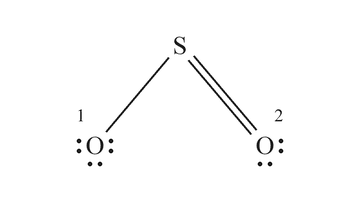
- 1101 mark
Question 110
Which of the following ion has maximum polarising power?
- 1111 mark
Question 111
Which of the following is not correct resonating structure for carbon dioxide?
- 1121 mark
Question 112
The bond angles in molecules , , and are in the order:
- 1131 mark
Question 113
The hybridisation of C involved in acetylene is:
- 1141 mark
Question 114
For which of the following hybridisation the bond angle is maximum?
- 1151 mark
Question 115
The angle between covalent bonds is maximum in
- 1161 mark
Question 116
The percentage s-character of the hybrid orbitals in methane, ethene and ethyne are
- 1171 mark
Question 117
The formation of a bond is accompanied by the ______ in the potential energy of the system.
- 1181 mark
Question 118
Most of the elements, while combining together to form the molecules achieve ______ configuration in their outermost shell.
- 1191 mark
Question 119
For the formation of an ionic bond between a metal and a non-metal, the ionisation energy of the metal should be ______.
- 1201 mark
Question 120
The binary compounds having ionic bonding are most readily formed by the elements of groups 1 and 2 with the elements of groups ______ and ______.
- 1211 mark
Question 121
______ possess high degree of electrical and ______ conductivity.
- 1221 mark
Question 122
The high electrical conductivity of metals is due to ______.
- 1231 mark
Question 123
The kind of delocalisation involving σ bond orbitals is called ______.
- 1241 mark
Question 124
The two types of bonds present in are covalent and ______.
- 1251 mark
Question 125
Explain the terms (i) Solvation energy (ii) Lattice energy.
- 1261 mark
Question 126
What do you understand by a covalent bond?
- 1271 mark
Question 127
What is the meaning of maximum covalency?
- 1281 mark
Question 128
What is octet rule?
- 1291 mark
Question 129
Explain why is a high melting solid while is a gas.
- 1301 mark
Question 130
Taking carbon (atomic number 6) as an example, explain the meaning of valence electrons.
- 1311 mark
Question 131
Out of P – F, F – F, S – F and Cl – F bonds, which bond is the least ionic?
- 1321 mark
Question 132
Sodium metal vaporises on heating and the vapour will have diatomic molecules of sodium (). What type of bonding is present in these molecules?
- 1331 mark
Question 133
Why an ionic bond is formed between two elements having large difference in their electronegativity?
- 1341 mark
Question 134
Cane sugar is a covalent compound but it dissolves in polar solvent water. Why?
- 1351 mark
Question 135
Write the resonating structures of that satisfy octet rule.
- 1361 mark
Question 136
Why is solid sodium chloride a bad conductor of electricity?
- 1372 marks
Question 137
When an element in the first group of the periodic table reacts with an element in the seventh group, what is the type of bond that is likely to be formed?
- 1382 marks
Question 138
(a) Which among the following compounds are expected to have fairly high dipole moments? Benzene, chlorobenzene, methane and methyl chloride.
(b) is a linear molecule and has a permanent dipole. Draw the electron dot structure of the molecule distinguishing the electrons of each atom.
- 1392 marks
Question 139
NaCl and urea, are soluble in water. NaCl solution is a conductor of electricity while urea is not. Explain.
- 1402 marks
Question 140
Calcium chloride and calcium fluoride are both ionic compounds. Why is calcium fluoride sparingly soluble in water while calcium chloride is very soluble?
- 1412 marks
Question 141
Among the following, NaCl, , HCl and , which is a polar compound?
- 1422 marks
Question 142
Explain the reason why:
(a) is more polar than ?
(b) HF is more polar than HI?
(c) Sulphur (Z = 16) exhibits variable covalency of 2, 4 and 6?
- 1432 marks
Question 143
What is inert electron pair effect? Explain the variable electrovalencies of Ga, Tl, Sn and As on the basis of this effect.
- 1442 marks
Question 144
What are ionic compounds? Describe some of their important properties. Explain the following:
(i) Ionic compounds do not conduct electricity when they are in the solid state, but they conduct electricity in solution or in the fused state.
(ii) Ionic solids have high melting and boiling points and are quite hard.
(iii) Ionic solids are soluble in polar solvents but not in non-polar solvents.
(iv) For an ionic solid to dissolve in a polar solvent the solvation energy of the solvent must be greater than the lattice energy of the solid.
(v) Ionic solids are highly brittle.
- 1452 marks
Question 145
Explain, with examples, single, double and triple covalent bonds. Write the electronic formulae of:
NaCl, , , HF, , , , , .
- 1462 marks
Question 146
What are covalent compounds? What are the necessary conditions for the formation of covalent compounds? What are the important properties of covalent compounds?
- 1472 marks
Question 147
Compare and contrast the properties of ionic and covalent compounds.
- 1482 marks
Question 148
Which of the following compounds do not obey this rule?
HF, NO, , , , , , , , ,
- 1492 marks
Question 149
How will you explain the deviation from the octet rule in case of the following molecules?
NO, , ,
- 1502 marks
Question 150
What are singlet linkages? How do they help in explaining the failure of octet rule in case of some molecules?
- 1512 marks
Question 151
How does the nature of a bond depend on electronegativity values of the atoms linked together?
- 1522 marks
Question 152
Define polar and non-polar covalent bonds. What are the conditions for their formation? What will be the nature of the bond formed by the combination of
(a) H and Cl
(b) H and F
(c) O and O
(d) Na and Cl
(e) C and H
- 1532 marks
Question 153
What do you understand by dipole moment? How will you explain the geometry of , , (X = Cl, Br, I), , molecules on the basis of their dipole moment values?
- 1542 marks
Question 154
What are Fajans's rules? Arrange the following cations in the increasing order of their polarising power: , and and hence predict which of the following molecules has maximum covalent character: NaCl, , .
- 1552 marks
Question 155
Arrange the following molecules in the increasing order of their covalent character:
(a) NaCl, ,
(b) , , , ,
(c) ,
(d) CuCl, NaCl
(e) AgCl, KCl
- 1562 marks
Question 156
Which of the following combinations is most likely to form predominantly covalent bond:
(a) K and Cl (b) Na and H (c) Ce and F (d) Cl and F (e) Mg and O
- 1572 marks
Question 157
What is electrovalency? How will you explain the variable electrovalencies of Fe, Co and Cu?
- 1582 marks
Question 158
Draw the MO diagrams for , and . Calculate the bond order and predict their paramagnetic behaviour.
- 1592 marks
Question 159
How does the nature of a bond depend on electronegativity values of the atoms linked together?
- 1602 marks
Question 160
Write down the molecular orbital configuration of the following species:
(a) (b) (c) (d)
- 1612 marks
Question 161
Define sigma and pi bonds. Compare and contrast them. How will you explain the formation of sigma and pi bonds in the following molecules?
, HF, , , ,
- 1622 marks
Question 162
What is the meaning of hybridisation? Explain the formation of the following molecules on the basis of hybridisation.
, ,
- 1632 marks
Question 163
Define coordinate bond. What are the conditions necessary for the formation of a coordinate bond? Explain the formation of the following:
, , , , , , CO, ,
- 1642 marks
Question 164
What is metallic bond? What is its nature? How does it differ from an ionic and a covalent bond?
- 1652 marks
Question 165
Explain how a metallic bond can explain the following properties of metals:
(a) electrical conductivity (b) strength (c) malleability (d) ductility (e) lustre.
- 1662 marks
Question 166
Discuss van der Waals forces operating in molecules. Explain the increase in the boiling points of inert gases with the rise in their molecular weight.
- 1672 marks
Question 167
What is a chemical bond? Explain the type of bonding in the following species:
(a) (b) (c) ion (d)
- 1682 marks
Question 168
What do you understand by inter-molecular and intra-molecular hydrogen bonding? Give examples.
- 1692 marks
Question 169
Arrange , and in the increasing order of their bond angle. Give reason.
- 1702 marks
Question 170
Draw the electron dot formula of clearly distinguishing between electrons of each atom.
- 1712 marks
Question 171
Give the main differences between sigma and pi bonds.
- 1722 marks
Question 172
Discuss the hybridisation, orientation of hybrid orbitals, sigma/pi bonds formed and shape of methane, ethylene (ethene) and acetylene (ethyne) molecules.
- 1732 marks
Question 173
Why hydrogen sulphide has lower boiling point than water?
- 1742 marks
Question 174
Draw the electron dot formula or any other suitable representation of chlorous acid. Name the types of bonds formed.
- 1752 marks
Question 175
Draw the electron dot structure of ethylene and state the following:
(i) No. of σ bonds
(ii) No. of π bonds
(iii) Hybridisation of carbon
(iv) HCH bond angle
- 1762 marks
Question 176
Give one example each of a planar, tetrahedral, pyramidal and trigonal bipyramidal molecule.
- 1772 marks
Question 177
Draw the electron dot or any equivalent structure of and name the types of bonds present.
- 1782 marks
Question 178
(a) Correct the following statements:
Linear overlap of two atomic p-orbitals leads to the formation of pi-bond.
(b) The bond angles in (109.5°), (107°) and (104.5°) are different although these molecules have the same hybridization, . Give a suitable reason for this.
- 1792 marks
Question 179
(i) What is the shape of an acetylene molecule? Mention the types of hybridization present in it.
(ii) Draw the molecular orbital diagram for . What is its bond order? State whether this molecule is paramagnetic or diamagnetic.
- 1802 marks
Question 180
(i) Correct the following statement:
In a nitrogen molecule, two nitrogen are linked together by three sigma bonds.
(ii) Which one of the following or , is considered to be more stable? Justify your answer on the basis of the Molecular Orbital Theory.
(iii) Draw the electron dot diagrams or any other suitable representation of chloric acid and hypochlorous acid.
- 1812 marks
Question 181
(i) The central atom of methane and water is in the same state of hybridisation, but the shapes of the two molecules are different. Discuss.
(ii) The molecular weight of is more than that of , but is a gas and is a liquid. Explain.
(iii) Draw the valence shell molecular orbital diagram of oxygen molecule and predict its magnetic nature.
- 1821 mark
Question 182
The geometry of molecule and the hybridization of Xe atom in the molecule is:
- 1832 marks
Question 183
(a) Draw the structure of:
(i) (ii)
(b) Explain the reason why the hydride of sulphur is a gas, while the hydride of oxygen is liquid.
- 1845 marks
Question 184
Why is HCl predominantly covalent in the gaseous state but is ionic in aqueous solution?
- 1855 marks
Question 185
Explain why covalent bonds are called directional bonds while ionic bonds are called non-directional.
- 1865 marks
Question 186
Why HCl is polar while molecule is non-polar?
- 1875 marks
Question 187
Which of the following has the largest value of dipole moment and why? , , , and .
- 1885 marks
Question 188
Explain why dipole moment of is higher than that of , although the electronegativity difference of bonding atoms in both the molecules is nearly the same.
- 1895 marks
Question 189
Dipole moment of 1-butyne (but-1-yne) is larger than that of 1-butene (but-1-ene). Explain.
- 1905 marks
Question 190
Which of the compounds viz , , and is the least covalent?
- 1915 marks
Question 191
An element 'X' has four electrons in the outer most shell of its atom and combines with an element 'Y' having seven electrons in the outermost shell of its atom.
(i) Write the formula of the compound formed.
(ii) What type of bond will be formed between X and Y?
(iii) Give its electron dot structure.
- 1925 marks
Question 192
An element 'X' has two electrons in the outermost shell of its atom and combines with an element 'Y' having seven electrons in the outermost shell of its atom.
(i) Write the formula of the compound formed.
(ii) What type of bond will be formed between X and Y?
(iii) Is it soluble in water or benzene?
- 1935 marks
Question 193
Draw the Lewis structures of the following compounds and tell in which case/cases the octet rule is violated: , , and .
- 1945 marks
Question 194
Draw the Lewis structure of .
- 1955 marks
Question 195
Why does NaCl give a white precipitate with but does not?
- 1965 marks
Question 196
Arrange the following compounds in the order of their increasing melting points:
(i) LiF, LiCl, LiBr, LiI
(ii) LiCl, NaCl, KCl, RbCl, CsCl.
- 1975 marks
Question 197
Explain the following:
(a) does not exist while does.
(b) HCl is predominantly covalent in gaseous state while it is ionic in aqueous solution.
(c) NaCl is soluble in while is not.
(d) is a liquid while is a gas.
(e) Ice floats on water.
(f) NaCl conducts electricity when it is in the fused state but not in the solid state.
(g) Ionic compounds have higher melting points than covalent compounds.
(h) is more polar than .
(i) HF is more polar than HI.
- 1985 marks
Question 198
(a) Hydrogen sulphide has a higher molecular weight than water. Why is hydrogen sulphide a gas while water is a liquid at room temperature?
(b) Represent sulphur trioxide with an electron dot or any other suitable diagram and identify the type of bonds present and indicate their number.
- 1995 marks
Question 199
(a) What type of chemical bonds are involved in the formation of the following compounds? Explain the bond formation on the basis of the electronic structure of the atoms involved in each.
(i) NaCl (ii) HCl (iii)
(b) Answer the following giving reasons:
(i) Which of the following compounds has highest melting point?
, KCl,
(ii) Which of the following compounds has the highest dipole moment?
, ,
- 2005 marks
Question 200
(a) What is the type of bond formed between hydrogen and chlorine in hydrogen chloride gas?
(b) (i) Among the following compounds , NaCl, and , which does not exhibit electrovalency? What is its shape?
(ii) Between electrovalent compounds and covalent compounds, which are the ones that normally have a higher melting point.
(iii) In a certain class of elements existing in the solid or liquid state, the atoms are held together because some electrons, distant from the individual nuclei, are shared by all the atoms. What is this type of bonding called?
(c) Explain the following:
(i) Oxygen and sulphur belong to the same group of the periodic table but their hydrides are found to be in different physical states.
(ii) Hydrogen chloride is a polar covalent molecule whereas chlorine is a non-polar molecule.
- 2015 marks
Question 201
Which among the following compounds are expected to have fairly high dipole moments: benzene, chlorobenzene, methane and methyl chloride?
- 2025 marks
Question 202
is a linear molecule and has a permanent dipole. Draw the electron dot structure of the molecule distinguishing the electrons of each atom.
- 2035 marks
Question 203
(i) What types of bonds and how many of each are present in ion?
(ii) When monovalent atoms are bonded to atom A through orbitals generated by the hybridisation of two p- and one s- orbital of A; what will be the orientation of the bonds?
- 2045 marks
Question 204
Why is water, which has a lower molecular weight than , is a liquid while is a gas at room temperature?
- 2055 marks
Question 205
(a) What is the shape of the methane molecule? What is the reason for this shape?
(b) What is the shape of molecule?
- 2065 marks
Question 206
Which of the following molecules will have a dipole moment: , , propane and propylene?
- 2075 marks
Question 207
Name the types of bonding in molecule and give an electron dot or any other suitable representation of the molecule.
- 2085 marks
Question 208
What is the shape of molecule? Why this shape and not any other?
- 2095 marks
Question 209
What are the bonding features common to , and HF? Arrange them in the increasing order of their boiling points.
- 2105 marks
Question 210
What type of bonds are present in perchloric acid? Represent this acid by an electron dot or other appropriate illustrative structures.
- 2115 marks
Question 211
(a) What kind of hybridisation takes place in a carbon atom when pi-bonding takes place?
(b) Give an electron dot representation of sulphur dioxide and sulphur trioxide, distinguishing the electrons of sulphur and oxygen.
- 2125 marks
Question 212
(i) Why does water have dipole moment carbon dioxide and methane do not?
(ii) In which type of bond electron density is more, the sigma-bond or the pi-bond?
(iii) What is hybridisation of carbon in the crystal of diamond?
- 2135 marks
Question 213
(i) What is the type of bonding present in sulphuric acid that is not present in water?
(ii) What is hydrogen bond?
(iii) What is the type of hybridisation in acetylene molecule? What is the shape of the molecule?
(iv) What is hybridisation of carbon in (a) diamond (b) graphite?
- 2145 marks
Question 214
Account for the following:
(i) Although chlorine has the same electronegativity as nitrogen, it does not for hydrogen bonds.
(ii) Bond angle in ammonia is different from that of methane, though hybridisation takes place in both cases.
(iii) Draw electron-dot or any other suitable representation of . Name the types of bond involved.
- 2155 marks
Question 215
What is the hybridisation of carbon in ethylene? How many sigma and pi-bonds are present in this molecule? State the orbitals involved and the type of overlap for the formation of these sigma and pi-bonds. Which is the HCH bond angle in ethylene?
- 2165 marks
Question 216
Discuss the hybridisation of C-atoms in allene molecule () and show the π-orbital overlaps.
[Hint: Allene molecule () is represented by the structure given below:
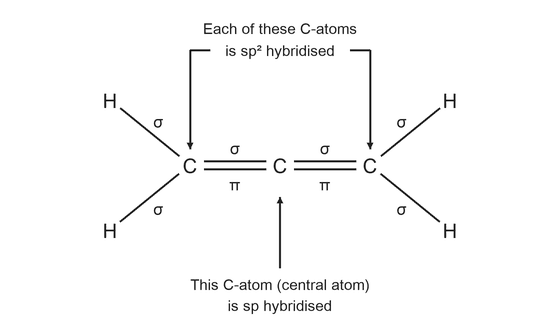
]
- 2175 marks
Question 217
(i) Draw the structure of and identify the number of single and double P—O bonds.
(ii) Explain the difference in the nature of bonding in LiF and LiI.
- 2185 marks
Question 218
What information can be obtained about a molecule from the fact that its dipole moment is zero?
- 2195 marks
Question 219
What reasons led to the development of concept of hybridisation?
- 2205 marks
Question 220
Compare bond strength of bond formed by different types of overlapping of p-atomic orbitals.
- 2215 marks
Question 221
How will you account for the difference in bond angles in (104.5°) and (109.5°) when oxygen and carbon are hybridised?
- 2225 marks
Question 222
Methane () and water have similar molecular weight. Yet methane has boiling point 112 K and water 373 K. Explain.
- 2235 marks
Question 223
The molecule is polar with a dipole moment of 1.02 D but molecule has no dipole moment. Explain this observation, electronegativities of F, P and Si are 4.0, 2.1 and 1.8 respectively.
- 2245 marks
Question 224
is a gas while is a liquid at ordinary temperature. Explain.
- 2255 marks
Question 225
Suggest a reason for the large difference between the boiling points of butanal and butanol although they have almost the same solubility in water.
- 2265 marks
Question 226
What type of hybridisation is present on the oxygen atoms of hydrogen peroxide. Draw its structure and mention the types of bonds present in it.
- 2275 marks
Question 227
(a) Discuss the hybridisation of carbon atoms in benzene and show the π-orbital overlap.
(b) Explain why o-hydroxybenzaldehyde is a liquid at room temperature while p-hydroxybenzaldehyde is a high melting solid.
- 2285 marks
Question 228
Write the M.O. electron distribution of . Specify its bond order and magnetic property.
- 2295 marks
Question 229
Deduce the structures of and considering the hybridisation of the metal ion. Calculate the magnetic moment (spin only) of the species.
- 2305 marks
Question 230
Boiling point of is greater than that of HCl. How can you account for this?
- 2315 marks
Question 231
Phosphine has lower boiling point than ammonia. Why?
- 2325 marks
Question 232
The molecule of magnesium chloride is linear whereas that of is angular.
- 2335 marks
Question 233
Give reasons for the following:
(i) Mercury has a shining lustre but water has not.
(ii) Ethanol is soluble in water while n-butane is not.
(iii) Ethanol boils at 78°C while methanol boils at 68°C.
(iv) Ortho-nitrophenol melts at a lower temperature compared to p-nitrophenol.
(v) Ice floats over water.
- 2345 marks
Question 234
has the shape of a trigonal bipyramid, whereas has the shape of a square pyramid. Explain.
- 2355 marks
Question 235
On the basis of molecular orbital theory, account for the following:
Bond order of is more than molecule whereas bond order of is less than .
- 2365 marks
Question 236
Using VSEPR theory, draw the shape of and .
- 2373 marks
Question 237
Deduce a relation between debye (D) and Coulomb metre (C m).
- 2383 marks
Question 238
The dipole moment of a diatomic molecule is equal to 1.2 D. If its bond distance is 1.0 Å, calculate the fraction of the electronic charge existing on each atom in the molecule.
- 2393 marks
Question 239
In NaCl ionic crystal, bond length is 2.36 Å and the experimental dipole moment of this molecule is 8.5 D. Calculate the percentage of ionic character in Na—Cl bond in the given molecule.
- 2403 marks
Question 240
The observed dipole moment for a molecule AB is 1.45 D and its bond length is 1.654 Å. Calculate the percentage of ionic character in the bond.
What Class 11 Chemistry Ch 4 covers
The sections of the chapter, in the order the book takes them. Every question above comes from one of these.
- 01Kossel–Lewis Approach and the Octet Rule
- 02Ionic Bond and Lattice Enthalpy
- 03Covalent Bond and Lewis Structures
- 04Formal Charge and Resonance
- 05Bond Parameters
- 06Polarity of Bonds and Dipole Moment
More ways to study this chapter
The same chapter asked three other ways. Practise it, revise it, and see what the board has set on Ch 4 before.
Class 11 Chemistry Ch 4 questions students ask
How many questions are there in Class 11 Chemistry Ch 4?
240 questions. Every one is solved step by step on this page.
Are these Class 11 Chemistry solutions free?
Yes. Every question and its full working is free to read, with no account needed.
Can I download the Class 11 Chemistry Ch 4 solutions as a PDF?
There is no PDF to download. Every solution is on this page instead, which means it is searchable, always the current syllabus, and readable on a phone. Use your browser's print option if you want it on paper.