
Question 2165 marksMedium
Discuss the hybridisation of C-atoms in allene molecule () and show the π-orbital overlaps.
[Hint: Allene molecule () is represented by the structure given below:
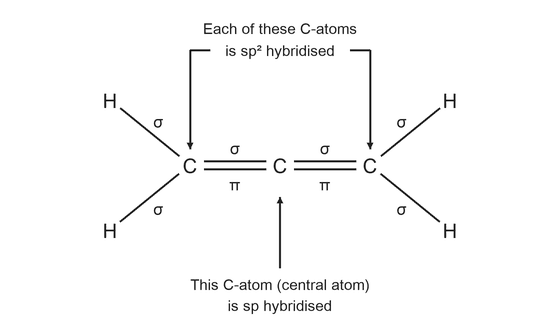
]
Confirming your payment
Sign up now and get 250 free tokens.
Chemical Bonding and Molecular Structure · Question 216 of 240
Discuss the hybridisation of C-atoms in allene molecule () and show the π-orbital overlaps.
[Hint: Allene molecule () is represented by the structure given below:
]
Solution:
Key idea: Allene is . A carbon forming one double bond is ; a carbon forming two double bonds (two π bonds) is . The π bonds use unhybridised p orbitals that must lie parallel to the partner p orbital.
Step 1 — Terminal carbons (C1 and C3): sp². Each terminal C forms three σ bonds (two C–H and one C–C) and one π bond. It uses three orbitals (120°, in one plane) and keeps one unhybridised p orbital at right angles to that plane.
Step 2 — Central carbon (C2): sp. C2 forms two σ bonds (to C1 and C3) and two π bonds. It uses two orbitals pointing opposite ways (C=C=C angle 180°) and keeps two unhybridised p orbitals, and , at right angles to each other.
Step 3 — The σ framework. C–H bonds: (C)–1s(H), four of them. C–C bonds: (C1)–(C2) and (C2)–(C3), two of them. So allene has 6 σ bonds.
Step 4 — First π bond. The orbital of C2 lies parallel to the unhybridised p orbital of C1, and they overlap sideways to form the C1=C2 π bond. For this, the plane of the C1 group must be the xz-plane (at right angles to ).
Step 5 — Second π bond. The orbital of C2 lies parallel to the unhybridised p orbital of C3, and they overlap sideways to form the C2=C3 π bond. For this, the C3 group must lie in the xy-plane.
Step 6 — Consequence for the shape. Because and of C2 are at 90°, the two π bonds are perpendicular to each other, and so the two terminal groups lie in perpendicular planes. Allene is therefore not planar; the C=C=C chain is linear (180°) and each H–C–H angle is about 118°.
Therefore, in allene the two terminal carbons are sp² hybridised and the central carbon is sp hybridised; there are 6 σ bonds and 2 π bonds, formed by sideways overlap of the central carbon's pᵧ and p_z orbitals with the p orbitals of C1 and C3, so the two π bonds (and the two CH₂ planes) are at right angles.