
Question 2175 marksMedium
(i) Draw the structure of and identify the number of single and double P—O bonds.
(ii) Explain the difference in the nature of bonding in LiF and LiI.
Confirming your payment
Sign up now and get 250 free tokens.
Chemical Bonding and Molecular Structure · Question 217 of 240
(i) Draw the structure of and identify the number of single and double P—O bonds.
(ii) Explain the difference in the nature of bonding in LiF and LiI.
Solution:
Key idea: In the four P atoms sit at the corners of a tetrahedron; each edge is bridged by an O atom and each P also carries one terminal O. Fajans' rules decide how covalent an ionic compound is.
(i)
Step 1 — Describe the structure. Start from a tetrahedron. Each of its 6 edges is bridged by one O atom (P–O–P), and each of the 4 P atoms carries one terminal O atom (P=O). Each P is therefore bonded to four O atoms, tetrahedrally. One P atom with its bonds looks like:
(three bridging O atoms, each joined to another P, and one terminal double-bonded O; the terminal P=O is also written P→O.)
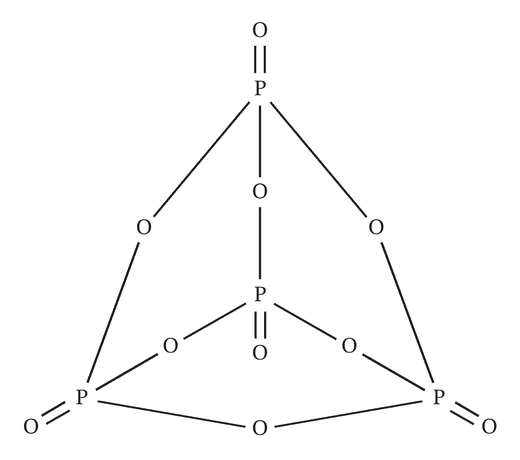
Step 2 — Count the single P–O bonds. Each of the 6 bridging O atoms forms two P–O single bonds:
Step 3 — Count the double P=O bonds. Each of the 4 P atoms has one terminal P=O bond, so there are 4 double bonds.
Step 4 — Check. Each P has 3 single + 1 double bond (valency 5), and the total O count is 6 + 4 = 10.
(ii)
Step 5 — LiF. is small (133 pm) and holds its electrons tightly, so the small ion can hardly distort it. LiF is largely ionic: high melting point (845 °C), high lattice energy, poorly soluble in organic solvents.
Step 6 — LiI. is very large (about 220 pm) and its outer electrons are loosely held. The small, highly polarising distorts its electron cloud strongly, so electron density is partly shared between the ions. LiI has considerable covalent character: lower melting point (469 °C) and appreciable solubility in organic solvents such as ethanol.
Therefore, (i) P₄O₁₀ has 12 single P–O bonds and 4 double P=O bonds; (ii) LiF is predominantly ionic, while LiI has much more covalent character because the large I⁻ ion is easily polarised by Li⁺.