
Question 2265 marksMedium
What type of hybridisation is present on the oxygen atoms of hydrogen peroxide. Draw its structure and mention the types of bonds present in it.
Confirming your payment
Sign up now and get 250 free tokens.
Chemical Bonding and Molecular Structure · Question 226 of 240
What type of hybridisation is present on the oxygen atoms of hydrogen peroxide. Draw its structure and mention the types of bonds present in it.
Solution:
Key idea: Each O atom in hydrogen peroxide forms two σ bonds and keeps two lone pairs: four electron pairs, so hybridisation.
Step 1 — Hybridisation of O. Each O () forms one bond to H and one to the other O and keeps two lone pairs. Four electron pairs need four hybrid orbitals: .
Step 2 — Structure. The molecule is H–O–O–H but it is not planar. It has an "open book" shape: the O–O bond lies along the spine and the two O–H bonds lie on two pages of the book, at an angle (the dihedral angle) of about 111° in the gas phase (about 90° in the crystal). The O–O–H angle is about 95° and the O–O bond length about 148 pm:
(written flat here; in space the two O–H bonds point out of each other's plane, as on the two pages of a half-open book).
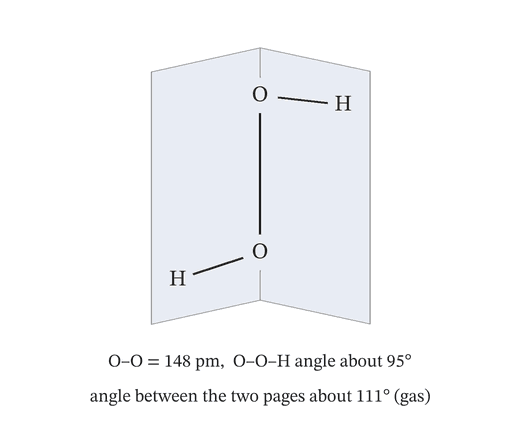
Step 3 — Types of bonds. All bonds are single covalent σ bonds: two O–H bonds (–1s overlap) and one O–O bond (–). There are no π bonds and no coordinate bonds. The O–H bonds are polar, so is a polar molecule and shows hydrogen bonding.
Therefore, both oxygen atoms in H₂O₂ are sp³ hybridised; the molecule H–O–O–H has a non-planar open-book structure and contains only covalent σ bonds: two O–H and one O–O.