
Opening your dashboard
Class 11 Chemistry Chapter 4 Chemical Bonding and Molecular Structure: Practice Questions
150 questions on Chapter 4, each worked through on its own page with the AI tutor. Class 11 Chemistry, ICSE 2026-27.
150 questions
1–4 marks · Mixed difficulty
- 11 mark
Question 1
The ion has the same electronic configuration as argon. How many dots are drawn in the Lewis symbol of the neutral atom X?
- 23 marks
Question 2
Magnesium (Z = 12) burns in nitrogen (Z = 7) to form the ionic solid magnesium nitride.
(a) How many electrons does each Mg atom lose and each N atom gain, and what are their electrovalencies?
(b) Use this to work out the formula of magnesium nitride and the total number of electrons transferred per formula unit.
(c) Which noble gas configuration do both ions reach?
- 31 mark
Question 3
Kossel's idea is that atoms form ions with the electron arrangement of a noble gas. For which ion below is this not true?
- 42 marks
Question 4
Xenon already has a complete octet, yet it forms the stable compound xenon difluoride, , in which each F is joined to Xe by a single bond.
(a) How many electrons surround the Xe atom in ?
(b) What does this compound show about the octet rule?
- 54 marks
Question 5
Use the data below to calculate the lattice enthalpy of potassium bromide, KBr (the energy needed to break one mole of solid KBr into gaseous and ions).
Enthalpy of formation of KBr(s) = −394 kJ mol⁻¹; enthalpy of sublimation of K = +89 kJ mol⁻¹; ionisation enthalpy of K = +419 kJ mol⁻¹; enthalpy to form one mole of Br(g) atoms from (l) = +112 kJ mol⁻¹; electron gain enthalpy of Br = −325 kJ mol⁻¹.
- 61 mark
Question 6
For sodium, the ionisation enthalpy is +496 kJ mol⁻¹, and for chlorine the electron gain enthalpy is −349 kJ mol⁻¹. So turning gaseous Na and Cl atoms into gaseous and ions costs energy overall. What makes the formation of solid NaCl energetically favourable?
- 73 marks
Question 7
Potassium chloride and calcium oxide both have the rock-salt crystal structure. Their lattice enthalpies are 717 kJ mol⁻¹ (KCl) and 3414 kJ mol⁻¹ (CaO). Ionic radii: 138 pm, 181 pm, 100 pm, 140 pm.
(a) Name the two factors that decide the size of a lattice enthalpy.
(b) Taking the lattice enthalpy to be proportional to (product of the ionic charges) ÷ (sum of the ionic radii), estimate how many times larger the lattice enthalpy of CaO should be than that of KCl.
(c) Compare your estimate with the actual ratio.
- 81 mark
Question 8
The lattice energy of calcium fluoride is the energy released when one mole of solid is formed from its gaseous ions. Which equation shows this process?
- 92 marks
Question 9
Draw the Lewis structure of hydrogen cyanide, HCN (carbon is the central atom), and state the number of bond pairs and lone pairs in the molecule.
- 101 mark
Question 10
In dinitrogen tetrafluoride, , the two N atoms are joined by a single bond and each N carries two F atoms. Every atom obeys the octet rule. What is the total number of lone pairs in the molecule?
- 113 marks
Question 11
Carbonyl chloride, , is a toxic gas used in industry to make plastics such as polyurethanes and polycarbonates. Draw its Lewis structure and show that every atom obeys the octet rule.
- 121 mark
Question 12
In which of these molecules are all the bonds single covalent bonds, with every atom other than hydrogen having an octet?
- 134 marks
Question 13
Three Lewis structures can be written for the cyanate ion, (C is the central atom):
I: II: III:
(a) How many valence electrons does the ion have?
(b) Complete each structure with lone pairs and work out the formal charge on O, C and N in each.
(c) Which structure contributes most to the real ion? Give a reason.
- 141 mark
Question 14
The azide ion, , is linear and its main Lewis structure is , with two lone pairs on each end N and none on the central N. What is the formal charge on the central N atom?
- 153 marks
Question 15
In the nitrate ion, , all three N–O bonds have the same length, 124 pm. This is shorter than a normal N–O single bond but longer than a normal N=O double bond.
(a) Write the resonance structures of the nitrate ion.
(b) Use them to explain why all three bonds are equal.
(c) Calculate the N–O bond order.
- 161 mark
Question 16
Which pair of structures are not resonance structures of each other?
- 172 marks
Question 17
Breaking the two O–H bonds of water one at a time needs different amounts of energy:
: 502 kJ mol⁻¹
: 427 kJ mol⁻¹
(a) Calculate the average O–H bond enthalpy in water.
(b) Why are the two values different?
- 183 marks
Question 18
Use the average bond enthalpies given to estimate the enthalpy change for the hydrogenation of ethene:
Average bond enthalpies (kJ mol⁻¹): C=C 614, C–C 348, C–H 413, H–H 436.
- 191 mark
Question 19
The bond enthalpies of nitrogen–nitrogen bonds are: N–N 163 kJ mol⁻¹, N=N 409 kJ mol⁻¹ and N≡N 945 kJ mol⁻¹. Which conclusion is correct?
- 203 marks
Question 20
The water molecule is bent, with an H–O–H angle of 104.5°, and its dipole moment is 1.85 D. Treating the molecular dipole as the vector sum of the two O–H bond moments only, calculate the O–H bond moment. ()
- 211 mark
Question 21
Fluorine is more electronegative than chlorine, yet the dipole moment of fluoromethane, (1.86 D), is slightly smaller than that of chloromethane, (1.89 D). Which is the best explanation?
- 222 marks
Question 22
All three atoms of ozone, , are oxygen atoms, yet ozone has a small dipole moment (0.53 D). Explain how this is possible.
- 231 mark
Question 23
The ions (100 pm) and (102 pm) have the same charge and almost the same radius. Yet is ionic (melting point 772 °C) while is largely covalent (melting point 276 °C). Which is the main reason?
- 242 marks
Question 24
Lithium chloride dissolves appreciably in ethanol, an organic solvent, whereas sodium chloride hardly dissolves in it. Explain this using Fajans' rules. (Ionic radii: 76 pm, 102 pm.)
- 253 marks
Question 25
Silver fluoride, AgF, is very soluble in water, but AgCl, AgBr and AgI are increasingly insoluble, AgI being the least soluble. (Ionic radii: 133 pm, 181 pm, 196 pm, 220 pm.)
(a) Arrange the four silver halides in increasing order of covalent character, giving a reason.
(b) Use your answer to explain the solubility trend.
(c) Why is AgF more soluble even than its strong lattice suggests?
- 261 mark
Question 26
According to VSEPR theory, what is the shape of the ion?
- 273 marks
Question 27
Sulphur trioxide, , is trigonal planar, but the sulphite ion, , is trigonal pyramidal, although in both the sulphur atom is bonded to three oxygen atoms.
(a) Find the number of lone pairs on the sulphur atom in each species.
(b) Use VSEPR theory to explain why their shapes are different.
(c) Which species has the larger O–S–O bond angle?
- 282 marks
Question 28
The H–O–H bond angle in water is 104.5°, but the F–O–F bond angle in oxygen difluoride, , is about 103°. Both molecules are bent, with two lone pairs on the oxygen atom. Explain why the bond angle is smaller in .
- 291 mark
Question 29
When five electron pairs round a central atom are arranged in a trigonal bipyramid, a lone pair always takes an equatorial position rather than an axial one. Which statement gives the correct reason?
- 303 marks
Question 30
Bromine forms two ions containing four fluorine atoms each: and .
(a) Find the number of bond pairs and lone pairs round the bromine atom in each ion.
(b) Predict and name the shape of each ion, saying where the lone pairs are placed.
(c) State the hybridisation of bromine in each ion.
- 311 mark
Question 31
Carbon dioxide, , is a linear molecule. Which statement correctly describes the bonds formed by the carbon atom?
- 323 marks
Question 32
The H–S–H bond angle in hydrogen sulphide is about 92°, while the H–O–H angle in water is 104.5°.
(a) What bond angle would be expected if a sulphur atom used two of its pure (unhybridised) orbitals to bond to the hydrogen atoms? Give a reason.
(b) Use valence bond theory to explain why the angle in is close to this value, whereas the angle in is close to the tetrahedral angle.
- 333 marks
Question 33
Methanal (formaldehyde), HCHO, is a planar molecule in which the carbon atom is bonded to two hydrogen atoms and to the oxygen atom.
(a) State the hybridisation of the carbon atom.
(b) How many σ bonds and how many π bonds are present in the molecule?
(c) Describe the orbitals that overlap to form the C=O double bond, and say where the π electron cloud lies.
- 341 mark
Question 34
In hybridisation, one , three and two orbitals mix to give six hybrid orbitals pointing to the corners of an octahedron. Which two orbitals take part?
- 354 marks
Question 35
But-2-yne has the structure .
(a) State the hybridisation of each of the carbon atoms C1, C2, C3 and C4.
(b) Find the total number of σ bonds and π bonds in the molecule.
(c) Explain why all four carbon atoms lie on one straight line.
(d) Do the six hydrogen atoms also lie on this line? Give a reason.
- 361 mark
Question 36
Taking the -axis as the line joining the two nuclei, which pair of atomic orbitals on two atoms can NOT combine to form a molecular orbital?
- 373 marks
Question 37
(a) Write the molecular orbital configurations of and , and calculate the bond order of each.
(b) The two species have the same bond order, yet is more stable than . Explain why.
- 381 mark
Question 38
Taking the -axis as the internuclear axis, which molecular orbital has a nodal plane that contains the internuclear axis, but has NO nodal plane between the two nuclei?
- 393 marks
Question 39
The ion , formed from a helium atom and a hydrogen ion, has been detected in space, but two helium atoms do not form a stable molecule under normal conditions. Using molecular orbital theory:
(a) Find the number of electrons in and write its molecular orbital configuration.
(b) Calculate its bond order and say whether a bond exists.
(c) State whether is paramagnetic or diamagnetic, and say why does not form.
- 401 mark
Question 40
In the vapour at moderate temperatures, aluminium chloride exists as the dimer , in which two chlorine atoms form bridges between the two aluminium atoms. How many coordinate bonds are present in one molecule?
- 413 marks
Question 41
Trimethylamine reacts with hydrogen peroxide to give trimethylamine N-oxide, in which the oxygen atom is attached only to the nitrogen atom:
(a) Identify the donor atom and the acceptor atom in the N–O bond, and show the bond in a structural formula.
(b) How many electrons surround the nitrogen atom in the product?
(c) Explain why the N–O bond cannot be written as an N=O double bond.
- 423 marks
Question 42
When aqueous ammonia is added to a precipitate of silver chloride, the precipitate dissolves because the diamminesilver(I) ion, , is formed.
(a) Name the donor atom and the acceptor in the bonds between silver and ammonia.
(b) How many coordinate bonds does the ion contain?
(c) The ion is linear. Account for this using the orbitals of the ion (Ag: atomic number 47).
- 433 marks
Question 43
A single F–H···F hydrogen bond is stronger than a single O–H···O hydrogen bond, yet water (b.p. 373 K) boils at a much higher temperature than hydrogen fluoride (b.p. 293 K). Explain this, giving the average number of hydrogen bonds per molecule in each liquid.
- 441 mark
Question 44
The four amines below all have the molecular formula . Which one has the lowest boiling point?
- 452 marks
Question 45
Potassium hydrogen difluoride, , is a stable salt containing the ion, but no similar stable salt is known. Explain.
- 461 mark
Question 46
Propanone, , mixes with water in all proportions, although its molecule has no O–H group. Which statement best explains this?
- 471 mark
Question 47
Magnesium melts at 923 K but sodium melts at only 371 K. Using the electron-sea model of metallic bonding, which statement best explains the difference?
- 483 marks
Question 48
The melting points of the alkali metals are: Li 454 K, Na 371 K, K 337 K, Rb 312 K, Cs 302 K.
(a) Describe the trend in these melting points.
(b) Explain the trend in terms of metallic bonding.
- 493 marks
Question 49
(a) When a copper wire is heated, its electrical conductivity decreases. Explain this using the electron-sea model.
(b) When an electric current is passed through molten sodium chloride, the salt is decomposed, but when a current is passed through a copper wire, the copper is not changed chemically. Explain the difference.
- 501 mark
Question 50
Assuming Hund's rule is violated, the bond order and magnetic nature of the diatomic molecule is
- 511 mark
Question 51
The species having pyramidal shape is:
- 521 mark
Question 52
Based on VSEPR theory, the number of 90 degree F—Br—F angles in is ______.
- 531 mark
Question 53
Likely bond angles of molecule are
- 541 mark
Question 54
Which of the following has maximum number of lone pairs associated with Xe?
- 551 mark
Question 55
The number of types of bonds between two carbon atoms in calcium carbide is
- 561 mark
Question 56
The shape of molecule is
- 571 mark
Question 57
In which of the following pairs the two species are not isostructural?
- 581 mark
Question 58
The increasing order of O—N—O bond angle in the species , and is
- 591 mark
Question 59
In which of the following pairs of molecules/ions, both the species are not likely to exist?
- 601 mark
Question 60
Stability of the species , and increases in the order of
- 611 mark
Question 61
The correct arrangement of species in the decreasing order of the bond length between carbon and oxygen in them is
- 621 mark
Question 62
Which one of the following properties is not shown by NO?
- 631 mark
Question 63
Which one of the following conversions involve change in both hybridization and shape?
- 641 mark
Question 64
Hydrogen bonding plays a central role in the following phenomena:
(a) Ice floats in water.
(b) Higher Lewis basicity of primary amines than tertiary amines in aqueous solutions.
(c) Formic acid is more acidic than acetic acid.
(d) Dimerisation of acetic acid in benzene.
- 651 mark
Question 65
A list of species having the formula is given below: , , , , , , , and . Defining shape on the basis of the location of X and Z atoms, the total number of species having a square planar shape is ______.
- 661 mark
Question 66
Among the triatomic molecules/ions, , , , , , , , and , total number of linear molecule(s)/ion(s) where the hybridization of the central atom does not have contribution from the -orbital(s) is ______. [Atomic number : S = 16, Cl = 17, I = 53 and Xe = 54]
- 671 mark
Question 67
Dipole moment of

is 1.5 D. The dipole moment of

is (X = halogen)
- 681 mark
Question 68
How many hydrogen bonded water molecule(s) are associated with ?
- 691 mark
Question 69
The species in which the N atom is in a state of hybridisation is
- 701 mark
Question 70
The compound(s) with two lone pairs of electrons on the central atom is (are)
(a)
(b)
(c)
(d)
- 711 mark
Question 71
According to molecular orbital theory,
(a) is expected to be diamagnetic.
(b) is expected to have a longer bond length than .
(c) and have the same bond order.
(d) has the same energy as two isolated He atoms.
- 721 mark
Question 72
The ground state magnetic property of and molecules will be
- 731 mark
Question 73
Which of the following pairs have identical bond order?
- 741 mark
Question 74
Which of the following species is not paramagnetic?
- 751 mark
Question 75
Among , , , , , , , and , the number of diamagnetic species is (Atomic numbers: H = 1, He = 2, Li = 3, Be = 4, B = 5, C = 6, N = 7, O = 8, F = 9).
- 761 mark
Question 76
The sum of the number of lone pairs of electrons on each central atom in the following species is , , , and (Atomic numbers: N = 7, F = 9, S = 16, Br = 35, Te = 52, Xe = 54).
- 771 mark
Question 77
The intramolecular hydrogen bond is present in
- 781 mark
Question 78
According to molecular orbital theory, which of the following will not be a viable molecule?
- 791 mark
Question 79
Which of the following compounds contain(s) no covalent bond(s)?
KCl, , , ,
- 801 mark
Question 80
Total number of lone pair of electrons in ion is:
- 811 mark
Question 81
According to molecular orbital theory, which of the following is true with respect to and ?
- 821 mark
Question 82
Which statements are correct for the peroxide ion?
(a) It has five completely filled anti-bonding molecular orbitals.
(b) It is diamagnetic.
(c) It has bond order one.
(d) It is isoelectronic with neon.
- 831 mark
Question 83
According to molecular orbital theory, which of the following is true with respect to and ?
- 841 mark
Question 84
Two pi and half sigma bonds are present in
- 851 mark
Question 85
Among the following, the molecule expected to be stabilized by anion formation is:
, , NO,
- 861 mark
Question 86
During the change of to , the incoming electron goes to the orbital:
- 871 mark
Question 87
Among the following species, the diamagnetic molecule is
- 881 mark
Question 88
Among the following molecules/ions,
, , ,
which one is diamagnetic and has the shortest bond length?
- 891 mark
Question 89
In which of the following processes, the bond order has increased and paramagnetic character has changed to diamagnetic?
- 901 mark
Question 90
The ion that has hybridization for the central atom, is:
- 911 mark
Question 91
Each of the following options contains a set of four molecules. Identify the option(s) where all four molecules possess permanent dipole moment at room temperature.
(a) , , ,
(b) , , ,
(c) , , ,
(d) , , ,
- 921 mark
Question 92
Bond order of , and are respectively:
- 931 mark
Question 93
The bond order and the magnetic characteristics of are:
- 941 mark
Question 94
Arrange the following bonds according to their average bond energies in descending order:
C—Cl, C—Br, C—F, C—I
- 951 mark
Question 95
If the magnetic moment of a dioxygen species is 1.73 B.M., it may be:
- 961 mark
Question 96
The molecular geometry of is octahedral. What is the geometry of (including lone pair(s) of electrons, if any)?
- 971 mark
Question 97
Of the species, NO, , and , the one with minimum bond strength is:
- 981 mark
Question 98
The compound that has the largest H—M—H bond angle (M = N, O, S, C), is:
- 991 mark
Question 99
The potential energy curve for the molecule as a function of internuclear distance is:
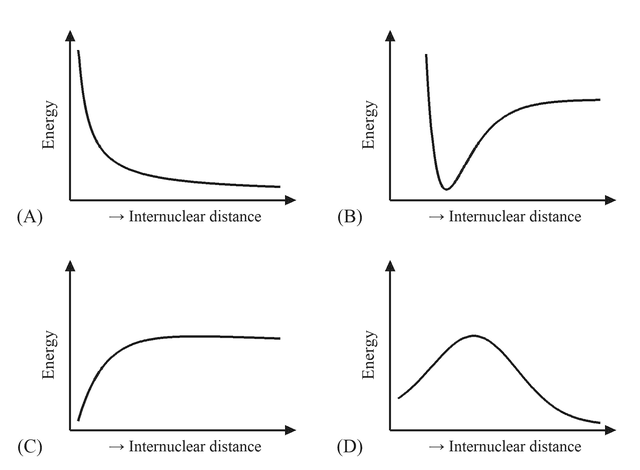
- 1001 mark
Question 100
Which of the following are isostructural pairs?
(A) and
(B) and
(C) and
(D) and
- 1011 mark
Question 101
According to molecular orbital theory, the species among the following that does not exist is:
- 1021 mark
Question 102
Match List-I with List-II.
List-I (Molecule) List-II (Bond Order) (A) (i) 1 (B) (ii) 2 (C) (iii) 0 (D) (iv) 3 Choose the correct answer from the options given below:
- 1031 mark
Question 103
The correct set from the following in which both pairs are in correct order of melting point is:
- 1041 mark
Question 104
Which among the following species has unequal bond lengths?
- 1051 mark
Question 105
Given below are two statements:
Statement I: -Nitrophenol is steam volatile due to intramolecular hydrogen bonding.
Statement II: -Nitrophenol has high melting point due to hydrogen bonding.
In the light of the above statements, choose the most appropriate answer from the options given below:
- 1061 mark
Question 106
Given below are two statements: One is labelled as Assertion A and the other is labelled as Reason R:
Assertion A: The H—O—H bond angle in water molecule is 104.5°
Reason R: The lone pair-lone pair repulsion of electrons is higher than the bond pair-bond pair repulsion.
- 1071 mark
Question 107
A central atom in a molecule has two lone pairs of electrons and forms three single bonds. The shape of this molecule is:
- 1081 mark
Question 108
Amongst the following, the linear species is:
- 1091 mark
Question 109
The total number of C–C sigma bond/s in mesityl oxide () is ______. (Rounded off to the nearest integer).
- 1101 mark
Question 110
AX is a covalent diatomic molecule where A and X are second row elements of periodic table. Based on molecular orbital theory, the bond order of AX is 2.5. The total number of electrons in AX is ______. (Rounded off to the nearest integer).
- 1111 mark
Question 111
The number of species below that have two lone pairs of electrons in their central atom is ______. (Rounded off to the nearest integer)
, , , , , , ,
- 1121 mark
Question 112
Which one of the following species does not exist under normal conditions?
- 1131 mark
Question 113
Which of the following has the minimum bond length?
- 1141 mark
Question 114
Which of the two ions from the list given below have the geometry that is explained by the same hybridization of orbitals: , , , , ?
- 1151 mark
Question 115
The pair of species with the same bond order is
- 1161 mark
Question 116
Which of the following species contains three bond pairs and one lone pair around the central atom?
- 1171 mark
Question 117
Which one of the following pairs is isostructural (i.e., having the same shape and hybridization)?
- 1181 mark
Question 118
Bond order of 1.5 is shown by
- 1191 mark
Question 119
Which of the following is a polar molecule?
- 1201 mark
Question 120
Which of the following is paramagnetic?
- 1211 mark
Question 121
Which one of the following molecules contains no π bond?
- 1221 mark
Question 122
The bond orders for and respectively are
- 1231 mark
Question 123
Which of the following molecules has the maximum dipole moment?
- 1241 mark
Question 124
Which one of the following species has plane triangular shape?
- 1251 mark
Question 125
Which of the following sets of molecules contain the same number of lone pairs of electrons in the central atom?
- 1261 mark
Question 126
Which one of the following does not match with respect to the shape of the molecule?
- 1271 mark
Question 127
Decreasing order of stability of , , , and .
- 1281 mark
Question 128
In which of the following pairs, both the species are not isostructural?
- 1291 mark
Question 129
Which of the following pairs of ions are isoelectronic and isostructural?
- 1301 mark
Question 130
Maximum bond angle at nitrogen is present in which of the following?
- 1311 mark
Question 131
The correct bond order in the following species is
- 1321 mark
Question 132
Consider the molecules , and . Which of the given statement is false?
- 1331 mark
Question 133
Predict the correct order among the following:
- 1341 mark
Question 134
Which one of the following compound shows the presence of intramolecular hydrogen bond?
- 1351 mark
Question 135
The correct geometry and hybridization for are
- 1361 mark
Question 136
The hybridizations of atomic orbitals of nitrogen in , and respectively are
- 1371 mark
Question 137
The species, having bond angles of 120° is
- 1381 mark
Question 138
Which one of the following pair of species have the same bond order?
- 1391 mark
Question 139
Among , , , the order of ionic character is
- 1401 mark
Question 140
Consider the following species: , , NO and CN. Which one of these will have the highest bond order?
- 1411 mark
Question 141
In the structure of , the number of lone pairs of electrons on central ‘Cl’ atom is
- 1421 mark
Question 142
Which of the following diatomic molecular species has only π bonds according to Molecular Orbital Theory?
- 1431 mark
Question 143
has bond order
- 1441 mark
Question 144
The carbon atoms in calcium carbide are held by
- 1451 mark
Question 145
Which of the following pair contains 2 lone pairs of electrons on the central atom?
- 1461 mark
Question 146
Identify the incorrect statement related to from the following:
- 1471 mark
Question 147
Identify a molecule which does not exist.
- 1481 mark
Question 148
Which of the following set of molecules will have zero dipole moment?
- 1491 mark
Question 149
is planar and electron deficient compound. Hybridization and number of electrons around the central atom, respectively are:
- 1501 mark
Question 150
Match List - I with List - II
List - I List - II (A) (i) Square pyramidal (B) (ii) Trigonal planar (C) (iii) Octahedral (D) (iv) Trigonal bipyramidal Choose the correct answer from the options given below.