
Question 2365 marksMedium
Using VSEPR theory, draw the shape of and .
Confirming your payment
Sign up now and get 250 free tokens.
Chemical Bonding and Molecular Structure · Question 236 of 240
Using VSEPR theory, draw the shape of and .
Solution:
Key idea: VSEPR theory: count the bond pairs and lone pairs on the central atom; the pairs take the arrangement that keeps them furthest apart; the shape is given by the atoms only. Lone pairs repel more strongly than bond pairs.
Step 1 — PCl₅: count the pairs. P has 5 valence electrons, all used in five P–Cl bonds: 5 bond pairs, 0 lone pairs.
Step 2 — PCl₅: shape. Five pairs give a trigonal bipyramid. Three Cl atoms lie in the equatorial plane at 120° to one another; two Cl atoms lie above and below on the axis, at 90° to the plane:
(ax = axial, eq = equatorial. The third equatorial Cl points out of the page towards the reader; in space the three equatorial bonds lie in one plane at 120°, and the two axial bonds are at 90° to that plane.) The axial bonds (219 pm) are longer than the equatorial ones (204 pm) because each axial pair is repelled by three pairs at 90°.

Step 3 — BrF₅: count the pairs. Br has 7 valence electrons; five form Br–F bonds and two form one lone pair: 5 bond pairs + 1 lone pair = 6 pairs.
Step 4 — BrF₅: shape. Six pairs point to the corners of an octahedron (). The lone pair takes one corner, so the five F atoms form a square pyramid: four F atoms in a square base and one F at the apex, with the lone pair pointing down, opposite the apical F:
(Two more F atoms are bonded to Br, one in front of and one behind the page, completing the square base with the two F atoms drawn beside Br; the two dots below Br are the lone pair.)
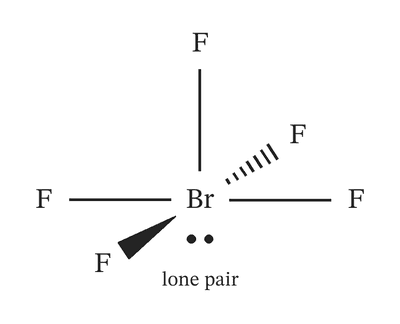
The lone pair pushes the four basal F atoms slightly up, so the F(apex)–Br–F(base) angles are a little less than 90° (about 85°).
Therefore, PCl₅ (5 bond pairs, no lone pair) is trigonal bipyramidal, and BrF₅ (5 bond pairs, 1 lone pair) is square pyramidal, as drawn.