
Question 1582 marksMedium
Draw the MO diagrams for , and . Calculate the bond order and predict their paramagnetic behaviour.
Confirming your payment
Sign up now and get 250 free tokens.
Chemical Bonding and Molecular Structure · Question 158 of 240
Draw the MO diagrams for , and . Calculate the bond order and predict their paramagnetic behaviour.
Solution:
Key idea: In molecular orbital (MO) theory the atomic orbitals of the two atoms combine into bonding and antibonding MOs, which are filled in order of energy (Aufbau principle, Pauli principle and Hund's rule). For and heavier molecules the order is σ2s < σ2s < σ2p_z < (π2p_x, π2p_y) < (π2p_x, π2p_y) < σ2p_z, where the two orbitals in each bracket have equal energy. Bond order = ½(N_b − N_a), where N_b and N_a are the numbers of electrons in bonding and antibonding MOs. Unpaired electrons make a species paramagnetic.
Step 1 — Count the electrons. O has 8 electrons, so has 16, has 15 and has 17. Leaving out the four 1s electrons (KK), they have 12, 11 and 13 valence electrons.
Step 2 — O₂. The configuration is KK σ2s² σ2s² σ2p_z² π2p_x² π2p_y² π2p_x¹ π2p_y¹. The bonding electrons are those in σ2s (2), σ2p_z (2) and π2p (4), so N_b = 8. The antibonding electrons are those in σ2s (2) and π*2p (2), so N_a = 4. Now we find the bond order:
The two π* electrons are unpaired (Hund's rule), so is paramagnetic (2 unpaired electrons).

Step 3 — O₂⁺. One electron is removed from a π* orbital: KK σ2s² σ2s² σ2p_z² π2p_x² π2p_y² π2p_x¹. Now N_b = 8 and N_a = 3:
One electron is unpaired, so is paramagnetic.
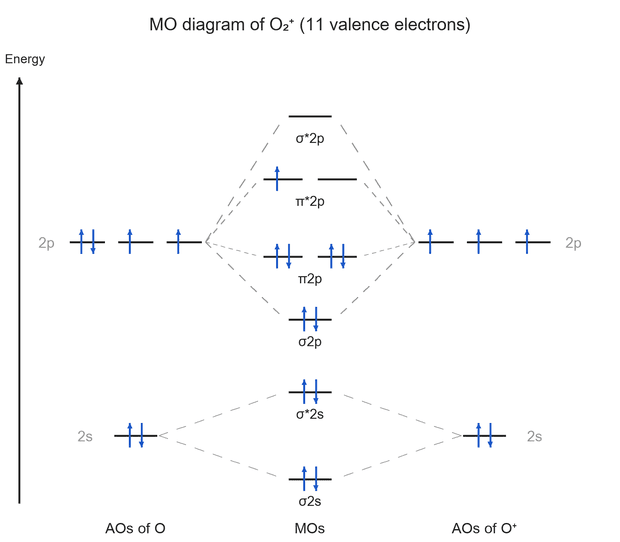
Step 4 — O₂⁻. One electron is added to a π* orbital: KK σ2s² σ2s² σ2p_z² π2p_x² π2p_y² π2p_x² π*2p_y¹. Now N_b = 8 and N_a = 5:
One electron is unpaired, so is paramagnetic.
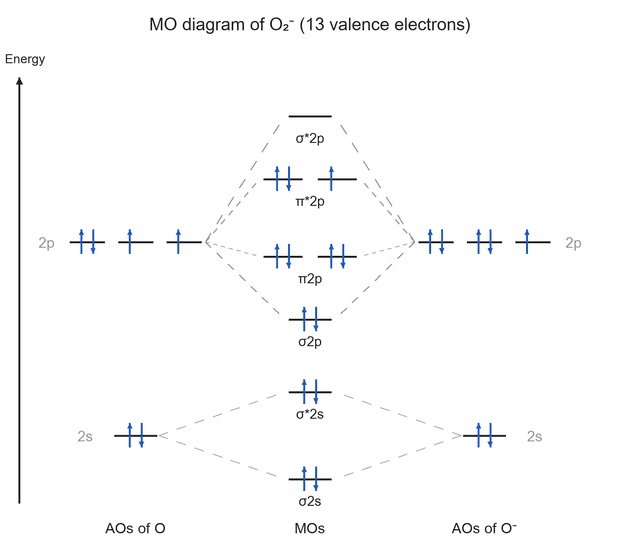
Step 5 — Compare. Bond order falls (2.5) > (2) > (1.5), so bond strength falls and bond length rises in the same order.
Therefore, bond orders are O₂ 2, O₂⁺ 2.5 and O₂⁻ 1.5; all three are paramagnetic (O₂ has 2 unpaired electrons, O₂⁺ and O₂⁻ one each).