Solution:
Key idea: Acetylene's carbons are sp hybridised, which makes the molecule linear. In MO theory bond order = ½(N_b − N_a), and unpaired electrons make a species paramagnetic.
(i)
Step 1 — Hybridisation in acetylene, HC≡CH. Each C mixes its 2s and one 2p orbital to give two sp hybrid orbitals at 180°. One forms the C–H σ bond and the other the C–C σ bond; the two unhybridised p orbitals on each C form two π bonds.
Step 2 — Shape. All four atoms lie on a straight line: the molecule is linear (H–C–C angle 180°).
(ii)
Step 3 — Electron count and configuration. O2+ has 15 electrons (11 valence). Filling the MOs: KK σ2s² σ2s² σ2p_z² π2p_x² π2p_y² π2p_x¹.
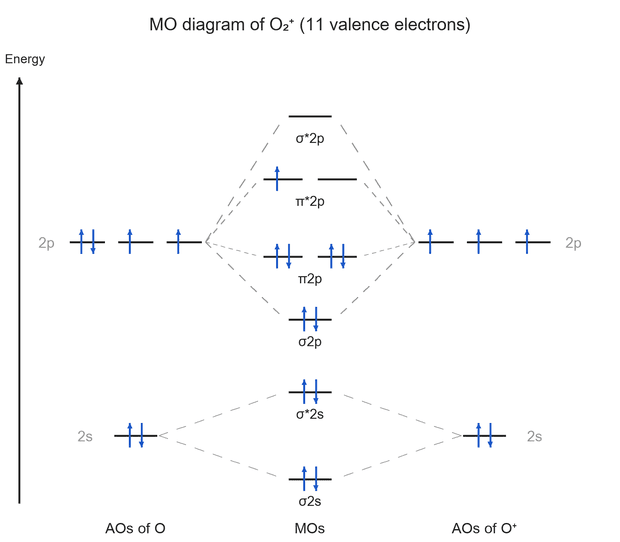
Step 4 — Bond order. Bonding electrons N_b = 8 (σ2s², σ2p_z², π2p⁴); antibonding N_a = 3 (σ2s², π2p¹):
Bond order=21(Nb−Na)
Bond order=21(8−3)
Bond order=2.5
Step 5 — Magnetic nature. There is one unpaired electron in π*2p, so the ion is paramagnetic.
Therefore, (i) acetylene is linear and both carbons are sp hybridised; (ii) O₂⁺ has bond order 2.5 and is paramagnetic.
