
Opening your dashboard
Class 11 Biology Chapter 22: Photomorphogenesis in Plants Solutions
41 textbook questions with step-by-step answers, free to read, for ISC 2026-27.
Get talked through Ch 22, not just shown the answer
Reading a finished solution is not the same as being able to do it. The AI tutor takes one question at a time and works it with you, in your own words, until you can.
- Ask it out loud, in your own words
- It gives you the next step, not the answer
- Stuck on part (ii)? Start there
41 questions with solutions
1–5 marks · Mixed difficulty
- 11 mark
Question 1
In short-day plants, what is the critical period, the length of the day or the night?
Solve with AIWritten solution
Solution:
Concept: Experiments with night breaks showed that short-day plants measure the length of the dark period, not the light period.
Step 1 — What is asked: We must say whether the day or the night is the critical (deciding) period for a short-day plant.
Step 2 — Recall the night-break result: A short flash of light in the middle of the night stops flowering, but a short dark break in the day does not. So the plant responds to the length of the uninterrupted night, which must be longer than a critical length (in a 24-hour cycle this means the day is shorter than the critical day length).
Therefore, the critical period is the length of the night (an uninterrupted dark period longer than a critical length).
- 21 mark
Question 2
What is important for the flowering in short-day plants, if it is the time of long nights?
Solve with AIWritten solution
Solution:
Concept: Short-day plants are better called long-night plants.
Step 1 — What is asked: We need the condition of the long night that matters for flowering.
Step 2 — Recall the fact: The long night must be uninterrupted; even a one-minute flash of light in the middle of the night prevents flowering.
Therefore, an uninterrupted (unbroken) long night is important.
- 31 mark
Question 3
Why do the short-day plants flower during the winter months?
Solve with AIWritten solution
Solution:
Concept: Short-day plants flower when the night is longer than their critical dark period.
Step 1 — What is asked: We must explain why winter is the flowering season of short-day plants.
Step 2 — Link to the season: In winter the days are short and the nights are long, so the night becomes longer than the critical length these plants need.
Therefore, they flower in winter because the nights are then longer (and the days shorter) than their critical length.
- 41 mark
Question 4
If for a short-day plant, the light period is interrupted by a short dark period but there is a long uninterrupted long night, will it show flowering?
Solve with AIWritten solution
Solution:
Concept: A short-day plant needs an uninterrupted long night; breaks in the light period do not matter.
Step 1 — What is asked: We must say whether a dark break in the day stops flowering when the long night is unbroken.
Step 2 — Apply the rule: The long, unbroken night is present, and a dark break in the day does not affect the plant's measurement of the night.
Therefore, yes, it will flower.
- 51 mark
Question 5
Give examples of two short-day flowering plants.
Solve with AIWritten solution
Solution:
Concept: Short-day plants flower when the nights become longer than a critical length, usually in autumn or winter.
Step 1 — What is asked: We need two examples of short-day plants.
Step 2 — Recall examples: Common short-day plants are Chrysanthemum, cocklebur (Xanthium), Cosmos, soybean and rice.
Therefore, two short-day plants are Chrysanthemum and cocklebur (Xanthium).
- 61 mark
Question 6
A long-day plant needs a long day and short night. If the long-day is interrupted by brief dark periods, will it flower?
Solve with AIWritten solution
Solution:
Concept: Long-day plants are short-night plants: what matters is that the night stays shorter than a critical length.
Step 1 — What is asked: We must say whether brief dark breaks in the long day stop flowering of a long-day plant.
Step 2 — Apply the rule: Brief dark periods in the day do not lengthen the night, and the long-day plant does not need unbroken light.
Therefore, yes, it will flower.
- 71 mark
Question 7
If the short night is interrupted by flashes of light, will a long-day plant flower?
Solve with AIWritten solution
Solution:
Concept: A long-day plant does not need an uninterrupted dark period.
Step 1 — What is asked: We must say whether light flashes in the short night stop flowering of a long-day plant.
Step 2 — Apply the rule: Flashes of light only make the dark stretches even shorter, which suits a short-night plant.
Therefore, yes, it will flower.
- 81 mark
Question 8
Give two examples of long-day plants that flower during summer.
Solve with AIWritten solution
Solution:
Concept: Long-day plants flower when the days are longer than a critical length, in late spring and summer.
Step 1 — What is asked: We need two long-day plants.
Step 2 — Recall examples: Spinach, radish, sugar beet, wheat, barley, lettuce and henbane (Hyoscyamus) are long-day plants.
Therefore, two long-day plants are wheat and spinach.
- 91 mark
Question 9
How much of day length is need for the day-neutral plants to flower?
Solve with AIWritten solution
Solution:
Concept: Day-neutral plants are indifferent to day length.
Step 1 — What is asked: We must state the day length that day-neutral plants need for flowering.
Step 2 — Recall the fact: They have no critical day length. They flower after a certain period of vegetative growth, whether the days are short or long (e.g. tomato, cucumber, sunflower).
Therefore, no particular day length is needed; day-neutral plants flower under any day length.
- 101 mark
Question 10
Which red light wavelength induces flowering in short-day plants?
Solve with AIWritten solution
Solution:
Concept: In a short-day plant, a flash of red light (about 660 nm) in the night converts phytochrome to its active form Pfr and prevents flowering; far-red light (about 730 nm) converts Pfr back to Pr and lets the plant flower.
Step 1 — What is asked: We must name the light given in the night that allows (induces) flowering in a short-day plant.
Step 2 — Use the red/far-red experiments: A night break with red light of 660 nm stops flowering. When far-red light (about 730 nm; light of 740 nm is also far-red) is given after it, the plant flowers again, and a far-red flash alone does not stop flowering.
Therefore, it is far-red light (about 730–740 nm) that allows a short-day plant to flower; red light of 660 nm given in the night prevents flowering.
- 111 mark
Question 11
What is the effect of red light 740 nm on the short-day plants?
Solve with AIWritten solution
Solution:
Concept: Light of about 730–740 nm is far-red light; it changes Pfr back into Pr.
Step 1 — What is asked: We must state the effect of 740 nm (far-red) light given in the night on a short-day plant.
Step 2 — Recall the fact: A far-red flash reverses the effect of a red (660 nm) flash, so the short-day plant flowers.
Note: Light of 740 nm is far-red, not red, light.
Therefore, 740 nm (far-red) light reverses the effect of red light (660 nm), and the plant flowers.
- 121 mark
Question 12
Which part of the plant perceives the light?
Solve with AIWritten solution
Solution:
Concept: Experiments on cocklebur showed where the photoperiodic stimulus is received.
Step 1 — What is asked: We need the plant part that perceives the photoperiod.
Step 2 — Recall the experiment: A plant with its leaves removed does not flower in short days, but a plant with only part of one leaf in short days flowers.
Therefore, the leaves perceive the light (photoperiodic) stimulus.
- 131 mark
Question 13
Name the flowering hormone that induces flowering.
Solve with AIWritten solution
Solution:
Concept: The leaves send a flowering signal to the shoot apex.
Step 1 — What is asked: We need the name of the flowering hormone.
Step 2 — Recall the term: It is called florigen; work from 2005 to 2007 showed that it is mainly a small mobile protein (FT protein) carried in the phloem.
Therefore, the flowering hormone is florigen.
- 141 mark
Question 14
Name the hormones that substitute the light requirement in short-day plant.
Solve with AIWritten solution
Solution:
Concept: Some plant hormones can bring about flowering without the proper photoperiod.
Step 1 — What is asked: We need the hormones that can replace the light requirement for flowering.
Step 2 — Recall the list: Gibberellins, auxins, cytokinins and ethylene can, in some plants, induce flowering without the right photoperiod.
Note: Gibberellins mainly replace long days in long-day rosette plants (such as henbane); auxin and ethylene induce flowering in pineapple. In most short-day plants no hormone fully replaces the short days.
Therefore, the hormones are gibberellins, auxins, cytokinins and ethylene.
- 151 mark
Question 15
What is the term used for the exposure to low temperature for initiation of early flowering?
Solve with AIWritten solution
Solution:
Concept: A cold treatment can hasten flowering.
Step 1 — What is asked: We need the name of the low-temperature treatment.
Step 2 — Recall the term: It is called vernalisation.
Therefore, the term is vernalisation.
- 161 mark
Question 16
Which part of the plant perceives the cold stimulus?
Solve with AIWritten solution
Solution:
Concept: In vernalisation the cold is sensed mainly by actively dividing cells.
Step 1 — What is asked: We need the part that perceives cold in vernalisation.
Step 2 — Recall the fact: It is mainly the shoot apex of a growing plant and the embryo in a seed, not the mature leaves that perceive the photoperiod.
Therefore, the shoot apex (and the embryo in the seed) perceives the cold stimulus.
- 171 mark
Question 17
Name the hormone involved in vernalisation.
Solve with AIWritten solution
Solution:
Concept: Grafting experiments in the 1930s (in henbane) suggested that a stimulus formed after cold treatment can pass across a graft.
Step 1 — What is asked: We need the name given to the vernalisation hormone.
Step 2 — Recall the term: It was named vernalin. It has never been isolated, so it remains a hypothetical hormone.
Therefore, the hormone is vernalin.
- 181 mark
Question 18
Which hormone level increases during vernalisation?
Solve with AIWritten solution
Solution:
Concept: Vernalisation changes the hormone balance at the shoot apex.
Step 1 — What is asked: We need the hormone whose level rises during vernalisation.
Step 2 — Recall the fact: Gibberellin levels rise, and gibberellin treatment can make some plants flower without cold.
Therefore, the gibberellin level increases.
- 191 mark
Question 19
Name the light receptor pigment present in seeds.
Solve with AIWritten solution
Solution:
Concept: Seeds such as lettuce germinate only after exposure to light.
Step 1 — What is asked: We need the pigment that receives light in seeds.
Step 2 — Recall the term: It is phytochrome, a blue-green chromoprotein.
Therefore, the pigment is phytochrome.
- 201 mark
Question 20
If seeds are exposed to red light 600 nm and far red light 730, which light if given last can bring seed germination?
Solve with AIWritten solution
Solution:
Concept: For light-sensitive seeds the last flash decides: red light forms active Pfr (germination), far-red light removes it (no germination).
Step 1 — What is asked: We need the light that, given last, makes the seeds germinate.
Step 2 — Apply the rule: Red light converts Pr to Pfr, the active form that promotes germination, so the seeds germinate when red is the last light.
Note: Red light acting on Pr has a peak of about 660 nm; "600 nm" in the stem stands for this red light.
Therefore, red light given last brings about seed germination.
- 212 marks
Question 21
What is photoperiodism? What is termed as critical day length?
Solve with AIWritten solution
Solution:
Concept: Many plants flower only in a particular season because they measure day and night lengths.
Step 1 — What is asked: We must define photoperiodism and the critical day length.
Step 2 — Define photoperiodism: Photoperiodism is the response of an organism (here, flowering of a plant) to the changing relative lengths of day and night. It was first described by Garner and Allard, in work published in 1920, in the Maryland Mammoth variety of tobacco.
Step 3 — Define critical day length: The critical day length (critical photoperiod) is the day length that decides flowering: a short-day plant flowers only when the day is at or below it, and a long-day plant only when the day is at or above it. For example, cocklebur (Xanthium) has a critical day length of 15½ hours.
Therefore, photoperiodism is the response of plants to relative day and night lengths, and the critical day length is the day length above or below which a plant flowers.
- 222 marks
Question 22
Under which conditions do short-day plants flower? Is it correct to say that short-day plants are actually long-night plants?
Solve with AIWritten solution
Solution:
Concept: Night-break experiments show that the dark period is the critical period.
Step 1 — What is asked: We must give the conditions for flowering of short-day plants and judge the name long-night plants.
Step 2 — Conditions: Short-day plants flower when the day is shorter than the critical day length and, above all, when they get a long, uninterrupted night longer than the critical dark period. A flash of light in the night prevents flowering, while a dark break in the day does not.
Step 3 — Judge the name: Since the length of the unbroken night, not the day, decides flowering, it is correct, and more accurate, to call them long-night plants.
Therefore, short-day plants flower with short days and long uninterrupted nights, and yes, they are really long-night plants.
- 232 marks
Question 23
What is essential requirement of long-day and short-day plants for flowering?
Solve with AIWritten solution
Solution:
Concept: Both groups respond to the length of the dark period.
Step 1 — What is asked: We need the essential requirement of each group.
Step 2 — Long-day plants: They need a short night (a dark period shorter than the critical length); they flower even if the night is interrupted by light or the day by brief dark periods.
Step 3 — Short-day plants: They need a long, uninterrupted night (longer than the critical length); a light break in the night prevents flowering.
Therefore, long-day plants need short nights, and short-day plants need long uninterrupted nights.
- 242 marks
Question 24
Which type of plants flower in the winter and which type in summer?
Solve with AIWritten solution
Solution:
Concept: The season of flowering follows the day and night lengths each group needs.
Step 1 — What is asked: We must name the group that flowers in winter and the group that flowers in summer.
Step 2 — Winter: In winter (and autumn) the nights are long, so short-day plants flower, e.g. Chrysanthemum, cocklebur, rice.
Step 3 — Summer: In summer the days are long and the nights short, so long-day plants flower, e.g. wheat, spinach, radish.
Therefore, short-day plants flower in winter and long-day plants flower in summer.
- 252 marks
Question 25
Give two important difference short-day and long-day plants.
Solve with AIWritten solution
Solution:
Concept: Short-day plants are long-night plants and long-day plants are short-night plants.
Step 1 — What is asked: We need two differences between short-day and long-day plants.
Step 2 — Compare them: The two main differences are set out in the table.
Feature Short-day plants Long-day plants Night needed Long night, longer than the critical length Short night, shorter than the critical length Light break in the night Prevents flowering Does not prevent flowering Therefore, short-day plants need long uninterrupted nights, while long-day plants need short nights, and a light break in the night does not prevent their flowering.
- 262 marks
Question 26
What is phytochrome?
Solve with AIWritten solution
Solution:
Concept: Plants detect red and far-red light through a special pigment.
Step 1 — What is asked: We must describe phytochrome.
Step 2 — Nature: Phytochrome is a blue-green chromoprotein (protein plus a light-absorbing pigment part) that acts as a light receptor in plants.
Step 3 — Two forms: It exists in two interconvertible forms: Pr (P660), which absorbs red light of about 660 nm, and Pfr (P730), which absorbs far-red light of about 730 nm. Red light changes Pr to the active form Pfr; far-red light, and slowly darkness, change Pfr back to Pr. It controls seed germination, flowering and other light responses.
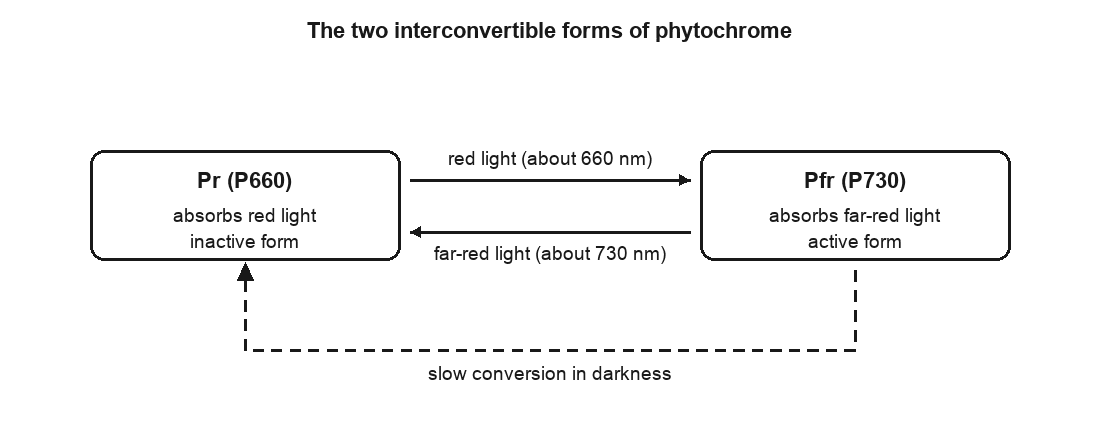
Therefore, phytochrome is a blue-green proteinaceous light-receptor pigment that exists as Pr and Pfr and controls light responses such as germination and flowering.
- 273 marks
Question 27
What is the effect of quality of light, i.e., red and far-red light on flowering in short-day plants? If red and far-red lights are given, how do they affect flowering in plants?
Solve with AIWritten solution
Solution:
Concept: Flowering is controlled by phytochrome. Red light (about 660 nm) changes Pr into the active form Pfr; far-red light (about 730 nm) changes Pfr back into Pr.
Step 1 — What is asked: We must explain how red and far-red flashes in the night affect a short-day plant, and what happens when both are given.
Step 2 — Red light: A flash of red light in the middle of the long night forms Pfr, which inhibits flowering in a short-day plant, so the plant does not flower (white light acts the same way because it is rich in red).
Step 3 — Far-red light: A flash of far-red light given after the red flash converts Pfr back to Pr, so the inhibition is removed and the plant flowers.
Step 4 — Both given alternately: When red and far-red flashes are given one after the other, the last flash decides: R → FR gives flowering, R → FR → R gives no flowering. The figure shows the results.
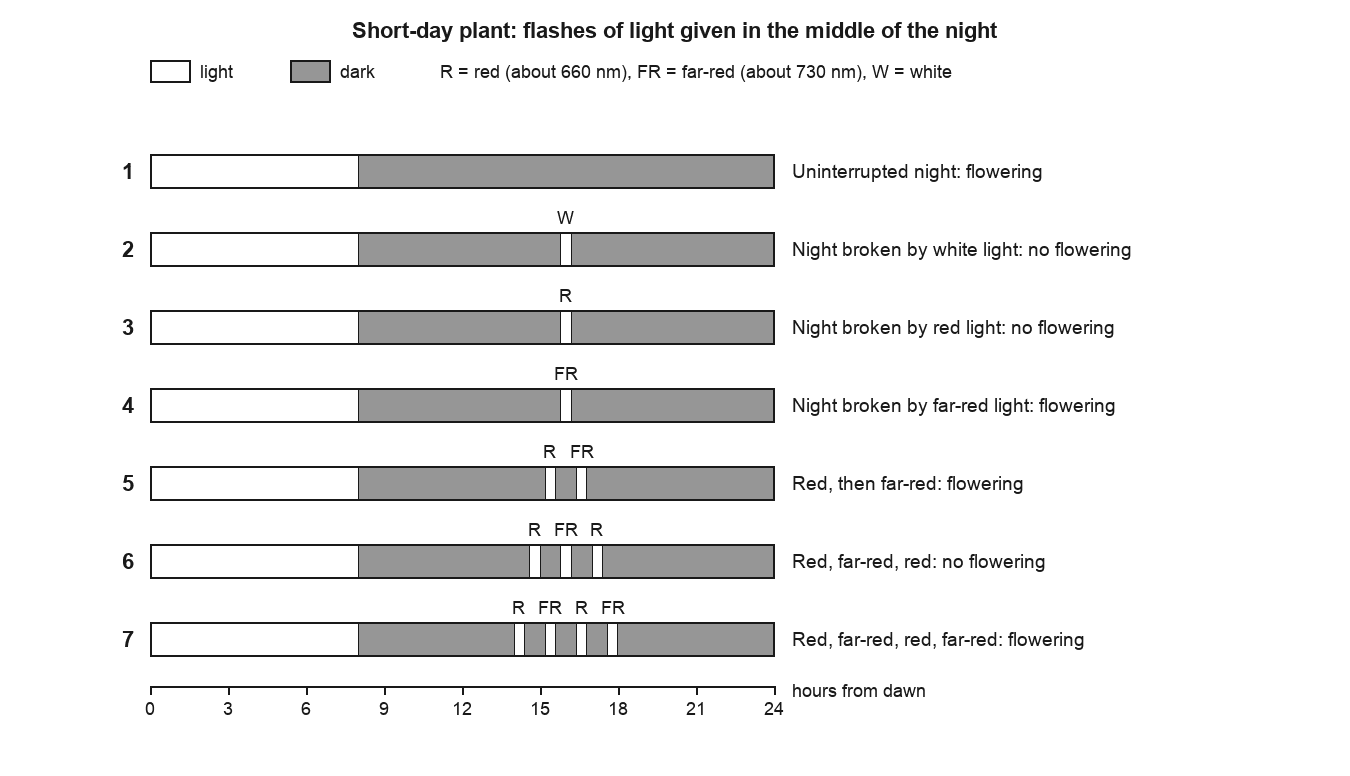
Note: In a long-day plant the effect is opposite: a red flash in the night (forming Pfr) promotes flowering.
Therefore, red light in the night prevents flowering in a short-day plant, far-red light reverses it, and when both are given the last one decides the result.
- 283 marks
Question 28
What is florigen? What is its function? Where is it synthesised in plants?
Solve with AIWritten solution
Solution:
Concept: The photoperiodic stimulus is received by the leaves but flowers form at the shoot apex, so a signal must travel between them.
Step 1 — What is asked: We must say what florigen is, what it does and where it is made.
Step 2 — What it is: Florigen is the name given to the flowering hormone (stimulus). Grafting experiments show that it is not species-specific. Work from 2005 to 2007 showed that it is mainly a small protein, the FT protein, carried in the phloem.
Step 3 — Function: It moves from the leaves to the shoot apex (apical and axillary buds) and makes the buds form flowers instead of leaves.
Step 4 — Where it is made: It is synthesised in the leaves, when they receive the inductive photoperiod.
Therefore, florigen is the flowering hormone, made in the leaves under the right photoperiod and carried to the shoot apex where it induces flowering.
- 293 marks
Question 29
What is the vernalisation? What is its role in plants?
Solve with AIWritten solution
Solution:
Concept: Many plants of temperate regions flower only after they have been through a cold period.
Step 1 — What is asked: We must define vernalisation and give its role.
Step 2 — Definition: Vernalisation is the exposure of soaked seeds or young plants to low temperature (about 1–10 °C, often near 4 °C, for a few days to some weeks) to bring about early flowering.
Step 3 — How it works: The cold is perceived mainly by the actively dividing cells of the shoot apex (or the embryo of a seed). Gibberellin levels rise. Grafting experiments in the 1930s (in henbane) suggested that a stimulus, named vernalin, forms and can pass to another plant across a graft, but it has never been isolated.
Step 4 — Role: It shortens the vegetative period: winter varieties of wheat and rye sown in spring flower in the same year, and biennials such as carrot, cabbage and sugar beet are made to flower. It does not itself make flowers but makes the plant ready to flower at the right time.
Watch out: A high temperature given soon after the cold treatment reverses vernalisation (devernalisation).
Therefore, vernalisation is a low-temperature treatment that prepares plants for early flowering, for example making winter wheat flower in the same year.
- 303 marks
Question 30
How is flowering affected by pre-treatment of seeds with a certain low temperature? Explain.
Solve with AIWritten solution
Solution:
Concept: Pre-treating seeds with cold is vernalisation.
Step 1 — What is asked: We must explain the effect of a cold pre-treatment of seeds on flowering.
Step 2 — The treatment: Soaked (germinating) seeds are kept at a low temperature of about 1–10 °C for a few days to some weeks.
Step 3 — Where it acts: The embryo of the seed perceives the cold. Gibberellin levels rise and the shoot apex becomes able to form flowers.
Step 4 — The effect: The plants flower earlier. For example, winter wheat normally sown in autumn needs the winter's cold; if its seeds are vernalised and sown in spring, it flowers and gives grain in the same year.
Therefore, cold pre-treatment of seeds hastens flowering, so that winter varieties can flower in the same year.
- 313 marks
Question 31
How does phytochrome affect seed germination? Explain.
Solve with AIWritten solution
Solution:
Concept: Light-sensitive seeds such as lettuce and tobacco germinate only after receiving some light, through the pigment phytochrome.
Step 1 — What is asked: We must explain how phytochrome controls the germination of seeds.
Step 2 — Red light: Red light (about 660 nm) converts Pr into Pfr, the active form, which promotes germination. Sunlight has more red than far-red light, so in daylight Pfr builds up and the seeds germinate.
Step 3 — Far-red light and darkness: Far-red light (about 730 nm) converts Pfr back into Pr, so the seeds stay dormant. In darkness Pfr slowly changes back to Pr.
Step 4 — Alternate flashes: When red and far-red flashes are given one after the other, the last one decides: R → germination, R + FR → no germination, R + FR + R → germination, R + FR + R + FR → no germination.
Therefore, red light forms Pfr and makes light-sensitive seeds germinate, far-red light reverses this, and the last light given decides the result.
- 322 marks
Question 32
Long-day and Short-day plants
Solve with AIWritten solution
Solution:
Concept: Plants are grouped by the night length they need for flowering.
Step 1 — What is asked: We must give the main differences between long-day plants and short-day plants.
Step 2 — Compare them: The differences are set out feature by feature in the table.
Feature Long-day plants Short-day plants Day length for flowering Longer than the critical day length Shorter than the critical day length Night needed Short night (short-night plants) Long uninterrupted night (long-night plants) Light break in the night Does not prevent flowering Prevents flowering Season and examples Summer; wheat, spinach, radish Winter; Chrysanthemum, cocklebur, rice Therefore, long-day plants need short nights and flower in summer, while short-day plants need long unbroken nights and flower in winter.
- 332 marks
Question 33
Short-day and Day-neutral plants
Solve with AIWritten solution
Solution:
Concept: Short-day plants depend on night length; day-neutral plants do not.
Step 1 — What is asked: We must give the main differences between short-day plants and day-neutral plants.
Step 2 — Compare them: The differences are set out feature by feature in the table.
Feature Short-day plants Day-neutral plants Critical day length Present; flower only below it Absent; flower at any day length Night needed Long uninterrupted night No special night length Light break in the night Prevents flowering No effect on flowering Examples Chrysanthemum, cocklebur, rice Tomato, cucumber, sunflower Therefore, short-day plants need long uninterrupted nights, while day-neutral plants flower after enough growth whatever the day length.
- 342 marks
Question 34
Photoperiodism and Vernalisation
Solve with AIWritten solution
Solution:
Concept: Both control the time of flowering, but they respond to different signals.
Step 1 — What is asked: We must give the main differences between photoperiodism and vernalisation.
Step 2 — Compare them: The differences are set out feature by feature in the table.
Feature Photoperiodism Vernalisation Signal Relative lengths of day and night A period of low temperature Perceived by Leaves Shoot apex (embryo in the seed) Hormone named Florigen (shown in 2005–2007 to be mainly the FT protein) Vernalin (never isolated) Effect Can bring about flowering Prepares the plant to flower; does not itself make flowers Therefore, photoperiodism is a response to day and night length perceived by the leaves, while vernalisation is a response to cold perceived by the shoot apex.
- 352 marks
Question 35
Phytochrome and Vernalin
Solve with AIWritten solution
Solution:
Concept: Phytochrome is a light receptor; vernalin is the name of a proposed cold-induced hormone.
Step 1 — What is asked: We must give the main differences between phytochrome and vernalin.
Step 2 — Compare them: The differences are set out feature by feature in the table.
Feature Phytochrome Vernalin Nature Blue-green chromoprotein pigment Proposed hormone; never isolated Signal it is linked to Red and far-red light Low temperature (vernalisation) Role Controls seed germination, flowering and other light responses Thought to bring about the effect of cold on flowering Location Present in seeds, leaves and other parts Thought to form in the shoot apex or embryo Therefore, phytochrome is a real light-receptor pigment, while vernalin is a hypothetical hormone of vernalisation.
- 365 marks
Question 36
Compare the effect of following on short-day plant
(i) Long-day and short night
(ii) Short-day and long night
(iii) Short-day and long interrupted night
(iv) Interrupted short-day and long night.
Solve with AIWritten solution
Solution:
Concept: A short-day plant is really a long-night plant: it flowers only when it gets an uninterrupted dark period longer than a critical length. For cocklebur (Xanthium) the critical day length is 15½ h, so its critical night length is 24 − 15½ = 8½ h.
Step 1 — What is asked: We must compare four light–dark schedules and say whether the short-day plant flowers in each.
Step 2 — Part (i), long day and short night: The night is shorter than the critical night length, so the plant does not flower.
Step 3 — Part (ii), short day and long night: The night is longer than the critical length and unbroken, so the plant flowers.
Step 4 — Part (iii), short day and long interrupted night: A flash of light (even about a minute long) in the middle splits the night into two short dark periods, each below the critical length. The plant does not flower; this is called a night break.
Step 5 — Part (iv), interrupted short day and long night: A brief dark period in the day does not matter, because the long night is still unbroken, so the plant flowers.
Step 6 — Draw the comparison: The four schedules are shown as 24-hour bars.

Step 7 — Conclusion: Parts (iii) and (iv) prove that the dark period, not the light period, is critical. That is why short-day plants are called long-night plants.
Therefore, the short-day plant flowers in (ii) and (iv), and does not flower in (i) and (iii).
- 375 marks
Question 37
Explain the effect of following on a long-day plant
(i) Long-day and short night
(ii) Short-day and long night
(iii) Long-day and interrupted short night
(iv) Interrupted long day and short night.
Solve with AIWritten solution
Solution:
Concept: A long-day plant is really a short-night plant: it flowers when the dark period is shorter than a critical length, and it does not need an uninterrupted night.
Step 1 — What is asked: We must explain whether a long-day plant flowers under four light–dark schedules.
Step 2 — Part (i), long day and short night: The night is shorter than the critical length, so the plant flowers.
Step 3 — Part (ii), short day and long night: The long night is longer than the critical length, so the plant does not flower.
Step 4 — Part (iii), long day and interrupted short night: Flashes of light in the night only shorten the dark period further, so the plant flowers.
Step 5 — Part (iv), interrupted long day and short night: Brief dark periods in the day do not stop flowering, because the night remains short, so the plant flowers.
Step 6 — Draw the comparison: The four schedules are shown as 24-hour bars.
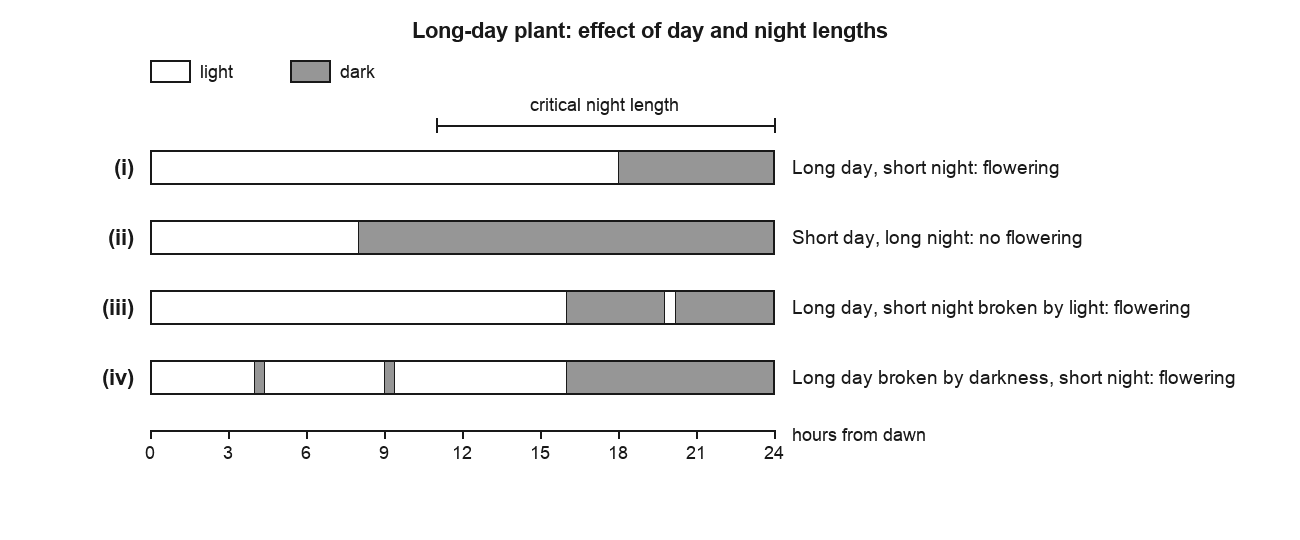
Step 7 — Conclusion: Long-day plants, such as wheat, spinach and radish, flower in summer when nights are short.
Therefore, the long-day plant flowers in (i), (iii) and (iv), and does not flower in (ii).
- 385 marks
Question 38
Compare the effect of critical photoperiod on a short day plant and a day-neutral plant.
Solve with AIWritten solution
Solution:
Concept: The critical photoperiod (critical day length) is the day length that decides whether a photoperiodic plant flowers.
Step 1 — What is asked: We must compare how the critical photoperiod affects a short-day plant and a day-neutral plant.
Step 2 — Short-day plant: A short-day plant has a definite critical day length. It flowers only when the day is at or below this length, that is, when the night is long enough. For example, cocklebur flowers when the day is 15½ h or less.
Step 3 — Night break: The long night must be unbroken; a flash of light in the night prevents flowering. So short-day plants flower in autumn and winter (Chrysanthemum, cocklebur (Xanthium), rice, soybean).
Step 4 — Day-neutral plant: A day-neutral plant has no critical photoperiod. It flowers after a period of vegetative growth whether the days are short or long, and light breaks have no effect.
Step 5 — Season: So day-neutral plants such as tomato, cucumber and sunflower can flower in any season.
Step 6 — Compare them: The comparison is summed up in the table.
Feature Short-day plant Day-neutral plant Critical photoperiod Present; flowers below it Absent Long uninterrupted night Essential Not needed Flowering time Autumn and winter Any season, after vegetative growth Therefore, the critical photoperiod controls flowering in a short-day plant (it flowers only below it, with long unbroken nights) but has no effect on a day-neutral plant.
- 395 marks
Question 39
What is the role of phytochrome in flowering and seed germination?
Solve with AIWritten solution
Solution:
Concept: Phytochrome is a blue-green chromoprotein that exists in two interconvertible forms: Pr (absorbs red light, about 660 nm) and Pfr (absorbs far-red light, about 730 nm; the active form).
Step 1 — What is asked: We must explain how phytochrome controls flowering and seed germination.
Step 2 — The two forms: Red light converts Pr to Pfr; far-red light converts Pfr to Pr; in darkness Pfr slowly changes back to Pr. In daylight Pfr builds up because sunlight has more red than far-red light.
Step 3 — Flowering in short-day plants: A flash of red light in the middle of the long night forms Pfr and prevents flowering. A far-red flash given after it changes Pfr back to Pr and the plant flowers. The last flash decides the result.
Step 4 — Flowering in long-day plants: In long-day plants Pfr works the other way: a red flash in the night promotes flowering.
Step 5 — Seed germination: Light-sensitive seeds such as lettuce and tobacco germinate after red light (Pfr formed) and stay dormant after far-red light (Pfr removed). With alternate flashes the last one decides: R → germination, R + FR → none, R + FR + R → germination, R + FR + R + FR → none.
Step 6 — Other roles: Phytochrome also controls leaf growth, stem lengthening and branching, and the prevention of etiolation.
Therefore, phytochrome acts as a red/far-red light switch: Pfr formed by red light stops flowering in short-day plants and starts germination of light-sensitive seeds, and far-red light reverses both.
- 405 marks
Question 40
Which part of plant perceives light? Give experiments to demonstrate the same.
Solve with AIWritten solution
Solution:
Concept: In photoperiodism the light stimulus is perceived by the leaves, not by the shoot tip. Experiments on the short-day plant cocklebur (Xanthium) proved this.
Step 1 — What is asked: We must name the part that perceives light and describe the experiments that show it.
Step 2 — Experiment A: A plant with its leaves exposed to inductive light (short days) flowers.
Step 3 — Experiment B: A plant with its leaves removed, kept in short days, does not flower, although its buds receive the inductive light.
Step 4 — Experiment C: A plant with only one-eighth of a leaf exposed to short days flowers. So even a small piece of leaf is enough to perceive the stimulus.
Step 5 — Experiment D: A plant with a single leaf given short days is grafted to another plant kept in long (non-inductive) days; both plants flower. So a stimulus passes from the leaf, through the graft, to the buds of the other plant.
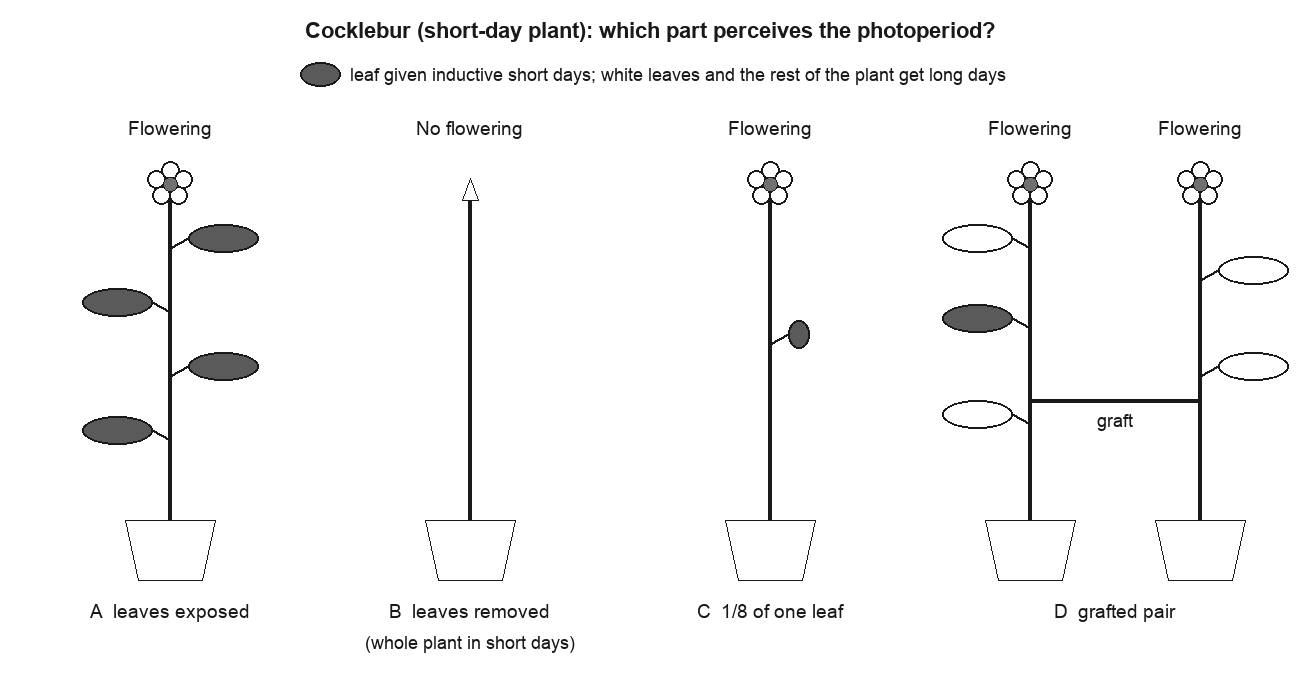
Step 6 — Conclusion: The leaves perceive the photoperiod and make a stimulus, florigen, which travels to the shoot apex and starts flowering. It is not species-specific. Work from 2005 to 2007 showed that it is mainly the FT protein, carried in the phloem.
Therefore, the leaves perceive the light stimulus, as shown by experiments A–D on cocklebur.
- 415 marks
Question 41
What is vernalisation? Explain.
Solve with AIWritten solution
Solution:
Concept: Vernalisation is the exposure of seeds or plants to low temperature to bring about (initiate) early flowering.
Step 1 — What is asked: We must define vernalisation and explain how it works and why it is useful.
Step 2 — The treatment: Soaked seeds or young plants are kept at about 1–10 °C (4 °C suits most) for a period ranging from four days to about three months, depending on the plant.
Step 3 — Plants that need it: It is needed mainly by plants of temperate regions: winter varieties of wheat and rye, and biennials such as carrot, cabbage and sugar beet. Vernalised seeds of winter wheat sown in spring flower in the same year.
Step 4 — Site of perception: The cold is perceived mainly by the actively dividing cells of the shoot apex of a growing plant and of the embryo of a seed, not by the mature leaves that perceive the photoperiod.
Step 5 — Hormones: Gibberellin levels rise, and gibberellin can make some plants flower without cold. A stimulus named vernalin was proposed after grafting experiments in the 1930s, in which a cold-treated henbane shoot made an untreated plant flower, but it has never been isolated.
Step 6 — Nature of the effect: Vernalisation does not itself produce flowers; it prepares the plant to flower at a favourable time of the year. A high temperature soon after the cold treatment reverses it (devernalisation).
Therefore, vernalisation is a low-temperature treatment, sensed by the shoot apex or embryo, that prepares plants such as winter wheat for early flowering.
What Class 11 Biology Ch 22 covers
The sections of the chapter, in the order the book takes them. Every question above comes from one of these.
- 01Photoperiodism
- 02Perception of Light Stimulus
- 03Vernalisation
More ways to study this chapter
The same chapter asked three other ways. Practise it, revise it, and see what the board has set on Ch 22 before.
Class 11 Biology Ch 22 questions students ask
How many questions are there in Class 11 Biology Ch 22?
41 questions. Every one is solved step by step on this page.
Are these Class 11 Biology solutions free?
Yes. Every question and its full working is free to read, with no account needed.
Can I download the Class 11 Biology Ch 22 solutions as a PDF?
There is no PDF to download. Every solution is on this page instead, which means it is searchable, always the current syllabus, and readable on a phone. Use your browser's print option if you want it on paper.