
Opening your dashboard
Class 11 Biology Chapter 22 Photomorphogenesis in Plants: Competency-Based Questions (CBQ)
40 questions on Chapter 22, each worked through on its own page with the AI tutor. Class 11 Biology, ICSE 2026-27.
40 questions
1–5 marks · Mixed difficulty
- 14 marks
Question 1
A flower grower near Pune raises potted poinsettias for a festival market that opens on 1 November. Poinsettia is a short-day plant, and its bright coloured bracts develop as it flowers. In this variety the plants are in full colour 50 days after the first of a run of uninterrupted nights, each longer than 12.5 hours. In the grower's area the natural nights first become longer than 12.5 hours on 25 October. To be ready in time, the grower covers the beds with black-out cloth every evening, as shown in the figure. (Hypothetical data.)
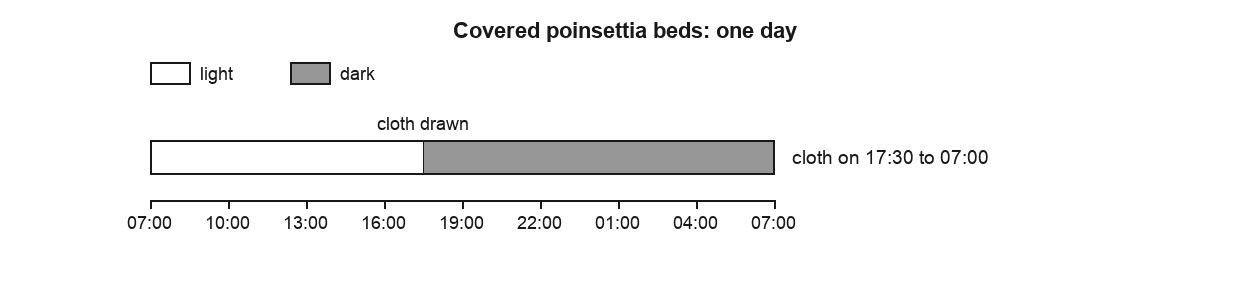
(a) Use the figure to find the length of the dark period the cloth gives. Is it long enough to induce flowering? (1 mark)
(b) Find the latest date on which the grower can start covering the beds so that the plants are in full colour by 1 November. (1 mark)
(c) A neighbour grows the same variety but does not cover the beds. On what date will the neighbour's plants be in full colour, and will they be ready for the market? Explain why covering the plants brings the colour earlier. (2 marks)
- 21 mark
Question 2
Assertion (A): A day-neutral plant flowers only when the day and the night are each exactly 12 hours long.
Reason (R): Day-neutral plants flower after a period of vegetative growth, whatever the length of the day.
- 34 marks
Question 3
A farm at Mahabaleshwar grows two strawberry cultivars. Cultivar J is a short-day type: it forms flower buds only when the day is shorter than its critical day length. Cultivar D is said to be day-neutral. Each month, 100 plants of each cultivar were examined and the number forming new flower buds was counted. The approximate day length is also given. Assume that the temperature was suitable all year. (Hypothetical data.)
Month Day length (h) J plants forming buds D plants forming buds September 12.2 0 45 October 11.6 55 50 November 11.1 90 50 December 10.9 100 55 January 11.0 95 50 February 11.4 70 50 March 11.9 0 45 April 12.4 0 45 May 12.8 0 40 (a) Which feature of the data shows that cultivar D is day-neutral? (1 mark)
(b) Between which two values must the critical day length of cultivar J lie? Explain. (1 mark)
(c) The farm wants plants that form flower buds in April and May, so that it has fresh berries for summer tourists. Which cultivar should it plant? Support your answer with the mean number of plants (per 100) forming buds in April and May for each cultivar. (2 marks)
- 41 mark
Question 4
A short-day ornamental species flowers in October and November in a park in Delhi (about 29° N). A botanist visiting Melbourne, Australia (about 38° S), finds the same species in full flower there in May. Which statement best explains this?
- 54 marks
Question 5
At a sugarcane breeding station in Tamil Nadu, breeders want to cross variety M with variety N. Sugarcane is a short-day plant. Variety M starts flowering (is induced) once its nights are longer than 11.7 hours, and variety N once its nights are longer than 12.2 hours. Each variety opens its flowers 75 days after induction starts. Sugarcane pollen stays alive for only a short time, so it cannot be stored until the other variety flowers. The natural night lengths at the station are given below. Assume that a variety is induced from the first date in the table on which the night is longer than its critical night. (Hypothetical data.)
Date Natural night length (h) 1 August 11.5 15 August 11.6 1 September 11.8 15 September 11.9 1 October 12.1 15 October 12.3 1 November 12.4 (a) For each variety, find the date on which induction starts and the date on which its flowers open. (2 marks)
(b) Explain why the breeders cannot cross M with N without help. (1 mark)
(c) The N plants are grown in pots on trolleys. Suggest how the breeders can make N open its flowers on the same date as M. State the date on which the treatment must begin. (1 mark)
- 61 mark
Question 6
Assertion (A): In the plains of north India, chrysanthemum, a short-day plant, comes into flower as the nights grow longer in autumn and early winter.
Reason (R): Short-day plants flower only when they receive an uninterrupted night longer than their critical night length.
- 74 marks
Question 7
A grower in a polyhouse near Solan raises a day-neutral tomato and the cut flower Cosmos, a short-day plant, side by side. In winter the plants get light from 07:00 to 17:00. To speed up the growth of the tomatoes, the grower switches on lamps that keep the whole polyhouse lit until 23:00. Schedule 1 in the figure shows the day before the lamps, and schedule 2 the day after. The grower's Cosmos variety flowers only when it gets an uninterrupted night longer than 11 hours. (Hypothetical data.)
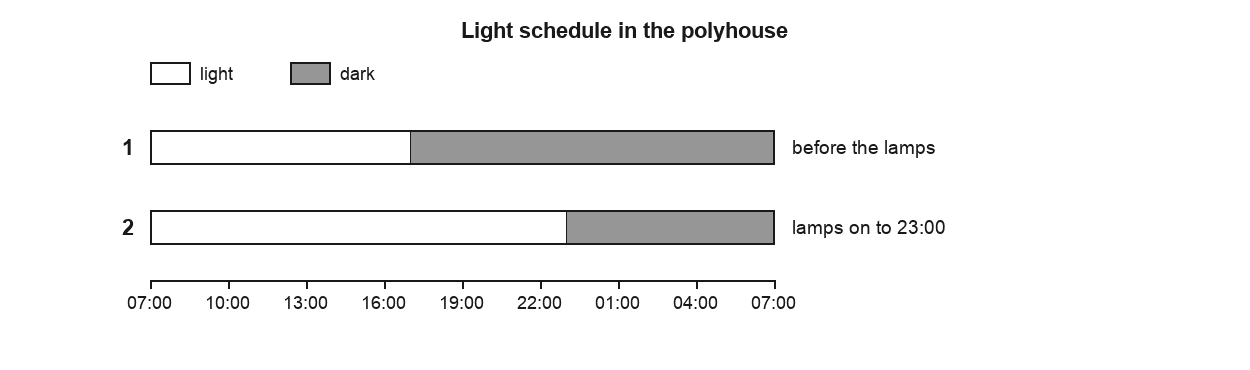
(a) Find the length of the night in schedule 1 and in schedule 2. (1 mark)
(b) Predict how the lamps will affect flowering of the tomato and of the Cosmos. Explain each prediction. (2 marks)
(c) Suggest one way in which the grower can keep using the lamps for the tomatoes without harming the flower crop. (1 mark)
- 81 mark
Question 8
Traditional rice varieties of eastern India are short-day plants that flower only when the nights lengthen in autumn. Breeders have developed rice varieties that are day-neutral (insensitive to photoperiod). What is the main advantage of such a variety to farmers?
- 94 marks
Question 9
In a growth-room study at a plant-science centre in Hisar, ten plants of a short-day species were placed in each of the groups A to H. Every day had 8 hours of light and a 16-hour night. Group A had an unbroken night. In groups B to H the night was interrupted by 30 minutes of white light at a different time after dusk, as shown in the figure. The plants were checked after six weeks. (Hypothetical data.)
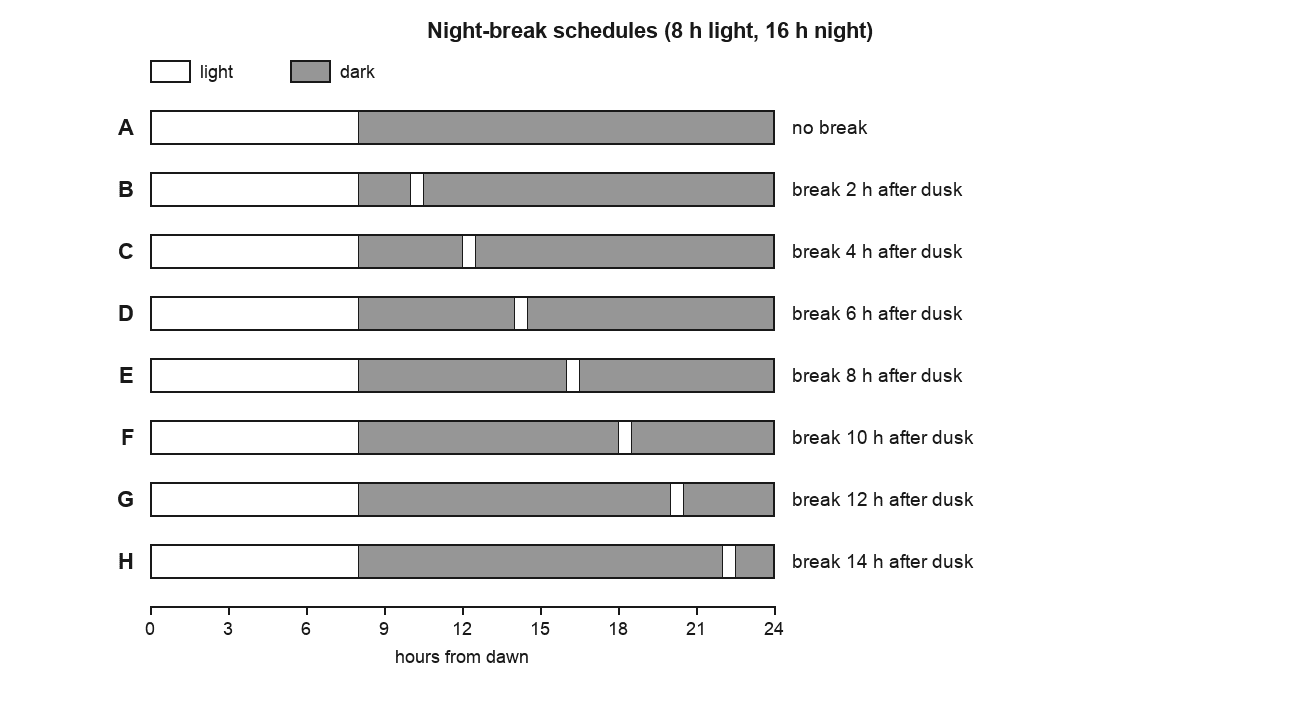
Group A B C D E F G H Plants flowering (out of 10) 10 10 10 0 0 0 10 10 (a) For group C and group F, work out the two dark periods and state the longest uninterrupted dark period of each. (1 mark)
(b) Use all the results to state the limits within which the critical night length of this species must lie. (1 mark)
(c) A gardener says, "A night break works best when it falls in the middle of the night." Use the data to explain why. Then predict whether a 30-minute break 8 hours after dusk would stop flowering if the night were 20 hours long. (2 marks)
- 101 mark
Question 10
A vertical farm in Gurugram grows lettuce, a long-day plant, under LED lamps. Its lettuce variety bolts (sends up a flowering stalk, which spoils the leaves) whenever its uninterrupted nights are shorter than 11 hours. (Hypothetical data.) The lamps are now on for all 24 hours and the crop bolts early. Which daily schedule will prevent bolting?
- 114 marks
Question 11
A seed-testing laboratory in Hyderabad tests a batch of tobacco seeds, which are light-sensitive. After soaking, the seeds are given light in a box fitted with red (about 660 nm) and far-red (about 730 nm) lamps, and then kept in total darkness at 25 °C for 7 days. Each tray holds 200 seeds. A separate test shows that 188 of every 200 seeds in the batch are alive. (Hypothetical data.)
Tray Light given after soaking Seeds germinated (out of 200) 1 none 12 2 red, 1 minute 84 3 red, 2 minutes 140 4 red, 5 minutes 182 5 red, 10 minutes 184 6 red, 5 minutes, then far-red, 5 minutes 16 (a) Calculate the percentage germination in tray 1 and in tray 4. (1 mark)
(b) Explain why germination rises from tray 1 to tray 4 but hardly changes from tray 4 to tray 5, and why tray 6 is so low. (2 marks)
(c) Until now the laboratory reported this batch's germination from trays kept in darkness only. Explain why this report misleads farmers, and suggest a change to the test. (1 mark)
- 121 mark
Question 12
Assertion (A): When a short-day plant gets a red flash in the middle of its long night, followed at once by a far-red flash, it still flowers.
Reason (R): Far-red light converts the Pr form of phytochrome into the Pfr form.
- 131 mark
Question 13
A research student must convince their guide that phytochrome is the pigment through which a short-day plant senses a night break. Which observation is the strongest evidence for this?
- 141 mark
Question 14
Assertion (A): A long-day plant kept in short days with long, unbroken nights does not flower.
Reason (R): During a long night much of the Pfr changes back to Pr, and long-day plants need Pfr to be present for flowering.
- 154 marks
Question 15
Researchers at a plant-science institute in Bengaluru work with a small long-day plant. They have joined the gene for the flowering protein FT to the gene for a green fluorescent protein, so that wherever FT is present it glows green under a special microscope. Plants grown in short days do not flower and show no glow. One mature leaf of each test plant is then given a single long day, while the rest of the plant stays in short days. The distance from the base of this leaf blade to the shoot apex, along the leaf stalk and stem, is 9 cm. (Hypothetical data.)
Hours after the long day ended Where the green glow is seen 0 phloem of the treated leaf blade only 2 phloem, up to 3 cm from the leaf blade 4 phloem, up to 6 cm from the leaf blade 6 shoot apex, 9 cm from the leaf blade Flower buds formed at the shoot apex some days later.
(a) Name the tissue that carries FT and calculate the average speed at which the glow moved towards the shoot apex. (1 mark)
(b) The chapter calls the flowering stimulus florigen. What do these results tell you about where florigen is made and what it is? (2 marks)
(c) Predict what would have been seen if the treated leaf had been kept in short days like the rest of the plant. Give a reason. (1 mark)
- 161 mark
Question 16
Assertion (A): The flowering stimulus made in an induced leaf of one plant species can act only on the shoot apex of a plant of that same species.
Reason (R): The flowering stimulus is produced in the leaves and carried to the shoot apex.
- 171 mark
Question 17
A laboratory has a mutant of a long-day plant that never flowers, even in long days. The fault may lie either in its leaves (they cannot make the flowering stimulus) or in its shoot apex (it cannot respond to the stimulus). Which experiment will tell these two possibilities apart?
- 181 mark
Question 18
Assertion (A): Phytochrome exists in two forms, Pr and Pfr, which are changed into each other by light.
Reason (R): The flowering stimulus moves from the leaves to the shoot apex through the phloem.
- 194 marks
Question 19
At a plant-physiology laboratory in Shimla, students soaked grains of a winter variety of wheat in water for a day and then set up four groups. In groups C and D the embryo was cut out of each grain and placed on moist agar, with or without sugar. Groups A, C and D were kept at 4 °C for 6 weeks, while group B was kept at 22 °C. All were then grown together in warm, long days, and the number of days to ear emergence (heading) was recorded. (Hypothetical data.)
Group Material and treatment Days to heading A whole soaked grains, 4 °C for 6 weeks 60 B whole soaked grains, 22 °C (no cold) 140 C embryos alone on agar with sugar, 4 °C for 6 weeks 64 D embryos alone on agar without sugar, 4 °C for 6 weeks 138 (a) By how many days, and by what percentage, did the cold treatment shorten the time to heading of whole grains? (1 mark)
(b) Which part of the grain perceives the cold? Explain how the results of groups A and C show this. (1 mark)
(c) Suggest why the cold had almost no effect in group D, and state what this tells you about the conditions needed for vernalisation. (2 marks)
- 201 mark
Question 20
Assertion (A): Soaked grains of winter wheat kept at about 4 °C for some weeks flower earlier after a spring sowing than untreated grains.
Reason (R): The hormone vernalin, produced in chilled seeds, has been isolated and is now sprayed on crops in place of the cold treatment.
- 214 marks
Question 21
A wheat breeder at a research station in Karnal wants to raise as many generations of a winter-wheat cross as possible each year, instead of the one generation a year possible in the field. The breeder's plan for each generation is given below. (Hypothetical data.)
Stage Conditions Time 1 germinating grains kept moist in a refrigerator at 4 °C 6 weeks 2 seedlings grown in a growth room with 22 h of light and 2 h of dark each day, until flowering 8 weeks 3 plants kept in the same room until the new grains are ripe and dry 6 weeks (a) Calculate the number of complete generations the breeder can raise in one year (52 weeks). (1 mark)
(b) Explain why stage 1 is needed for this cross, though it would not be needed for a spring variety. (1 mark)
(c) A colleague suggests saving electricity by giving the seedlings only 10 hours of light a day in stage 2. Wheat is a long-day plant. Predict the effect of this change and explain it. (2 marks)
- 221 mark
Question 22
A research farm in the Lahaul valley wants to grow a winter variety of wheat. The snow-free season lasts only 140 days from sowing in May, and the grain needs 25 days after heading to ripen. Four seed lots were tested earlier in a warm glasshouse with long days. (Hypothetical data.)
Lot Treatment of soaked grains before sowing Days from sowing to heading P none 175 Q 2 weeks at 4 °C 150 R 6 weeks at 4 °C 110 S 4 weeks at 4 °C 125 Which lot should the farm sow to get ripe grain before the first snow?
- 234 marks
Question 23
A seed farm in the Kullu valley grows a winter variety of wheat. For this variety a day counts as a cold day if its mean temperature is between 1 °C and 8 °C (colder days are not counted), and seedlings are fully vernalised after 42 cold days. The table gives the cold days counted at the farm in one winter. Field 1 seedlings emerged on 1 November; Field 2, sown late, emerged on 1 January. (Hypothetical data.)
Period Cold days 1–15 November 2 16–30 November 6 1–15 December 10 16–31 December 12 1–15 January 8 16–31 January 9 1–14 February 11 15–28 February 7 1–15 March 3 (a) In which period did the Field 1 seedlings become fully vernalised? Show the running total. (1 mark)
(b) Find the total number of cold days the Field 2 seedlings received up to 15 March. (1 mark)
(c) Predict how heading in Field 2 will compare with Field 1, and suggest one way the farm could avoid this problem when it has to sow late. (2 marks)
- 241 mark
Question 24
Assertion (A): Vernalisation is seen mainly in plants of temperate regions, which have cold winters.
Reason (R): Vernalisation can be given to soaked seeds before sowing as well as to growing plants.
- 251 mark
Question 25
A plant breeder in Coimbatore, where even the coolest month has nights of about 19 °C, receives seed of a winter-wheat variety from a hill station. The breeder must make these plants flower within a few months for a crossing programme. Which plan will work best?
- 265 marks
Question 26
Match the following:
Column A Column B 1. Phytochrome (a) A hormone perceived by shoot apex and embryo in a plant 2. Photoperiod (b) Flowering is induced by dark periods shorter than critical day length 3. Florigen (c) Response of a plant to changing relative day and night lengths 4. Vernalin (d) A flowering hormone present in plants 5. Long-day plant (e) A light receptor pigment in a seed - 275 marks
Question 27
Read the sources given and answer any four from the questions given below.
The response of plants to the relative length of the day and night for flowering is called as photoperiodism. Plants that flower only when day length drops below a certain threshold are called short-day plants. Rice is an example of a short-day plant. Plants that flower only when day length rises above a certain threshold are called long-day plants. Spinach and sugar beets are long-day plants. Not all plants are short-day or long-day. Some plants are day-neutral, meaning that flowering does not depend on day length. Long-day plants, such as hibiscus, petunias and spinach, can never be found where the length of the day is less. Similarly, short-day plants, such as cotton, spinach, rice and sugarcane are not typically found where the length of the night is less. Research and investigations have shown that darkness is more important to short-day plants than long-day plants. Long-day plants are more likely to flower even if their period in the light is interrupted by darkness but short-day plants do not flower, if their period in darkness is interrupted by sudden bright light. Day-neutral plants, on the other hand, do not let light or darkness affect the timing of their flowering, e.g., rose, tomato and cucumber.
(1) Plants that flower only when day length rises above a certain threshold are
(a) photoperiodic plants
(b) short-day plants
(c) long-day plants
(d) day-neutral plants
(2) Cotton and spinach are typically found in the season when
(a) days are very long
(b) night is very long
(c) equal day and night
(d) summer season
(3) Which of the following is very important for short-day plants?
(a) uninterrupted dark period
(b) interrupted dark period
(c) short-day only
(d) long night which may have some flashes of light
(4) ____________ is an example of long-day plant.
(a) Spinach
(b) Tomato
(c) Rice
(d) Rose
(5) The length of the day or night does not affect the following plants
(a) sugar beet
(b) sugarcane
(c) hibiscus
(d) cucumber
- 281 mark
Question 28
At an agricultural university farm in Punjab, one strip of a field was ploughed at midday and a neighbouring strip of the same field was ploughed at night, with the tractor's lights switched off. Most weeds of this field have small, light-requiring seeds, many of which lie buried in the soil. During ploughing the soil is turned over, and each buried seed spends a moment at the surface before it is covered again. Three weeks later the weed seedlings were counted. (Hypothetical data.)
Strip Weed seedlings per square metre Ploughed at midday 136 Ploughed at night 52 Which statement best explains the result?
- 291 mark
Question 29
A wild shrub in the foothills of Uttarakhand flowers every year in December and January, when the nights are long and the weather is also cold. A student wants to find out which of the two, the long nights or the cold, makes the shrub flower. Potted plants of flowering age are available, together with a cold room and growth rooms in which the temperature and the hours of light can be set. Which experiment will best separate the two possible causes?
- 301 mark
Question 30
Assertion (A): Photoperiodism helps the plants of a species growing in one area to come into flower at about the same time each year.
Reason (R): At any one place, the length of the day on a given date is nearly the same every year, unlike the temperature or the rainfall.
- 311 mark
Question 31
Assertion (A): Freshly shed seeds of a light-requiring weed, kept moist in total darkness, mostly stay dormant even though they are alive.
Reason (R): Before any light falls on such seeds, most of their phytochrome is in the Pfr form.
- 321 mark
Question 32
At a seed laboratory in Ludhiana, grains of a winter variety of rye were treated in four ways, as shown below. All four lots were then sown on the same day and grown together in warm, long days. All the lots germinated equally well, and the number of days from sowing to the emergence of the ears (heading) was recorded. (Hypothetical data.)
Lot Treatment before sowing Days to heading P dry grains, 6 weeks at 4 °C in air 127 Q soaked grains, 6 weeks at 4 °C in air 58 R soaked grains, 6 weeks at 4 °C in a sealed box filled with nitrogen gas (no oxygen) 124 S no cold: grains soaked just before sowing 126 Which conclusion is best supported by these results?
- 332 marks
Question 33
A research farm grows two crops in separate glasshouses. In one, chrysanthemum, a short-day plant, is being brought into flower: black-out cloth is drawn over the beds every evening so that the plants get an unbroken 13-hour night, which is longer than their critical night length. In the other, a long-day spinach crop is being grown for seed under 16-hour days and 8-hour nights. A total solar eclipse is expected to darken the farm for about 4 minutes around noon one day, while the cloth over the chrysanthemum beds is rolled back. (Hypothetical data.)
The farm manager worries that the eclipse may upset flowering. Predict, with a reason, whether the eclipse will affect flowering of (a) the chrysanthemum and (b) the spinach. (1 mark each)
- 342 marks
Question 34
Henbane (Hyoscyamus niger) has a biennial strain that stays as a rosette of leaves until it has been through a cold period, and then flowers in long days. In grafting experiments of the 1930s, a leafy shoot from one henbane plant was grafted onto another plant (the receptor) that had never been chilled. The grafted plants were then kept warm. (Hypothetical data.)
Graft Donor shoot taken from Grafted plants kept in Did the receptor flower? 1 a chilled henbane plant warm, long days Yes 2 an unchilled henbane plant warm, long days No (a) What do grafts 1 and 2 together suggest about the effect of the cold? (1 mark)
(b) Predict whether the receptor would flower if graft 1 were repeated but the grafted plants were kept in warm short days. Explain. (1 mark)
- 352 marks
Question 35
In a pineapple field, the plants come into flower naturally over a period of several months, so the fruits ripen at very different times. Many pineapple growers in Kerala and the north-eastern states therefore spray the plants, once they are old enough, with ethephon, a chemical that releases the plant hormone ethylene inside the plant. Within a few weeks, most of the sprayed plants form flower heads together.
(a) Give one advantage to the grower of making the whole field flower together. (1 mark)
(b) Which idea about the control of flowering, given in this chapter, does this practice show? Explain. (1 mark)
- 363 marks
Question 36
In a seed laboratory in Pune, batches of 200 soaked lettuce seeds were given a 5-minute flash of red light and then a 5-minute flash of far-red light. The time between the end of the red flash and the start of the far-red flash was different for each batch. All the seeds were kept in darkness at 20 °C between and after the flashes, and germination was counted 3 days after the far-red flash. Two control batches were also set up: one kept in darkness only (8% germinated) and one given the red flash only (86% germinated). (Hypothetical data.)
Time between red and far-red flashes Germination (%) 0 (at once) 9 1 hour 15 3 hours 31 6 hours 55 12 hours 76 24 hours 84 (a) Explain the germination of the batch given far-red at once. (1 mark)
(b) Explain why germination rises as the far-red flash is given later. Between which two times in the table does the far-red flash lose about half of its effect? (1 mark)
(c) A technician setting out a dark-control batch of lettuce seeds accidentally switches on the room light for a minute. Suggest what the technician should do at once, and use the data to say how quickly it must be done. (1 mark)
- 373 marks
Question 37
A plant scientist at a research centre in Thiruvananthapuram (about 8.5° N) collects two wild plants for study. Plant S, collected near Guwahati (about 26° N), is a short-day plant that flowers only when its nights are longer than 11.5 hours. Plant L, collected near Leh in Ladakh (about 34° N), is a long-day plant that flowers only when its days are longer than 14 hours. Both plants are old enough to flower all through the year. The table gives the approximate day length, from sunrise to sunset, on six dates; the critical lengths are made up for this question. (Hypothetical data.)
Place 15 Jan 15 Apr 15 Jun 15 Aug 15 Oct 15 Dec Thiruvananthapuram 11.7 12.3 12.6 12.4 12.0 11.6 Guwahati 10.7 12.8 13.8 13.1 11.6 10.5 Leh 10.1 13.0 14.4 13.5 11.4 9.9 (a) In which of the listed months can plant S flower at Guwahati, and in which can it flower at Thiruvananthapuram? Show how you decided. (1 mark)
(b) Explain why plant L will not flower at Thiruvananthapuram in the open, and suggest how the scientist could make it flower there. (1 mark)
(c) Use the table to explain why flowering is timed less sharply by the season in plants near the equator. (1 mark)
- 383 marks
Question 38
Before an examination, a student writes this revision card comparing photoperiodism and vernalisation.
Statement 1: In photoperiodism the stimulus is perceived by the shoot apex, while in vernalisation the cold is perceived by the leaves.
Statement 2: Vernalisation can itself induce flowering, in the same way as a long night does in a short-day plant.
Statement 3: Only short-day and long-day plants may need a cold treatment; day-neutral plants do not.
Statement 4: Both responses help a plant to flower at a favourable time of the year.
Three of the four statements are wrong. Identify each wrong statement and rewrite it correctly. (3 marks)
- 394 marks
Question 39
A floriculture unit near Bengaluru raises chrysanthemum, a short-day plant, in a closed growth room. The lamps are on from 08:00 to 18:00, so the plants should get a 14-hour night. This variety flowers only when it gets an unbroken dark period longer than 11 hours. For this variety, light brighter than about 5 lux for a few minutes acts as a night break, while light dimmer than about 1 lux has no noticeable effect. After eight weeks the plants have not formed any flower buds. A light logger placed among the plants recorded the following every night. (Hypothetical data.)
Time Light reading (lux) Source 18:00 to 01:10 0.3 small green standby light on the room's controller 01:10 to 01:14 60 corridor light through the open door while a guard checks the room 01:14 to 08:00 0.3 small green standby light on the room's controller (a) Work out the dark periods the plants actually received each night, and say whether either is long enough for flowering. (1 mark)
(b) Which light source caused the failure? Use the data to explain your choice. (1 mark)
(c) The guard's 4-minute check cannot be cancelled. Find the range of clock times at which the check could start so that the plants still get an unbroken dark period longer than 11 hours, and recommend a time. (2 marks)
- 405 marks
Question 40
Honesty (Lunaria) is a biennial garden plant grown in hill gardens, for example around Darjeeling. It needs a long cold period before it can flower. A cut leaf of honesty keeps a zone of actively dividing cells at the base of its stalk, and when the leaf is planted, new roots and a new shoot grow from this zone.
In an experiment, detached leaves of young honesty plants were kept with their stalks in moist sand for 8 weeks under the conditions shown, using a cooling sleeve where only part of a leaf was chilled. Afterwards all the leaves were rooted and grown at 20 °C in long days, and the new shoots were watched for flowering. Each lot had 20 leaves. (Hypothetical data.)
Lot Treatment for 8 weeks Leaves whose new shoot flowered (out of 20) A whole leaf at 5 °C 18 B whole leaf at 20 °C 0 C leaf blade at 5 °C, lowest 1 cm of the stalk kept at 20 °C 1 D leaf blade at 20 °C, lowest 1 cm of the stalk at 5 °C 17 (a) What do lots A and B show? (1 mark)
(b) Use lots C and D to find which part of the leaf perceived the cold. How does this fit with the chapter's statement that the cold is perceived by the shoot apex in a plant and by the embryo in a seed? (2 marks)
(c) A nursery wants flowering honesty plants for a spring show but has refrigerator space only for small items, not for potted plants. Using these results, suggest a plan for the nursery and include one control. (2 marks)