
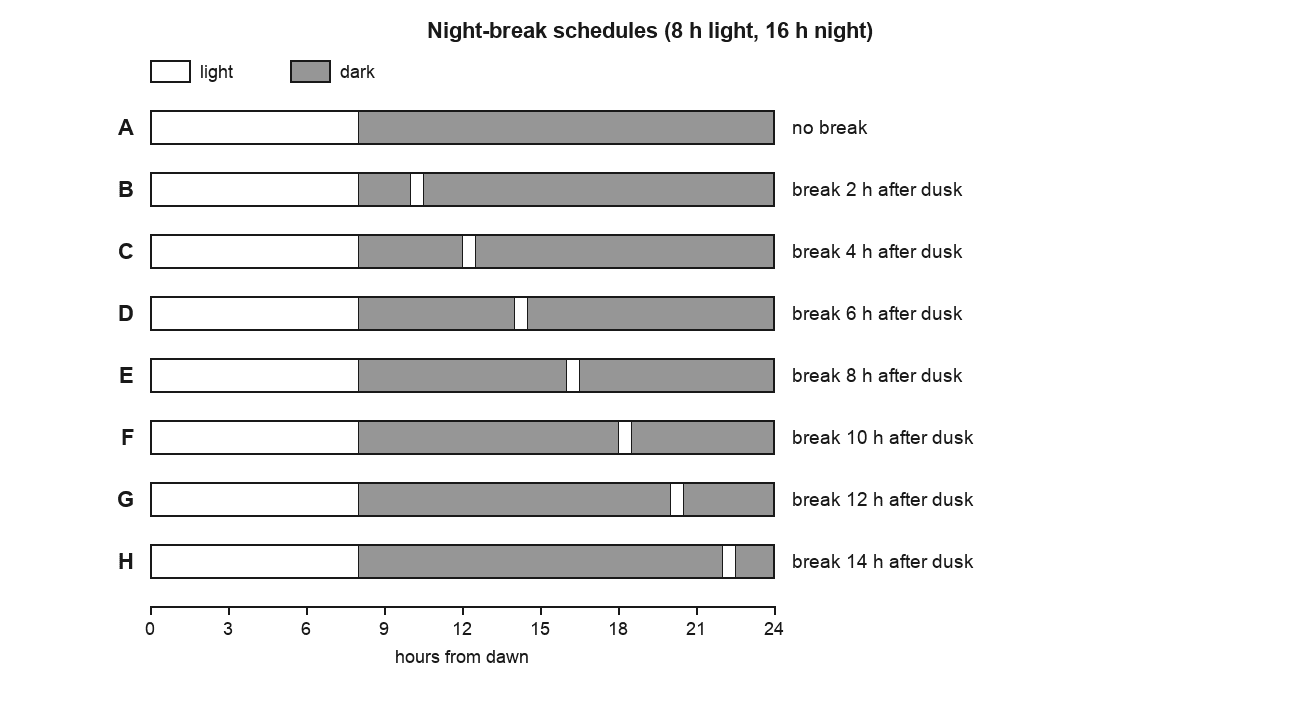
In a growth-room study at a plant-science centre in Hisar, ten plants of a short-day species were placed in each of the groups A to H. Every day had 8 hours of light and a 16-hour night. Group A had an unbroken night. In groups B to H the night was interrupted by 30 minutes of white light at a different time after dusk, as shown in the figure. The plants were checked after six weeks. (Hypothetical data.)
| Group | A | B | C | D | E | F | G | H |
|---|---|---|---|---|---|---|---|---|
| Plants flowering (out of 10) | 10 | 10 | 10 | 0 | 0 | 0 | 10 | 10 |
(a) For group C and group F, work out the two dark periods and state the longest uninterrupted dark period of each. (1 mark)
(b) Use all the results to state the limits within which the critical night length of this species must lie. (1 mark)
(c) A gardener says, "A night break works best when it falls in the middle of the night." Use the data to explain why. Then predict whether a 30-minute break 8 hours after dusk would stop flowering if the night were 20 hours long. (2 marks)