
Question 405 marksMedium
Which part of plant perceives light? Give experiments to demonstrate the same.
Confirming your payment
Sign up now and get 250 free tokens.
Photomorphogenesis in Plants · Question 40 of 41
Which part of plant perceives light? Give experiments to demonstrate the same.
Solution:
Concept: In photoperiodism the light stimulus is perceived by the leaves, not by the shoot tip. Experiments on the short-day plant cocklebur (Xanthium) proved this.
Step 1 — What is asked: We must name the part that perceives light and describe the experiments that show it.
Step 2 — Experiment A: A plant with its leaves exposed to inductive light (short days) flowers.
Step 3 — Experiment B: A plant with its leaves removed, kept in short days, does not flower, although its buds receive the inductive light.
Step 4 — Experiment C: A plant with only one-eighth of a leaf exposed to short days flowers. So even a small piece of leaf is enough to perceive the stimulus.
Step 5 — Experiment D: A plant with a single leaf given short days is grafted to another plant kept in long (non-inductive) days; both plants flower. So a stimulus passes from the leaf, through the graft, to the buds of the other plant.
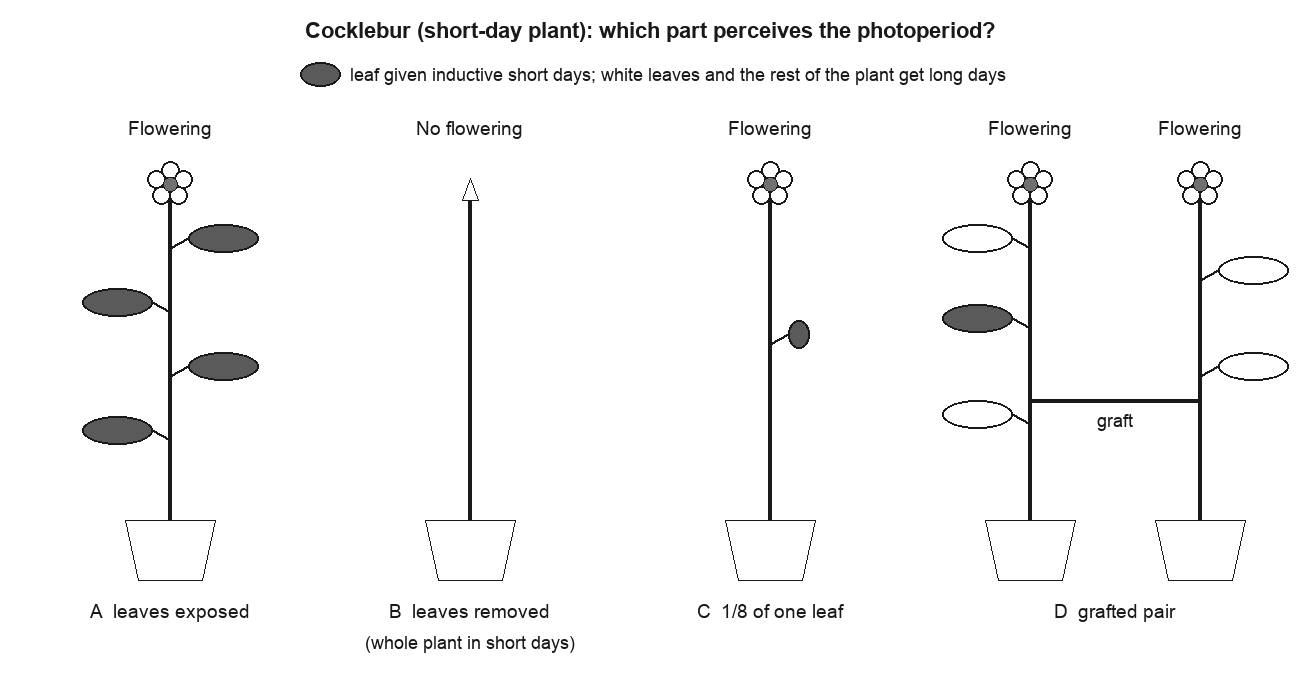
Step 6 — Conclusion: The leaves perceive the photoperiod and make a stimulus, florigen, which travels to the shoot apex and starts flowering. It is not species-specific. Work from 2005 to 2007 showed that it is mainly the FT protein, carried in the phloem.
Therefore, the leaves perceive the light stimulus, as shown by experiments A–D on cocklebur.