
Question 395 marksMedium
What is the role of phytochrome in flowering and seed germination?
Confirming your payment
Sign up now and get 250 free tokens.
Photomorphogenesis in Plants · Question 39 of 41
What is the role of phytochrome in flowering and seed germination?
Solution:
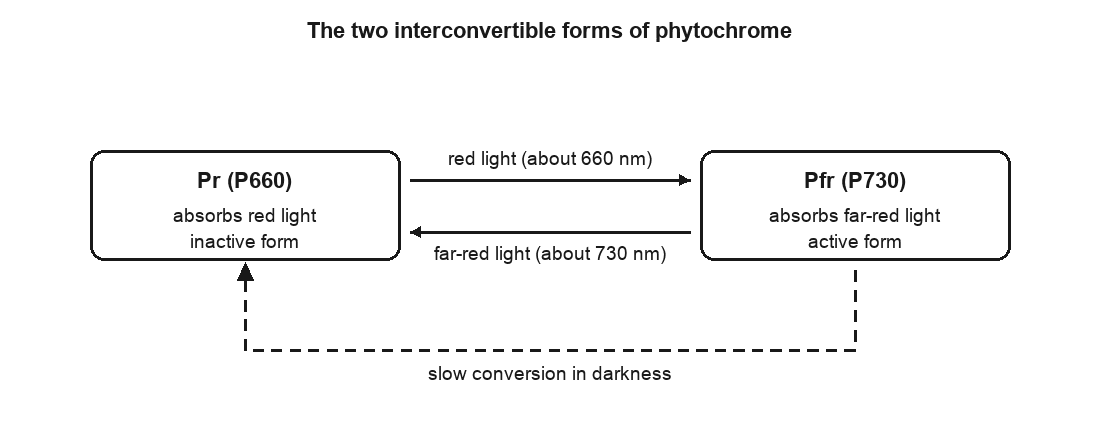
Concept: Phytochrome is a blue-green chromoprotein that exists in two interconvertible forms: Pr (absorbs red light, about 660 nm) and Pfr (absorbs far-red light, about 730 nm; the active form).
Step 1 — What is asked: We must explain how phytochrome controls flowering and seed germination.
Step 2 — The two forms: Red light converts Pr to Pfr; far-red light converts Pfr to Pr; in darkness Pfr slowly changes back to Pr. In daylight Pfr builds up because sunlight has more red than far-red light.
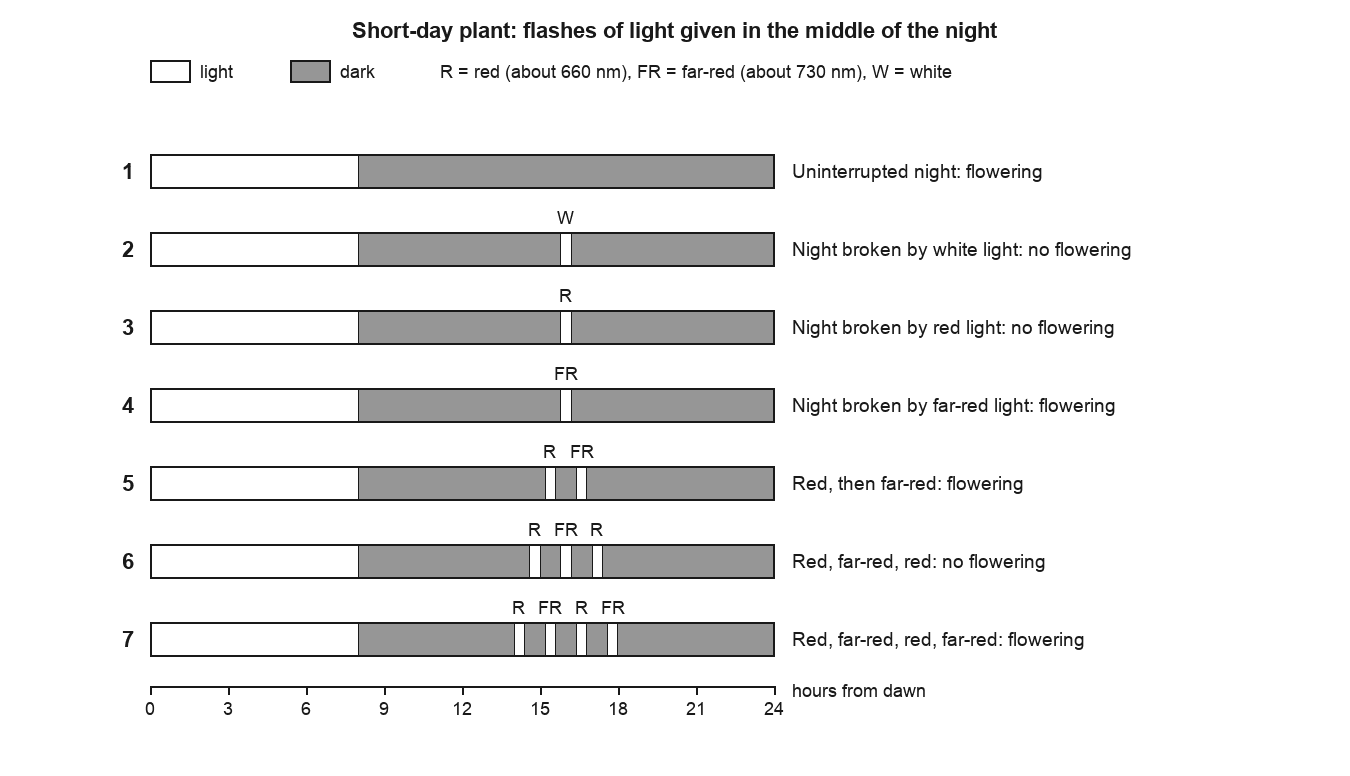
Step 3 — Flowering in short-day plants: A flash of red light in the middle of the long night forms Pfr and prevents flowering. A far-red flash given after it changes Pfr back to Pr and the plant flowers. The last flash decides the result.
Step 4 — Flowering in long-day plants: In long-day plants Pfr works the other way: a red flash in the night promotes flowering.
Step 5 — Seed germination: Light-sensitive seeds such as lettuce and tobacco germinate after red light (Pfr formed) and stay dormant after far-red light (Pfr removed). With alternate flashes the last one decides: R → germination, R + FR → none, R + FR + R → germination, R + FR + R + FR → none.
Step 6 — Other roles: Phytochrome also controls leaf growth, stem lengthening and branching, and the prevention of etiolation.
Therefore, phytochrome acts as a red/far-red light switch: Pfr formed by red light stops flowering in short-day plants and starts germination of light-sensitive seeds, and far-red light reverses both.