
Question 313 marksEasy
How does phytochrome affect seed germination? Explain.
Confirming your payment
Sign up now and get 250 free tokens.
Photomorphogenesis in Plants · Question 31 of 41
How does phytochrome affect seed germination? Explain.
Solution:
Concept: Light-sensitive seeds such as lettuce and tobacco germinate only after receiving some light, through the pigment phytochrome.
Step 1 — What is asked: We must explain how phytochrome controls the germination of seeds.
Step 2 — Red light: Red light (about 660 nm) converts Pr into Pfr, the active form, which promotes germination. Sunlight has more red than far-red light, so in daylight Pfr builds up and the seeds germinate.
Step 3 — Far-red light and darkness: Far-red light (about 730 nm) converts Pfr back into Pr, so the seeds stay dormant. In darkness Pfr slowly changes back to Pr.
Step 4 — Alternate flashes: When red and far-red flashes are given one after the other, the last one decides: R → germination, R + FR → no germination, R + FR + R → germination, R + FR + R + FR → no germination.
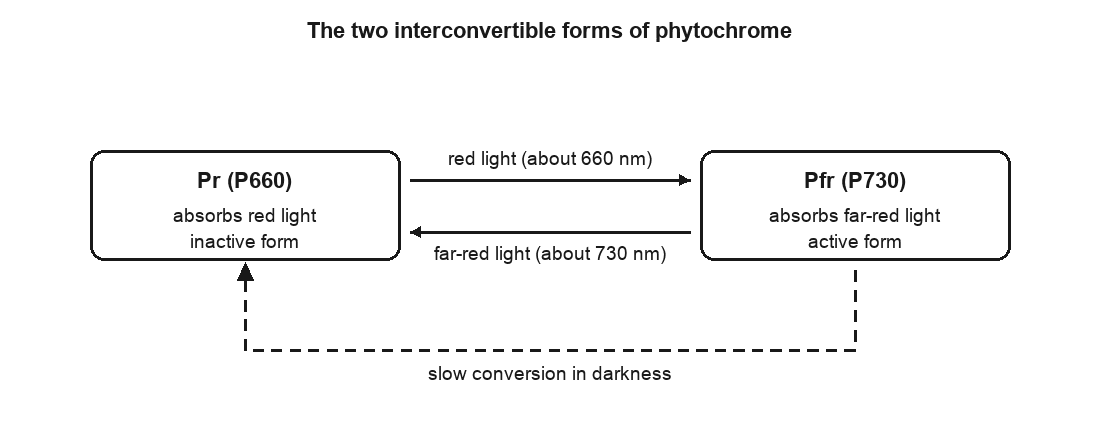
Therefore, red light forms Pfr and makes light-sensitive seeds germinate, far-red light reverses this, and the last light given decides the result.