
Opening your dashboard
Class 11 Biology Chapter 22 Photomorphogenesis in Plants: Practice Questions
80 questions on Chapter 22, each worked through on its own page with the AI tutor. Class 11 Biology, ICSE 2026-27.
80 questions
1–4 marks · Mixed difficulty
- 11 mark
Question 1
A grower near Delhi raises a chrysanthemum cultivar that flowers only when it gets an uninterrupted night longer than 11 hours. (Hypothetical data.) In mid-June Delhi has about 14 hours of daylight. Which treatment will make this crop flower in June?
- 23 marks
Question 2
The same chrysanthemum cultivar (it flowers only after an uninterrupted night longer than 11 hours) is grown in Delhi in mid-December, when the sun rises at about 07:12 and sets at about 17:30. (Hypothetical data.) The grower switches on lamps over the beds from 23:30 to 00:30 every night. The figure shows one day.
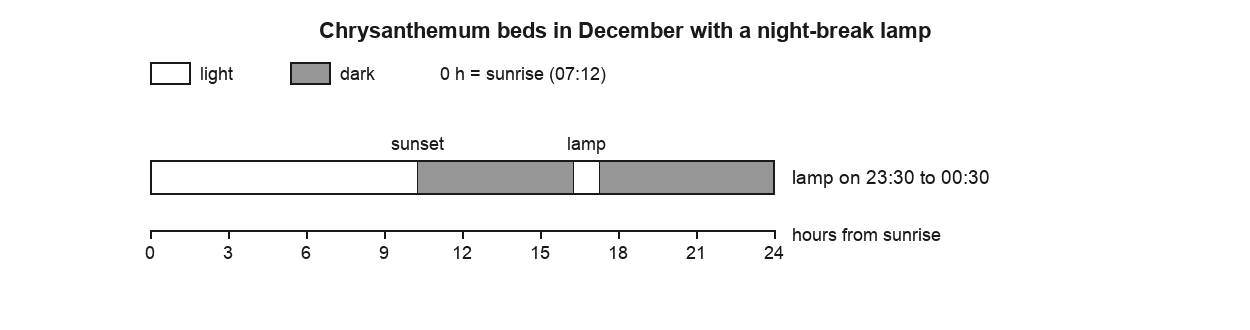
(a) Without the lamps, would the plants flower in December? Show the night length.
(b) Work out the two dark periods the plants get with the lamps, and predict the result.
(c) Why do growers use these lamps in December, and what happens once the lamps are switched off for good?
- 31 mark
Question 3
Approximate day lengths on 21 June are: Chennai (13° N) 12.9 h, Delhi (28.6° N) 14.0 h and Srinagar (34° N) 14.4 h. A long-day variety flowers only when the day is longer than 13.5 hours. (Hypothetical data.) In June, where will it flower without extra lighting?
- 42 marks
Question 4
In a study published in 1920, Garner and Allard reported that a tobacco variety called Maryland Mammoth grew very tall in the fields of Maryland (USA) all summer without flowering, yet plants of the same variety flowered when kept in a greenhouse in winter. Explain these observations and name the group of plants this variety belongs to.
- 51 mark
Question 5
At the equator the day is about 12 hours long all through the year. Which of these plants would flower there without any artificial lighting or shading?
- 63 marks
Question 6
Batches of a plant species were grown in rooms with different day lengths (each day = 24 hours) and observed for 10 weeks. (Hypothetical data.)
Day length (h) 8 10 12 14 16 Flowered? Yes Yes Yes No No (a) Is the plant short-day, long-day or day-neutral? Give a reason.
(b) Between which values must its critical night length lie?
(c) Predict the result for a 12-hour day whose 12-hour night is broken in the middle by 30 minutes of light.
- 73 marks
Question 7
A short-day plant with a critical night length of 10 hours was grown under light–dark cycles that were not 24 hours long. (Hypothetical data.)
Group Light (h) Dark (h) Length of one cycle (h) Flowered? 1 8 16 24 Yes 2 16 16 32 Yes 3 8 8 16 No 4 4 12 16 Yes (a) Which group shows that a long light period does not stop flowering? Explain.
(b) Which group shows that a short light period alone does not bring flowering? Explain.
(c) State what these results tell us about the factor that really controls flowering.
- 81 mark
Question 8
In winter a grower has spinach, a long-day plant, under 10.5 hours of daylight and 13.5 hours of night. This variety flowers only if no dark period is longer than 10 hours. (Hypothetical data.) Which change will make it flower?
- 92 marks
Question 9
A student says, "A short-day plant flowers whenever the days are short." The plant in question has a critical night length of 9 hours. (Hypothetical data.) Use two 24-hour schedules, one with a short day and one with a fairly long day, to show that the student's statement is misleading.
- 101 mark
Question 10
Plant X is a short-day plant with a critical night length of 9 hours. Plant Y is a long-day plant with a critical night length of 12 hours. (Hypothetical data.) The figure shows four daily schedules.
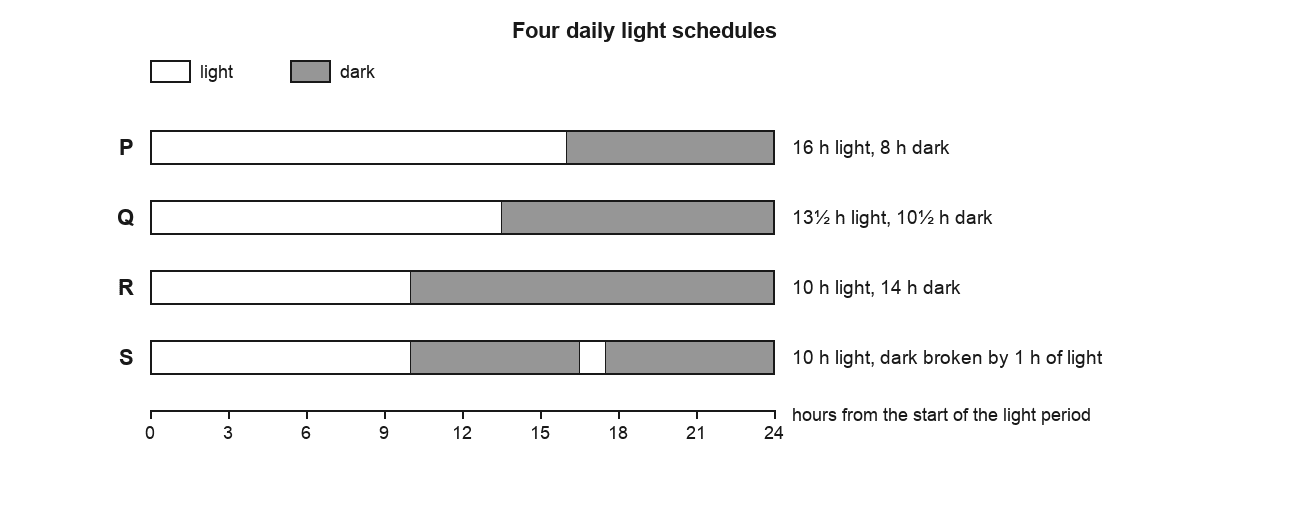
Under which schedule will both X and Y flower?
- 113 marks
Question 11
Tomato and soybean were sown at one farm in different months and the days from sowing to first flower were recorded. (Hypothetical data.)
Sowing month February May August November Tomato 60 58 61 59 Soybean 95 70 45 40 (a) Which crop is day-neutral? Give the evidence.
(b) Soybean is a short-day plant. Explain why it flowered fastest after August and November sowings.
(c) Which crop is easier to bring into flower on a fixed date throughout the year? Why?
- 122 marks
Question 12
A soybean variety bred for Jabalpur (about 23° N) is sown on the same June date at Ludhiana (about 31° N). Approximate day lengths are given below. At Ludhiana it flowers later and grows taller. Explain.
Date Jabalpur day length (h) Ludhiana day length (h) 15 July 13.4 14.0 15 August 13.0 13.3 - 134 marks
Question 13
A farmer in eastern India sows a traditional, photoperiod-sensitive rice variety in one field on 1 June and in another on 15 July. Both fields flower in mid-October.
(a) Why do both fields flower at about the same time?
(b) Which field is likely to give smaller plants and a lower yield? Why?
(c) What happens to day and night length between August and October in north and east India, and why does that suit this variety?
(d) Breeders have produced photoperiod-insensitive rice varieties that flower a fixed number of days after sowing. Give one advantage of these for farmers.
- 141 mark
Question 14
A short-day plant was kept in long days. In plant 1 only the shoot tip was covered every evening with a small light-tight cap, giving the tip long nights; the leaves stayed in long days. In plant 2 the leaves were covered every evening and the shoot tip was left uncovered. Plant 2 flowered and plant 1 did not. What does this show?
- 153 marks
Question 15
A short-day plant has two branches, B1 and B2, on a main stem, and the whole plant is kept in long days. One leaf on B1 is given long nights in a dark bag. A ring of bark (which removes the phloem) is then cut round B1 between this leaf and the main stem; B1 above the leaf is left intact. Only the apex of B1 flowers. In a control plant without the ring, both apices flower. Explain these results.
- 164 marks
Question 16
Plants of a short-day species R were kept in long days throughout. Each was grafted with a leafy shoot from a donor plant, as below. (Hypothetical data.)
Graft Donor shoot Donor kept in Did plant R flower? 1 Species R short days Yes 2 Species R long days No 3 another short-day species short days Yes 4 a long-day species long days Yes (a) Why was graft 2 included?
(b) What does graft 3 show?
(c) What does graft 4 show?
(d) Name the stimulus and state what it is now known to be.
- 171 mark
Question 17
The flowering stimulus called florigen was long thought to be a hormone that could never be isolated. Which statement describes what it is now known to be?
- 182 marks
Question 18
Cocklebur plants in long days were given one long night and then returned to long days. Their leaves were removed at different times after the end of that night. (Hypothetical data.)
Leaves removed after (h) 0 12 24 48 Plants that flowered (%) 0 30 80 100 Explain the trend.
- 191 mark
Question 19
At sunset most of the phytochrome in a leaf is in the Pfr form. What is the state of the leaf's phytochrome at the end of a long, uninterrupted night?
- 203 marks
Question 20
Soaked lettuce seeds were given short flashes of red (R) and far-red (FR) light in the sequences shown, each flash following the last within a few minutes, and then kept in darkness. (Hypothetical data.)
Batch Treatment Germination (%) 1 darkness only 8 2 FR ? 3 FR, R ? 4 R, FR, R, FR, R ? (a) Predict whether germination will be high or low in batches 2, 3 and 4, with reasons.
(b) Light-requiring seeds like lettuce are usually small. Suggest why a light requirement suits a small seed.
- 211 mark
Question 21
In a long winter night, one hour of red light given in the middle of the night makes a long-day plant flower. How does the red light act?
- 223 marks
Question 22
Short-day plants under long nights were given a brief night break of equal energy at different wavelengths. (Hypothetical data.)
Wavelength (nm) 450 (blue) 550 (green) 660 (red) 730 (far-red) Fall in flowering (%) 25 10 95 0 (a) Which wavelength works best, and which form of which pigment absorbs it?
(b) Why did the 730 nm break cause no fall in flowering?
(c) Which form of the pigment does an effective night break leave in the leaves, and what does that form do in a short-day plant?
- 231 mark
Question 23
Light-requiring lettuce seeds sown 3 cm deep in moist, warm soil did not germinate, while those pressed onto the surface of the same soil germinated well. What is the best explanation?
- 242 marks
Question 24
A flash of white light in the middle of the night stops a short-day plant from flowering, just as a red flash does. White light contains far-red as well as red. Explain why the white flash still acts like red light.
- 253 marks
Question 25
Draw a labelled diagram of a flowering plant to show where the photoperiod is perceived, the route taken by the flowering stimulus, and where the stimulus acts. Write one line about each label.
- 261 mark
Question 26
A winter variety of wheat, normally sown in autumn, was sown in spring in a cold country by mistake. The plants grew well but stayed leafy and did not flower that season. What is the best explanation?
- 273 marks
Question 27
Soaked seeds of a winter cereal were kept at 4 °C for different numbers of weeks and then sown together in warm conditions. (Hypothetical data.)
Weeks at 4 °C 0 2 4 6 8 10 Days from sowing to flowering 150 118 86 68 62 62 (a) Describe the effect of the length of cold treatment.
(b) How many days earlier did the 8-week plants flower than the untreated plants?
(c) What length of treatment would you advise a seed farm to use? Give a reason.
- 281 mark
Question 28
In a cold-requiring rosette plant kept in a warm room, only the shoot tip was chilled with a fine cold-water coil for several weeks: the plant flowered. In another plant only the leaves were chilled while the shoot tip stayed warm: it did not flower. What does this show?
- 292 marks
Question 29
Cabbage is a biennial. In the plains of India cabbage heads are grown and harvested in winter, but the seed of cabbage is mostly produced in hill areas such as the Kullu valley. Explain why.
- 303 marks
Question 30
Soaked seeds of a cold-requiring variety were treated as below and then sown together. (Hypothetical data.)
Lot Treatment before sowing Days to flowering 1 none 140 2 6 weeks at 4 °C 70 3 6 weeks at 4 °C, then at once 3 days at 35 °C 135 4 6 weeks at 4 °C, then 3 weeks at 20 °C, then 3 days at 35 °C 72 (a) What name is given to the effect seen in lot 3?
(b) Why did the same 35 °C treatment have almost no effect in lot 4?
(c) What should a farmer who has bought vernalised seed avoid before sowing it?
- 311 mark
Question 31
A grower wants a cold-requiring biennial rosette plant to flower in its first year but has no cold store. In some such plants, which treatment can take the place of the cold?
- 322 marks
Question 32
A student writes: "Chilled plants make a hormone called vernalin, which travels to the shoot apex and makes the plant flower." Point out two problems with this statement and give the better explanation.
- 331 mark
Question 33
A seed company is choosing a wheat variety for a region where winter night temperatures rarely fall below 15 °C. Which choice is most suitable?
- 343 marks
Question 34
Describe how a farmer could vernalise seeds of a winter cereal before a spring sowing. Explain why the seeds must be soaked first, and describe a control that would show whether the treatment worked.
- 351 mark
Question 35
In a cold country a winter variety of wheat is sown in autumn and flowers in late spring. Which sequence best explains the timing of its flowering?
- 362 marks
Question 36
Sugar beet is a biennial grown for the sugar stored in its swollen root. When it is sown very early in a cold spring, some plants "bolt" (send up a flowering stem) in their first season, and their roots become woody and low in sugar. Explain this and give one piece of advice to farmers.
- 372 marks
Question 37
Two varieties were grown with and without a cold treatment of 8 weeks at 4 °C. (Hypothetical data.)
Variety Days to flowering with cold Days to flowering without cold P 70 140 Q 75 did not flower in 240 days Compare the cold requirement of the two varieties, and say which one could still give a crop in a region with warm winters.
- 383 marks
Question 38
Young plants of a cold-requiring biennial were kept at different temperatures for 8 weeks and then grown in warm, long days. The percentage of plants that flowered is shown. (Hypothetical data.)
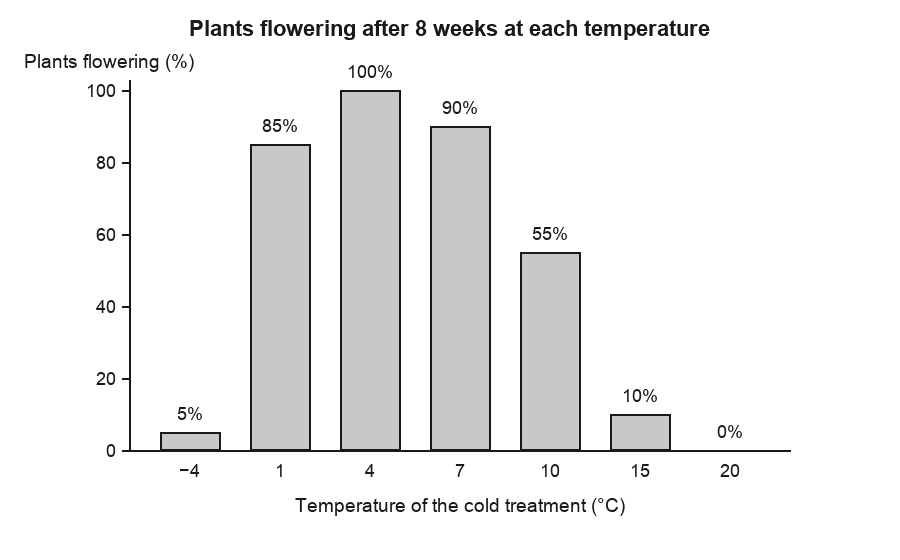
(a) Over what range of temperature was the treatment most effective?
(b) Suggest why the treatment at −4 °C was poor.
(c) Why did no plant flower after the 20 °C treatment?
- 392 marks
Question 39
Many plants that live in cold-winter regions will not flower until they have passed through a winter. Explain how this requirement helps such plants to survive and reproduce.
- 403 marks
Question 40
A biennial species K needs both a cold period and long days to flower. (Hypothetical data.)
Group Treatment Result A no cold; then warm, long days no flowers in 240 days B 8 weeks of cold; then warm, long days flowered after 5 weeks C 8 weeks of cold; then 12 weeks warm, short days; then warm, long days flowered 5 weeks after the long days began D seeds from group B plants, sown with no cold; then warm, long days no flowers in 240 days (a) What do groups A and B show?
(b) What does group C show about the effect of the cold?
(c) What does group D show?
- 411 mark
Question 41
Farmers have noticed that rice plants growing right next to bright street lamps flower late, or not at all, while the rest of the field flowers normally in autumn. Why?
- 422 marks
Question 42
Wheat in north India is sown in November. At Delhi the day lasts about 10.5 hours in mid-January, 11.2 hours in mid-February and 11.9 hours in mid-March. Wheat is a long-day plant. Use these figures to explain why the crop comes into ear and flowers in February–March rather than in December–January.
- 433 marks
Question 43
Two short-day species, M and N, kept in long days, were given different numbers of inductive cycles (short day + long night) and then returned to long days. (Hypothetical data.)
Number of inductive cycles 1 2 4 8 M: plants flowering (%) 100 100 100 100 N: plants flowering (%) 0 0 40 100 (a) Compare the two species.
(b) The plants flowered even though they were back in long days. What does this tell you?
(c) Which species is more convenient for an experiment on when the flowering stimulus leaves the leaf? Why?
- 441 mark
Question 44
Approximate day lengths at Delhi on the 15th of some months are given below. A chrysanthemum cultivar sown in April needs uninterrupted nights longer than 12 hours to flower. (Hypothetical data.)
Date 15 Aug 15 Sep 15 Oct 15 Dec Day length (h) 13.2 12.4 11.5 10.3 Which is the earliest of these dates on which the night is already longer than 12 hours?
- 451 mark
Question 45
A chrysanthemum crop (a short-day plant) flowered on its usual date in a year when October had many heavily overcast days. Why did the cloudy weather not change the flowering date?
- 462 marks
Question 46
A plant sown in October flowered in December, when the days in north India are short. A student concludes that it must be a short-day plant. Why is this conclusion unsafe, and how could the plant's type be found?
- 471 mark
Question 47
Light-requiring seeds of a weed lie on the soil surface under a dense crop canopy. They do not germinate in daytime shade, but germinate within days once the crop is harvested. What is the best explanation?
- 481 mark
Question 48
In a laboratory, soaked light-sensitive seeds are handled under a dim green safelight while they are being set out for an experiment. Why is green light used?
- 492 marks
Question 49
A long-day plant that grows as a flat rosette of leaves stays as a rosette when kept in short days. When the rosettes are sprayed with gibberellin, still in short days, the stem lengthens (bolts) and the plant flowers.
(a) What requirement has the gibberellin replaced?
(b) Why does this result not show that gibberellin is florigen?
- 503 marks
Question 50
Phytochrome takes part in three responses: (1) germination of lettuce seeds, (2) flowering of a short-day plant given a night break, (3) flowering of a long-day plant given a night break.
(a) Which form of phytochrome does a red flash produce in each case?
(b) State the effect of that form in each of the three responses.
(c) How can one pigment have opposite effects on flowering in short-day and long-day plants?
- 511 mark
Question 51
Two sets of plants were grown. One at 12 hours day and 12 hours night period cycles and it flowered, while in the other set, night phase was interrupted by flash of light and it did not produce flower. Under which one of the following categories will you place these plants?
- 521 mark
Question 52
Photoperiodism is due to hormone
- 531 mark
Question 53
Induction of flowering by low temperature treatment is called
- 541 mark
Question 54
The flowering hormone 'Florigen' is perceived by
- 551 mark
Question 55
What is not critical for flowering in a short-day plant?
- 561 mark
Question 56
What is true of vernalisation?
- 571 mark
Question 57
Vernalisation is done at
- 581 mark
Question 58
The wavelength of light absorbed by Pr form of phytochrome is
- 591 mark
Question 59
Which of the following is a long-day plant
(A) Lactuca
(B) Pisum
(C) Cucumis
(D) Avena
- 601 mark
Question 60
An example of a short day plant is
- 611 mark
Question 61
Plants requiring exposure to light for less than the critical period in order to flower are called
- 621 mark
Question 62
The practice of subjecting seeds to low temperatures for a short period of time to induce flowering is known as ____________.
- 631 mark
Question 63
If the dark period is interrupted by flashes of light ____________ plant will not flower.
- 641 mark
Question 64
In a long day plant if the short night is interrupted by flashes of light, it will ____________.
- 651 mark
Question 65
The plants that flower during winter are ____________ plants and the ones that flower during summer are ____________ plants.
- 661 mark
Question 66
Vernalisation is perceived by ____________ part of a mature plant.
- 671 mark
Question 67
A long-day plant will not flower, if the long days are interrupted by flashes of light.
- 681 mark
Question 68
The flowering hormone florigen is perceived by the apical bud of a plant.
- 691 mark
Question 69
Short-day plants flower during the winter season.
- 701 mark
Question 70
During vernalisation the cold stimulus is perceived by the young leaves of a plant.
- 711 mark
Question 71
The blue-green pigment phytochrome is proteinaceous in nature.
- 721 mark
Question 72
Plants that require uninterrupted long nights and short days for flowering.
- 731 mark
Question 73
The flowering hormone that is perceived by the leaves.
- 741 mark
Question 74
Response of a plant to changing lengths of day and night for flowering.
- 751 mark
Question 75
Minimum photoperiod or day length needed for a plant to flower.
- 761 mark
Question 76
Assertion (A): Dark period plays more important role in flowering than light period.
Reason (R): Flowering occurs in short-day plant, if the dark period is interrupted by light break.
- 771 mark
Question 77
Assertion (A): Vernalisation is initiation of flowering by exposing a plant to low temperature.
Reason (R): The cold stimulus is perceived by the shoot apex of mature plants.
- 781 mark
Question 78
Assertion (A): The flowering in plants is perceived by a plant hormone florigen.
Reason (R): Active form of florigen directly induces floral induction in shoot buds.
- 791 mark
Question 79
Assertion (A): Vernalisation can be transmitted to another untreated plant by grafting it with the cold treated twig.
Reason (R): Vernalisation leads to increased gibberellin levels.
- 801 mark
Question 80
Assertion (A): Short night is critical for flowering in a long-day plant.
Reason (R): Flowering gets inhibited by the interruption in the dark period.