
Question 273 marksEasy
What is the effect of quality of light, i.e., red and far-red light on flowering in short-day plants? If red and far-red lights are given, how do they affect flowering in plants?
Confirming your payment
Sign up now and get 250 free tokens.
Photomorphogenesis in Plants · Question 27 of 41
What is the effect of quality of light, i.e., red and far-red light on flowering in short-day plants? If red and far-red lights are given, how do they affect flowering in plants?
Solution:
Concept: Flowering is controlled by phytochrome. Red light (about 660 nm) changes Pr into the active form Pfr; far-red light (about 730 nm) changes Pfr back into Pr.
Step 1 — What is asked: We must explain how red and far-red flashes in the night affect a short-day plant, and what happens when both are given.
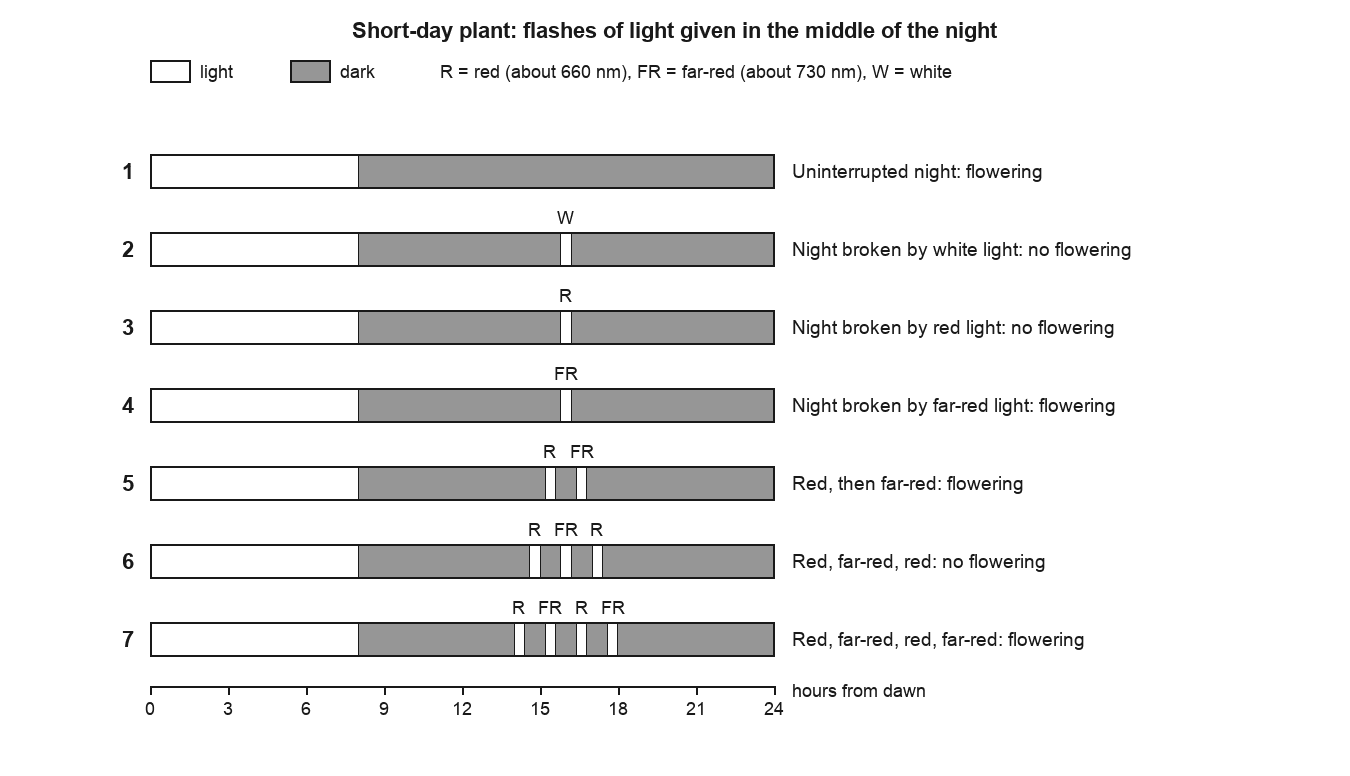
Step 2 — Red light: A flash of red light in the middle of the long night forms Pfr, which inhibits flowering in a short-day plant, so the plant does not flower (white light acts the same way because it is rich in red).
Step 3 — Far-red light: A flash of far-red light given after the red flash converts Pfr back to Pr, so the inhibition is removed and the plant flowers.
Step 4 — Both given alternately: When red and far-red flashes are given one after the other, the last flash decides: R → FR gives flowering, R → FR → R gives no flowering. The figure shows the results.
Note: In a long-day plant the effect is opposite: a red flash in the night (forming Pfr) promotes flowering.
Therefore, red light in the night prevents flowering in a short-day plant, far-red light reverses it, and when both are given the last one decides the result.