
Question 375 marksMedium
Explain the effect of following on a long-day plant
(i) Long-day and short night
(ii) Short-day and long night
(iii) Long-day and interrupted short night
(iv) Interrupted long day and short night.
Confirming your payment
Sign up now and get 250 free tokens.
Photomorphogenesis in Plants · Question 37 of 41
Explain the effect of following on a long-day plant
(i) Long-day and short night
(ii) Short-day and long night
(iii) Long-day and interrupted short night
(iv) Interrupted long day and short night.
Solution:
Concept: A long-day plant is really a short-night plant: it flowers when the dark period is shorter than a critical length, and it does not need an uninterrupted night.
Step 1 — What is asked: We must explain whether a long-day plant flowers under four light–dark schedules.
Step 2 — Part (i), long day and short night: The night is shorter than the critical length, so the plant flowers.
Step 3 — Part (ii), short day and long night: The long night is longer than the critical length, so the plant does not flower.
Step 4 — Part (iii), long day and interrupted short night: Flashes of light in the night only shorten the dark period further, so the plant flowers.
Step 5 — Part (iv), interrupted long day and short night: Brief dark periods in the day do not stop flowering, because the night remains short, so the plant flowers.
Step 6 — Draw the comparison: The four schedules are shown as 24-hour bars.
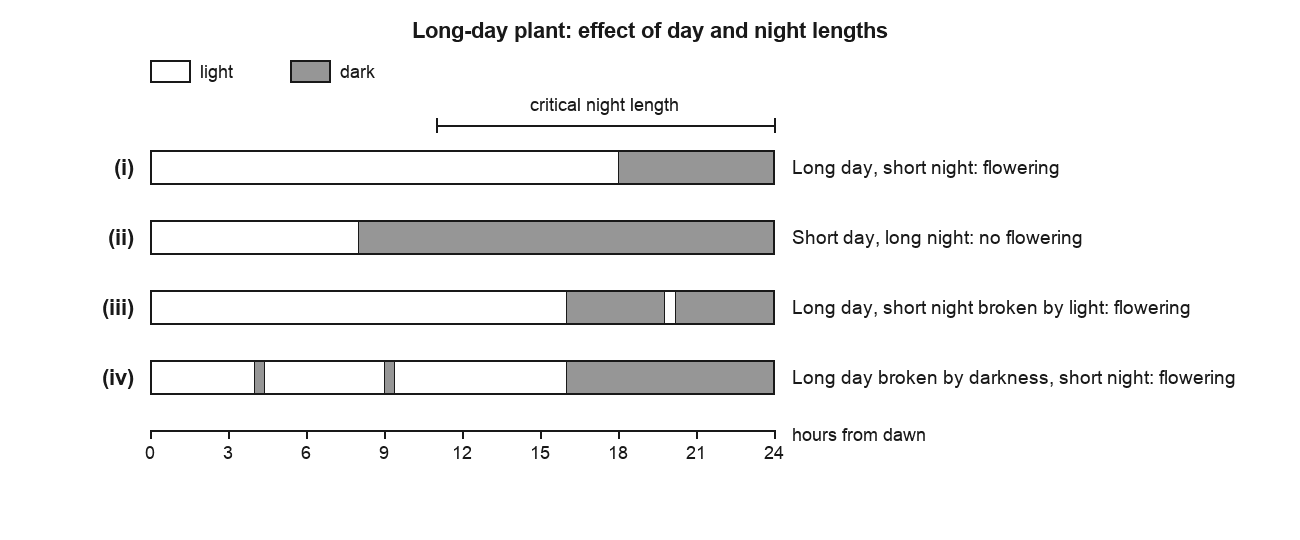
Step 7 — Conclusion: Long-day plants, such as wheat, spinach and radish, flower in summer when nights are short.
Therefore, the long-day plant flowers in (i), (iii) and (iv), and does not flower in (ii).