
Opening your dashboard
Class 11 Biology Chapter 18: Photosynthesis in Higher Plants Solutions
84 textbook questions with step-by-step answers, free to read, for ISC 2026-27.
Get talked through Ch 18, not just shown the answer
Reading a finished solution is not the same as being able to do it. The AI tutor takes one question at a time and works it with you, in your own words, until you can.
- Ask it out loud, in your own words
- It gives you the next step, not the answer
- Stuck on part (ii)? Start there
84 questions with solutions
1–5 marks · Mixed difficulty
- 11 mark
Question 1
What is the source of oxygen released during photosynthesis?
Solve with AIWritten solution
Solution:
Key idea: In photosynthesis, light energy is used to split water molecules in the thylakoids (photolysis). The oxygen atoms of the split water join in pairs and leave the leaf as oxygen gas (O₂), while carbon dioxide supplies the carbon of the sugar.
Step 1 — Write the balanced equation.
The overall equation is written with 12 molecules of water, so that the oxygen given out and the water formed can both be traced:
Step 2 — Use the labelling evidence.
In 1941 Samuel Ruben and Martin Kamen, with co-workers, gave the green alga Chlorella water labelled with the heavy oxygen isotope ¹⁸O. The oxygen gas given out carried the ¹⁸O label, so it came from water and not from CO₂. The labelled equation shows where the ¹⁸O ends up:
Step 3 — Name the process that releases it.
The water is split by light at photosystem II in the light reaction. This photolysis of water gives oxygen gas, hydrogen ions and electrons:
Therefore, the oxygen released in photosynthesis comes from water (H₂O), split by light in the photolysis of water.
- 21 mark
Question 2
Who demonstrated the photolysis of water by isolated chloroplasts?
Solve with AIWritten solution
Solution:
Key idea: Photolysis is the splitting of water by light. Chloroplasts taken out of their cells can still split water and give out oxygen when they are lit, provided a substance is present that accepts the electrons removed from water.
Step 1 — Recall the experiment.
In 1937 the British biochemist Robert (Robin) Hill lit chloroplasts isolated from leaves in a solution containing an artificial electron acceptor, a ferric (Fe³⁺) salt. The chloroplasts gave out oxygen, and the acceptor was reduced to the ferrous (Fe²⁺) form. Later workers often used other acceptors, such as ferricyanide.
Step 2 — See why this shows photolysis.
No CO₂ was supplied and no sugar was made, yet oxygen was released. So the oxygen could not have come from CO₂; it came from water split by light, and the electrons passed to the acceptor. With a ferric salt as the acceptor, the reaction is:
Step 3 — Name the reaction.
This release of oxygen by isolated chloroplasts in light, with an artificial acceptor taking the electrons, is called the Hill reaction.
Therefore, Robert (Robin) Hill demonstrated the photolysis of water by isolated chloroplasts in 1937 (the Hill reaction).
- 31 mark
Question 3
What are thylakoids? What is their function?
Solve with AIWritten solution
Solution:
Key idea: A chloroplast has an outer and an inner envelope membrane around a fluid called the stroma. Inside the stroma lies a third set of membranes, the thylakoids, which carries the machinery of the light reaction.
Step 1 — Describe the thylakoids.
Thylakoids are flattened, membrane-bound sacs lying in the stroma of the chloroplast. Each one encloses a fluid-filled space called the lumen. In many places they are stacked like coins to form grana, and the grana are joined by unstacked stroma lamellae.
Step 2 — Name what their membranes hold.
The thylakoid membranes carry the chlorophylls and carotenoids, grouped into photosystems I and II, together with the electron transport chain and ATP synthase.
Step 3 — State their function.
Because these parts sit in the thylakoid membranes, the light reaction takes place there: light is absorbed, water is split to release O₂, and ATP and NADPH are made. Protons pumped into the lumen build up the gradient that drives ATP synthase. The ATP and NADPH are released into the stroma, where the Calvin cycle uses them.
Therefore, thylakoids are flattened membrane sacs in the stroma of the chloroplast; they hold the pigments, photosystems, electron carriers and ATP synthase, and are the site of the light reaction that makes ATP, NADPH and O₂.
- 41 mark
Question 4
What are grana? Where are they present?
Solve with AIWritten solution
Solution:
Key idea: The thylakoids of a chloroplast are not spread evenly through the stroma. In many places they lie piled one above another, and each pile is called a granum (plural: grana).
Step 1 — Describe a granum.
A granum is a stack of disc-shaped thylakoids lying one above another like a pile of coins. Neighbouring grana are joined by unstacked membranes called stroma (intergranal) lamellae.
Step 2 — State where grana are found.
Grana lie in the stroma of the chloroplast, inside its double envelope. Chloroplasts with many grana occur mainly in the mesophyll cells of green leaves. In some C₄ plants, such as maize, the bundle sheath chloroplasts have few or no grana.
Step 3 — Link the grana to their role.
The stacked membranes of the grana hold most of the photosystem II and much of the light-harvesting pigment, so grana are a main site of the light reaction.
Therefore, grana are stacks of thylakoids, and they are present in the stroma of chloroplasts.
- 51 mark
Question 5
Name the photosynthetic pigments present in higher plants.
Solve with AIWritten solution
Solution:
Key idea: Photosynthetic pigments are coloured substances in the thylakoid membranes that absorb light. One pigment changes light energy into chemical energy; the others, the accessory pigments, widen the range of light absorbed and pass the energy on.
Step 1 — Name the main pigment.
Chlorophyll a (blue-green) is the main pigment. A special chlorophyll a forms the reaction centre of each photosystem, where light energy is changed into chemical energy.
Step 2 — Name the accessory pigments.
Higher plants also have chlorophyll b (yellow-green) and the carotenoids. The carotenoids are of two kinds: carotenes (orange, such as β-carotene) and xanthophylls (yellow). They absorb light that chlorophyll a absorbs poorly and pass the energy on to chlorophyll a; the carotenoids also protect chlorophyll from damage in very bright light.
Therefore, the photosynthetic pigments of higher plants are chlorophyll a, chlorophyll b, carotenes and xanthophylls.
- 61 mark
Question 6
Which molecule acts as a reaction centre?
Solve with AIWritten solution
Solution:
Key idea: A photosystem has a light-harvesting complex (antenna) of a few hundred pigment molecules and one reaction centre. The antenna pigments absorb light and pass the energy inward; only the reaction centre uses it to give away an electron.
Step 1 — Name the reaction-centre pigment.
The reaction centre is a special form of chlorophyll a. In photosystem II it is P680, and in photosystem I it is P700; the numbers are the wavelengths (in nm) of red light that each absorbs best.
Step 2 — Say what it does.
When the energy collected by the antenna reaches the reaction centre, its chlorophyll a is excited and gives away an electron to an acceptor. This changes light energy into chemical energy and starts the flow of electrons.
Note: The textbook describes the reaction centre as one chlorophyll a molecule; structurally, each reaction centre (P680, P700) is now known to be a special pair of chlorophyll a molecules.
Therefore, a special chlorophyll a acts as the reaction centre: P680 in photosystem II and P700 in photosystem I.
- 71 mark
Question 7
Give one structural difference between chlorophyll a and chlorophyll b.
Solve with AIWritten solution
Solution:
Key idea: Chlorophyll a and chlorophyll b have the same basic structure: a flat porphyrin-type head with a magnesium atom at its centre, and a long phytol tail. They differ in one side group on the head.
Step 1 — Compare the side group on ring II.
On ring II of the head, chlorophyll a carries a methyl group (–CH₃), while chlorophyll b carries an aldehyde group (–CHO) in the same position.
Step 2 — See how this changes the formulas.
Replacing –CH₃ by –CHO takes away two hydrogen atoms and adds one oxygen atom, so the molecular formulas differ:
Step 3 — Note the effect of the change.
This one change shifts the light each pigment absorbs, so chlorophyll a looks blue-green and chlorophyll b looks yellow-green.
Therefore, chlorophyll a has a methyl group (–CH₃) on ring II where chlorophyll b has an aldehyde group (–CHO).
- 81 mark
Question 8
Name the pigments that appear to be yellow orange or red in colour.
Solve with AIWritten solution
Solution:
Key idea: Besides the green chlorophylls, chloroplasts hold a second group of pigments whose colours range from yellow to orange-red. In a green leaf the chlorophylls usually hide them.
Step 1 — Name the pigment group.
The yellow, orange or red pigments are the carotenoids. They are of two kinds: carotenes, which are orange to red (β-carotene is orange, lycopene in tomatoes is red), and xanthophylls, which are yellow.
Step 2 — Explain their colour.
Carotenoids absorb mainly violet, blue and blue-green light (about 400–500 nm) and reflect yellow, orange and red light, so they look yellow to red.
Step 3 — Show when the colour is seen.
When the chlorophyll of an ageing leaf breaks down, the carotenoids are left behind, so the leaf turns yellow or orange.
Therefore, the pigments that appear yellow, orange or red are the carotenoids: carotenes and xanthophylls.
- 91 mark
Question 9
Name the region of light that the carotenoids absorb.
Solve with AIWritten solution
Solution:
Key idea: A pigment looks the colour of the light it reflects, not the light it absorbs. Carotenoids look yellow to orange, so they absorb the colours at the blue end of the visible spectrum.
Step 1 — Name the region absorbed.
Carotenoids absorb mainly in the blue-violet region of the spectrum (about 400–500 nm). They reflect yellow, orange and red light.
Step 2 — Say what happens to the energy.
The energy they absorb is passed on to chlorophyll a. In this way carotenoids let the plant use light between about 450 and 500 nm, which the chlorophylls absorb less well, and they also protect chlorophyll from damage in very bright light.
Therefore, carotenoids absorb the blue-violet region of light (about 400–500 nm).
- 101 mark
Question 10
From which region does chlorophyll a absorb the light?
Solve with AIWritten solution
Solution:
Key idea: An absorption spectrum shows how strongly a pigment absorbs each wavelength of light. The absorption spectrum of chlorophyll a has two main peaks in the visible range.
Step 1 — Locate the peaks.
Chlorophyll a absorbs most strongly in the violet-blue region (peak near 430 nm) and in the red region (peak near 660 nm) of the visible spectrum.
Step 2 — Explain its colour.
It absorbs green and yellow-green light (about 500–600 nm) least. More of this light than any other colour is reflected or passes through, which is why chlorophyll a, and the leaves that contain it, look green.
Therefore, chlorophyll a absorbs light mainly from the violet-blue and red regions of the spectrum.
- 111 mark
Question 11
Does the absorption spectrum have any correlation to the action spectrum?
Solve with AIWritten solution
Solution:
Key idea: An absorption spectrum shows how much light of each wavelength a pigment absorbs. An action spectrum shows how fast photosynthesis goes at each wavelength.
Step 1 — Compare the peaks.
Yes, the two are closely related. The action spectrum of photosynthesis has its peaks in the blue and red regions, just where the absorption spectra of chlorophyll a and b have their peaks, and both dip in the green region.
Step 2 — Explain what the match shows.
Light that the chlorophylls absorb is the light that drives photosynthesis, so the chlorophylls are the main photosynthetic pigments. Engelmann first showed this in 1882: oxygen-seeking bacteria gathered along a filament of the alga Cladophora at the parts lit by blue and red light, where most O₂ was being released.
Step 3 — Note where they differ.
The two curves do not match exactly. The action spectrum is a little broader, especially in the blue-green region, because carotenoids absorb there and pass the energy on to chlorophyll a.
Therefore, yes: the action spectrum closely follows the absorption spectrum of chlorophyll a and b, which shows that light absorbed by the chlorophylls drives photosynthesis.
- 121 mark
Question 12
In which part of the chloroplast does light reaction occur?
Solve with AIWritten solution
Solution:
Key idea: The pigments, photosystems and electron carriers of the light reaction are built into membranes, not dissolved in the stroma. The enzymes of the Calvin cycle, by contrast, are in the stroma.
Step 1 — Name the site.
The light reaction takes place on the thylakoid membranes of the chloroplast. Water is split on the lumen side of the membrane, and ATP and NADPH are released into the stroma.
Step 2 — Say how the work is shared.
Photosystem II lies mainly in the stacked thylakoids of the grana, while photosystem I and ATP synthase lie mainly in the unstacked stroma lamellae and at the edges of the grana. Non-cyclic electron flow needs both photosystems; cyclic photophosphorylation uses only photosystem I, so it can run in the stroma lamellae.
Therefore, the light reaction occurs in the thylakoid membranes of the chloroplast (the grana and the stroma lamellae).
- 131 mark
Question 13
Which phase of photosynthesis, light or dark reaction is called biosynthetic phase?
Solve with AIWritten solution
Solution:
Concept: Photosynthesis has a light reaction that makes ATP and NADPH and a second phase that uses them to build sugars.
Step 1 — What is asked: We need the phase in which sugars are built.
Step 2 — The answer: The dark reaction (Calvin cycle, carbon reactions) builds carbohydrates from CO₂ using ATP and NADPH, so it is called the biosynthetic phase.
Therefore, the dark reaction is the biosynthetic phase.
- 141 mark
Question 14
Does dark reaction occur at night in the leaves?
Solve with AIWritten solution
Solution:
Concept: The 'dark' reaction does not use light directly, but it needs the ATP and NADPH made by the light reaction.
Step 1 — What is asked: We need to say whether the Calvin cycle runs during the night.
Step 2 — The reason: The Calvin cycle needs a steady supply of ATP and NADPH, which are made only in light, and several of its enzymes (including RuBisCO) are switched on in light. In darkness it continues only for a short time until the stored ATP and NADPH are used up.
Step 3 — The answer: So the dark reaction normally runs in the daytime, alongside the light reaction, even though it does not itself need light.
Therefore, no: the dark reaction does not continue through the night; it takes place in the daytime.
- 151 mark
Question 15
Dark reaction does not need light, then why does dark reaction not take place at night?
Solve with AIWritten solution
Solution:
Concept: The dark reaction is light-independent only in the sense that light is not absorbed in it.
Step 1 — What is asked: We need the reason the Calvin cycle stops at night.
Step 2 — The reason: It depends on the products of the light reaction — ATP and NADPH. At night no light reaction runs, so no new ATP and NADPH are made; the small stock is used up within minutes. Its key enzymes are also activated by light, so they slow down in the dark.
Therefore, the dark reaction stops at night because ATP and NADPH from the light reaction are not available.
- 161 mark
Question 16
Under which condition, does chlorophyll a molecule change from the ground state to the excited state?
Solve with AIWritten solution
Solution:
Concept: A molecule is excited when one of its electrons is lifted to a higher energy level.
Step 1 — What is asked: We need the condition that excites chlorophyll a.
Step 2 — The answer: When chlorophyll a absorbs a photon of light of suitable wavelength (or receives energy passed on from accessory pigments), one of its electrons is raised to a higher energy level and the molecule goes from the ground state to the excited state.
Therefore, chlorophyll a becomes excited when it absorbs a photon of light.
- 171 mark
Question 17
Where does the electron go, that is released from the excited chlorophyll molecule?
Solve with AIWritten solution
Solution:
Concept: An excited reaction-centre chlorophyll loses a high-energy electron to a neighbouring carrier.
Step 1 — What is asked: We need the first receiver of the electron.
Step 2 — The answer: The electron is taken by the primary electron acceptor of that photosystem, and from there it passes along the electron transport chain.
Therefore, the electron goes to the primary electron acceptor.
- 181 mark
Question 18
Name the primary pigment molecules of PS I and PS II.
Solve with AIWritten solution
Solution:
Concept: The number after P gives the wavelength (nm) at which the reaction-centre chlorophyll absorbs best.
Step 1 — What is asked: We need the reaction-centre pigments of the two photosystems.
Step 2 — The answer: PS I has P700 (absorbs best at 700 nm) and PS II has P680 (absorbs best at 680 nm); both are special chlorophyll a molecules.
Therefore, the primary pigment of PS I is P700 and that of PS II is P680.
- 191 mark
Question 19
What happens in the Electron Transport Chain?
Solve with AIWritten solution
Solution:
Concept: An electron transport chain is a series of electron carriers in the thylakoid membrane, each more ready to accept electrons than the one before. Electrons pass along it by redox reactions and give up energy on the way.
Step 1 — Follow the electrons from PS II to PS I.
Light excites P680 of photosystem II, and its high-energy electron passes from one carrier to the next: plastoquinone, the cytochrome b₆f complex and plastocyanin, which delivers it to P700 of photosystem I. Each carrier is reduced when it takes an electron and oxidised when it passes it on, so these steps are redox reactions.
Step 2 — Use the released energy to make ATP.
The electrons move downhill in energy along this chain, and the cytochrome b₆f complex uses the energy released to pump H⁺ ions from the stroma into the thylakoid lumen. The H⁺ ions then flow back out through ATP synthase, which joins ADP and phosphate to form ATP (chemiosmosis).
Step 3 — Boost the electrons again at PS I and reduce NADP⁺.
At photosystem I, light excites P700 a second time. Its electron passes through the iron–sulphur centres of PS I to ferredoxin, and ferredoxin–NADP⁺ reductase uses these electrons to reduce NADP⁺ to NADPH. The electrons lost by P680 are replaced from water, which is split to release O₂.
Therefore, in the electron transport chain electrons pass from carrier to carrier by redox reactions; the energy released pumps H⁺ ions that drive ATP synthesis, and after a second boost at PS I the electrons reduce NADP⁺ to NADPH.
- 201 mark
Question 20
In which PS system does cyclic photophosphorylation work?
Solve with AIWritten solution
Solution:
Concept: In cyclic photophosphorylation the electron returns to the same reaction centre that released it.
Step 1 — What is asked: We need the photosystem used in cyclic flow.
Step 2 — The answer: Cyclic photophosphorylation uses PS I only; its reaction centre P700 sends out the electron and receives it back.
Therefore, cyclic photophosphorylation works in PS I (P700).
- 211 mark
Question 21
What kind of photophosphorylation takes place in P680 (PS II)?
Solve with AIWritten solution
Solution:
Concept: In a working chloroplast, photosystem II (P680) passes its electrons along the chain to photosystem I and refills its own electrons from water, so the electrons never return to P680.
Step 1 — Read what is asked.
We need the type of photophosphorylation in which the reaction centre P680 of photosystem II takes part.
Step 2 — Follow the electrons from P680.
Excited P680 passes its electrons along the electron transport chain (plastoquinone, cytochrome b₆f complex, plastocyanin) to PS I, and they finally reduce NADP⁺. P680 gets new electrons from the splitting of water, not back from PS I.
Step 3 — Name the type.
Because the electrons travel one way, from water to NADP⁺, and never come back to the reaction centre that released them, this is non-cyclic photophosphorylation. Cyclic photophosphorylation uses PS I alone, so P680 takes no part in it.
Note: Isolated chloroplasts can run PS II on its own when an artificial electron acceptor such as DCPIP or ferricyanide is added (the Hill reaction), but in a living leaf PS II works in series with PS I.
Therefore, non-cyclic photophosphorylation takes place in P680 (PS II).
- 221 mark
Question 22
In which photophosphorylation, photo system I and photo system II, both are involved?
Solve with AIWritten solution
Solution:
Concept: In one type of photophosphorylation both photosystems work in series (the Z-scheme).
Step 1 — What is asked: We need the type that uses both photosystems.
Step 2 — The answer: Non-cyclic photophosphorylation uses PS II and PS I in series: water → PS II → electron transport chain → PS I → NADP⁺.
Therefore, both photosystems are involved in non-cyclic photophosphorylation.
- 231 mark
Question 23
From which molecule does ferredoxin pick up the electrons? In which photo system does it participate?
Solve with AIWritten solution
Solution:
Concept: Ferredoxin (Fd) is a small, soluble iron–sulphur protein on the stroma side of the thylakoid membrane. It carries electrons away from photosystem I.
Step 1 — Follow the electron from P700.
When light excites P700, the reaction centre of PS I, its electron first goes to the primary electron acceptor (a chlorophyll a molecule). It then moves along a short chain inside PS I that ends in the iron–sulphur (Fe–S) centres of PS I.
Step 2 — Name the molecule that reduces ferredoxin.
Ferredoxin picks up the electron from these iron–sulphur centres at the acceptor end of PS I. Older books call this acceptor the ferredoxin-reducing substance (FRS) or simply the primary acceptor of PS I.
Step 3 — Name its photosystem.
Ferredoxin works with photosystem I. In non-cyclic flow it passes the electrons to ferredoxin–NADP⁺ reductase, which reduces NADP⁺ to NADPH; in cyclic flow it sends them back through plastoquinone and the cytochrome b₆f complex towards P700.
Therefore, ferredoxin picks up electrons from the iron–sulphur centres at the acceptor end of PS I (called the primary acceptor of PS I in older books), and it participates in photosystem I.
- 241 mark
Question 24
In which part of the chloroplast, only PS I is functional?
Solve with AIWritten solution
Solution:
Concept: PS II is concentrated in the stacked (appressed) grana thylakoids; PS I is in the unstacked parts.
Step 1 — What is asked: We need the part of the chloroplast that has PS I but no PS II.
Step 2 — The answer: The stroma lamellae (unstacked thylakoids joining the grana) have PS I and ATP synthase but no PS II, so only cyclic photophosphorylation runs there.
Therefore, only PS I is functional in the stroma lamellae.
- 251 mark
Question 25
What are the products of light reaction?
Solve with AIWritten solution
Solution:
Concept: The light reaction changes light energy into chemical energy and splits water.
Step 1 — What is asked: We need the substances made by the light reaction.
Step 2 — The answer: It makes ATP and NADPH (the 'assimilatory power' used in the Calvin cycle) and releases O₂ as a by-product of water splitting.
Therefore, the products of the light reaction are ATP, NADPH and O₂.
- 261 mark
Question 26
Why is Calvin cycle also known as C₃ cycle?
Solve with AIWritten solution
Solution:
Concept: Pathways of carbon fixation are named after the number of carbon atoms in their first stable product.
Step 1 — What is asked: We need the reason for the name C₃ cycle.
Step 2 — The reason: In the Calvin cycle CO₂ is fixed by RuBisCO and the first stable product is 3-phosphoglyceric acid (PGA), a 3-carbon compound; hence the name C₃ cycle.
Therefore, the Calvin cycle is called the C₃ cycle because its first stable product, PGA, has 3 carbon atoms.
- 271 mark
Question 27
Name the first product of CO₂ fixation in C₄ pathway.
Solve with AIWritten solution
Solution:
Concept: In C₄ plants CO₂ is first fixed in mesophyll cells by PEP carboxylase.
Step 1 — What is asked: We need the first stable compound formed when CO₂ is fixed in the C₄ pathway.
Step 2 — The answer: PEP (3C) combines with CO₂ (as HCO₃⁻) to form oxaloacetic acid (OAA), a 4-carbon acid.
Therefore, the first product of CO₂ fixation in the C₄ pathway is oxaloacetic acid (OAA).
- 281 mark
Question 28
Where does C₃ cycle take place?
Solve with AIWritten solution
Solution:
Concept: The enzymes of the Calvin cycle are dissolved in the fluid matrix of the chloroplast.
Step 1 — What is asked: We need the site of the C₃ (Calvin) cycle.
Step 2 — The answer: It takes place in the stroma of the chloroplast — in the mesophyll cells of C₃ plants and in the bundle-sheath cells of C₄ plants.
Therefore, the C₃ cycle takes place in the stroma of chloroplasts.
- 291 mark
Question 29
What is the full form of RuBisCO?
Solve with AIWritten solution
Solution:
Concept: The name of this enzyme tells its substrate and both the reactions it can catalyse.
Step 1 — What is asked: We need the expanded name of RuBisCO.
Step 2 — The answer: RuBisCO stands for ribulose-1,5-bisphosphate carboxylase-oxygenase: it adds CO₂ to RuBP (carboxylase) and can also add O₂ to RuBP (oxygenase), which starts photorespiration.
Watch out: The name has both parts, carboxylase and oxygenase; writing only 'carboxylase' leaves out the reaction that causes photorespiration.
Therefore, RuBisCO is ribulose-1,5-bisphosphate carboxylase-oxygenase.
- 301 mark
Question 30
To generate one molecule of glucose, how many turns of Calvin cycle are needed?
Solve with AIWritten solution
Solution:
Concept: Each turn of the Calvin cycle fixes one molecule of CO₂, that is, one carbon atom.
Step 1 — Count the carbon: Glucose (C₆H₁₂O₆) has 6 carbon atoms, and each turn adds 1 carbon atom.
Step 2 — Divide: The number of turns is the carbon atoms needed divided by the carbon atoms fixed per turn:
Therefore, 6 turns of the Calvin cycle are needed to make one glucose molecule.
- 311 mark
Question 31
How many molecules of ATP and NADPH are required to make one molecule of glucose?
Solve with AIWritten solution
Solution:
Concept: Fixing one CO₂ in the Calvin cycle uses 3 ATP and 2 NADPH, and glucose needs 6 CO₂.
Step 1 — Per CO₂: Reduction uses 2 ATP and 2 NADPH per CO₂, and regeneration of RuBP uses 1 ATP per CO₂, so each CO₂ needs 3 ATP and 2 NADPH.
Step 2 — ATP for glucose: We multiply the ATP per CO₂ by the 6 CO₂ in one glucose:
Step 3 — NADPH for glucose: We multiply the NADPH per CO₂ by 6 in the same way:
Therefore, 18 ATP and 12 NADPH are needed to make one molecule of glucose.
- 321 mark
Question 32
What is another term given for C₄ cycle?
Solve with AIWritten solution
Solution:
Concept: Pathways are often named after the scientists who worked them out.
Step 1 — What is asked: We need the other name of the C₄ cycle.
Step 2 — The answer: It is called the Hatch–Slack pathway, after M.D. Hatch and C.R. Slack (1965–66), who worked it out in sugarcane; it is also called the C₄ dicarboxylic acid pathway.
Therefore, the C₄ cycle is also called the Hatch–Slack pathway.
- 331 mark
Question 33
Name a few plants in which C₄ cycle occurs.
Solve with AIWritten solution
Solution:
Concept: C₄ plants are mostly tropical plants of hot, bright and often dry places.
Step 1 — What is asked: We need examples of C₄ plants.
Step 2 — The examples: Maize, sugarcane, sorghum and pearl millet (tropical grasses) are C₄ plants; Amaranthus is a C₄ dicot.
Watch out: Not every grass is a C₄ plant: wheat and rice are C₃ grasses.
Therefore, maize, sugarcane, sorghum and pearl millet are plants with the C₄ cycle.
- 341 mark
Question 34
Why is C₄ cycle seen more in some tropical plants?
Solve with AIWritten solution
Solution:
Concept: At high light and high temperature RuBisCO reacts more with O₂, which causes photorespiration in C₃ plants.
Step 1 — The problem in the tropics: Tropical regions have high light intensity and high temperature, which increase photorespiration and waste fixed carbon in C₃ plants.
Step 2 — How C₄ helps: The C₄ cycle concentrates CO₂ around RuBisCO in the bundle-sheath cells, so photorespiration is almost stopped and the plant gains more carbon, with less water loss.
Therefore, the C₄ cycle is common in tropical plants because it lets them avoid photorespiration under high light and temperature.
- 351 mark
Question 35
What is the special arrangement seen in the leaves of C₄ plants?
Solve with AIWritten solution
Solution:
Concept: C₄ plants divide the work of fixing CO₂ between two kinds of cells.
Step 1 — What is asked: We need the special leaf anatomy of C₄ plants.
Step 2 — The answer: They show Kranz anatomy: each vascular bundle is surrounded by a ring of large, chloroplast-rich bundle-sheath cells, which in turn is surrounded by mesophyll cells.
Therefore, the leaves of C₄ plants show Kranz anatomy.
- 361 mark
Question 36
Which is the first acceptor of CO₂ in C₄ pathway?
Solve with AIWritten solution
Solution:
Concept: In C₄ plants the first fixation of CO₂ takes place in the cytoplasm of mesophyll cells.
Step 1 — What is asked: We need the molecule that first accepts CO₂.
Step 2 — The answer: The acceptor is phosphoenolpyruvate (PEP), a 3-carbon compound; the enzyme is PEP carboxylase.
Therefore, the first acceptor of CO₂ in the C₄ pathway is phosphoenolpyruvate (PEP).
- 371 mark
Question 37
In which plants-C₃ or C₄ plants, does photorespiration occur?
Solve with AIWritten solution
Solution:
Concept: Photorespiration starts when RuBisCO adds O₂ instead of CO₂ to RuBP.
Step 1 — What is asked: We need the type of plant in which photorespiration is significant.
Step 2 — The answer: It occurs in C₃ plants, where RuBisCO is exposed to air levels of O₂. In C₄ plants it is negligible because CO₂ is concentrated around RuBisCO.
Therefore, photorespiration occurs in C₃ plants.
- 381 mark
Question 38
Which type of plants show Kranz anatomy?
Solve with AIWritten solution
Solution:
Concept: Kranz ('wreath') anatomy is the leaf structure linked with the C₄ pathway.
Step 1 — What is asked: We need the plants with a wreath of bundle-sheath cells.
Step 2 — The answer: C₄ plants such as maize and sugarcane show Kranz anatomy.
Therefore, C₄ plants show Kranz anatomy.
- 391 mark
Question 39
Name the organelles involved in photorespiration.
Solve with AIWritten solution
Solution:
Concept: Photorespiration is a pathway shared among three organelles of a green cell.
Step 1 — What is asked: We need the organelles through which the photorespiratory pathway runs.
Step 2 — The answer: It involves chloroplasts (glycolate formed), peroxisomes (glycolate to glycine) and mitochondria (glycine to serine with release of CO₂).
Therefore, chloroplasts, peroxisomes and mitochondria are involved in photorespiration.
- 401 mark
Question 40
What is the role of photorespiration?
Solve with AIWritten solution
Solution:
Concept: Photorespiration is wasteful, but it also protects the plant when light is high and CO₂ is low.
Step 1 — Protection: Under high light and limited CO₂, it uses up excess light energy and so protects the chloroplast from photo-oxidative damage.
Step 2 — Salvage: It also turns the toxic 2-phosphoglycolate made by RuBisCO's oxygenase reaction back into PGA, recovering three of every four carbon atoms.
Therefore, photorespiration protects plants from photo-oxidative damage under high light and low CO₂.
- 411 mark
Question 41
Which part of visible light is most suitable for photosynthesis?
Solve with AIWritten solution
Solution:
Concept: The action spectrum shows the rate of photosynthesis at each wavelength.
Step 1 — What is asked: We need the colours of light that give the highest rate.
Step 2 — The answer: The blue and red regions of visible light give the highest rate, because chlorophylls absorb them most; green light gives the least.
Therefore, the blue and red regions of visible light are most suitable for photosynthesis.
- 421 mark
Question 42
At which temperature do C₃ plants work best?
Solve with AIWritten solution
Solution:
Concept: Enzyme-controlled dark reactions have an optimum temperature, which differs between C₃ and C₄ plants.
Step 1 — What is asked: We need the optimum temperature of C₃ plants.
Step 2 — The answer: C₃ plants of temperate regions work best at about 20–25 °C (optimum about 25 °C); C₄ plants have a higher optimum of about 30–45 °C.
Therefore, C₃ plants work best at about 25 °C.
- 431 mark
Question 43
What is the effect of increase of CO₂ concentration on photosynthesis in plants?
Solve with AIWritten solution
Solution:
Concept: CO₂ is the raw material of the dark reaction. The air held about 0.042 % CO₂ (about 420 ppm in 2023, roughly 425 ppm by 2025), and at this level CO₂ is often the factor that limits photosynthesis.
Step 1 — State the effect on the rate.
When the CO₂ concentration increases, and light and temperature are not limiting, the rate of photosynthesis increases, because RuBisCO gets more of its substrate. The rise continues only up to a saturation level, after which another factor (light, temperature or water) becomes limiting.
Step 2 — Compare C₃ and C₄ plants.
C₃ plants gain much more, because at present CO₂ levels their RuBisCO is not saturated, and extra CO₂ also lets CO₂ win more often against O₂, so photorespiration falls. C₄ plants already concentrate CO₂ around RuBisCO in their bundle-sheath cells, so they are near saturation at present CO₂ levels and gain little.
Therefore, an increase in CO₂ concentration increases the rate of photosynthesis up to a saturation point, and C₃ plants respond much more than C₄ plants.
- 441 mark
Question 44
Name the organ that translocates the foods.
Solve with AIWritten solution
Solution:
Concept: Food made in leaves is moved to other parts by the vascular system.
Step 1 — What is asked: We need the part of the plant that carries food.
Step 2 — The answer: Food (mainly sucrose) is carried by the phloem, through its sieve tubes, from source (leaf) to sink (roots, fruits, growing parts). Phloem is strictly a vascular tissue, not an organ.
Therefore, food is translocated by the phloem.
- 451 mark
Question 45
What is the disadvantage of photorespiration?
Solve with AIWritten solution
Solution:
Concept: In photorespiration RuBisCO adds O₂ instead of CO₂ to RuBP, and part of the carbon already fixed is later given out as CO₂.
Step 1 — Count the carbon lost.
When RuBisCO adds O₂, it forms a 2-carbon compound (phosphoglycolate) that cannot enter the Calvin cycle directly. Salvaging it through the peroxisomes and mitochondria releases one CO₂ for every two phosphoglycolate molecules, so carbon that was already fixed is lost. Photorespiration can cut the carbon gain of C₃ plants by about a quarter, and by even more in hot, dry weather, which lowers their yield.
Step 2 — Count the energy used.
The salvage pathway uses ATP and reducing power (NADPH or its equivalents), but it gives no net ATP and makes no sugar, so this energy is wasted.
Therefore, photorespiration wastes fixed carbon as well as ATP and reducing power, lowering the yield of C₃ plants.
- 461 mark
Question 46
Name the ground substance present in a chloroplast.
Solve with AIWritten solution
Solution:
Concept: A chloroplast has membranes (thylakoids) lying in a fluid matrix.
Step 1 — What is asked: We need the name of the fluid matrix of a chloroplast.
Step 2 — The answer: It is the stroma, a gel-like fluid containing the enzymes of the dark reaction, DNA, ribosomes and starch grains.
Therefore, the ground substance of a chloroplast is the stroma.
- 471 mark
Question 47
Why is it said that animals owe their existence to chlorophyll?
Solve with AIWritten solution
Solution:
Concept: Chlorophyll is the pigment that traps the Sun's energy for photosynthesis, which is the starting point of almost every food chain on Earth.
Step 1 — Trace the food.
Using light trapped by chlorophyll, plants and algae make food. Animals eat plants directly or eat other animals that ate plants, so almost all animal food comes from photosynthesis. The only exceptions are small communities, such as those around deep-sea hydrothermal vents, that are fed by chemosynthetic bacteria.
Step 2 — Trace the oxygen.
Almost all the oxygen in the air that animals breathe has been given out by photosynthesis, which splits water and releases O₂.
Therefore, animals owe their existence to chlorophyll, because it lets plants make the food and oxygen that animals need.
- 481 mark
Question 48
Explain the term: Photolysis.
Solve with AIWritten solution
Solution:
Concept: Photolysis is the light-driven splitting of water during the light reaction.
Step 1 — Where and how: The water-splitting (oxygen-evolving) complex of PS II, on the lumen side of the thylakoid, uses light energy trapped by PS II to split water; manganese, calcium and chloride ions are needed:
Step 2 — What the products do: The electrons replace those lost by P680, the H⁺ stay in the lumen and help make ATP, and O₂ is released as a by-product.
Therefore, photolysis is the splitting of water by light into protons, electrons and oxygen.
- 491 mark
Question 49
Write the full form of NADP and ADP.
Solve with AIWritten solution
Solution:
Concept: NADP⁺ is the electron carrier reduced in the light reaction; ADP is converted into ATP.
Step 1 — NADP: NADP stands for nicotinamide adenine dinucleotide phosphate.
Step 2 — ADP: ADP stands for adenosine diphosphate.
Therefore, NADP is nicotinamide adenine dinucleotide phosphate and ADP is adenosine diphosphate.
- 501 mark
Question 50
Where does the dark reaction of photosynthesis occur in chloroplast?
Solve with AIWritten solution
Solution:
Concept: The enzymes of the dark reaction (including RuBisCO) are soluble enzymes of the chloroplast matrix.
Step 1 — What is asked: We need the site of the dark reaction in a chloroplast.
Step 2 — The answer: The dark reaction occurs in the stroma of the chloroplast.
Therefore, the dark reaction occurs in the stroma of the chloroplast.
- 512 marks
Question 51
Give an overview of light and dark reaction in photosynthesis.
Solve with AIWritten solution
Solution:
Concept: Photosynthesis has two linked stages: a light reaction that makes ATP and NADPH, and a dark reaction that uses them to fix CO₂ into sugar. Overall:
Step 1 — Light reaction: It takes place on the thylakoid membranes. Chlorophyll absorbs light, water is split (O₂ released), and the energy is stored as ATP (photophosphorylation) and NADPH.
Step 2 — Dark reaction: It takes place in the stroma. Using the ATP and NADPH, CO₂ is fixed by RuBisCO and reduced to sugars in the Calvin cycle; light is not used directly.
Therefore, the light reaction makes ATP, NADPH and O₂ in the thylakoids, and the dark reaction uses them in the stroma to change CO₂ into sugars.
- 522 marks
Question 52
Name the site where photosynthesis takes place in a leaf cell. Which spectrum is referred as photosynthetically active radiation (PAR)?
Solve with AIWritten solution
Solution:
Concept: Photosynthesis needs pigments, which in a leaf cell are packed into one kind of organelle.
Step 1 — Site: Photosynthesis takes place in the chloroplasts of the leaf cells, mainly the mesophyll cells: the light reaction on the thylakoids and the dark reaction in the stroma.
Step 2 — PAR: Photosynthetically active radiation (PAR) is the part of light that plants can use, the visible spectrum from about 400 to 700 nm (violet to red).
Therefore, photosynthesis occurs in the chloroplasts, and the visible range of about 400–700 nm is called PAR.
- 532 marks
Question 53
Why does chlorophyll appear green in reflected light and red in transmitted light?
Solve with AIWritten solution
Solution:
Concept: A pigment's colour comes from the light it does not absorb; an excited chlorophyll molecule can also give out red light (fluorescence).
Step 1 — Why green: Chlorophyll absorbs blue and red light strongly but absorbs green light least. So more green light than any other colour is reflected from a leaf and passes through a chlorophyll solution, and we see green.
Step 2 — Why red: When chlorophyll molecules in a solution absorb light, they are excited and give back part of the energy as red light. This fluorescence makes the solution look red when it is viewed in reflected light, from the side where the light falls.
Note: For a chlorophyll solution in a test tube the usual observation is the other way round: green in transmitted light and red (fluorescence) in reflected light. A leaf seen in reflected light looks green.
Therefore, chlorophyll looks green because it absorbs green light least, and red because it fluoresces red.
- 542 marks
Question 54
Structurally, what is the difference between chlorophyll a and b? Name various kinds of chlorophyll molecules present in photosynthetic organisms.
Solve with AIWritten solution
Solution:
Concept: All chlorophylls have a porphyrin head with a magnesium ion at the centre and (most) a phytol tail.
Step 1 — Difference: In chlorophyll a ring II of the porphyrin head carries a methyl group (–CH₃), while in chlorophyll b it carries an aldehyde group (–CHO).
Step 2 — Kinds of chlorophyll: Chlorophyll a (all oxygen-producing photosynthetic organisms), chlorophyll b (higher plants and green algae), chlorophyll c (diatoms and brown algae), chlorophyll d (some cyanobacteria) and bacteriochlorophylls (photosynthetic bacteria).
Note: Chlorophyll d was first reported from red algae; it is now known to be made by cyanobacteria such as Acaryochloris that live on them. A further kind, chlorophyll f, found in 2010, also occurs in some cyanobacteria.
Therefore, chlorophyll a has –CH₃ and chlorophyll b has –CHO on ring II; the kinds are chlorophyll a, b, c, d and bacteriochlorophylls.
- 552 marks
Question 55
What is the importance of Kranz anatomy? In which plants is it found?
Solve with AIWritten solution
Solution:
Concept: Kranz anatomy is the C₄ leaf structure in which a ring of bundle-sheath cells surrounds each vein.
Step 1 — Importance: It separates the two fixations: PEP carboxylase in the outer mesophyll cells fixes CO₂ into C₄ acids, which release CO₂ inside the thick-walled bundle-sheath cells, whose walls let only a little CO₂ leak back out. This builds up CO₂ around RuBisCO, so photorespiration is almost stopped and photosynthesis is efficient in high light and heat.
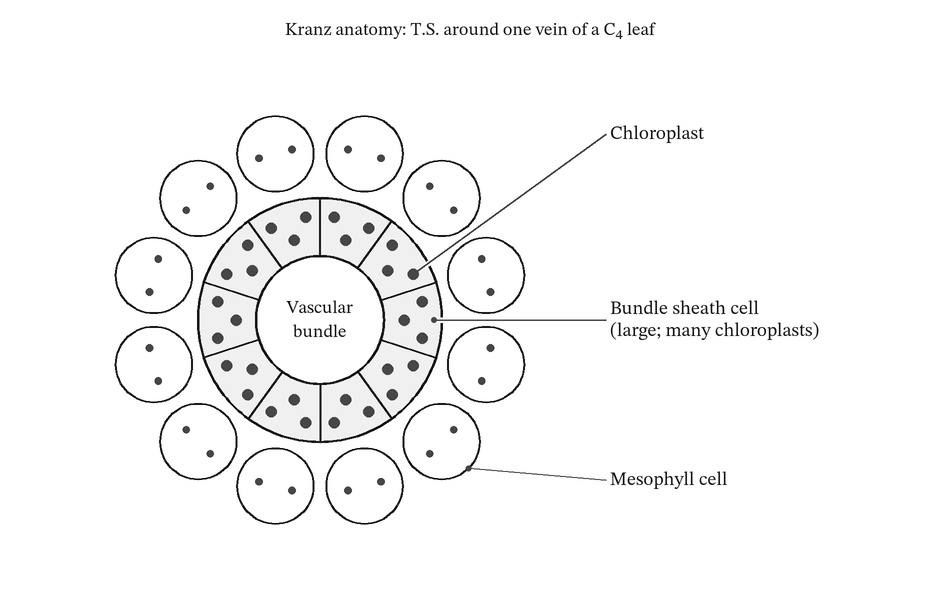
Step 2 — Where found: It is found in C₄ plants such as maize, sugarcane and sorghum.
Therefore, Kranz anatomy concentrates CO₂ around RuBisCO and prevents photorespiration; it is found in C₄ plants.
- 562 marks
Question 56
What is a photosystem? Name two important photosystems present in a cell.
Solve with AIWritten solution
Solution:
Concept: Light is gathered by many pigment molecules but used by one reaction centre.
Step 1 — Photosystem: A photosystem is a unit in the thylakoid membrane made of a light-harvesting complex (antenna) of a few hundred pigment molecules — chlorophylls and carotenoids — around one reaction centre of chlorophyll a (structurally a special pair of chlorophyll a molecules), with its primary electron acceptor.
Step 2 — The two photosystems: Photosystem I (PS I), with reaction centre P700, and photosystem II (PS II), with reaction centre P680.
Therefore, a photosystem is an antenna of pigments with one reaction centre; the two are PS I (P700) and PS II (P680).
- 572 marks
Question 57
Give two important differences between cyclic and non-cyclic photophosphorylation.
Solve with AIWritten solution
Solution:
Concept: Both make ATP using light, but they differ in the path of the electrons.
Step 1 — Path of electrons: In cyclic photophosphorylation the electron released by P700 returns to P700; in non-cyclic photophosphorylation electrons go from water through PS II and PS I to NADP⁺ and do not return.
Step 2 — Photosystems and products: Cyclic uses PS I only and makes only ATP; non-cyclic uses both PS II and PS I and makes ATP, NADPH and O₂.
Therefore, cyclic flow returns electrons to P700 and makes only ATP using PS I, while non-cyclic flow sends electrons from water to NADP⁺ and makes ATP, NADPH and O₂ using both photosystems.
- 582 marks
Question 58
What is the need of so many chlorophyll molecules for PS I and PS II?
Solve with AIWritten solution
Solution:
Concept: Each photosystem has one reaction centre (a special pair of chlorophyll a molecules) but about 250–400 light-harvesting pigment molecules.
Step 1 — Catching light: Even in bright sunlight a single chlorophyll molecule absorbs only about ten photons a second, far fewer than a reaction centre can use; a large antenna of many pigment molecules covers a bigger area and absorbs far more light, including more wavelengths (chlorophyll b, carotenoids).
Step 2 — Feeding the reaction centre: All this energy is funnelled to the reaction centre (P680 or P700), so it is excited often enough to keep the electron flow going.
Therefore, many chlorophyll molecules are needed to harvest enough light and funnel it to the single reaction centre.
- 592 marks
Question 59
What are the common steps in the dark reaction of C₃ and C₄ plants?
Solve with AIWritten solution
Solution:
Concept: In plants, the Calvin cycle is the only pathway that makes sugar from CO₂; C₄ plants add a CO₂-concentrating step before it.
Step 1 — The shared pathway: Both C₃ and C₄ plants make sugars through the Calvin cycle, using RuBisCO, ATP and NADPH (in C₄ plants it runs in the bundle-sheath cells).
Step 2 — Its three steps: Carboxylation (CO₂ + RuBP → 2 PGA, by RuBisCO), reduction (PGA → G3P, using ATP and NADPH) and regeneration of RuBP (using ATP).
Therefore, the common steps are those of the Calvin cycle: carboxylation, reduction and regeneration of RuBP.
- 602 marks
Question 60
When does C₄ cycle occur in CAM plants? Which condition is favourable for photorespiration?
Solve with AIWritten solution
Solution:
Concept: CAM plants separate their two carboxylations in time instead of in space.
Step 1 — C₄ cycle in CAM plants: It occurs at night, when the stomata are open: PEP carboxylase fixes CO₂ into OAA, which becomes malic acid and is stored in the vacuole; in the day the malic acid releases CO₂ for the Calvin cycle.
Step 2 — Condition for photorespiration: Photorespiration is favoured by high temperature, high light and a high O₂ : CO₂ ratio (low CO₂), for example when stomata close on a hot, bright day.
Therefore, in CAM plants the C₄ cycle runs at night, and photorespiration is favoured by high temperature, high light and low CO₂.
- 613 marks
Question 61
How do absorption spectrum and action spectrum of chlorophyll a differ from that of chlorophyll b?
Solve with AIWritten solution
Solution:
Concept: An absorption spectrum belongs to one pigment; an action spectrum belongs to the process of photosynthesis as a whole.
Step 1 — Absorption spectra compared: Chlorophyll a absorbs most in the violet-blue (about 430 nm) and red (about 660 nm) regions; chlorophyll b absorbs more in the blue (about 450 nm) and in a shorter-wavelength (lighter) red region (about 640 nm). So each fills gaps left by the other.
Step 2 — Action spectrum: The action spectrum shows the rate of photosynthesis (for example O₂ given out) at each wavelength. It has peaks in the blue and red, matching the combined absorption of chlorophyll a and b, a little broadened by carotenoids.
Step 3 — Their roles: Light absorbed by chlorophyll b is passed to chlorophyll a, which alone acts as the reaction centre. So chlorophyll a drives the action spectrum, and chlorophyll b widens the range of useful light.
Therefore, chlorophyll a and b absorb at slightly different blue and red wavelengths, and the action spectrum follows their combined absorption.
- 623 marks
Question 62
What are the reaction centres in PS I and PS II? What is the role of accessory pigments?
Solve with AIWritten solution
Solution:
Concept: Accessory pigments are the photosynthetic pigments other than chlorophyll a: chlorophyll b and the carotenoids in plants (and phycobilins in red algae and cyanobacteria).
Step 1 — Reaction centres: The reaction centre of PS I is P700 and that of PS II is P680 — special forms of chlorophyll a (each structurally a special pair of chlorophyll a molecules) that absorb best at 700 nm and 680 nm.
Step 2 — Light harvesting: Accessory pigments (chlorophyll b, carotenes and xanthophylls) absorb wavelengths that chlorophyll a absorbs poorly and pass the energy to the reaction centre, widening the range of light used.
Step 3 — Protection: Carotenoids also protect chlorophyll from photo-oxidation by taking up excess light energy and harmful activated oxygen.
Therefore, P700 and P680 are the reaction centres, and accessory pigments harvest extra light and protect chlorophyll.
- 633 marks
Question 63
Though C₄ photosynthesis consumes more energy than C₃ photosynthesis, it is still advantageous for tropical plants. Why?
Solve with AIWritten solution
Solution:
Concept: C₃ plants use 3 ATP per CO₂ fixed, while C₄ plants use 5 ATP (2 extra to regenerate PEP).
Step 1 — The extra cost: Per glucose a C₃ plant uses 18 ATP, but a C₄ plant uses:
Step 2 — No photorespiration: C₃ plants can lose about a quarter of their fixed carbon by photorespiration, and more in hot, dry tropical weather. C₄ plants concentrate CO₂ around RuBisCO, so photorespiration is negligible and much more carbon is kept.
Step 3 — Better use of resources: PEP carboxylase has a high affinity for CO₂, so C₄ plants keep fixing CO₂ even with partly closed stomata, losing less water; with plenty of sunlight, the extra ATP is easy to make, and they have a higher temperature optimum and greater productivity.
Therefore, despite using more ATP, C₄ plants gain because they avoid photorespiration, save water and use high light and temperature efficiently.
- 643 marks
Question 64
Explain the terms (i) ETC (ii) Photolysis of water (iii) PS I.
Solve with AIWritten solution
Solution:
Concept: These three parts work together in the light reaction on the thylakoid membrane.
Step 1 — (i) ETC: The electron transport chain is a series of carriers (plastoquinone, cytochrome b₆f complex, plastocyanin, ferredoxin) that pass electrons from PS II to PS I and on to NADP⁺ by redox reactions; the energy released pumps H⁺ into the lumen for ATP synthesis.
Step 2 — (ii) Photolysis of water: It is the light-driven splitting of water by the oxygen-evolving complex of PS II (with Mn, Ca and Cl ions), giving electrons for P680, H⁺ for the lumen and O₂:
Step 3 — (iii) PS I: Photosystem I is a pigment complex with reaction centre P700, found in the stroma lamellae and the outer parts of grana. It receives electrons from PS II (via plastocyanin) and passes them through ferredoxin to reduce NADP⁺ to NADPH; it alone can also run cyclic photophosphorylation.
Therefore, the ETC carries electrons between the photosystems, photolysis splits water to supply electrons, and PS I (P700) reduces NADP⁺.
- 653 marks
Question 65
What is photorespiration? Why is it almost negligible in C₄ plants?
Solve with AIWritten solution
Solution:
Concept: RuBisCO can add either CO₂ or O₂ to RuBP; the two gases compete for the same active site.
Step 1 — Definition: Photorespiration is the light-dependent uptake of O₂ and release of CO₂ that begins when RuBisCO acts as an oxygenase: RuBP + O₂ gives one PGA and one 2-phosphoglycolate.
Step 2 — The pathway: Phosphoglycolate becomes glycolate, which passes through peroxisomes (to glycine) and mitochondria (glycine to serine, releasing CO₂); the pathway uses ATP and NADPH and gives no net ATP, so carbon and energy are wasted.
Step 3 — Why negligible in C₄: In C₄ plants RuBisCO is only in the bundle-sheath cells, where malate releases CO₂ and keeps its concentration very high; CO₂ then wins the competition for RuBisCO, so oxygenation hardly happens.
Therefore, photorespiration is the oxygenase activity of RuBisCO with loss of CO₂, and it is negligible in C₄ plants because CO₂ is concentrated around RuBisCO.
- 663 marks
Question 66
What is chemiosmosis? Where does it occur? Give a brief summary of events.
Solve with AIWritten solution
Solution:
Concept: Chemiosmosis (Mitchell's hypothesis) links electron transport to ATP synthesis through a proton gradient.
Step 1 — Definition: Chemiosmosis is the making of ATP using the energy of a proton (H⁺) gradient across a membrane, as protons flow back through ATP synthase.
Step 2 — Where: In chloroplasts it occurs across the thylakoid membrane: protons build up in the lumen and flow out to the stroma.
Step 3 — Summary of events: Three events build the gradient. (a) Splitting of water on the lumen side releases H⁺ into the lumen; (b) plastoquinone takes H⁺ from the stroma and the cytochrome b₆f complex releases them into the lumen; (c) NADP⁺ reductase removes H⁺ from the stroma when it forms NADPH. The lumen becomes acidic, and H⁺ flow back through the CF₀ channel of ATP synthase, which turns a rotor and a central stalk inside the CF₁ head (the head itself is held still); the changes of shape this causes in the head make ATP from ADP and Pi on the stroma side.

Therefore, chemiosmosis is ATP synthesis driven by a proton gradient across the thylakoid membrane, made by water splitting, proton pumping and NADPH formation.
- 673 marks
Question 67
Name the basic steps in a Calvin cycle. Why is called a C₃ cycle also? How is it different from C₄ cycle?
Solve with AIWritten solution
Solution:
Concept: The Calvin cycle is the pathway in the stroma that turns CO₂ into sugar using ATP and NADPH.
Step 1 — Basic steps: The cycle has three steps. (a) Carboxylation — RuBisCO adds CO₂ to RuBP (5C) to give two PGA (3C); (b) reduction — PGA is reduced to glyceraldehyde-3-phosphate using ATP and NADPH; (c) regeneration — most G3P is used to remake RuBP, using ATP.
Step 2 — Why C₃: The first stable product, PGA, has 3 carbon atoms, so it is called the C₃ cycle.
Step 3 — Difference from the C₄ cycle: In the C₄ cycle the CO₂ acceptor is PEP (not RuBP), the enzyme is PEP carboxylase (not RuBisCO), the first product is OAA (4C), and its carboxylation takes place in the mesophyll cells, from where the C₄ acid carries CO₂ to the bundle sheath; it does not itself make sugar.
Therefore, the Calvin cycle has carboxylation, reduction and regeneration, is called C₃ because PGA has 3 carbons, and differs from the C₄ cycle in acceptor, enzyme, first product and site.
- 682 marks
Question 68
Non-cyclic and Cyclic photophosphorylation
Solve with AIWritten solution
Solution:
Concept: Photophosphorylation is the making of ATP from ADP and Pi using light energy. Both kinds use the proton gradient built by electron flow in the thylakoid membrane; they differ in the path the electrons take and so in what they produce.
Step 1 — Describe non-cyclic photophosphorylation.
In non-cyclic photophosphorylation, electrons taken from water by PS II pass through the electron transport chain to PS I and then to NADP⁺. They never return to the molecule that lost them, so the flow is one-way, and it makes ATP, NADPH and O₂.
Step 2 — Describe cyclic photophosphorylation.
In cyclic photophosphorylation, only PS I takes part. The electron that leaves P700 goes to ferredoxin and then back through plastoquinone, the cytochrome b₆f complex and plastocyanin to P700, so it moves in a closed circle. Protons are still pumped into the lumen, so ATP is made, but no water is split and NADP⁺ is not reduced.
Step 3 — Compare them side by side.
The table sums up the differences.
Feature Non-cyclic photophosphorylation Cyclic photophosphorylation Path of electrons One-way, from water to NADP⁺; they do not return Closed circle; they return to P700 Photosystems PS II and PS I PS I only First donor and last acceptor Water; NADP⁺ P700; P700 Splitting of water Yes; O₂ is released No; no O₂ is released Products ATP, NADPH and O₂ ATP only Therefore, non-cyclic photophosphorylation uses both photosystems and makes ATP, NADPH and O₂, while cyclic photophosphorylation uses PS I only and makes only ATP.
- 692 marks
Question 69
Light and Dark reaction
Solve with AIWritten solution
Solution:
Concept: Photosynthesis has two linked stages. The light reaction (photochemical phase) traps light energy as ATP and NADPH; the dark reaction (biosynthetic phase) uses them to fix CO₂ into sugar.
Step 1 — Describe the light reaction.
The light reaction takes place on the thylakoid membranes of the chloroplast. Chlorophyll absorbs light, water is split and O₂ is given off, and the trapped energy is stored in ATP and NADPH.
Step 2 — Describe the dark reaction.
The dark reaction takes place in the stroma and does not use light directly. RuBisCO fixes CO₂ onto RuBP, and the ATP and NADPH from the light reaction reduce the product to sugars in the Calvin cycle.
Step 3 — Compare them side by side.
The table sums up the differences.
Feature Light reaction Dark reaction Site Thylakoid membranes Stroma Need for light Light is essential Light not used directly (needs ATP and NADPH) Main events Water split, O₂ released, ATP and NADPH formed CO₂ fixed and reduced to sugars Another name Photochemical phase Biosynthetic phase (Calvin cycle) Watch out: The name "dark reaction" does not mean that it happens in the dark. It normally runs in daylight, at the same time as the light reaction, because it needs a steady supply of ATP and NADPH and several of its enzymes are switched on by light; that is why it is also called the light-independent reaction.
Therefore, the light reaction makes ATP, NADPH and O₂ on the thylakoids, while the dark reaction uses them to fix CO₂ in the stroma.
- 702 marks
Question 70
Photorespiration and Respiration
Solve with AIWritten solution
Solution:
Concept: Both processes take in O₂ and give out CO₂, but they start from different compounds, take place in different parts of the cell and have opposite effects on the plant's energy.
Step 1 — Describe photorespiration.
Photorespiration begins in the chloroplast when RuBisCO adds O₂ instead of CO₂ to RuBP. The 2-phosphoglycolate formed is passed on as glycolate through the peroxisome and the mitochondrion, where CO₂ is released; the pathway uses ATP and NADPH and gives no net ATP, so energy and fixed carbon are wasted.
Step 2 — Describe respiration.
Respiration is the breakdown of glucose and other food to release energy. It begins with glycolysis in the cytoplasm and, when O₂ is present, is completed in the mitochondria, where most of the ATP is made.
Step 3 — Compare them side by side.
The table sums up the differences.
Feature Photorespiration Respiration When Only in light All the time, in light and dark Where Chloroplasts, peroxisomes and mitochondria of green cells Cytoplasm and mitochondria of all living cells Substrate RuBP (via glycolate) Glucose and other food Energy No net ATP; ATP and NADPH are used ATP produced Therefore, photorespiration is a light-dependent, wasteful process starting from RuBP, while respiration runs all the time and produces ATP.
- 712 marks
Question 71
C₃ plants and C₄ plants
Solve with AIWritten solution
Solution:
Concept: Plants are named by the number of carbon atoms in the first stable product of CO₂ fixation.
Step 1 — Describe C₃ plants.
In C₃ plants, CO₂ from the air is fixed directly by RuBisCO onto RuBP in the mesophyll cells. The first stable product is 3-phosphoglyceric acid (PGA), a 3-carbon compound. Because RuBisCO can also add O₂, photorespiration can be high in hot, bright weather.
Step 2 — Describe C₄ plants.
In C₄ plants, CO₂ is first fixed by PEP carboxylase onto PEP in the mesophyll cells, giving oxaloacetic acid (OAA), a 4-carbon compound. The C₄ acid carries CO₂ to the bundle-sheath cells of the Kranz anatomy, where RuBisCO fixes it again in the Calvin cycle; the high CO₂ there keeps photorespiration very low.
Step 3 — Compare them side by side.
The table sums up the differences.
Feature C₃ plants C₄ plants First CO₂ acceptor and product RuBP; PGA (3C) PEP; OAA (4C) Leaf anatomy No Kranz anatomy Kranz anatomy Photorespiration Present, can be high Negligible Optimum temperature; examples About 20–25 °C; wheat, rice, potato About 30–45 °C; maize, sugarcane Therefore, C₃ plants fix CO₂ first into PGA and show photorespiration, while C₄ plants fix it first into OAA with Kranz anatomy and almost no photorespiration.
- 722 marks
Question 72
Mesophyll chloroplast and Bundle sheath chloroplast
Solve with AIWritten solution
Solution:
Concept: The chloroplasts of the two cell types of a C₄ leaf are dimorphic (of two forms), because the two cells carry out different parts of the C₄ pathway.
Step 1 — Describe the mesophyll chloroplast.
The mesophyll chloroplast has many well-developed grana and an active PS II, so it carries out the full light reaction and supplies ATP and NADPH. It has no RuBisCO and runs no Calvin cycle. PEP carboxylase, which first fixes CO₂ in the mesophyll cell, is in the cytoplasm, not inside this chloroplast.
Step 2 — Describe the bundle-sheath chloroplast.
The bundle-sheath chloroplast has few or poorly developed grana (in maize it is agranal) and little PS II activity. It holds the leaf's RuBisCO: malate releases CO₂ here, and the CO₂ is fixed in the Calvin cycle, so starch builds up in it.
Step 3 — Compare them side by side.
The table sums up the differences.
Feature Mesophyll chloroplast Bundle sheath chloroplast Grana Many well-developed grana Few or poorly developed grana (agranal in maize) RuBisCO and Calvin cycle RuBisCO absent; no Calvin cycle RuBisCO abundant; Calvin cycle runs PS II activity Active; makes ATP, NADPH and O₂ Low Starch Little starch Much starch Therefore, mesophyll chloroplasts are granal with active PS II but no RuBisCO, while bundle-sheath chloroplasts have few grana, much RuBisCO and much starch.
- 732 marks
Question 73
C₄ plants and CAM plants
Solve with AIWritten solution
Solution:
Concept: Both C₄ and CAM plants fix CO₂ first with PEP carboxylase and then again with RuBisCO in the Calvin cycle. C₄ plants separate the two steps in space (two cell types); CAM plants separate them in time (night and day).
Step 1 — Describe C₄ plants.
In C₄ plants both fixations run in the day. PEP carboxylase fixes CO₂ in the mesophyll cells, and the C₄ acid releases it in the bundle-sheath cells, where RuBisCO fixes it again; this keeps photorespiration low in hot, bright places.
Step 2 — Describe CAM plants.
CAM plants are mostly succulents of dry places. Their stomata open at night, when PEP carboxylase fixes CO₂ into malic acid that is stored in the vacuole. In the day the stomata stay closed to save water, and the malic acid releases CO₂ in the same cell for the Calvin cycle.
Step 3 — Compare them side by side.
The table sums up the differences.
Feature C₄ plants CAM plants Separation of steps In space: mesophyll and bundle-sheath cells In time: night and day, same cells Stomata Open in the day Open at night, closed in the day Time of PEP carboxylation Day Night (malic acid stored in vacuole) Examples Maize, sugarcane Pineapple, cacti, Bryophyllum Therefore, C₄ plants separate the two fixations between two cell types in the day, while CAM plants do both in one cell, at night and in the day.
- 742 marks
Question 74
Transpiration and Translocation
Solve with AIWritten solution
Solution:
Concept: Transpiration moves water out of the plant as vapour; translocation moves food inside the plant.
Step 1 — Describe transpiration.
Transpiration is the evaporation of water from the aerial parts of a plant, mainly through the stomata of the leaves. The loss of water sets up a pull that draws water up the xylem from the roots; the energy comes from the sun's heat, not from ATP.
Step 2 — Describe translocation.
Translocation is the movement of food, mainly sucrose, in solution through the sieve tubes of the phloem, from a source such as a mature leaf to a sink such as a root, fruit or growing tip. Sugar is loaded into the sieve tubes at the source, usually using ATP; water follows by osmosis, and the pressure this builds drives the sap towards the sink.
Step 3 — Compare them side by side.
The table sums up the differences.
Feature Transpiration Translocation What moves Water lost as vapour Food (mainly sucrose) in solution Tissue or route Mainly through stomata; pulls water up the xylem Phloem (sieve tubes) Direction Upwards and out into the air From source to sink, up or down Energy Driven by evaporation (no ATP) Needs ATP for loading (and for unloading in some sinks) Therefore, transpiration is loss of water vapour from aerial parts, while translocation is movement of food through the phloem from source to sink.
- 755 marks
Question 75
Trace the path of carbon in Calvin cycle. Give an experiment to demonstrate Hill's reaction.
Solve with AIWritten solution
Solution:
Concept: Melvin Calvin traced carbon by feeding ¹⁴CO₂ to the alga Chlorella and identifying the labelled compounds by paper chromatography and autoradiography.
Step 1 — Carboxylation: In the stroma, RuBisCO joins each CO₂ to RuBP (5C); the unstable 6C product splits into two molecules of 3-PGA (3C), the first stable product. For 3 CO₂, 3 RuBP give 6 PGA.
Step 2 — Reduction: The 6 PGA are phosphorylated by 6 ATP and reduced by 6 NADPH to 6 glyceraldehyde-3-phosphate (G3P), a triose phosphate sugar.
Step 3 — Regeneration: One G3P leaves the cycle to make glucose, sucrose and starch; the other five G3P (15C) are rearranged, using 3 ATP, into 3 RuBP (15C), so the cycle can continue.
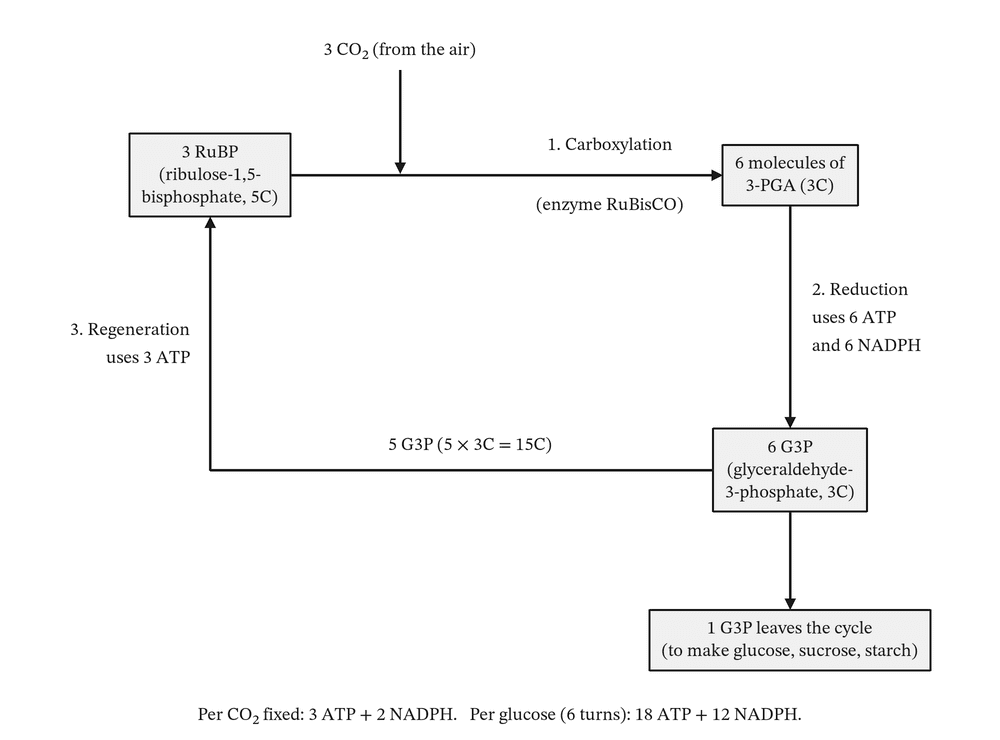
Step 4 — Cost: So each CO₂ needs 3 ATP and 2 NADPH, and one glucose (6 turns) needs 18 ATP and 12 NADPH.
Step 5 — Hill's reaction — set-up: Spinach leaves are ground in cold 0.4 M sucrose solution, the homogenate is filtered through muslin and centrifuged; the pellet of chloroplasts is resuspended and divided between two test tubes, A and B. Tube A is wrapped in black paper; the blue dye DCPIP (an electron acceptor) is added to both and both are kept in light.
Step 6 — Hill's reaction — result: Tube A stays blue, but in tube B the blue colour disappears: the lit chloroplasts split water and the electrons reduce DCPIP to its colourless form, while O₂ is given out. This shows that isolated chloroplasts split water in light, without CO₂.
Therefore, carbon passes from CO₂ to PGA, then to G3P, and then to sugars or back to RuBP; the Hill reaction is shown by isolated chloroplasts decolourising DCPIP only in light.
- 765 marks
Question 76
What is a photosystem? Which is the pigment that acts as a reaction centre? Describe the interaction of photosystem I and photosystem II.
Solve with AIWritten solution
Solution:
Concept: In non-cyclic electron flow the two photosystems work in series; drawn on an energy scale, the path looks like the letter Z (the Z-scheme).
Step 1 — Photosystem: A photosystem is a light-harvesting complex of a few hundred pigment molecules (chlorophyll a, chlorophyll b, carotenoids) around one reaction centre in the thylakoid membrane.
Step 2 — Reaction-centre pigment: The reaction centre is a special form of chlorophyll a (structurally a special pair of chlorophyll a molecules), called P680 in PS II and P700 in PS I.
Step 3 — PS II starts the flow: Light excites P680; it gives an electron to its primary acceptor (pheophytin). P680 is refilled with electrons from the photolysis of water, which releases O₂.
Step 4 — Transport to PS I: The electron passes downhill through plastoquinone, the cytochrome b₆f complex and plastocyanin to P700; the energy released pumps H⁺ into the lumen, which is used for ATP synthesis.
Step 5 — PS I finishes the flow: Light excites P700; its electron goes through the Fe–S centres and ferredoxin to NADP⁺ reductase, which reduces NADP⁺ to NADPH. The hole in P700 is filled by the electron coming from PS II.

Therefore, a photosystem is a pigment antenna with a chlorophyll a reaction centre, and PS II and PS I work in series — water to P680 to P700 to NADP⁺ — making ATP, NADPH and O₂.
- 775 marks
Question 77
What is the role of PS I and PS II in photosynthesis?
Solve with AIWritten solution
Solution:
Concept: The two photosystems are pigment–protein complexes of the thylakoid membrane, each with its own reaction centre.
Step 1 — PS II: water splitting: PS II (P680) uses light to take electrons from water, through its oxygen-evolving complex, releasing O₂ and H⁺ into the lumen.
Step 2 — PS II: driving the chain: It passes these electrons to plastoquinone and the cytochrome b₆f complex, so H⁺ are pumped into the lumen and the proton gradient used for ATP is built up.
Step 3 — PS I: making NADPH: PS I (P700), excited by light, passes electrons through ferredoxin to NADP⁺ reductase, forming NADPH on the stroma side.
Step 4 — PS I: cyclic flow: When NADP⁺ is short or light is above 680 nm, PS I alone sends electrons back to the cytochrome complex (cyclic photophosphorylation), making extra ATP without NADPH or O₂.
Step 5 — Working together: In non-cyclic flow both work in series (Z-scheme), giving ATP and NADPH in the ratio the Calvin cycle needs (3 ATP : 2 NADPH per CO₂, helped by cyclic ATP).
Therefore, PS II splits water, gives O₂ and drives proton pumping for ATP, while PS I makes NADPH and, alone, makes extra ATP by cyclic flow.
- 785 marks
Question 78
Describe carbon reactions of C₃ pathway. Does this process operate in C₄ plants?
Solve with AIWritten solution
Solution:
Concept: The carbon reactions (Calvin cycle) take place in the stroma and use the ATP and NADPH of the light reaction.
Step 1 — Carboxylation: RuBisCO adds CO₂ to ribulose-1,5-bisphosphate (RuBP, 5C), giving two molecules of 3-phosphoglyceric acid (PGA, 3C), the first stable product.
Step 2 — Reduction: PGA is converted to 1,3-bisphosphoglycerate using ATP, which is then reduced by NADPH to glyceraldehyde-3-phosphate (G3P), a triose phosphate.
Step 3 — Regeneration: For every 3 CO₂, one G3P is used to make sugars; the other five G3P are rearranged, using ATP, into three RuBP.
Step 4 — Energy balance: Per CO₂ the cycle uses 3 ATP and 2 NADPH; per glucose (6 CO₂) it uses:
Step 5 — In C₄ plants: Yes. C₄ plants also make all their sugar through the Calvin cycle, but it runs only in the bundle-sheath cells, using CO₂ released from malate.
Therefore, the C₃ carbon reactions are carboxylation, reduction and regeneration of RuBP, and they also operate in C₄ plants, in the bundle-sheath cells.
- 795 marks
Question 79
Discuss the mechanism of Hatch-Slack pathway in C₄ plants.
Solve with AIWritten solution
Solution:
Concept: The Hatch–Slack (C₄) pathway is a CO₂ pump that works across the two cell types of Kranz anatomy.
Step 1 — Fixation in mesophyll: CO₂ entering the leaf dissolves as HCO₃⁻ in the mesophyll cytoplasm; PEP carboxylase adds it to phosphoenolpyruvate (PEP, 3C), giving oxaloacetic acid (OAA, 4C).
Step 2 — Conversion and transport: OAA is reduced to malic acid (malate) using NADPH (in some plants it is changed to aspartate), which moves through plasmodesmata into the bundle-sheath cells.
Step 3 — Decarboxylation: In the bundle-sheath chloroplasts malate is decarboxylated, releasing CO₂ and pyruvate (3C); the CO₂ concentration there becomes many times that in a C₃ leaf.
Step 4 — Calvin cycle: The released CO₂ is fixed by RuBisCO in the normal Calvin cycle, and the sugars pass to the phloem; photorespiration is almost absent.
Step 5 — Regeneration of PEP: Pyruvate returns to the mesophyll, where it is converted back to PEP using ATP (2 extra ATP per CO₂), so each CO₂ costs 5 ATP and 2 NADPH.
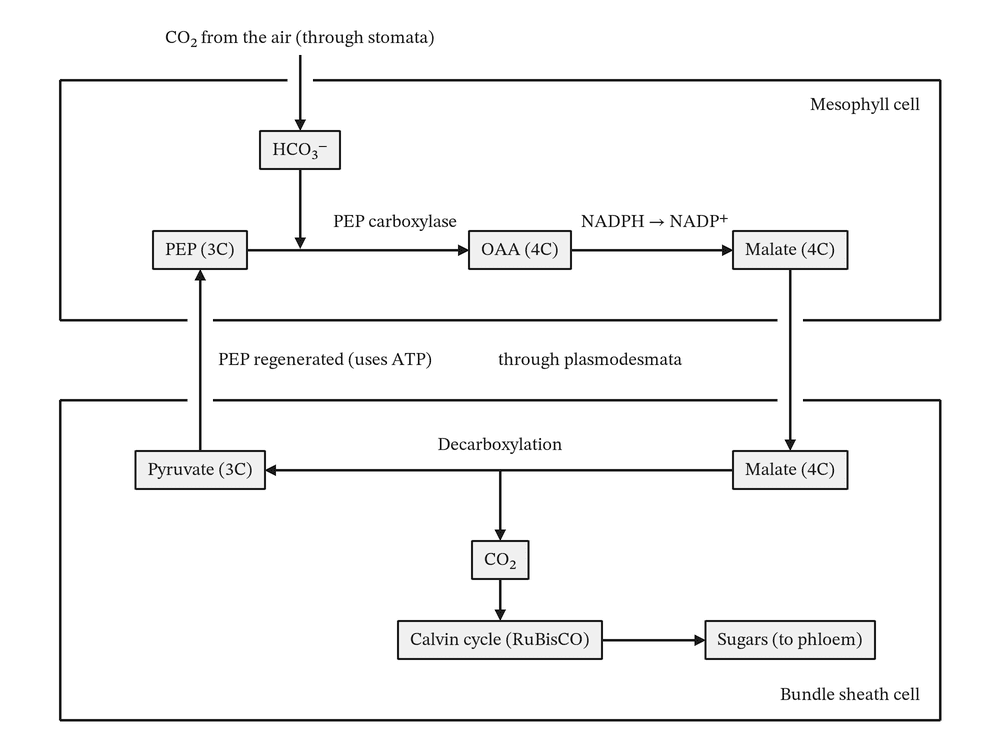
Therefore, in the Hatch–Slack pathway PEP fixes CO₂ into OAA and malate in the mesophyll, malate releases CO₂ in the bundle sheath for the Calvin cycle, and pyruvate returns to remake PEP.
- 805 marks
Question 80
What led to the evolution of C₄ pathway of photosynthesis? Describe in detail.
Solve with AIWritten solution
Solution:
Concept: RuBisCO cannot fully tell CO₂ from O₂; when O₂ wins, photorespiration wastes carbon.
Step 1 — The problem: In C₃ plants RuBisCO is exposed to air with much more O₂ than CO₂. At high temperature and light, and when stomata close to save water, the O₂ : CO₂ ratio rises, so RuBisCO's oxygenase activity increases and about a quarter of fixed carbon (more in hot, dry weather) is lost in photorespiration.
Step 2 — The pressure: Plants of hot, bright and dry tropical habitats therefore lost much carbon; scientists link the rise of C₄ plants to such climates at times when CO₂ in the air was low.
Step 3 — The solution: a CO₂ pump: C₄ plants put PEP carboxylase, an enzyme present in small amounts in all plants, to a new use. Made in large amounts in the mesophyll, it uses HCO₃⁻, does not react with O₂ and works well at low CO₂, so it fixes CO₂ first into C₄ acids.
Step 4 — Kranz anatomy: These acids release CO₂ inside the thick-walled bundle-sheath cells, which let only a little CO₂ leak back out and hold RuBisCO; the high CO₂ there makes RuBisCO act almost only as a carboxylase.
Step 5 — The result: Photorespiration becomes negligible; C₄ plants have a higher temperature optimum, high light saturation, better water use and higher productivity, though they spend 5 ATP instead of 3 per CO₂.
Therefore, the C₄ pathway evolved to overcome photorespiration in hot, bright, dry conditions by concentrating CO₂ around RuBisCO in the bundle-sheath cells.
- 815 marks
Question 81
Explain the pathway of photorespiration in leaf cells. What is its useful role? How is it different from respiration?
Solve with AIWritten solution
Solution:
Concept: Photorespiration (the C₂ cycle) begins when RuBisCO adds O₂ instead of CO₂ to RuBP.
Step 1 — In the chloroplast: RuBisCO, acting as an oxygenase, converts RuBP + O₂ into one 3-PGA and one 2-phosphoglycolate; phosphoglycolate loses its phosphate to give glycolate.
Step 2 — In the peroxisome: Glycolate is oxidised by O₂ to glyoxylate (making H₂O₂, broken down by catalase) and then changed to the amino acid glycine.
Step 3 — In the mitochondrion: Two glycine give one serine, releasing CO₂ (and NH₃). Serine returns to the peroxisome to form glycerate, which goes back to the chloroplast and, using ATP, re-forms PGA.

Step 4 — Useful role: Under high light and low CO₂ it uses up excess light energy and so protects the chloroplast from photo-oxidative damage; it also recovers three out of four carbon atoms of phosphoglycolate.
Step 5 — Difference from respiration: Photorespiration occurs only in light, in chloroplasts, peroxisomes and mitochondria of green cells, starts from RuBP and makes no net ATP; respiration occurs all the time in all living cells (cytoplasm and mitochondria), starts from glucose and produces ATP.
Therefore, photorespiration runs from RuBP through chloroplast, peroxisome and mitochondrion with loss of CO₂, protects against photo-oxidation, and unlike respiration makes no net ATP and works only in light.
- 825 marks
Question 82
What is the law of limiting factors? Explain with the help of an example.
Solve with AIWritten solution
Solution:
Concept: When a process depends on several factors, its rate is set by the factor in shortest supply (Blackman, 1905).
Step 1 — The law: Blackman's law of limiting factors: when a process is affected by more than one factor, its rate is limited by the factor that is nearest its minimum value (the most limiting factor); only a change in that factor changes the rate.
Step 2 — Example — light limiting: At low light, with enough CO₂ and a suitable temperature, the rate rises as light intensity is increased, because light is the limiting factor.
Step 3 — Example — CO₂ limiting: At a certain light intensity the curve levels off. More light now has no effect, because CO₂ has become limiting; if CO₂ concentration is raised, the rate rises again to a higher plateau.
Step 4 — Example — temperature limiting: With high CO₂ at 15 °C the curve again levels off; raising the temperature to 25 °C raises it further, because the enzyme-controlled dark reaction was being limited by temperature.
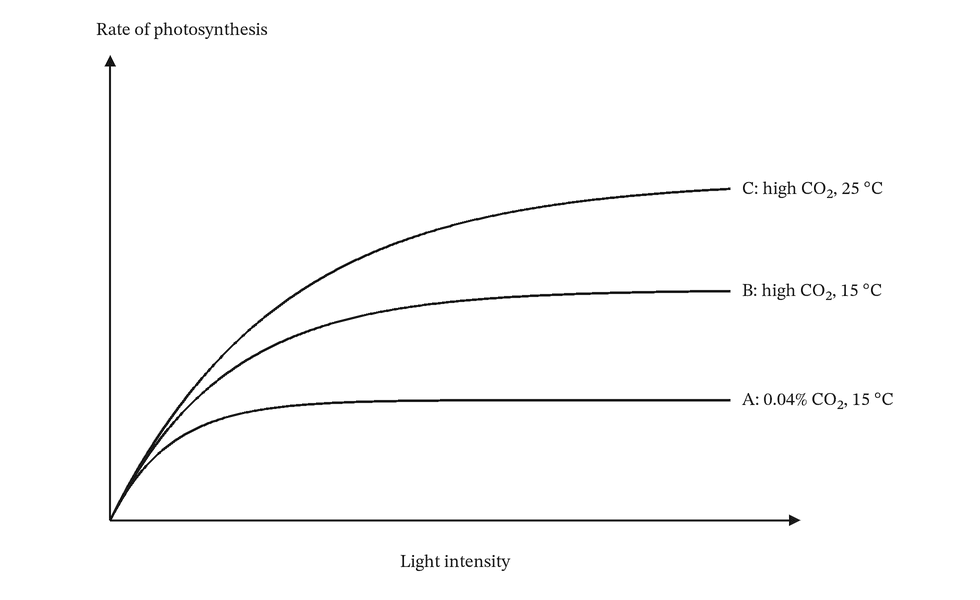
Step 5 — Another example: A leaf with good light and CO₂ photosynthesises only very slowly near 0 °C; on warming, its rate rises, showing that temperature was the limiting factor.
Therefore, the law says the rate of a process is controlled by its most limiting factor, as seen when photosynthesis stops rising with light until CO₂ or temperature is increased.
- 835 marks
Question 83
What is CAM? How is it useful?
Solve with AIWritten solution
Solution:
Concept: CAM (crassulacean acid metabolism) was first found in plants of the family Crassulaceae, such as Bryophyllum.
Step 1 — What CAM is: CAM is a pathway of succulent plants of dry places (cacti, pineapple, Bryophyllum) in which stomata open at night and close in the day — the reverse of most plants.
Step 2 — At night: CO₂ enters and is fixed by PEP carboxylase to OAA, which is reduced to malic acid and stored in the vacuole, so the cell sap becomes acidic.
Step 3 — In the day: With stomata closed, malic acid releases CO₂, which is fixed by RuBisCO in the Calvin cycle using ATP and NADPH from the light reaction.
Step 4 — Useful to the plant: Keeping stomata closed in the hot day saves a great deal of water, so the plant survives drought.
Step 5 — Further use: The high CO₂ released inside the closed leaf in the day reduces photorespiration, and the plant can photosynthesise even in very dry conditions.
Therefore, CAM is night-time fixation of CO₂ into malic acid followed by daytime Calvin cycle, which lets succulents save water and reduce photorespiration.
- 845 marks
Question 84
Explain the Blackman's law of limiting factors. Give an example. How do light and CO₂ concentration affect rate of photosynthesis?
Solve with AIWritten solution
Solution:
Concept: Blackman (1905) stated that when several factors affect a process, the slowest (most limiting) factor sets its rate.
Step 1 — The law: When a process depends on several factors, its rate is limited by the factor present at the level nearest its minimum; increasing any other factor has no effect until that one is increased.
Step 2 — Example: At atmospheric CO₂ (about 0.04 %) and 15 °C, the rate rises with light and then levels off; raising CO₂ gives a higher plateau, and raising the temperature to 25 °C a higher one still.
Step 3 — Effect of light: There is no photosynthesis in darkness; the rate rises with light intensity up to the light saturation point, beyond which another factor limits; very strong light can damage chlorophyll (photo-oxidation). Blue and red light are most effective.
Step 4 — Effect of CO₂: CO₂ (about 0.042 %: about 420 ppm in 2023, roughly 425 ppm by 2025) is often the limiting factor in the field. Raising it increases the rate up to a saturation level; C₃ plants respond more, as extra CO₂ also cuts photorespiration, while C₄ plants are nearly saturated at present levels.
Step 5 — Linking the two: At low light, adding CO₂ does little, because light limits; at high light, adding CO₂ raises the rate a lot, because CO₂ limits.
Note: The CO₂ level of the air keeps rising; values of 0.03 % in older tables are out of date, and it was about 0.042 % (about 420 ppm) in 2023 and roughly 425 ppm by 2025.
Therefore, Blackman's law states that the most limiting factor controls the rate; the rate rises with light up to saturation and with CO₂ up to saturation, whichever is limiting.
What Class 11 Biology Ch 18 covers
The sections of the chapter, in the order the book takes them. Every question above comes from one of these.
- 01Early Experiments
- 02Chloroplasts and Photosynthetic Pigments
- 03Absorption and Action Spectrum
- 04Light Reaction and Photophosphorylation
- 05Chemiosmotic Hypothesis
- 06Dark Reaction - Calvin Cycle
More ways to study this chapter
The same chapter asked three other ways. Practise it, revise it, and see what the board has set on Ch 18 before.
Class 11 Biology Ch 18 questions students ask
How many questions are there in Class 11 Biology Ch 18?
84 questions. Every one is solved step by step on this page.
Are these Class 11 Biology solutions free?
Yes. Every question and its full working is free to read, with no account needed.
Can I download the Class 11 Biology Ch 18 solutions as a PDF?
There is no PDF to download. Every solution is on this page instead, which means it is searchable, always the current syllabus, and readable on a phone. Use your browser's print option if you want it on paper.