
Question 755 marksMedium
Trace the path of carbon in Calvin cycle. Give an experiment to demonstrate Hill's reaction.
Confirming your payment
Sign up now and get 250 free tokens.
Photosynthesis in Higher Plants · Question 75 of 84
Trace the path of carbon in Calvin cycle. Give an experiment to demonstrate Hill's reaction.
Solution:
Concept: Melvin Calvin traced carbon by feeding ¹⁴CO₂ to the alga Chlorella and identifying the labelled compounds by paper chromatography and autoradiography.
Step 1 — Carboxylation: In the stroma, RuBisCO joins each CO₂ to RuBP (5C); the unstable 6C product splits into two molecules of 3-PGA (3C), the first stable product. For 3 CO₂, 3 RuBP give 6 PGA.
Step 2 — Reduction: The 6 PGA are phosphorylated by 6 ATP and reduced by 6 NADPH to 6 glyceraldehyde-3-phosphate (G3P), a triose phosphate sugar.
Step 3 — Regeneration: One G3P leaves the cycle to make glucose, sucrose and starch; the other five G3P (15C) are rearranged, using 3 ATP, into 3 RuBP (15C), so the cycle can continue.
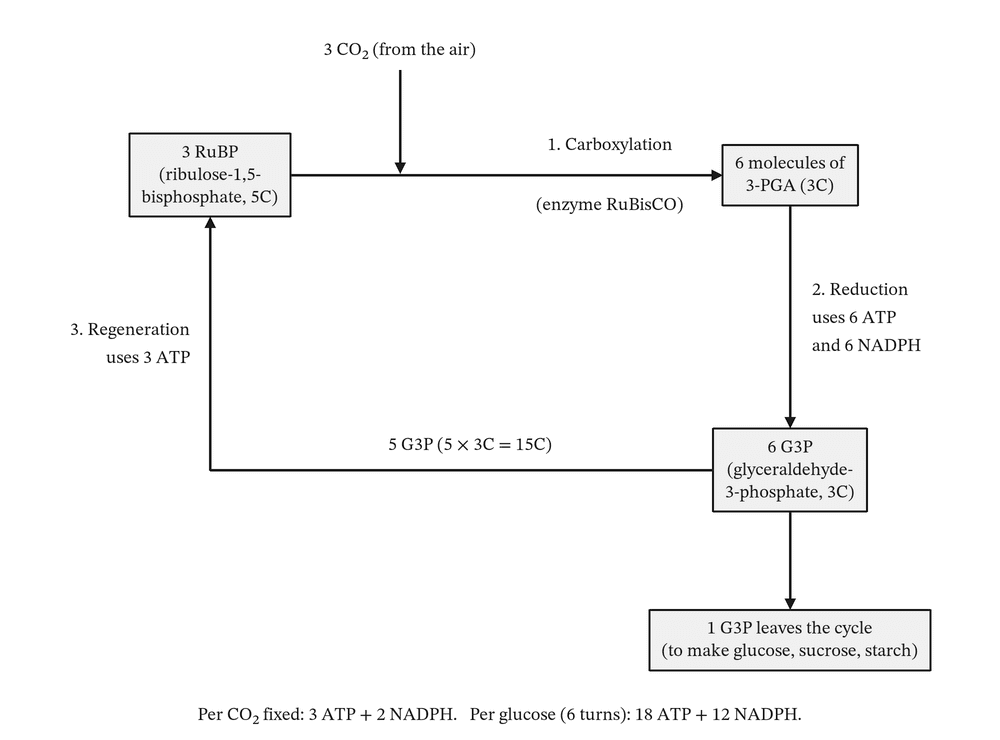
Step 4 — Cost: So each CO₂ needs 3 ATP and 2 NADPH, and one glucose (6 turns) needs 18 ATP and 12 NADPH.
Step 5 — Hill's reaction — set-up: Spinach leaves are ground in cold 0.4 M sucrose solution, the homogenate is filtered through muslin and centrifuged; the pellet of chloroplasts is resuspended and divided between two test tubes, A and B. Tube A is wrapped in black paper; the blue dye DCPIP (an electron acceptor) is added to both and both are kept in light.
Step 6 — Hill's reaction — result: Tube A stays blue, but in tube B the blue colour disappears: the lit chloroplasts split water and the electrons reduce DCPIP to its colourless form, while O₂ is given out. This shows that isolated chloroplasts split water in light, without CO₂.
Therefore, carbon passes from CO₂ to PGA, then to G3P, and then to sugars or back to RuBP; the Hill reaction is shown by isolated chloroplasts decolourising DCPIP only in light.