
Opening your dashboard
Class 11 Biology Chapter 18 Photosynthesis in Higher Plants: Competency-Based Questions (CBQ)
40 questions on Chapter 18, each worked through on its own page with the AI tutor. Class 11 Biology, ICSE 2026-27.
40 questions
1–7 marks · Mixed difficulty
- 14 marks
Question 1
A college project in Bengaluru grows a potted plant inside a large glass chamber fitted with gas analysers. The pot and soil are sealed in a plastic cover, so only the shoot exchanges gases with the chamber air. Over 10 days in normal day and night conditions, the analysers show that the shoot took in a net 44 g of carbon dioxide and gave out a net 32 g of oxygen. Compared with identical plants dried at the start, the plant's dry mass increased by 30 g. Assume that all of this increase is carbohydrate, of general formula (CH₂O), and that none of it comes from soil minerals. (Hypothetical data.)
(a) Calculate the net mass that the plant gained from the exchange of gases with the air. (1 mark)
(b) Show that the rest of the gain in dry mass must have come from water, and find the mass of water used. Then check that the equation CO₂ + H₂O → (CH₂O) + O₂ balances by mass for these amounts. (2 marks)
(c) Which early scientist first showed, in 1804, that water is important in photosynthesis, as this project does? (1 mark)
- 21 mark
Question 2
Assertion (A): A destarched leaf, with a strip of black paper fixed across both of its surfaces and kept in sunlight for six hours, turns blue-black with iodine solution only in the parts that were not covered.
Reason (R): Starch is the first product formed in the light reaction of photosynthesis.
- 31 mark
Question 3
At a school science fair in Kochi, a student puts two equal shoots of Hydrilla in beakers of the same pond water under the same lamp. Before starting, the student breathes out through a straw into beaker 2 for one minute. Beaker 1 gives 12 gas bubbles per minute and beaker 2 gives 21 bubbles per minute. (Hypothetical data.) Which early discovery does the student's result repeat?
- 44 marks
Question 4
A Class 11 student in Mysuru uses a variegated money plant, whose leaves have green parts and white parts. The white parts lack chlorophyll. The student keeps the plant in the dark for 48 hours, then fixes a strip of black paper across the middle of one leaf, on both surfaces, so that it covers some green and some white tissue. After six hours in sunlight the student removes the leaf, boils it in water, then in alcohol, washes it and puts it in iodine solution. Four regions of the leaf are marked as below.
Region Colour of leaf tissue Covered by black paper? P Green No Q White No R Green Yes S White Yes (a) Predict the colour of each region after the iodine test. (1 mark)
(b) Which two regions should be compared to show that chlorophyll is needed for photosynthesis, and which two to show that light is needed? Explain each choice. (2 marks)
(c) The white parts of the leaf are made of living cells that keep growing, although they make no sugar of their own. Suggest how these cells get their food. (1 mark)
- 51 mark
Question 5
Assertion (A): Leaves of cotton plants growing in magnesium-deficient soil turn yellow between the veins, while the veins themselves stay green.
Reason (R): Magnesium is the metal atom at the centre of the porphyrin ring of every chlorophyll molecule.
- 61 mark
Question 6
In a school laboratory in Lucknow, students boil fresh spinach leaves in water for five minutes. The water stays almost colourless and the leaves stay green. When the boiled leaves are then placed in hot alcohol, the alcohol turns deep green and the leaves become pale. Which explanation is correct?
- 74 marks
Question 7
A hydroponic farm near Pune grows lettuce in a closed room lit only by LED panels. Two types of panel were compared, each over an identical tray of plants for 30 days, with the lights on for 16 hours a day. Both panels deliver the same number of photons per second between 400 nm and 700 nm to their tray. (Hypothetical data.)
Panel Light given out Electrical power Dry mass gained by the tray in 30 days X Only blue (peak 450 nm) and red (peak 660 nm) 80 W 144 g Y White (all colours from 400 nm to 700 nm) 100 W 132 g The absorption peaks of chlorophyll a lie near 430 nm and 662 nm, and those of chlorophyll b near 453 nm and 642 nm.
(a) Use the absorption peaks to explain why panel X gave more growth than panel Y, although both delivered the same number of photons. (1 mark)
(b) Calculate the electrical energy, in kilowatt-hours (kWh), used by each panel in the 30 days. (1 mark)
(c) Calculate the dry mass gained per kWh for each panel, and say which panel the farm should choose. (2 marks)
- 81 mark
Question 8
Assertion (A): Plant scientists take the band of sunlight from 400 nm to 700 nm as photosynthetically active radiation (PAR).
Reason (R): Light of wavelength shorter than 400 nm carries too little energy in each photon to excite a chlorophyll molecule.
- 94 marks
Question 9
Diuron is a herbicide used to control weeds in sugarcane fields. It binds to photosystem II and stops electrons from passing from PS II to plastoquinone. In a college laboratory in Coimbatore, students punch out small discs from the leaves of a weed. They draw the air out of the discs so that the discs sink in a dilute sodium hydrogencarbonate solution, and then place two dishes of discs under the same lamp. (Hypothetical data.)
Dish Solution Discs floating after 20 minutes 1 Sodium hydrogencarbonate only 10 out of 10 2 Sodium hydrogencarbonate + diuron 0 out of 10 (a) Explain why the discs in dish 1 float, and why the discs in dish 2 stay at the bottom. (1 mark)
(b) In the diuron-treated chloroplasts, can (i) NADPH and (ii) ATP still be formed in light? Explain each answer with reference to the photosystems. (2 marks)
(c) Weeds sprayed with diuron in bright sunshine turn white (bleach) within a few days, instead of slowly using up their stored food. Suggest a reason. (1 mark)
- 101 mark
Question 10
Assertion (A): In non-cyclic photophosphorylation, the electrons lost by the reaction centre of photosystem II are replaced by electrons taken from water.
Reason (R): When P680 loses an electron, the oxidised reaction centre (P680⁺) is a strong enough oxidising agent to pull electrons from water.
- 111 mark
Question 11
To explain chemiosmosis to a Class 11 group in Bhopal, a teacher compares a thylakoid with a hydroelectric dam. Pumps fill a high reservoir with water, and the water can flow back down only through turbines that turn generators to make electricity. Which pairing of dam parts with chloroplast parts is correct?
- 121 mark
Question 12
Assertion (A): The ATP synthase of the thylakoid membrane makes ATP on the lumen side of the membrane.
Reason (R): Hydrogen ions flow out of the thylakoid lumen into the stroma through the ATP synthase.
- 131 mark
Question 13
A research student in Hyderabad treats brightly lit leaf discs with a chemical that blocks only one enzyme: the one that uses ATP to turn ribulose 5-phosphate into RuBP, the last step of the regeneration phase of the Calvin cycle. The light reaction is not affected at first. Which change is expected within a minute or two?
- 141 mark
Question 14
Assertion (A): For each molecule of CO₂ fixed in the Calvin cycle, more NADPH is used than ATP.
Reason (R): ATP is used both to convert 3-PGA in the reduction phase and to regenerate RuBP, whereas NADPH is used only in the reduction phase.
- 154 marks
Question 15
A farmer near Kota in Rajasthan can grow either maize or wheat on the same field. The graphs show the net rate of CO₂ uptake by leaves of the two crops at different leaf temperatures, measured in bright light and normal air. (Hypothetical data.)
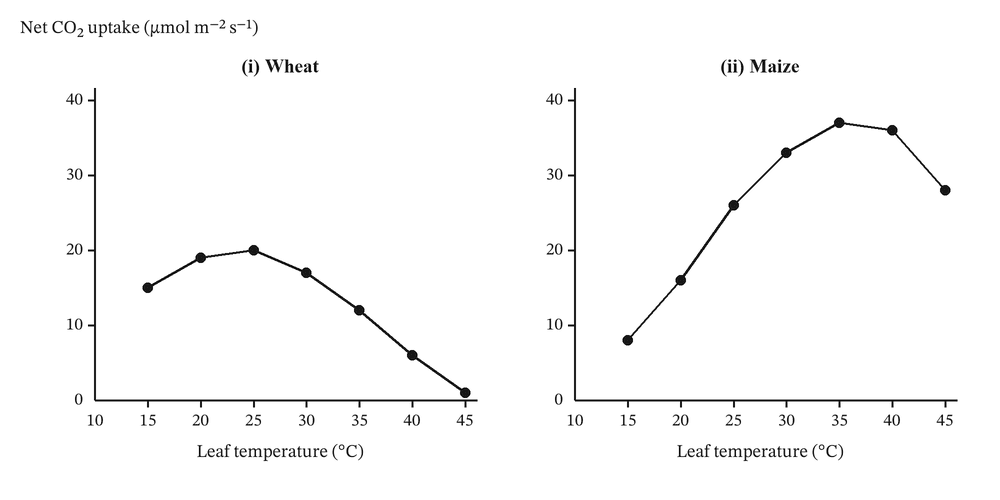
(a) From the graphs, give the leaf temperature at which each crop has its highest rate. (1 mark)
(b) In the kharif (hot) season, leaf temperatures at midday reach 40 °C. Read the rate of each crop at 40 °C, work out how many times faster maize takes up CO₂, and explain the difference in terms of the C₄ pathway. (2 marks)
(c) At 15 °C wheat has the higher rate. In which season, kharif (hot) or rabi (cool winter), should the farmer grow wheat? Give a reason. (1 mark)
- 161 mark
Question 16
Rice is a C₃ crop. An international team of scientists, including researchers from India, is trying to give rice the C₄ pathway. Why would such ‘C₄ rice’ be expected to give higher yields in hot, sunny summers?
- 174 marks
Question 17
In a plant physiology laboratory in Delhi, a potted rice plant and a potted maize plant are sealed in two separate glass chambers of the same size, with the pots covered so that no gas from the soil enters the chamber air. Both chambers are kept in bright light at 30 °C, and an analyser records the CO₂ level in each. (Hypothetical data.)
Time (minutes) 0 30 60 90 120 150 180 CO₂ in rice chamber (ppm) 420 250 120 70 52 50 50 CO₂ in maize chamber (ppm) 420 200 60 15 6 5 5 The steady CO₂ level that a plant reaches in a sealed, lit chamber, where the CO₂ it takes in by photosynthesis just equals the CO₂ it gives out, is called its CO₂ compensation point.
(a) Read the CO₂ compensation point of each plant from the table. (1 mark)
(b) Explain why rice cannot lower the CO₂ level below its value, while maize brings it almost to zero. (2 marks)
(c) Predict what would happen to the rice plant if both plants were sealed together in one lit chamber for several days. Give a reason. (1 mark)
- 181 mark
Question 18
Assertion (A): Photorespiration lowers the net rate of photosynthesis of C₃ plants.
Reason (R): The first step of photorespiration, the reaction of RuBP with oxygen, takes place in the stroma of the chloroplast.
- 194 marks
Question 19
For a project, a Class 11 student in Chennai places a shoot of the water plant Ceratophyllum in a test tube of pond water with a little sodium hydrogencarbonate. In a dark room the student counts the oxygen bubbles it gives off per minute with a 60 W filament lamp at different distances. For a small lamp, the light intensity falls with the square of the distance (intensity ∝ 1/d²). (Hypothetical data.)
Distance of lamp (cm) 10 15 20 30 40 Bubbles per minute 30 29 24 11 6 (a) Calculate how many times brighter the light is at 20 cm than at 40 cm. Compare this with the ratio of the bubble counts at these two distances, and say what the comparison shows. (2 marks)
(b) Between 15 cm and 10 cm the light becomes more than twice as bright, yet the bubble count hardly changes. Give one reason based on the law of limiting factors. (1 mark)
(c) A filament lamp very close to the tube may warm the water. Suggest one change to the set-up that would keep the temperature the same at every distance. (1 mark)
- 204 marks
Question 20
A botany student in Ratnagiri measures the net O₂ release of two leaves of the same mango tree at different light intensities: a sun leaf from the sunny top of the canopy and a shade leaf from deep inside the shaded crown. Equal leaf areas are used. A negative value means the leaf takes in more O₂ than it gives out. (Hypothetical data.)
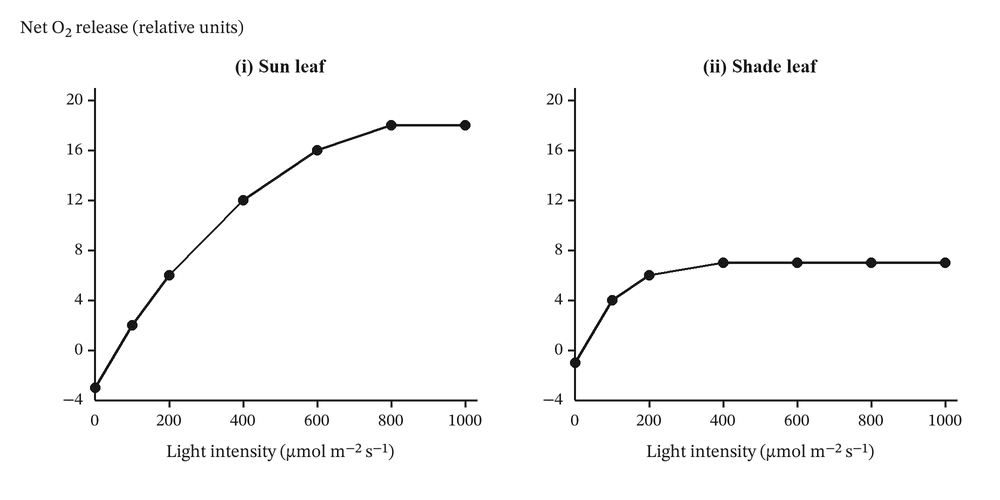
(a) Which leaf has the higher net O₂ release at a light intensity of 100, and which at 600? (1 mark)
(b) The light intensity at which net O₂ release is zero is called the light compensation point. Using the readings at 0 and 100, and assuming the rate changes in a straight line between them, estimate this point for each leaf. Why is a low value an advantage to the shade leaf? (2 marks)
(c) Above about 400 units, the shade leaf's rate stops rising. Name this point, and state what may happen to the chlorophyll of the shade leaf if its branch is suddenly exposed to full sunlight. (1 mark)
- 211 mark
Question 21
Neem trees beside a highway near a cement factory in Rajasthan have leaves coated with a layer of fine grey dust. Their rate of photosynthesis is lower than that of clean leaves on neem trees a few kilometres away. Which explanation is the most likely?
- 221 mark
Question 22
A farmer runs a polyhouse at Leh in Ladakh, about 3,500 m above sea level, where the air pressure is about 65% of that at sea level. CO₂ makes up about 0.042% (about 420 ppm, the global average in 2023) of the air both at Leh and at sea level. Which statement about the CO₂ available to the farmer's tomato plants is correct?
- 234 marks
Question 23
Grape growers near Nashik often ‘girdle’ the trunk of Thompson Seedless vines soon after the berries set. A narrow ring of bark, about 4 mm wide and including the phloem, is cut away all round the trunk. The wood (xylem) is not cut, and the wound heals in about four weeks. (Hypothetical data.)
Measurement Girdled vines Ungirdled vines Mean mass of one berry at harvest (g) 5.6 4.2 Starch in the roots three weeks after girdling (% of dry mass) 5 9 Leaves wilted? No No (a) Calculate the percentage increase in berry mass caused by girdling. (1 mark)
(b) Explain why girdling increased the berry mass but lowered the starch in the roots. (2 marks)
(c) Why do the leaves of girdled vines not wilt, and why must the ring be narrow enough to heal? (1 mark)
- 244 marks
Question 24
In a soil-science laboratory in Ludhiana, moist field soil is mixed with ammonium sulphate and kept in a dark incubator at 25 °C. A second sample of the same soil is first sterilised by heating in an autoclave and then treated in the same way. The amounts of three forms of nitrogen added to the soil are measured every 3 days, in mg of nitrogen per kg of soil (amounts already present in the soil at the start are subtracted). (Hypothetical data.)
Day 0 3 6 9 12 15 Ammonium (NH₄⁺) 100 80 45 15 5 2 Nitrite (NO₂⁻) 0 12 25 15 3 1 Nitrate (NO₃⁻) 0 8 30 70 92 97 In the sterilised soil, ammonium stayed at 100 and no nitrite or nitrate appeared.
(a) Describe the changes in the unsterilised soil, and name a bacterium that carries out each of the two steps. (2 marks)
(b) The soil was kept in the dark. From where do these bacteria get the energy and the carbon to make their carbohydrates? (1 mark)
(c) What does the result with the sterilised soil show, and what does the constant total of the three forms of nitrogen show? (1 mark)
- 251 mark
Question 25
Assertion (A): The sugars made in leaves travel through the phloem mainly in the form of sucrose.
Reason (R): Sieve tubes are loaded with sugar at the source and unloaded at the sink, and this needs energy from ATP.
- 267 marks
Question 26
Match the following:
Column I Column II 1. Van Helmont (a) C₃ pathway 2. Joseph Priestly (b) Fixation of CO₂ by isolated chloroplasts 3. Blackman (c) Experiment with willow twig 4. Calvin (d) Law of limiting factors 5. Arnon (e) Gave the term phlogiston for the air produced by burning candle 6. Hatch and Slack (f) Photolysis of water in the presence of an electron acceptor 7. Hill (g) C₄ cycle - 275 marks
Question 27
Match the following:
Column I Column II 1. Carboxylation (a) Involves three organelles: chloroplasts, peroxisomes and mitochondria 2. C4 pathway (b) Splitting of water molecule and formation of ATP and NADPH 3. Photorespiration (c) Addition of CO₂ to Ribulose 1,5 biphosphate 4. CAM pathway (d) First product of photosynthesis is oxalic acid 5. Photochemical phase (e) Stomata open during the night and photorespiration is negligible. - 285 marks
Question 28
Read the sources given and answer any four from the questions given below.
Scientists Emerson and Arnold observed that all the chlorophyll molecules do not bring about the photochemical reaction. A group of 200–300 pigment molecules, called the photosynthetic unit, act together. They are organised into two types of complex known as photosystem I (PS I) and photosystem II (PS II) which work in coordination. Each photosystem has a single chlorophyll a molecule called the reaction centre that performs the photochemical reaction and the rest called the antenna molecules that absorb light energy in different wave lengths of light and transfer it to the reaction centre molecule. Pigment molecules are bound to proteins. In PS I, the reaction centre chlorophyll a molecule absorbs maximum light at 700 nm, hence is called P700 while in PS II, the reaction centre molecule absorbs maximum light at 680 nm and is so called P680.
(1) The photochemical reaction in a plant is carried by
(a) a group of 200–300 chlorophyll molecules
(b) chlorophyll a molecules present in antenna
(c) chlorophyll a molecule present in reaction centre
(d) proteins bound to the pigments
(2) In PS I, the function of antenna molecules is to
(a) absorb light at 700 nm
(b) absorb light at 680 nm
(c) carry photosynthetic reaction
(d) absorb light energy and transfer it to the reaction centre molecule
(3) The reaction centre of a photosystem consists of
(a) one molecule of chlorophyll a
(b) two molecules of chlorophyll a
(c) P700 and P680
(d) PSI and PSII
(4) P700 refers to the following
(a) Chlorophyll a molecule
(b) reaction centre absorbing light at 700 nm
(c) antenna molecules absorbing light at 700 nm
(d) antenna molecules absorbing light
(5) In _____________, the reaction centre molecule absorbs maximum light in 680 nm.
(a) PS I
(b) PS II
(c) chlorophyll a
(d) antenna molecules
- 295 marks
Question 29
Read the sources given and answer any four from the questions given below.
In the dark reaction there is the fixation of carbon dioxide. During dark reaction, energy released from ATP, NADPH (products of the light reaction) is utilised for the fixation of carbon from carbon dioxide in the carbon compound (sugars like glucose). The fact that non-photochemical process (dark reaction process) is involved in the photosynthesis was established by Blackman (1905). But it was only after 1946 that usage of radioactive and other modern sophisticated techniques could elucidate recent concept of photosynthesis and Calvin and his co-workers proposed the pathway of CO₂ reduction. The use of radioactive ¹⁴C-labelled compound by Calvin and his co-workers gave a new impetus to work on CO₂ fixation. They observed that carbon reduction is a cyclic process and the first stable product is 3-phosphoglyceric acid (3-carbon compound). The entire process of photosynthesis runs in a cyclic fashion which includes formation of hexose sugars or starch and regeneration of ribulose diphosphate.
(1) Dark reaction as non-photochemical reaction was established by
(a) Calvin
(b) Kelvin
(c) Blackman
(d) CO₂ fixation
(2) Which of the following radioactive elements was used to study CO₂ fixation reactions?
(a) water
(b) oxygen
(c) hydrogen
(d) carbon
(3) The first stable product identified in CO₂ reduction was
(a) 3-phosphoglutamic acid
(b) 3-phosphoglyceric acid
(c) ribulose diphosphate
(d) hexose sugar
(4) Which of the following statements is true for dark reaction?
(a) ATP is formed
(b) NADPH is a product
(c) ATP is utilised
(d) Occurs only at night
(5) During dark reaction carbon is fixed
(a) from CO₂ to ribulose diphosphate
(b) from carbon compounds to CO₂
(c) from CO₂ to water
(d) from CO₂ to glucose
- 305 marks
Question 30
Read the sources given and answer any four from the questions given below.
In the process of carbon fixation, RuBP carboxylase (RuBisCO) a key enzyme in photosynthesis, fixes carbon dioxide (CO₂) into an organic molecule during the first stage of the Calvin cycle. But it has been seen that high concentration of oxygen inhibits photosynthesis because RuBisCO initiates a pathway called photorespiration, in which the same enzyme accepts O₂ and is called RuBP oxygenase. Photorespiration wastes energy and decreases sugar synthesis. It leads to wasteful loss of ATP and NADPH₂ and the already-fixed carbon. It involves three organelles—chloroplasts, peroxisomes and mitochondria. It occurs in light and has no relation to normal respiration. It has a useful role in protecting the plants from photo-oxidative damage under conditions of high light and temperature and limited CO₂ supply.
(1) During photorespiration the enzyme RuBisCO
(a) binds with CO₂
(b) binds with sugars
(c) binds with O₂
(d) binds with ATP
(2) Photorespiration occurs when
(a) O₂ is abundant
(b) O₂ is limited
(c) light is limited
(d) temperature is very low
(3) Photorespiration in plants leads to _____________ in plants.
(a) loss of already fixed carbon
(b) gain of less ATP
(c) loss of H₂O
(d) Calvin cycle
(4) Photorespiration involves the following organelles
(a) chloroplasts, mitochondria, oxisomes
(b) chloroplasts, mitochondria, peroxisomes
(c) chromoplasts, mitochondria, oxisomes
(d) chromoplasts, mitochondria, peroxisomes
(5) Which of the following statement is true for photorespiration?
(a) occurs always along with respiration
(b) occurs during both day and night
(c) occurs during limited O₂ supply
(d) is independent of normal respiration
- 314 marks
Question 31
In a T.S. of a leaf given.

(i) Label the parts a, b, c, d and e.
(ii) What is the role of b?
(iii) What role does part 'e' play?
(iv) Name the gas that will diffuse during the day in the direction of arrow in f and in g.
- 326 marks
Question 32
Given below is a diagrammatic representation of the internal structure of an organelle found in a plant cell, study the same and then answer the questions that follow:

(i) Identify the organelle.
(ii) Name the physiological process occurring in this organelle.
(iii) Mention one way in which this process is beneficial to man.
(iv) Name the phases of the process occurring in the part labelled 'a' and 'b'.
(v) A chemical substance 'NADP' plays an active part in one of the phases. Give the expanded form of NADP and state its role in the above process.
(vi) Represent the physiological process mentioned in (ii) above in the form of a chemical equation.
- 335 marks
Question 33
(i) Draw a neat and well-labelled diagram of the chloroplast.
(ii) List the events taking place in the photo-chemical phase of photosynthesis.
(iii) If you are planning an experiment to show the effect of light on the photosynthesis:
(1) Will you select white light or green light? Justify your answer.
(2) Why would you select a destarched plant?
- 343 marks
Question 34
Even though a very few cells in C₄ plant carry out the biosynthetic—Calvin pathway, yet they are highly productive. Can you discuss why?
- 353 marks
Question 35
RuBisCO is an enzyme that acts both as a carboxylase and oxygenase. Why do you think RuBisCO carries out more carboxylation in C₄ plants?
- 363 marks
Question 36
Figure shows the effect of light on the rate of photosynthesis. Based on the graph, answer the following questions:
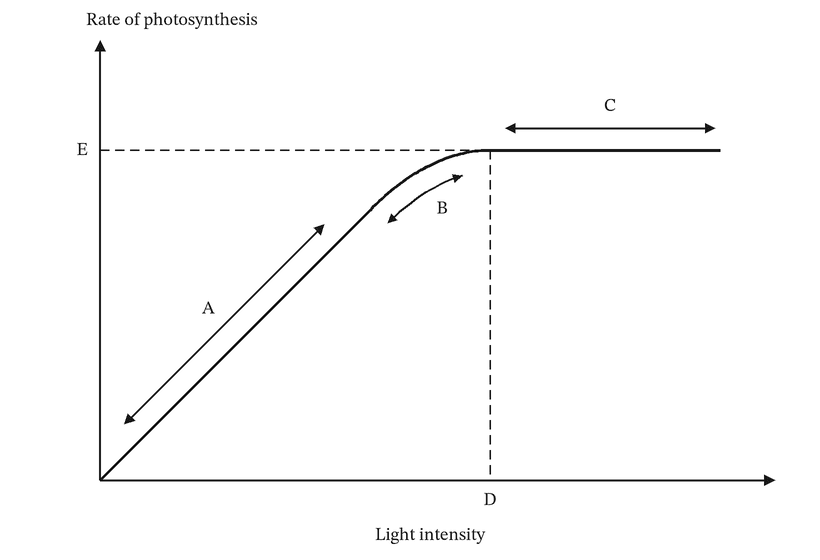
(i) At which point/s (A, B or C) in the curve is light a limiting factor?
(ii) What could be the limiting factor/s in region A?
(iii) What do C and D represent on the curve?
- 371 mark
Question 37
In a normal C₃ leaf, the glycine made in photorespiration is turned into serine and CO₂ in the mitochondria, and the serine is then changed back into 3-PGA, which returns to the Calvin cycle in the chloroplast. A research group grows a mutant barley plant whose mitochondria cannot turn glycine into serine. In bright light, the mutant grows as well as normal barley in air enriched to 1% CO₂. When it is moved into normal air (about 0.04% CO₂ and 21% O₂) in the same bright light, glycine piles up in its leaves, its CO₂ fixation falls steeply and the leaves turn yellow within a few days. (Hypothetical data.)
Which explanation fits these observations best?
- 381 mark
Question 38
A pineapple farm and a maize farm lie side by side in Tripura. Over the same hot, dry fortnight, scientists measure how much water each crop loses for every gram of CO₂ that it fixes.
Assertion (A): The pineapple crop loses far less water for each gram of CO₂ fixed than the maize crop.
Reason (R): Pineapple fixes CO₂ with RuBisCO at night, when RuBisCO is not slowed down by photorespiration.
- 393 marks
Question 39
A teacher in Kanpur uses a simple scheme of the light reaction for a class exercise. In this scheme:
- each pair of electrons that passes from water to NADP⁺ by non-cyclic photophosphorylation gives 1 NADPH and 1 ATP;
- each pair of electrons that goes round the cyclic path through photosystem I gives 2 ATP and no NADPH.
The Calvin cycle uses 3 ATP and 2 NADPH for each CO₂ fixed. A leaf cell fixes 6 CO₂ to make one molecule of glucose.
(a) How many ATP and NADPH does the Calvin cycle need for this, and how many ATP are left short when non-cyclic photophosphorylation alone makes all the NADPH? (1 mark)
(b) How many pairs of electrons must go round the cyclic path to make up the shortfall? (1 mark)
(c) A mutant cannot use the cyclic path at all, while its non-cyclic path works normally. Predict what happens to the level of 3-PGA in its chloroplasts and to its release of O₂ in bright light. Give reasons. (1 mark)
- 405 marks
Question 40
Sugarcane, a C₄ plant, is one of the most productive crops in India. On a farm near Mandya in Karnataka, an agricultural officer measures one sugarcane crop over its whole 12-month life. The sunlight falling on the field adds up to 7,000 MJ per square metre, and about 45% of this energy is photosynthetically active radiation (PAR, 400–700 nm). At harvest the crop holds 4.0 kg of dry matter per square metre (stems, leaves and roots), and each kilogram of this dry matter stores 17.5 MJ of chemical energy. (Hypothetical data.)
Use these facts: fixing one CO₂ in the Calvin cycle needs at least 8 photons; one mole of red photons (680 nm) carries about 175 kJ; and one mole of glucose stores about 2,870 kJ.
(a) Calculate the percentage of the sunlight energy that the crop stored as dry matter. (1 mark)
(b) Treating all PAR as red light, calculate the largest percentage of the light energy absorbed that can be stored in glucose. Use it to find the upper limit for the percentage of all the sunlight that a crop could store. (2 marks)
(c) A seed company claims that its new sugarcane variety will store 10% of the sunlight falling on a field over a season. Using your answers and what you know about photosynthesis, judge whether this claim is believable. Give two reasons for the gap between the field value in (a) and the limit in (b). (2 marks)