
Question 805 marksMedium
What led to the evolution of C₄ pathway of photosynthesis? Describe in detail.
Confirming your payment
Sign up now and get 250 free tokens.
Photosynthesis in Higher Plants · Question 80 of 84
What led to the evolution of C₄ pathway of photosynthesis? Describe in detail.
Solution:
Concept: RuBisCO cannot fully tell CO₂ from O₂; when O₂ wins, photorespiration wastes carbon.
Step 1 — The problem: In C₃ plants RuBisCO is exposed to air with much more O₂ than CO₂. At high temperature and light, and when stomata close to save water, the O₂ : CO₂ ratio rises, so RuBisCO's oxygenase activity increases and about a quarter of fixed carbon (more in hot, dry weather) is lost in photorespiration.
Step 2 — The pressure: Plants of hot, bright and dry tropical habitats therefore lost much carbon; scientists link the rise of C₄ plants to such climates at times when CO₂ in the air was low.
Step 3 — The solution: a CO₂ pump: C₄ plants put PEP carboxylase, an enzyme present in small amounts in all plants, to a new use. Made in large amounts in the mesophyll, it uses HCO₃⁻, does not react with O₂ and works well at low CO₂, so it fixes CO₂ first into C₄ acids.
Step 4 — Kranz anatomy: These acids release CO₂ inside the thick-walled bundle-sheath cells, which let only a little CO₂ leak back out and hold RuBisCO; the high CO₂ there makes RuBisCO act almost only as a carboxylase.
Step 5 — The result: Photorespiration becomes negligible; C₄ plants have a higher temperature optimum, high light saturation, better water use and higher productivity, though they spend 5 ATP instead of 3 per CO₂.
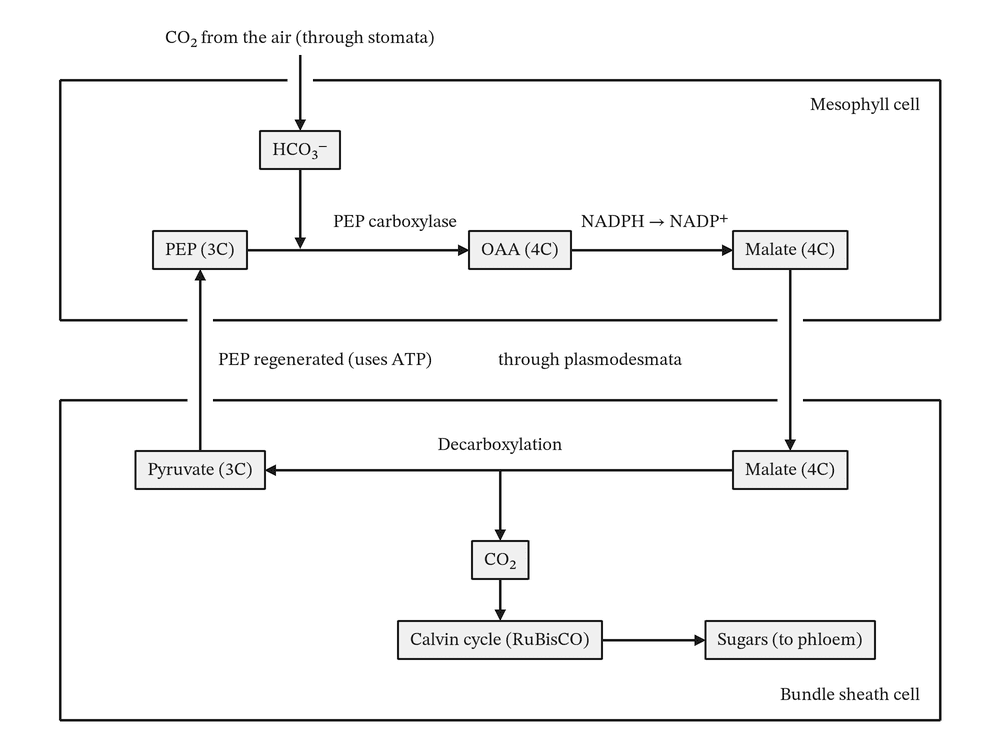
Therefore, the C₄ pathway evolved to overcome photorespiration in hot, bright, dry conditions by concentrating CO₂ around RuBisCO in the bundle-sheath cells.