
Question 795 marksMedium
Discuss the mechanism of Hatch-Slack pathway in C₄ plants.
Confirming your payment
Sign up now and get 250 free tokens.
Photosynthesis in Higher Plants · Question 79 of 84
Discuss the mechanism of Hatch-Slack pathway in C₄ plants.
Solution:
Concept: The Hatch–Slack (C₄) pathway is a CO₂ pump that works across the two cell types of Kranz anatomy.
Step 1 — Fixation in mesophyll: CO₂ entering the leaf dissolves as HCO₃⁻ in the mesophyll cytoplasm; PEP carboxylase adds it to phosphoenolpyruvate (PEP, 3C), giving oxaloacetic acid (OAA, 4C).
Step 2 — Conversion and transport: OAA is reduced to malic acid (malate) using NADPH (in some plants it is changed to aspartate), which moves through plasmodesmata into the bundle-sheath cells.
Step 3 — Decarboxylation: In the bundle-sheath chloroplasts malate is decarboxylated, releasing CO₂ and pyruvate (3C); the CO₂ concentration there becomes many times that in a C₃ leaf.
Step 4 — Calvin cycle: The released CO₂ is fixed by RuBisCO in the normal Calvin cycle, and the sugars pass to the phloem; photorespiration is almost absent.
Step 5 — Regeneration of PEP: Pyruvate returns to the mesophyll, where it is converted back to PEP using ATP (2 extra ATP per CO₂), so each CO₂ costs 5 ATP and 2 NADPH.
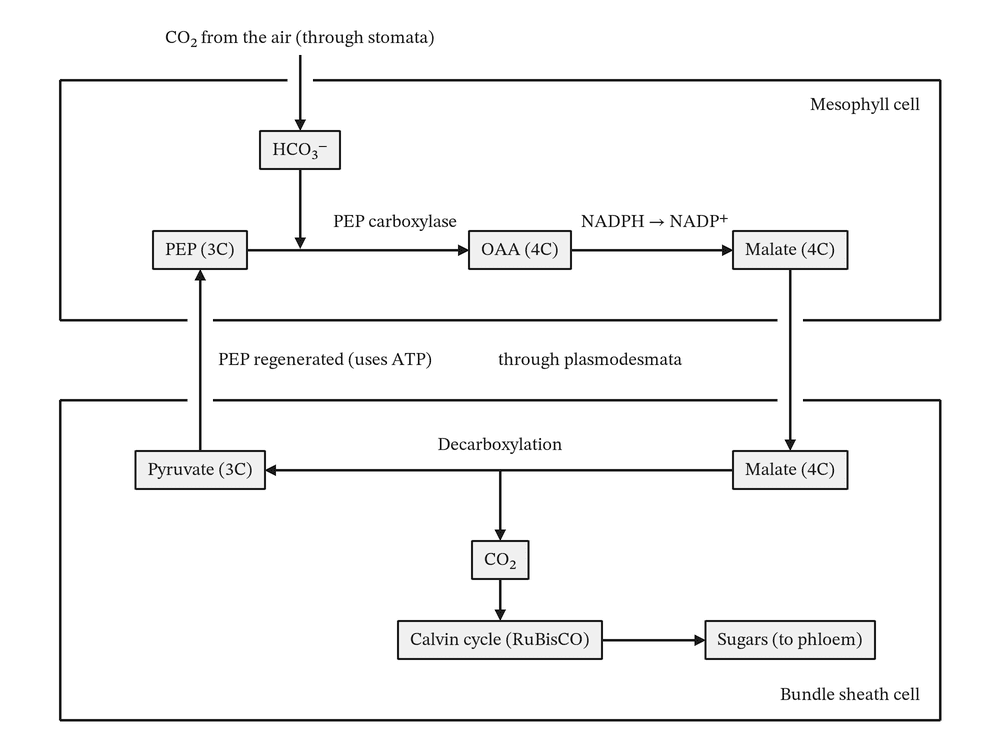
Therefore, in the Hatch–Slack pathway PEP fixes CO₂ into OAA and malate in the mesophyll, malate releases CO₂ in the bundle sheath for the Calvin cycle, and pyruvate returns to remake PEP.