
Opening your dashboard
Class 11 Biology Chapter 18 Photosynthesis in Higher Plants: Practice Questions
142 questions on Chapter 18, each worked through on its own page with the AI tutor. Class 11 Biology, ICSE 2026-27.
142 questions
1–4 marks · Mixed difficulty
- 11 mark
Question 1
In an isotope experiment, a green alga was given water and carbon dioxide containing different proportions of the heavy oxygen isotope ¹⁸O, and the oxygen gas it released was analysed. (Hypothetical data.)
Experiment ¹⁸O in water ¹⁸O in CO₂ ¹⁸O in O₂ released I 0.85% 0.20% 0.85% II 0.20% 0.68% 0.20% Which conclusion do these results support?
- 23 marks
Question 2
Van Niel studied photosynthetic sulphur bacteria and proposed a general equation for photosynthesis:
Here (CH₂O) stands for one carbon's share of a carbohydrate, and H₂A is the substance that supplies hydrogen.
(a) Name H₂A and A for a green plant and for a green sulphur bacterium.
(b) Show that the equation is balanced when it is written for the sulphur bacterium.
(c) Explain what Van Niel's idea predicted about the source of the oxygen released by green plants.
- 31 mark
Question 3
A student repeated a famous experiment. A 2.0 kg willow sapling was planted in 90.00 kg of oven-dried soil and watered only with rainwater for five years. The tree then weighed 68.0 kg, and the oven-dried soil weighed 89.94 kg. (Hypothetical data.) Which conclusion do these data alone justify?
- 43 marks
Question 4
A candle was burnt inside each of two sealed glass bell jars, A and B, until it went out because the air could no longer support burning. A healthy potted mint plant was then placed in each jar without letting in fresh air. Jar A was kept in sunlight and jar B in a dark cupboard for a week. Each candle was then relit from outside by focusing sunlight on its wick with a lens.
(a) Predict whether the candle burns in each jar.
(b) Explain the result in jar A.
(c) Name the scientist whose work explains the difference between jars A and B, and state what he showed.
- 51 mark
Question 5
Chloroplasts isolated from leaves were suspended in water containing an electron acceptor, but no carbon dioxide was supplied. On illumination, oxygen was released and the acceptor was reduced. What does this experiment show most directly?
- 63 marks
Question 6
A leaf extract was run on a paper chromatogram using petroleum ether and acetone (9 : 1) as the solvent. The figure shows the strip after the run, with four bands P, Q, R and S. (Hypothetical data.)
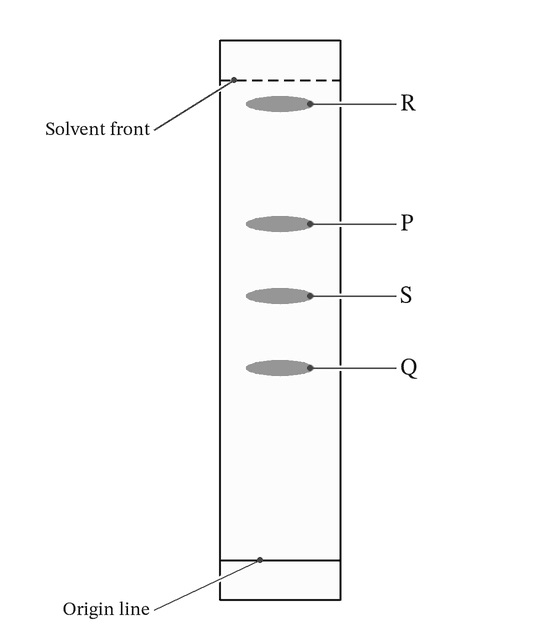
The distances moved from the origin line were:
Band P Q R S Distance moved (cm) 8.4 4.8 11.4 6.6 The solvent front moved 12.0 cm. For this solvent, a reference card gives these Rf values: carotene 0.95, xanthophyll 0.70, chlorophyll a 0.55, chlorophyll b 0.40.
(a) Calculate the Rf value of each band.
(b) Identify the pigment in each band.
(c) Which of these pigments are accessory pigments?
- 71 mark
Question 7
Chloroplasts were broken open and separated into two fractions: the thylakoid membranes and the stroma. Tube 1 held the thylakoids with water, ADP, inorganic phosphate (Pi) and NADP⁺, and was kept in light. Tube 2 held the stroma with CO₂, ATP, NADPH and ribulose bisphosphate (RuBP), and was kept in the dark. Which result is expected?
- 83 marks
Question 8
Both a cyanobacterium (blue-green alga) and a mesophyll cell of a spinach leaf carry out photosynthesis. Give three differences between them in where their photosynthetic pigments are held and in the kinds of pigments they contain.
- 91 mark
Question 9
A mutant maize seedling cannot make carotenoids. In dim light it is pale green, but in bright sunlight its leaves soon turn white and the seedling dies. Which is the best explanation?
- 102 marks
Question 10
An acetone extract of spinach leaves contained 2.4 mg of chlorophyll a and 0.8 mg of chlorophyll b per gram of leaf. (Hypothetical data.)
(a) Calculate the ratio of chlorophyll a to chlorophyll b, and the fraction of the total chlorophyll that is chlorophyll b.
(b) State the different role each of these two chlorophylls plays in the light reaction.
- 113 marks
Question 11
A student placed a shoot of Hydrilla in dilute sodium hydrogencarbonate solution and counted the oxygen bubbles it released per minute when a lamp shone on it through filters of different colours. The bar chart shows the mean counts. (Hypothetical data.)

(a) Which two colours of light gave the highest rates of photosynthesis?
(b) Explain why the rate under the green filter was the lowest, though not zero.
(c) Name two conditions the student must keep the same for every filter, and explain why.
- 121 mark
Question 12
Pigment Y, extracted from the leaves of a plant, absorbs most strongly at 530 nm. The action spectrum of the same leaves shows a low rate of photosynthesis at 530 nm and high rates at 430 nm and 660 nm. (Hypothetical data.) What is the most reasonable conclusion about pigment Y?
- 131 mark
Question 13
A filament of the green alga Cladophora was lit with light split into a spectrum by a prism, so that different parts of the filament received different colours. Aerobic bacteria in the water gathered mostly around the parts lit by blue and red light. Why do the bacterial clusters show where photosynthesis is fastest?
- 143 marks
Question 14
The table gives the relative absorption of three pigments extracted from a leaf, and the rate of photosynthesis of the leaf (as a percentage of its highest rate), at five wavelengths. (Hypothetical data.)
Wavelength (nm) 430 460 490 600 660 Chlorophyll a absorption 90 40 10 20 85 Chlorophyll b absorption 45 95 25 25 20 Carotenoid absorption 55 90 75 0 0 Rate of photosynthesis (%) 88 86 60 30 100 (a) At which two wavelengths is the rate of photosynthesis much higher than the absorption by chlorophyll a alone would suggest?
(b) Which pigments account for the rate at these wavelengths, and how does the energy they absorb reach the reaction centre?
(c) What does this show about how the action spectrum of a leaf compares with the absorption spectrum of chlorophyll a?
- 151 mark
Question 15
Small herbs growing on the floor of a dense forest photosynthesise slowly even at midday. Which reason relates best to the quality (colour) of the light that reaches them?
- 161 mark
Question 16
Isolated chloroplasts supplied with water, ADP, inorganic phosphate and NADP⁺ are lit only with light of wavelength longer than 680 nm. Which process continues?
- 173 marks
Question 17
In the light reaction, water is split and NADP⁺ is reduced:
(a) How many NADPH can be formed from the electrons released when one O₂ molecule is produced?
(b) The Calvin cycle uses 12 NADPH to fix the 6 CO₂ needed for one glucose. How many O₂ molecules are released while these 12 NADPH are being formed?
(c) In non-cyclic electron flow each electron is raised to a higher energy level twice, once at PS II and once at PS I, and each raise uses one photon. Find the minimum number of photons needed to release one O₂ molecule.
- 181 mark
Question 18
A plant is deficient in manganese, which, together with calcium and chloride ions, is needed by the water-splitting complex of photosystem II. Which step of the light reaction fails first?
- 193 marks
Question 19
Grana stacks and stroma lamellae were separated from spinach chloroplasts. Each fraction was lit in the presence of water, ADP, inorganic phosphate and NADP⁺. (Hypothetical data.)
Fraction O₂ released NADPH formed ATP formed Grana stacks yes yes yes Stroma lamellae no no yes Explain these results in terms of where photosystem I and photosystem II are found.
- 202 marks
Question 20
(a) Arrange these components in the order in which an electron passes through them in non-cyclic photophosphorylation, starting from water:
plastocyanin, ferredoxin, P680, NADP⁺, plastoquinone, P700, cytochrome complex
(b) At which two components in your sequence is light energy absorbed to raise the electron to a higher energy level?
- 211 mark
Question 21
In illuminated thylakoids the pH of the lumen was 5.0 and the pH of the stroma was 8.0. (Hypothetical data.) How many times greater is the hydrogen ion concentration in the lumen than in the stroma?
- 223 marks
Question 22
In a well-known experiment, isolated thylakoids were soaked in the dark in an acid solution of pH 4 until the inside of the thylakoids (the lumen) also reached pH 4. They were then moved quickly, still in the dark, into a solution of pH 8 containing ADP and inorganic phosphate. A burst of ATP was formed for a short time.
(a) Why was ATP formed even though there was no light?
(b) Why did ATP formation stop after a short time?
(c) What does this experiment show about the role of light in ATP synthesis in chloroplasts?
- 231 mark
Question 23
Which of the following does NOT help to build up the proton gradient across the thylakoid membrane in light?
- 242 marks
Question 24
A chemical X makes the thylakoid membrane leaky to H⁺ ions but does not block any electron carrier. Illuminated chloroplasts treated with X still release O₂ and reduce NADP⁺, but form almost no ATP. Explain these results.
- 254 marks
Question 25
Both chloroplasts and mitochondria make ATP by chemiosmosis. Give four differences between the two organelles in how this happens.
- 261 mark
Question 26
Chlorella cells photosynthesising in light were given ¹⁴CO₂, and samples were killed at different times. The table shows the share of the total ¹⁴C found in each compound. (Hypothetical data.)
Time after adding ¹⁴CO₂ 3-PGA Triose phosphates Hexose phosphates Sucrose 2 s 85% 10% 5% 0% 10 s 50% 25% 20% 5% 60 s 20% 20% 35% 25% Which conclusion is best supported?
- 273 marks
Question 27
Sucrose (C₁₂H₂₂O₁₁) is made in the cytoplasm of a leaf cell from triose phosphates exported by the chloroplasts. For a C₃ plant making one molecule of sucrose entirely from newly fixed CO₂, find:
(a) the number of CO₂ molecules fixed and the number of turns of the Calvin cycle;
(b) the number of ATP and NADPH molecules used by the Calvin cycle;
(c) the number of triose phosphate molecules exported from the chloroplasts.
- 281 mark
Question 28
Leaves of a C₃ plant were photosynthesising steadily in bright light with plenty of CO₂. The light was then suddenly switched off. In the next few seconds, how do the amounts of RuBP and 3-PGA in the chloroplasts change?
- 293 marks
Question 29
In three turns of the Calvin cycle, 3 CO₂ are fixed by 3 RuBP and 6 molecules of glyceraldehyde 3-phosphate (G3P, a 3-carbon sugar) are formed. Five G3P are used to regenerate RuBP and one leaves the cycle.
(a) By counting carbon atoms, show that five G3P can make exactly three RuBP.
(b) Show that the one G3P that leaves the cycle carries all the carbon newly fixed in these three turns.
(c) Explain what would happen to the cycle if all six G3P were removed to make sugars.
- 301 mark
Question 30
In Calvin's experiments, samples of Chlorella were dropped into hot methanol at intervals of a few seconds after ¹⁴CO₂ had been supplied. Why was this done?
- 313 marks
Question 31
Leaves of two plants, P and Q, were given ¹⁴CO₂ in bright light. The table shows the share of the ¹⁴C found in two groups of compounds after 2 seconds and after 60 seconds; the rest of the label was in other compounds. (Hypothetical data.)
Plant Time Malate and oxaloacetate 3-PGA P 2 s 5% 85% P 60 s 5% 30% Q 2 s 90% 6% Q 60 s 40% 30% (a) Which plant uses the C₄ pathway? Give the evidence.
(b) Explain the order in which the label appears in plant Q, naming the cells and enzymes involved.
(c) Why does plant P show so little label in malate?
- 321 mark
Question 32
In C₃ plants the Calvin cycle uses 3 ATP for each CO₂ fixed. A C₄ plant uses 2 more ATP for each CO₂, to regenerate PEP in its mesophyll cells. How many ATP does sugarcane, a C₄ plant, use in all to fix the CO₂ for one sucrose molecule (12 carbon atoms)?
- 333 marks
Question 33
Thin cross-sections of two leaves were examined under a microscope.
Leaf X: Each vein is surrounded by a ring of large, thick-walled cells packed with chloroplasts that have few or poorly developed grana; the mesophyll cells form a ring around this layer.
Leaf Y: There are distinct palisade and spongy mesophyll layers; the cells around each vein are small and contain few chloroplasts.
(a) Which leaf belongs to a C₄ plant? Name its type of leaf anatomy.
(b) In each leaf, name the cells in which RuBisCO fixes CO₂ in the Calvin cycle.
(c) In the C₄ leaf, in which cells, and in which part of those cells, does PEP carboxylase act?
- 343 marks
Question 34
The graph shows the acidity of the cell sap of a pineapple leaf, measured every 3 hours over one day. The light period lasted from 06:00 to 18:00. (Hypothetical data.)

(a) During which period are the stomata of this leaf open? Give the evidence from the graph.
(b) Explain why the acidity falls between 06:00 and 18:00.
(c) How does this daily pattern help the plant in a hot, dry habitat?
- 351 mark
Question 35
Which single observation is enough to show that a plant uses the C₄ pathway?
- 361 mark
Question 36
On a hot, dry afternoon the stomata of a wheat crop (a C₃ plant) partly close. Why does photorespiration in the leaves increase?
- 373 marks
Question 37
In a leaf, 100 molecules of RuBP react with O₂ instead of CO₂ during a short period. (Hypothetical data.)
(a) How many molecules of 2-phosphoglycolate and of 3-PGA are formed directly by this reaction?
(b) The glycolate formed is converted to glycine. In the mitochondria, two glycine molecules (2 carbon atoms each) form one serine (3 carbon atoms) and one CO₂. How many CO₂ molecules are released from the glycolate of part (a)?
(c) What percentage of the carbon in that glycolate is lost as CO₂, and what happens to the rest?
- 381 mark
Question 38
As the temperature of a C₃ leaf rises from 25 °C to 35 °C in bright light, photorespiration increases. Which statement explains this?
- 392 marks
Question 39
Photorespiration takes place only in the light, although none of its own reactions absorbs light. Explain why it occurs only in the light and why it stops within minutes when the leaf is put in the dark.
- 403 marks
Question 40
The rate of CO₂ released by wheat leaves into CO₂-free air was measured at two oxygen concentrations, in light and in the dark. Both oxygen levels lie in the range in which ordinary (dark) respiration does not change with the oxygen level. (Hypothetical data.)
Oxygen in the air CO₂ released in light (units) CO₂ released in the dark (units) 21% 6.0 1.5 12% 3.4 1.5 Assume that ordinary respiration goes on at the same rate in light as in the dark.
(a) Calculate the extra CO₂ released in light (above the dark value) at each oxygen level.
(b) Which process accounts for this extra CO₂? Explain why it is smaller at 12% oxygen.
(c) Why is the CO₂ released in the dark the same at both oxygen levels?
- 414 marks
Question 41
The rate of oxygen release by a C₃ leaf was measured at 25 °C at different light intensities and at two CO₂ concentrations. (Hypothetical data.)
Light intensity (relative units) 1 2 4 6 8 10 Rate at 0.042% CO₂ 5 10 16 18 18 18 Rate at 0.10% CO₂ 5 10 20 28 32 32 (a) Which factor limits the rate at light intensities 1 to 2? Give the evidence.
(b) Which factor limits the rate at light intensities 8 to 10 in 0.042% CO₂? Give the evidence.
(c) By what percentage does raising the CO₂ concentration increase the rate at light intensity 10?
(d) At light intensity 10 and 0.10% CO₂, light is no longer limiting. Suggest how you would find out which factor now limits the rate.
- 421 mark
Question 42
For a C₃ leaf, raising the temperature from 15 °C to 25 °C doubled the rate of photosynthesis in bright light with plenty of CO₂, but hardly changed the rate in very dim light. (Hypothetical data.) What best explains the difference?
- 433 marks
Question 43
A greenhouse grower raises the CO₂ concentration around a tomato crop (a C₃ plant) from the outdoor level of about 0.042% to 0.10%.
(a) Express both concentrations in parts per million (ppm), and find how many times the CO₂ concentration has been increased.
(b) Explain why a C₃ crop gains more from this than a C₄ crop such as maize would.
(c) Name one other factor the grower must keep from becoming limiting.
- 441 mark
Question 44
Leaves of a maize plant growing in nitrogen-poor soil turn pale yellow-green and photosynthesise slowly. Which reason best explains the slow rate?
- 453 marks
Question 45
The net rate of photosynthesis (relative units) of two plots of the same C₃ crop was measured on a hot, sunny day. One plot was well watered; the other was short of water. (Hypothetical data.)
Time 08:00 10:00 12:00 14:00 16:00 Well-watered plot 12 20 24 22 15 Water-short plot 11 16 9 8 12 (a) Describe how the two plots differ between 12:00 and 14:00.
(b) Explain this difference, naming the factor that becomes limiting in the water-short plot.
(c) Suggest why the rate of the water-short plot rises again at 16:00.
- 461 mark
Question 46
In spring, a stored potato tuber is planted and begins to sprout. Before the new shoot has any green leaves, how should the tuber and the growing shoot be described?
- 473 marks
Question 47
In sugarcane, sucrose made in the leaves is carried in the phloem and stored in the stem.
(a) Which part acts as the source and which as the sink?
(b) Using the pressure flow (mass flow) hypothesis, explain how loading sucrose at the source and unloading it at the sink make the phloem sap flow.
(c) Why does translocation of sucrose need ATP?
- 481 mark
Question 48
A soil bacterium gets its energy by oxidising nitrite ions (NO₂⁻) to nitrate ions (NO₃⁻), and uses this energy to make carbohydrates from CO₂. Which organism fits this description?
- 493 marks
Question 49
Both photosynthesis in green plants and chemosynthesis in bacteria such as Nitrosomonas make carbohydrates from carbon dioxide. Give one way in which they are similar and two ways in which they differ.
- 502 marks
Question 50
Around hot-water vents on the deep ocean floor, where no sunlight reaches, there are dense communities of worms, clams and crabs. The vent water is rich in hydrogen sulphide (H₂S). Explain how the food chains here can be based on bacteria instead of green plants.
- 511 mark
Question 51
The process in which light energy is converted into chemical energy is called
- 521 mark
Question 52
The role of chlorophyll during photosynthesis is that of a
- 531 mark
Question 53
Light reaction takes place in the
- 541 mark
Question 54
Oxygen evolved during photosynthesis comes from
- 551 mark
Question 55
Porphyrin ring of the chlorophyll molecule has following number of pyrrole rings
- 561 mark
Question 56
The first step in photosynthesis is
- 571 mark
Question 57
Calvin cycle takes place
- 581 mark
Question 58
Chlorophyll molecule appears green because it
- 591 mark
Question 59
Role of oxygen in photosynthesis is as a
- 601 mark
Question 60
Cyclic photophosphorylation involves
- 611 mark
Question 61
A cell that lacks chloroplasts does not
- 621 mark
Question 62
The primary pigment molecule of PS I is
- 631 mark
Question 63
First electron donor in cyclic photophosphorylation is
- 641 mark
Question 64
The first acceptor of CO₂ in Calvin cycle is
- 651 mark
Question 65
The enzyme required for CO₂ fixation in Calvin cycle is
- 661 mark
Question 66
The first carbohydrate, a 3C sugar produced during photosynthesis is
- 671 mark
Question 67
The first product of C₄ pathway is
- 681 mark
Question 68
Photorespiration involves
- 691 mark
Question 69
The first acceptor of CO₂ in C₄ pathway is
- 701 mark
Question 70
In photosynthesis CO₂ combines with
- 711 mark
Question 71
Photosynthesis is correctly explained by the equation
- 721 mark
Question 72
Photosynthetically active radiation (PAR) has the following range of wavelength
- 731 mark
Question 73
Plants adapted to low light intensity have
- 741 mark
Question 74
Law of limiting factors was proposed by
- 751 mark
Question 75
In C₄ plants, synthesis of sugars/final CO₂ fixation occurs in
- 761 mark
Question 76
Phenomenon which converts light energy into chemical energy is
- 771 mark
Question 77
Chloroplast lacks
- 781 mark
Question 78
Chlorophyll in chloroplasts is located in
- 791 mark
Question 79
As compared to C₃ plants, how many additional molecules of ATP are needed for net production of one hexose sugar molecule by C₄ plants?
- 801 mark
Question 80
Dark reaction occurs
- 811 mark
Question 81
During photorespiration, the oxygen consuming reaction (s) occur in
- 821 mark
Question 82
Enzyme involved in fixation of CO₂ in C₄ plants is
(A) PEP carboxylase
(B) RuDP carboxylase
(C) RuDP oxidase
(D) Both (A) and (C)
- 831 mark
Question 83
Which electron carrier is common to both photosynthesis and respiration?
- 841 mark
Question 84
The special structure present in C₄ plants is
- 851 mark
Question 85
Non-cyclic photophosphorylation produces
P. NADPH
Q. ATP and O₂
R. ATP only
S. O₂ only
Choose the correct answer
- 861 mark
Question 86
C₄ pathway occurs
(A) only in monocots
(B) in monocots
(C) in most of the dicots
(D) in few dicots
- 871 mark
Question 87
For yielding one molecule of glucose, the Calvin cycle occurs
- 881 mark
Question 88
3-PGA is the first stable product in
- 891 mark
Question 89
Movement of electron from chlorophyll molecules to NADP occurs in
(A) photosystem I
(B) photophosphorylation
(C) photosystem II
(D) photorespiration
- 901 mark
Question 90
Calvin cycle leads to reduction of
- 911 mark
Question 91
First compound that accepts CO₂ during dark phase
- 921 mark
Question 92
C₄ plants are photosynthetically more efficient than C₃ plants because
- 931 mark
Question 93
In C₃ plants, the first stable product of photosynthesis during dark reaction is
- 941 mark
Question 94
The chloroplast pigment is present in the _____ part of the membrane.
- 951 mark
Question 95
The porphyrin ring has a metal atom _______ in the centre.
- 961 mark
Question 96
Chlorophyll a and b have the same structure except that Chl a has ______ group while Chl b has _____ group in side chain.
- 971 mark
Question 97
All pigments except _____ are called accessory pigments.
- 981 mark
Question 98
Visible light has wavelength range of ______.
- 991 mark
Question 99
Non-cyclic photophosphorylation needs a constant supply of _______.
- 1001 mark
Question 100
_____________ is the first product of photosynthesis.
- 1011 mark
Question 101
The enzyme that accepts O₂ during photorespiration is ______.
- 1021 mark
Question 102
Mesophyll chloroplasts of C₄ plants have high concentration of ________ enzyme.
- 1031 mark
Question 103
C₄ plants show ______ type of leaf anatomy.
- 1041 mark
Question 104
Leaves absorb green light and so appear green in colour.
- 1051 mark
Question 105
Photolysis of water takes place during dark reaction in photosynthesis.
- 1061 mark
Question 106
ATP and NADPH molecules formed during light reaction are utilised in the dark reaction.
- 1071 mark
Question 107
Chlorophylls absorb mainly violet-blue and red region of light.
- 1081 mark
Question 108
Dark phase is also called as photochemical phase.
- 1091 mark
Question 109
Dark reaction occurs in the thylakoids of chloroplast.
- 1101 mark
Question 110
Oxygen liberated during photosynthesis comes from CO₂.
- 1111 mark
Question 111
Light energy splits water molecules to hydrogen ions and oxygen ions.
- 1121 mark
Question 112
Light energy activates chlorophyll molecules.
- 1131 mark
Question 113
Photosynthesis occurs maximum in green light.
- 1141 mark
Question 114
Molecules from which oxygen is evolved during photosynthesis.
- 1151 mark
Question 115
Site of light reaction.
- 1161 mark
Question 116
Process of formation of ATP in the presence of light.
- 1171 mark
Question 117
Part of chloroplast where the dark reaction of photosynthesis takes place.
- 1181 mark
Question 118
Scientific term for splitting of water molecules in the presence of light.
- 1191 mark
Question 119
Primary chlorophyll a molecule which is the reaction centre of PS II.
- 1201 mark
Question 120
The primary acceptor of CO₂ in Calvin cycle.
- 1211 mark
Question 121
A pathway to fix CO₂ that occurs in plants growing in dry and hot regions and occurs during the night.
- 1221 mark
Question 122
A process that results in wasteful loss of NADPH and ATP and RuBP combines with oxygen to form phosphoglycolate.
- 1231 mark
Question 123
Phase of photosynthesis in which energy from ATP and NADPH is used to form carbohydrates.
- 1241 mark
Question 124
Assertion (A): Rhoeo leaves contain anthocyanin pigments in epidermal cells.
Reason (R): Anthocyanins are accessory photosynthetic pigments.
- 1251 mark
Question 125
Assertion (A): Cyclic photophosphorylation synthesises ATP.
Reason (R): ATP synthesis in cyclic photophosphorylation is not associated with NADPH formation.
- 1261 mark
Question 126
Assertion (A): Oxidative phosphorylation requires oxygen.
Reason (R): Oxidative photophosphorylation occurs in mitochondria.
- 1271 mark
Question 127
Assertion (A): OAA is the first product of CO₂ fixation in C₃ pathway.
Reason (R): The first product of CO₂ fixation in C₄ pathway is PGA.
- 1281 mark
Question 128
Assertion (A): In C₄ plants, the bundle sheath cells are rich in enzyme phosphoenol pyruvate carboxylase.
Reason (R): In C₄ plants, the mesophyll cells are rich in enzyme ribulose bisphosphate carboxylase oxygenase (RuBisCO).
- 1291 mark
Question 129
Assertion (A): C₄ photosynthetic pathway is more efficient than the C₃ pathway.
Reason (R): Photorespiration is suppressed in C₄ plants.
- 1301 mark
Question 130
Assertion (A): Under conditions of high light intensity and limited CO₂ supply, photorespiration has a useful role in protecting the plants from photo-oxidative damage.
Reason (R): If enough CO₂ is not available to utilise light energy for carboxylation to proceed, the excess energy may not cause damage to plants.
- 1311 mark
Question 131
Assertion (A): Photosynthetically C₄ plants are less efficient than C₃ plants.
Reason (R): The C₄ pathway requires the involvement of only bundle sheath cells.
- 1321 mark
Question 132
Assertion (A): CAM plants lack structural compartmentation of leaf, as found in C₄ plants.
Reason (R): Stomata of CAM plants are open during the day.
- 1331 mark
Question 133
Assertion (A): Plants utilising first RuBP in CO₂ fixation are called C₃ plants.
Reason (R): Plants utilising first PEP in CO₂ fixation are called C₄ plants.
- 1343 marks
Question 134
Observe the set-up given and answer the questions given:
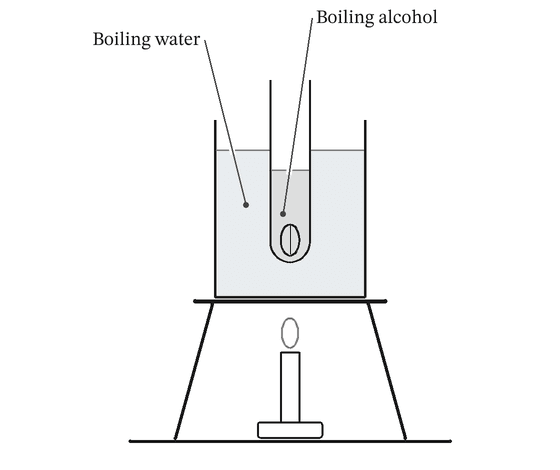
(i) What is the purpose of this set-up?
(ii) Why is alcohol being used in the test-tube?
(iii) To test this leaf for starch, which chemical will it be dipped in?
- 1354 marks
Question 135
(i) What does this experiment show?

(ii) Name the gas evolved in this process.
(iii) What is the source of this gas?
(iv) Name the plant used in this experiment.
- 1363 marks
Question 136
The plant in the set-up shown is kept in the dark for 24 hours. The leaf of this set-up is tested for starch.
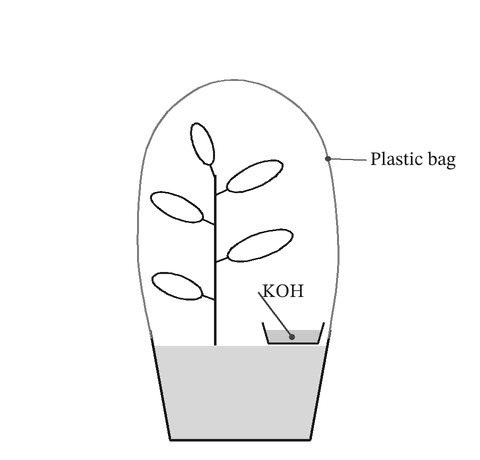
(i) What colour does the leaf show when tested with iodine?
(ii) What is the purpose of KOH?
(iii) What is the aim of this experiment?
- 1373 marks
Question 137
In the diagram drawn alongside
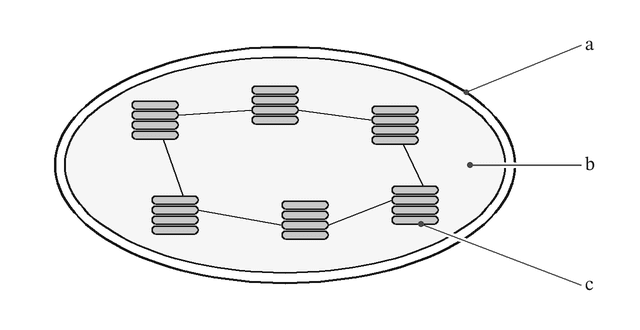
(i) Label the parts a, b and c.
(ii) In which part the light reaction occur?
(iii) Name the part in which the dark phase of photosynthesis occur in.
- 1382 marks
Question 138
By looking at a plant externally can you tell whether a plant is C₃ or C₄? Why and how?
- 1393 marks
Question 139
By looking at which internal structure of a plant can you tell whether a plant is C₃ or C₄? Explain.
- 1403 marks
Question 140
Suppose there were plants that had a high concentration of chlorophyll b, but lacked chlorophyll a, would it carry out photosynthesis? Then why do plants have chlorophyll b and other accessory pigments?
- 1412 marks
Question 141
Why is the colour of a leaf kept in the dark frequently turns yellow or pale green? Which pigment do you think is more stable?
- 1422 marks
Question 142
Look at leaves of the same plant on the shady side and compare it with the leaves on the sunny side. Or, compare the potted plants kept in the sunlight with those in the shade. Which of them has leaves that are darker green? Why?