
Question 825 marksMedium
What is the law of limiting factors? Explain with the help of an example.
Confirming your payment
Sign up now and get 250 free tokens.
Photosynthesis in Higher Plants · Question 82 of 84
What is the law of limiting factors? Explain with the help of an example.
Solution:
Concept: When a process depends on several factors, its rate is set by the factor in shortest supply (Blackman, 1905).
Step 1 — The law: Blackman's law of limiting factors: when a process is affected by more than one factor, its rate is limited by the factor that is nearest its minimum value (the most limiting factor); only a change in that factor changes the rate.
Step 2 — Example — light limiting: At low light, with enough CO₂ and a suitable temperature, the rate rises as light intensity is increased, because light is the limiting factor.
Step 3 — Example — CO₂ limiting: At a certain light intensity the curve levels off. More light now has no effect, because CO₂ has become limiting; if CO₂ concentration is raised, the rate rises again to a higher plateau.
Step 4 — Example — temperature limiting: With high CO₂ at 15 °C the curve again levels off; raising the temperature to 25 °C raises it further, because the enzyme-controlled dark reaction was being limited by temperature.
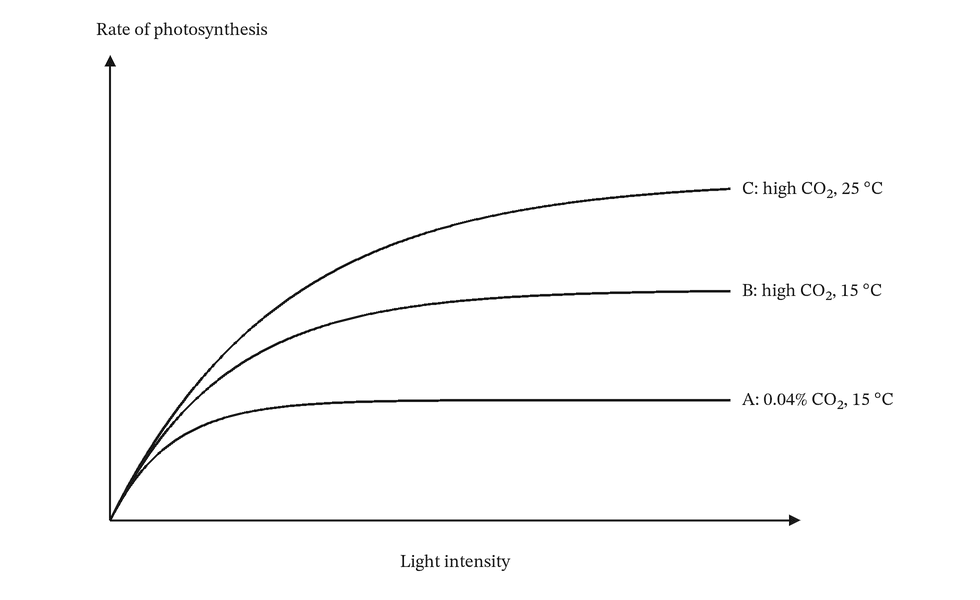
Step 5 — Another example: A leaf with good light and CO₂ photosynthesises only very slowly near 0 °C; on warming, its rate rises, showing that temperature was the limiting factor.
Therefore, the law says the rate of a process is controlled by its most limiting factor, as seen when photosynthesis stops rising with light until CO₂ or temperature is increased.