
Question 845 marksMedium
Explain the Blackman's law of limiting factors. Give an example. How do light and CO₂ concentration affect rate of photosynthesis?
Confirming your payment
Sign up now and get 250 free tokens.
Photosynthesis in Higher Plants · Question 84 of 84
Explain the Blackman's law of limiting factors. Give an example. How do light and CO₂ concentration affect rate of photosynthesis?
Solution:
Concept: Blackman (1905) stated that when several factors affect a process, the slowest (most limiting) factor sets its rate.
Step 1 — The law: When a process depends on several factors, its rate is limited by the factor present at the level nearest its minimum; increasing any other factor has no effect until that one is increased.
Step 2 — Example: At atmospheric CO₂ (about 0.04 %) and 15 °C, the rate rises with light and then levels off; raising CO₂ gives a higher plateau, and raising the temperature to 25 °C a higher one still.
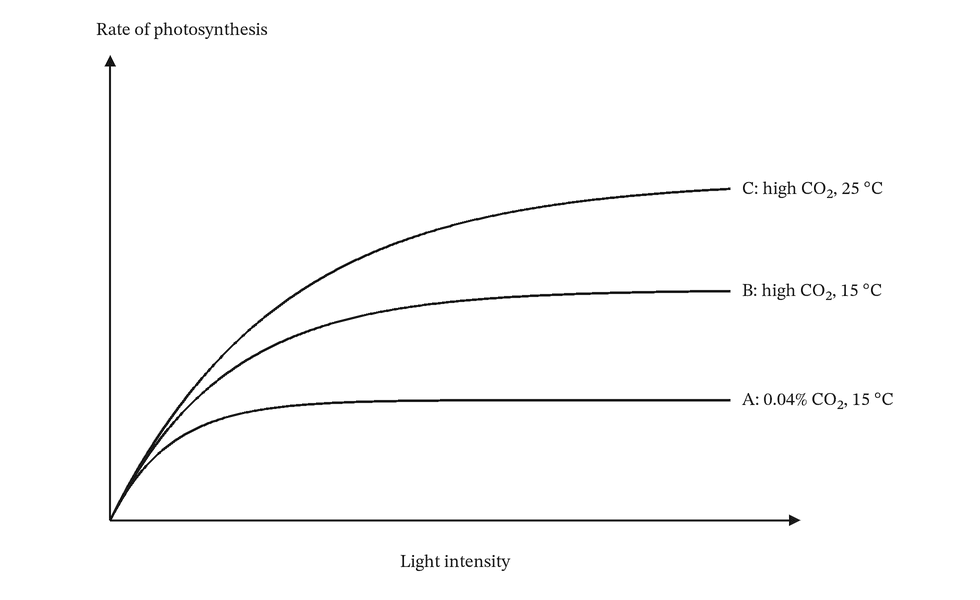
Step 3 — Effect of light: There is no photosynthesis in darkness; the rate rises with light intensity up to the light saturation point, beyond which another factor limits; very strong light can damage chlorophyll (photo-oxidation). Blue and red light are most effective.
Step 4 — Effect of CO₂: CO₂ (about 0.042 %: about 420 ppm in 2023, roughly 425 ppm by 2025) is often the limiting factor in the field. Raising it increases the rate up to a saturation level; C₃ plants respond more, as extra CO₂ also cuts photorespiration, while C₄ plants are nearly saturated at present levels.
Step 5 — Linking the two: At low light, adding CO₂ does little, because light limits; at high light, adding CO₂ raises the rate a lot, because CO₂ limits.
Note: The CO₂ level of the air keeps rising; values of 0.03 % in older tables are out of date, and it was about 0.042 % (about 420 ppm) in 2023 and roughly 425 ppm by 2025.
Therefore, Blackman's law states that the most limiting factor controls the rate; the rate rises with light up to saturation and with CO₂ up to saturation, whichever is limiting.