
Opening your dashboard
Class 10 Maths Chapter 12 Reflection: Previous Year Questions
13 questions on Chapter 12, each solved step by step. Class 10 Maths, ICSE 2026-27.
13 questions with solutions
1–5 marks · Mixed difficulty
- 14 marks
Question 1
Use graph paper for this question.
(Take 2 cm = 1 unit along both and axis.)
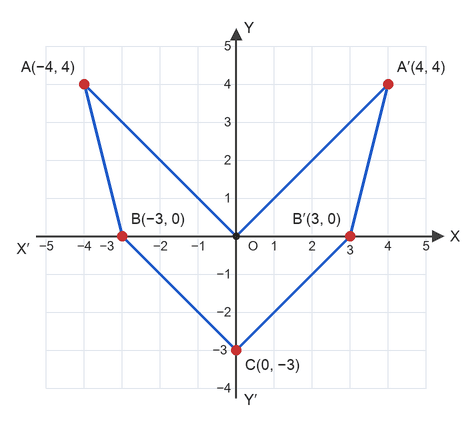
Plot the points O (0, 0), A (–4, 4), B (–3, 0) and C (0, –3)
(i) Reflect points A and B on the axis and name them A' and B' respectively. Write down their coordinates.
(ii) Name the figure OABCB'A'.
(iii) State the line of symmetry of this figure.
Solve with AIWritten solution
Solution:
Concept: Reflection in the -axis (the line ) keeps the -co-ordinate and changes the sign of the -co-ordinate: . A figure is symmetrical about a line when the part on one side of the line is the mirror image of the part on the other side; that line is the line of symmetry.
Given: O(0, 0), A(−4, 4), B(−3, 0) and C(0, −3), with 2 cm = 1 unit on both axes.
Step 1 — Plot the points.
We mark each point by moving along the -axis first (by its -co-ordinate) and then parallel to the -axis (by its -co-ordinate). O and C lie on the -axis.
Step 2 — Part (i): reflect A and B in the y-axis.
In the -axis each point keeps its -co-ordinate and the sign of its -co-ordinate changes.
Step 3 — Part (ii): name the figure.
We join O, A, B, C, B′, A′ and back to O. The figure has six sides, with a dent at O and a point at C, so it has the shape of an arrow head.
Step 4 — Part (iii): find the line of symmetry.
O and C lie on the -axis, and A′, B′ are the mirror images of A, B in the -axis. So the left half of the figure is the mirror image of the right half, and the -axis is the line of symmetry.
Check: A and A′ are both 4 units from the -axis at the same height, and B and B′ are both 3 units from it.
Watch out: The line is the -axis and the line is the -axis. In the -axis it is the -co-ordinate whose sign changes; in the -axis it is the -co-ordinate.
Therefore, (i) A′ = (4, 4) and B′ = (3, 0); (ii) OABCB′A′ is an arrow head; (iii) the line of symmetry is the -axis, that is, the line .
- 25 marks
Question 2
Use a graph paper for this question (Take 2 cm = 1 unit on both x and y axis)
(i) Plot the following points:
A(0,4), B(2,3), C(1,1) and D(2,0).
(ii) Reflect points B, C, D on the y-axis and write down their coordinates. Name the images as B’, C’, D’ respectively.
(iii) Join the points A, B, C, D, D’, C’, B’ and A in order, so as to form a closed figure. Write down the equation of the line of symmetry of the figure formed.
Solve with AIWritten solution
Solution:
Concept: Reflection in the -axis (the line ) keeps the -co-ordinate and changes the sign of the -co-ordinate: . A figure is symmetrical about a line when the part on one side of the line is the mirror image of the part on the other side; that line is the line of symmetry.
Given: A(0, 4), B(2, 3), C(1, 1) and D(2, 0), with 2 cm = 1 unit on both axes.
Step 1 — Part (i): plot the points.
We mark each point by moving along the -axis first (by its -co-ordinate) and then parallel to the -axis (by its -co-ordinate). A lies on the -axis.
Step 2 — Part (ii): reflect B, C and D in the y-axis.
Each point keeps its -co-ordinate and the sign of its -co-ordinate changes.
Step 3 — Part (iii): join the points.
We join A, B, C, D, D′, C′, B′ and back to A in this order.

Step 4 — Part (iii): find the line of symmetry.
A lies on the -axis, and every other vertex has its mirror partner on the other side of the -axis (B and B′, C and C′, D and D′). So the figure is symmetrical about the -axis, whose equation is:
Check: If the figure is folded along the -axis, B falls on B′, C on C′ and D on D′, so the two halves coincide.
Watch out: The line is the -axis and the line is the -axis. In the -axis it is the -co-ordinate whose sign changes; in the -axis it is the -co-ordinate.
Therefore, (ii) B′ = (−2, 3), C′ = (−1, 1) and D′ = (−2, 0); (iii) the line of symmetry is (the -axis).
- 34 marks
Question 3
Use graph paper for this question (Take 2 cm = 1 unit along both x and y axis).
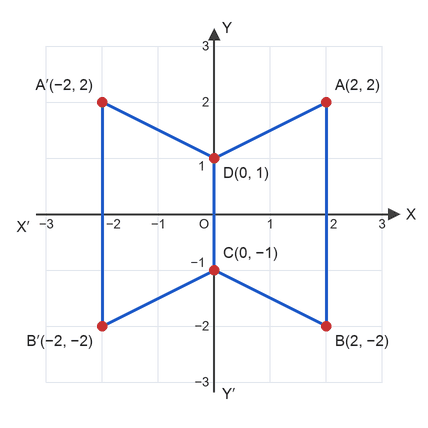
ABCD is a quadrilateral whose vertices are A(2, 2), B(2, – 2), C(0, –1) and D(0, 1)
(i) Reflect quadrilateral ABCD on the y-axis and name it as A'B'CD.
(ii) Write down the coordinates of A' and B'.
(iii) Name two points which are invariant under the above reflection.
(iv) Name the polygon A'B'CD.
Solve with AIWritten solution
Solution:
Concept: Reflection in the -axis (the line ) keeps the -co-ordinate and changes the sign of the -co-ordinate: . A point is invariant under a reflection when it is its own image. This happens only when the point lies on the mirror line, so the mirror line passes through every invariant point. A trapezium has one pair of parallel sides; it is isosceles when its two non-parallel sides are equal.
Given: A(2, 2), B(2, −2), C(0, −1) and D(0, 1).
Step 1 — Part (i): reflect the quadrilateral.
Each vertex keeps its -co-ordinate and the sign of its -co-ordinate changes. C and D have -co-ordinate 0, so they lie on the -axis and stay where they are. The image is A′B′CD.
Step 2 — Part (ii): write the co-ordinates of A′ and B′.
We change the sign of each -co-ordinate.
Step 3 — Part (iii): name the invariant points.
The points on the mirror line are their own images. C(0, −1) and D(0, 1) are on the -axis, so C and D are invariant.
Step 4 — Part (iv): find the parallel sides.
A′ and B′ both have -co-ordinate −2, so A′B′ is vertical and 4 units long. C and D both have -co-ordinate 0, so CD is vertical and 2 units long. So A′B′ ∥ CD, and these parallel sides are not equal.
Step 5 — Part (iv): compare the other two sides.
We find A′D and B′C with the distance formula.
The non-parallel sides are equal, so A′B′CD is an isosceles trapezium.
Watch out: C and D lie on the mirror line, so they do not move; do not change the sign of 0 into a new point.
Therefore, (ii) A′ = (−2, 2) and B′ = (−2, −2); (iii) C and D are invariant; (iv) A′B′CD is an isosceles trapezium.
- 44 marks
Question 4
Use a graph sheet for this question.
Take 1 cm = 1 unit along both and axis.
(i) Plot the following points:
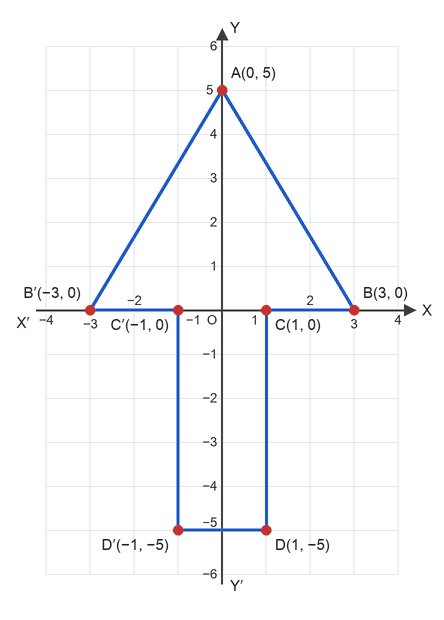
A(0, 5), B(3, 0), C(1, 0) and D(1, –5)
(ii) Reflect the points B, C and D on the y axis and name them as B', C' and D' respectively.
(iii) Write down the coordinates of B', C' and D'.
(iv) Join the points A, B, C, D, D', C', B', A in order and give a name to the closed figure ABCDD'C'B'.
Solve with AIWritten solution
Solution:
Concept: Reflection in the -axis (the line ) keeps the -co-ordinate and changes the sign of the -co-ordinate: .
Given: A(0, 5), B(3, 0), C(1, 0) and D(1, −5), with 1 cm = 1 unit on both axes.
Step 1 — Part (i): plot the points.
We mark each point by moving along the -axis first (by its -co-ordinate) and then parallel to the -axis (by its -co-ordinate). A lies on the -axis, so it is its own image.
Step 2 — Parts (ii) and (iii): reflect B, C and D in the y-axis.
Each point keeps its -co-ordinate and the sign of its -co-ordinate changes.
Step 3 — Part (iv): join and name the figure.
We join A, B, C, D, D′, C′, B′ and back to A. The triangle ABB′ on top is 6 units wide and forms the head; the part CDD′C′ below it is 2 units wide and forms the shaft. So the closed figure is an arrow pointing upwards.
Check: The figure is symmetrical about the -axis: B and B′ are 3 units from it, and C, C′, D, D′ are each 1 unit from it.
Watch out: The line is the -axis and the line is the -axis. In the -axis it is the -co-ordinate whose sign changes; in the -axis it is the -co-ordinate.
Therefore, (iii) B′ = (−3, 0), C′ = (−1, 0) and D′ = (−1, −5); (iv) ABCDD′C′B′ is an arrow.
- 54 marks
Question 5
Use graph paper for this question.
Take 1 cm = 1 unit on both and axes.
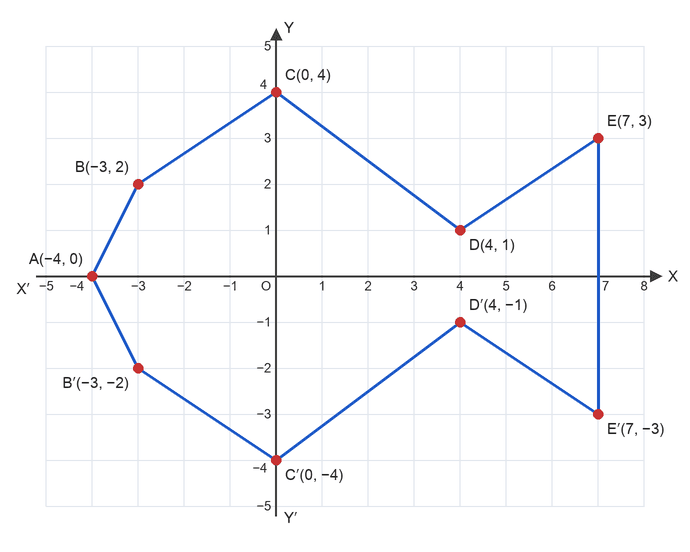
(i) Plot the following points on your graph sheets. , , , and
(ii) Reflect the points , , and on the -axis and name them as , , and respectively.
(iii) Join the points and in order.
(iv) Name the closed figure formed.
Solve with AIWritten solution
Solution:
Concept: Reflection in the -axis (the line ) keeps the -co-ordinate and changes the sign of the -co-ordinate: .
Given: A(−4, 0), B(−3, 2), C(0, 4), D(4, 1) and E(7, 3), with 1 cm = 1 unit on both axes.
Step 1 — Part (i): plot the points.
We mark each point by moving along the -axis first (by its -co-ordinate) and then parallel to the -axis (by its -co-ordinate). A(−4, 0) lies on the -axis, so it is its own image.
Step 2 — Part (ii): reflect B, C, D and E in the x-axis.
Each point keeps its -co-ordinate and the sign of its -co-ordinate changes.
Step 3 — Part (iii): join the points.
We join A, B, C, D, E, E′, D′, C′, B′ and back to A in this order.
Step 4 — Part (iv): name the figure.
The figure is widest at CC′ (8 units), narrows to DD′ (2 units) and opens out again to EE′ (6 units). So it looks like a fish: A is the mouth and EE′ is the tail.
Check: The figure is symmetrical about the -axis, because B′, C′, D′ and E′ are the mirror images of B, C, D and E in it.
Watch out: In the -axis it is the -co-ordinate whose sign changes; the -co-ordinates stay the same.
Therefore, (ii) B′ = (−3, −2), C′ = (0, −4), D′ = (4, −1) and E′ = (7, −3); (iv) the closed figure is a fish.
- 61 mark
Question 6
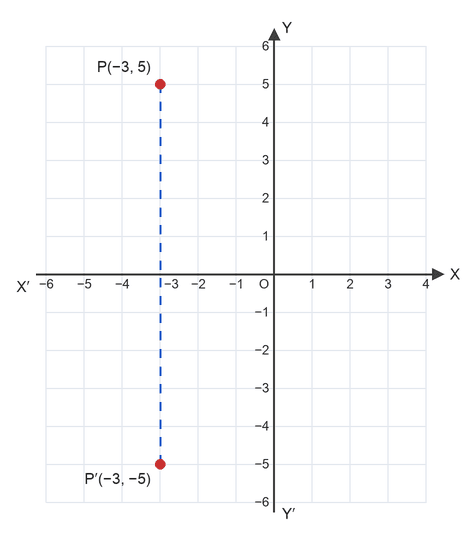
The coordinates of the point P(–3, 5) on reflecting on the X axis are:
Solve with AIAnswer
(A) (3, 5)
- Correct
(B) (–3, –5)
(C) (3, –5)
(D) (–3, 5)
Answer: (B) (–3, –5)
Concept: Reflection in the -axis (the line ) keeps the -co-ordinate and changes the sign of the -co-ordinate: .
Step 1 — Keep x and change the sign of y.
We keep the -co-ordinate −3 and change the sign of the -co-ordinate 5.
Step 2 — Check the result.
P is 5 units above the -axis and P′ is 5 units below it, on the same vertical line, so the -axis is exactly half-way between them.
Watch out: The line is the -axis and the line is the -axis. In the -axis it is the -co-ordinate whose sign changes; in the -axis it is the -co-ordinate.
Why the other options are wrong:
- (A) (3, 5): only the sign of is changed; that is the image of P in the -axis.
- (C) (3, –5): both signs are changed; that is the image of P in the origin.
- (D) (–3, 5): this is P itself; P is not on the -axis, so it is not its own image.
Therefore, the image of P is (–3, –5), option (B).
- 73 marks
Question 7
Use a graph paper for this question. Take 2 cm - 1 unit along both the axes.
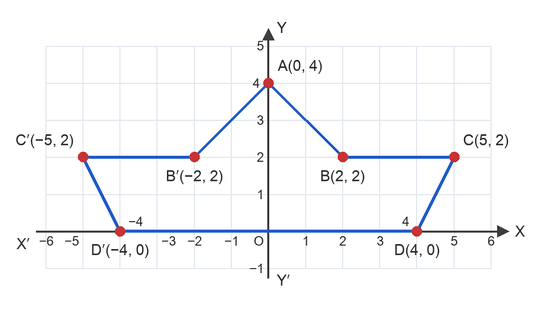
(a) Plot the points A (0, 4), B (2, 2), C(5, 2) and D (4, 0), E(0, 0) is the origin.
(b) Reflect B, C, D on the Y-axis and name them as B′, C′ and D′ respectively.
(c) Join the points ABCDD′C′B′ and A in order and give a geometrical name to the closed figure.
Solve with AIWritten solution
Solution:
Concept: Reflection in the -axis (the line ) keeps the -co-ordinate and changes the sign of the -co-ordinate: . A closed figure with straight sides is named by counting its sides: 6 sides make a hexagon, 7 a heptagon, 8 an octagon and 10 a decagon.
Given: A(0, 4), B(2, 2), C(5, 2), D(4, 0) and the origin E(0, 0), with 2 cm = 1 unit.
Step 1 — Part (a): plot the points.
We mark each point by moving along the -axis first (by its -co-ordinate) and then parallel to the -axis (by its -co-ordinate). A and E lie on the -axis.
Step 2 — Part (b): reflect B, C and D in the y-axis.
Each point keeps its -co-ordinate and the sign of its -co-ordinate changes.
Step 3 — Part (c): join and count the sides.
We join A, B, C, D, D′, C′, B′ and back to A. The sides are AB, BC, CD, DD′, D′C′, C′B′ and B′A, and no two neighbouring sides lie on one straight line. So there are 7 sides.
Step 4 — Part (c): name the figure.
A closed figure with 7 sides is a heptagon. It is a concave heptagon (it has dents at B and B′) and it is symmetrical about the -axis. E(0, 0) lies on the side DD′, so it is not a corner.
Watch out: Join the points in exactly the order given and close the figure back to the first point; a different order gives a different figure.
Therefore, (b) B′ = (−2, 2), C′ = (−5, 2) and D′ = (−4, 0); (c) the closed figure ABCDD′C′B′ is a heptagon.
- 85 marks
Question 8
Use graph sheet to answer this question. Take 2 cm = 1 unit along both the axes.
(a) Plot A, B, C where , and .
(b) Reflect A and B on the x-axis and name them as E and D respectively.
(c) Reflect B through the origin and name it F. Write down the coordinates of F.
(d) Reflect B and C on the y-axis and name them as H and G respectively.
(e) Join points A, B, C, D, E, F, G, H and A in order and name the closed figure formed.
Solve with AIWritten solution
Solution:
Concept: Reflection in the -axis (the line ) keeps the -co-ordinate and changes the sign of the -co-ordinate: . Reflection in the origin changes the signs of both co-ordinates: . Reflection in the -axis (the line ) keeps the -co-ordinate and changes the sign of the -co-ordinate: .
Given: A(0, 4), B(1, 1) and C(4, 0), with 2 cm = 1 unit on both axes.
Step 1 — Part (a): plot the points.
We mark each point by moving along the -axis first (by its -co-ordinate) and then parallel to the -axis (by its -co-ordinate).
Step 2 — Part (b): reflect A and B in the x-axis.
Each point keeps its -co-ordinate and the sign of its -co-ordinate changes.
Step 3 — Part (c): reflect B in the origin.
Both signs change.
Step 4 — Part (d): reflect B and C in the y-axis.
Each point keeps its -co-ordinate and the sign of its -co-ordinate changes.
Step 5 — Part (e): join and name the figure.
We join A, B, C, D, E, F, G, H and back to A. A, C, E and G are each 4 units from the origin and form four tips; B, D, F and H lie close to the origin between the tips. So the closed figure is a four-pointed star.
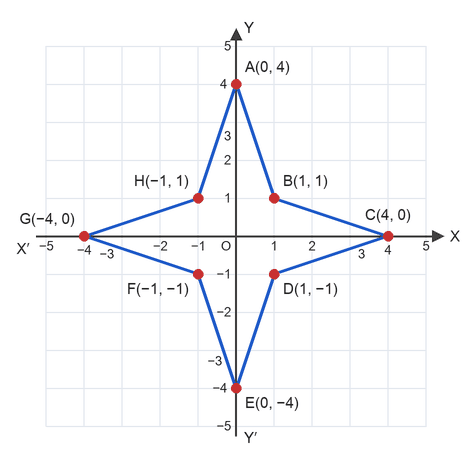
Check: The star is symmetrical about both axes, as expected from the reflections used.
Watch out: Use the right rule for each part: the -axis changes the sign of , the -axis changes the sign of , and the origin changes both.
Therefore, (b) E = (0, −4) and D = (1, −1); (c) F = (−1, −1); (d) H = (−1, 1) and G = (−4, 0); (e) the figure is a four-pointed star.
- 95 marks
Question 9
Use graph sheet for this question.
(a) Plot , and .
(b) Reflect point B and C in y-axis and name their images as B' and C' respectively. Plot and write coordinates of the points B' and C'.
(c) Reflect point A in the line BB' and name its images as A'.
(d) Plot and write coordinates of point A'.
(e) Join the points ABA'B' and give the geometrical name of the closed figure so formed.
Solve with AIWritten solution
Solution:
Concept: Reflection in the -axis (the line ) keeps the -co-ordinate and changes the sign of the -co-ordinate: . When a point is reflected in a line, the line is the perpendicular bisector of the segment joining the point to its image. So the image is as far behind the line as the point is in front of it, and the segment joining them is perpendicular to the line. A quadrilateral whose diagonals are equal and bisect each other at right angles is a square.
Given: A(0, 3), B(2, 1) and C(4, −1).
Step 1 — Part (a): plot the points.
We mark each point by moving along the -axis first (by its -co-ordinate) and then parallel to the -axis (by its -co-ordinate). A lies on the -axis.
Step 2 — Part (b): reflect B and C in the y-axis.
Each point keeps its -co-ordinate and the sign of its -co-ordinate changes.
Step 3 — Part (c): find the line BB′.
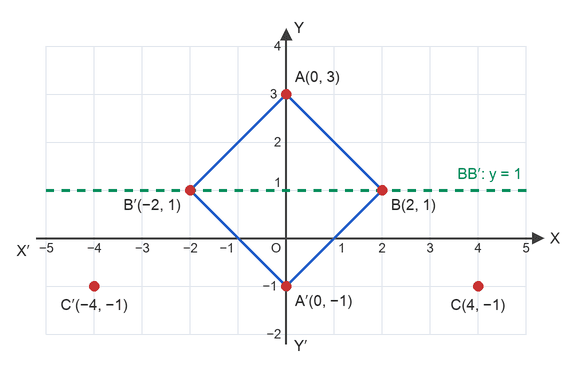
B(2, 1) and B′(−2, 1) both have -co-ordinate 1, so BB′ is the horizontal line .
Step 4 — Parts (c) and (d): reflect A in the line y = 1.
First we find how far A is from the line.
A is 2 units above the line, so its image is 2 units below it. The line is horizontal, so the -co-ordinate stays 0.
Step 5 — Part (e): name ABA′B′.
The diagonals are AA′ and BB′. AA′ is vertical, from (0, 3) to (0, −1), so it is 4 units long; BB′ is horizontal, from (2, 1) to (−2, 1), so it is also 4 units long. Both have the mid-point (0, 1), so they bisect each other, and one is vertical and the other horizontal, so they cross at right angles. Hence ABA′B′ is a square.
Check: Each side is the same length; for example:
Watch out: Reflect A in the line BB′ (), not in the -axis; reflecting in the -axis would wrongly give (0, −3).
Therefore, (b) B′ = (−2, 1) and C′ = (−4, −1); (d) A′ = (0, −1); (e) ABA′B′ is a square.
- 105 marks
Question 10
Use a graph paper for this question taking 2 cm = 1 unit along both axes.
(a) Plot , and .
(b) Reflect A and B on the x-axis and name their images as E and D respectively. Write down their coordinates.
(c) Reflect A and B through the origin and name their images as F and G respectively.
(d) Reflect A, B and C on the y-axis and name their images as J, I and H respectively.
(e) Join all the points A, B, C, D, E, F, G, H, I and J in order and name the closed figure so formed.
Solve with AIWritten solution
Solution:
Concept: Reflection in the -axis (the line ) keeps the -co-ordinate and changes the sign of the -co-ordinate: . Reflection in the origin changes the signs of both co-ordinates: . Reflection in the -axis (the line ) keeps the -co-ordinate and changes the sign of the -co-ordinate: . A closed figure with straight sides is named by counting its sides: 6 sides make a hexagon, 7 a heptagon, 8 an octagon and 10 a decagon.
Given: A(1, 3), B(1, 2) and C(3, 0), with 2 cm = 1 unit.
Step 1 — Part (a): plot the points.
We mark each point by moving along the -axis first (by its -co-ordinate) and then parallel to the -axis (by its -co-ordinate).
Step 2 — Part (b): reflect A and B in the x-axis.
Each point keeps its -co-ordinate and the sign of its -co-ordinate changes.
Step 3 — Part (c): reflect A and B in the origin.
Both signs change.
Step 4 — Part (d): reflect A, B and C in the y-axis.
Each point keeps its -co-ordinate and the sign of its -co-ordinate changes.
Step 5 — Part (e): join and name the figure.
We join A, B, C, D, E, F, G, H, I, J and back to A. The sides are AB, BC, CD, DE, EF, FG, GH, HI, IJ and JA, and no two neighbouring sides lie on one straight line. So there are 10 sides and the figure is a decagon.
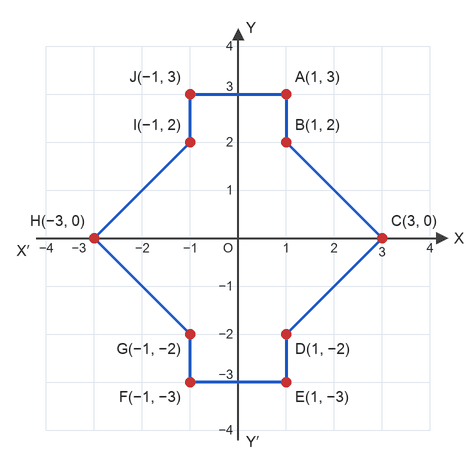
Check: The figure is symmetrical about both axes, as expected from the reflections used.
Watch out: Keep track of which letter goes with which image: E and D are the -axis images of A and B, in that order.
Therefore, (b) E = (1, −3) and D = (1, −2); (c) F = (−1, −3) and G = (−1, −2); (d) J = (−1, 3), I = (−1, 2) and H = (−3, 0); (e) the closed figure is a decagon.
- 115 marks
Question 11
Using the given graph, answer the following:
(a) Write down the coordinates of the points A, B, C, and E.
(b) Name and write down the coordinates of the image of B under reflection in x-axis.
(c) Name and write the coordinates of the image of D under reflection through the origin.
(d) Which point is the image of A under reflection on the line BH? Write its coordinates.
(e) Name the closed figure ABCDEFGH.
 Solve with AI
Written solution
Solution:
Concept: Reflection in the -axis (the line ) keeps the -co-ordinate and changes the sign of the -co-ordinate: . Reflection in the origin changes the signs of both co-ordinates: . When a point is reflected in a line, the line is the perpendicular bisector of the segment joining the point to its image. So the image is as far behind the line as the point is in front of it, and the segment joining them is perpendicular to the line.
Step 1 — Part (a): read the co-ordinates.
For each point we read the -co-ordinate along the -axis first and then the -co-ordinate along the -axis (one square is 1 unit).
Step 2 — Part (b): reflect B in the x-axis.
We keep the -co-ordinate and change the sign of the -co-ordinate.
The graph shows the point D at (3, 2), so the image of B is D.
Step 3 — Part (c): reflect D in the origin.
Both signs change.
The graph shows the point H at (−3, −2), so the image of D is H.
Step 4 — Part (d): find the line BH.
B(3, −2) and H(−3, −2) both have -co-ordinate −2, so BH is the horizontal line .
Step 5 — Part (d): reflect A in the line BH.
First we find how far A(0, −4) is from the line.
A is 2 units below the line, so its image is 2 units above it. The line is horizontal, so the -co-ordinate stays 0.
The image is (0, 0), the origin O. The figure shows the line BH and the points with their co-ordinates.
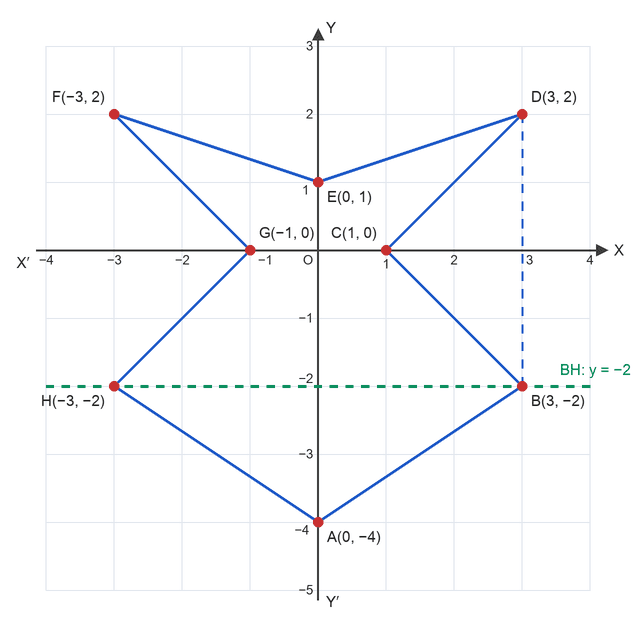
Step 6 — Part (e): name the figure.
The sides of ABCDEFGH are AB, BC, CD, DE, EF, FG, GH and HA, so it has 8 sides. It is an octagon (a concave octagon, symmetrical about the -axis).
Check: F(−3, 2) and G(−1, 0) are the mirror images of D and C in the -axis, which agrees with the symmetry of the figure.
Watch out: The line BH is , not the -axis; measure the distance of A from BH, not from the -axis.
Therefore, (a) A = (0, −4), B = (3, −2), C = (1, 0) and E = (0, 1); (b) the image of B is D(3, 2); (c) the image of D is H(−3, −2); (d) the image of A in BH is the origin O(0, 0); (e) ABCDEFGH is an octagon.
- 124 marks
Question 12
Use graph sheet for this question. Take 2 cm = 1 unit along both x and y axis. Graphically represent parallelogram OABC, where , , and .
Reflect OABC :
(a) on the x-axis and name its image as ODEC.
(b) through the origin and name its image as OIJH.
(c) on the y-axis and name its image as OFGH.
Solve with AIWritten solution
Solution:
Concept: Reflection in the -axis (the line ) keeps the -co-ordinate and changes the sign of the -co-ordinate: . Reflection in the origin changes the signs of both co-ordinates: . Reflection in the -axis (the line ) keeps the -co-ordinate and changes the sign of the -co-ordinate: . A reflection does not change the shape or size of a figure, so each image of the parallelogram is again a parallelogram.
Given: O(0, 0), A(2, 3), B(5, 3) and C(3, 0), with 2 cm = 1 unit.
Step 1 — Draw OABC.
We mark each point by moving along the -axis first (by its -co-ordinate) and then parallel to the -axis (by its -co-ordinate). O and C lie on the -axis.
Step 2 — Part (a): reflect OABC in the x-axis.
Each vertex keeps its -co-ordinate and the sign of its -co-ordinate changes. O and C lie on the -axis, so they stay where they are.
So the image is ODEC.
Step 3 — Part (b): reflect OABC in the origin.
Both signs of each vertex change; O stays at the origin.
So the image is OIJH.
Step 4 — Part (c): reflect OABC in the y-axis.
Each vertex keeps its -co-ordinate and the sign of its -co-ordinate changes.
So the image is OFGH. H appears in both (b) and (c) because C lies on the -axis: changing both signs of (3, 0) and changing only the sign of its -co-ordinate give the same point. The four parallelograms are shown below.

Check: OABC has base OC = 3 units and height 3 units, so its area is 3 × 3 = 9 sq. units; each image has the same base and height, so each also has area 9 sq. units.
Watch out: A vertex on the mirror line (O and C in part (a)) is its own image; it keeps its letter.
Therefore, (a) ODEC with D(2, −3) and E(5, −3); (b) OIJH with I(−2, −3), J(−5, −3) and H(−3, 0); (c) OFGH with F(−2, 3), G(−5, 3) and H(−3, 0).
- 135 marks
Question 13
Use graph sheet for this question. Take 2 cm = 1 unit along the axes. Plot and write coordinates of:
(a) and .
(b) image of A and B in the x-axis as A′ and B′.
(c) image of A′ in the y-axis as A″.
(d) name the single transformation that maps A to A″.
Solve with AIWritten solution
Solution:
Concept: Reflection in the -axis (the line ) keeps the -co-ordinate and changes the sign of the -co-ordinate: . Reflection in the -axis (the line ) keeps the -co-ordinate and changes the sign of the -co-ordinate: . Reflection in the origin changes the signs of both co-ordinates: .
Given: A(2, 3) and B(4, 5), with 2 cm = 1 unit.
Step 1 — Part (a): plot A and B.
We mark each point by moving along the -axis first (by its -co-ordinate) and then parallel to the -axis (by its -co-ordinate).
Step 2 — Part (b): reflect A and B in the x-axis.
Each point keeps its -co-ordinate and the sign of its -co-ordinate changes.
Step 3 — Part (c): reflect A′ in the y-axis.
Now the -co-ordinate stays and the sign of the -co-ordinate changes.
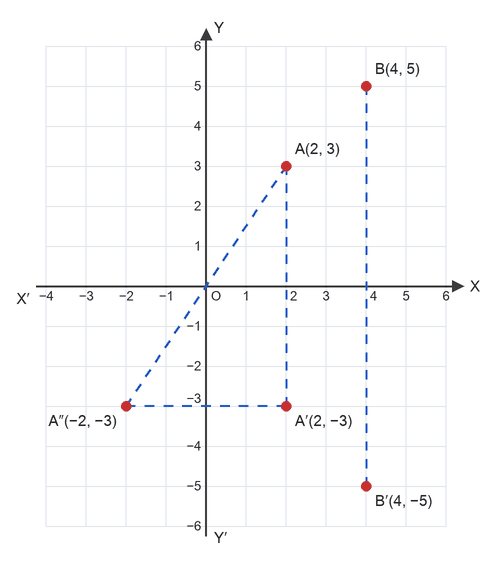
Step 4 — Part (d): name the single transformation.
We compare A(2, 3) with A″(−2, −3): the signs of both co-ordinates have changed. That is the rule , reflection in the origin. (A reflection in the -axis followed by a reflection in the -axis always acts like one reflection in the origin.)
Check: The mid-point of AA″ is , which is (0, 0); the origin is the mid-point, as it must be for a reflection in the origin.
Watch out: In part (c) reflect A′, not A; reflecting A in the -axis would give (−2, 3).
Therefore, (b) A′ = (2, −3) and B′ = (4, −5); (c) A″ = (−2, −3); (d) the single transformation is reflection in the origin.