Use graph paper for this question (Take 2 cm = 1 unit along both x and y axis).
Question 34 marksAsked 2018Easy
Use graph paper for this question (Take 2 cm = 1 unit along both x and y axis).
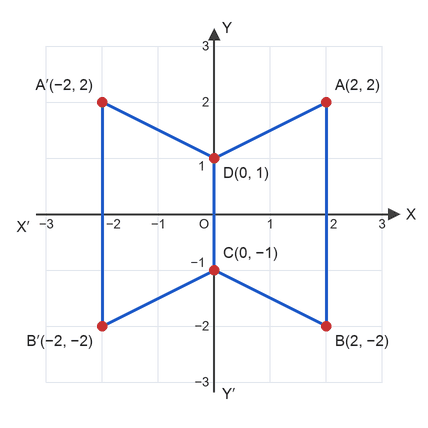
ABCD is a quadrilateral whose vertices are A(2, 2), B(2, – 2), C(0, –1) and D(0, 1)
(i) Reflect quadrilateral ABCD on the y-axis and name it as A'B'CD.
(ii) Write down the coordinates of A' and B'.
(iii) Name two points which are invariant under the above reflection.
(iv) Name the polygon A'B'CD.
Solution:
Concept: Reflection in the y-axis (the line x=0) keeps the y-co-ordinate and changes the sign of the x-co-ordinate: (x,y)→(−x,y). A point is invariant under a reflection when it is its own image. This happens only when the point lies on the mirror line, so the mirror line passes through every invariant point. A trapezium has one pair of parallel sides; it is isosceles when its two non-parallel sides are equal.
Given: A(2, 2), B(2, −2), C(0, −1) and D(0, 1).
Step 1 — Part (i): reflect the quadrilateral.
Each vertex keeps its y-co-ordinate and the sign of its x-co-ordinate changes. C and D have x-co-ordinate 0, so they lie on the y-axis and stay where they are. The image is A′B′CD.
Step 2 — Part (ii): write the co-ordinates of A′ and B′.
We change the sign of each x-co-ordinate.
A(2,2)→A′(−2,2)
B(2,−2)→B′(−2,−2)
Step 3 — Part (iii): name the invariant points.
The points on the mirror line are their own images. C(0, −1) and D(0, 1) are on the y-axis, so C and D are invariant.
Step 4 — Part (iv): find the parallel sides.
A′ and B′ both have x-co-ordinate −2, so A′B′ is vertical and 4 units long. C and D both have x-co-ordinate 0, so CD is vertical and 2 units long. So A′B′ ∥ CD, and these parallel sides are not equal.