Solution:
Concept: Reflection in the x-axis (the line y=0) keeps the x-co-ordinate and changes the sign of the y-co-ordinate: (x,y)→(x,−y).
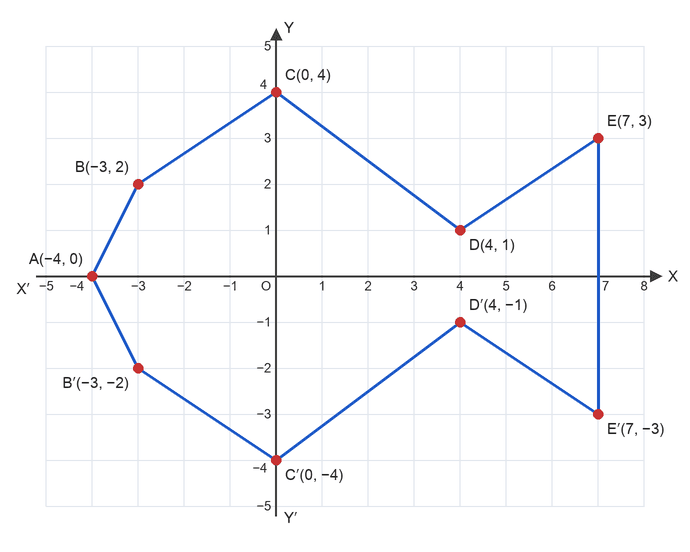
Given: A(−4, 0), B(−3, 2), C(0, 4), D(4, 1) and E(7, 3), with 1 cm = 1 unit on both axes.
Step 1 — Part (i): plot the points.
We mark each point by moving along the x-axis first (by its x-co-ordinate) and then parallel to the y-axis (by its y-co-ordinate). A(−4, 0) lies on the x-axis, so it is its own image.
Step 2 — Part (ii): reflect B, C, D and E in the x-axis.
Each point keeps its x-co-ordinate and the sign of its y-co-ordinate changes.
B(−3,2)→B′(−3,−2)
C(0,4)→C′(0,−4)
D(4,1)→D′(4,−1)
E(7,3)→E′(7,−3)
Step 3 — Part (iii): join the points.
We join A, B, C, D, E, E′, D′, C′, B′ and back to A in this order.
Step 4 — Part (iv): name the figure.
The figure is widest at CC′ (8 units), narrows to DD′ (2 units) and opens out again to EE′ (6 units). So it looks like a fish: A is the mouth and EE′ is the tail.
Check: The figure is symmetrical about the x-axis, because B′, C′, D′ and E′ are the mirror images of B, C, D and E in it.
Watch out: In the x-axis it is the y-co-ordinate whose sign changes; the x-co-ordinates stay the same.
Therefore, (ii) B′ = (−3, −2), C′ = (0, −4), D′ = (4, −1) and E′ = (7, −3); (iv) the closed figure is a fish.
