Solution:
Concept: Reflection in the x-axis (the line y=0) keeps the x-co-ordinate and changes the sign of the y-co-ordinate: (x,y)→(x,−y). Reflection in the origin changes the signs of both co-ordinates: (x,y)→(−x,−y). When a point is reflected in a line, the line is the perpendicular bisector of the segment joining the point to its image. So the image is as far behind the line as the point is in front of it, and the segment joining them is perpendicular to the line.
Step 1 — Part (a): read the co-ordinates.
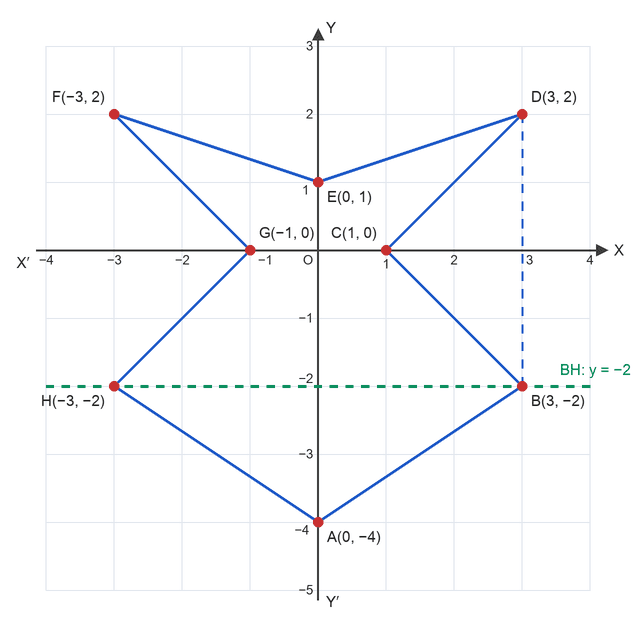
For each point we read the x-co-ordinate along the x-axis first and then the y-co-ordinate along the y-axis (one square is 1 unit).
A(0,−4),B(3,−2),C(1,0),E(0,1)
Step 2 — Part (b): reflect B in the x-axis.
We keep the x-co-ordinate and change the sign of the y-co-ordinate.
B(3,−2)→(3,2)
The graph shows the point D at (3, 2), so the image of B is D.
Step 3 — Part (c): reflect D in the origin.
Both signs change.
D(3,2)→(−3,−2)
The graph shows the point H at (−3, −2), so the image of D is H.
Step 4 — Part (d): find the line BH.
B(3, −2) and H(−3, −2) both have y-co-ordinate −2, so BH is the horizontal line y=−2.
Step 5 — Part (d): reflect A in the line BH.
First we find how far A(0, −4) is from the line.
distance of A from y=−2=−2−(−4)=2 units
A is 2 units below the line, so its image is 2 units above it. The line is horizontal, so the x-co-ordinate stays 0.
y-co-ordinate of the image=−2+2=0
The image is (0, 0), the origin O. The figure shows the line BH and the points with their co-ordinates.
Step 6 — Part (e): name the figure.
The sides of ABCDEFGH are AB, BC, CD, DE, EF, FG, GH and HA, so it has 8 sides. It is an octagon (a concave octagon, symmetrical about the y-axis).
Check: F(−3, 2) and G(−1, 0) are the mirror images of D and C in the y-axis, which agrees with the symmetry of the figure.
Watch out: The line BH is y=−2, not the x-axis; measure the distance of A from BH, not from the x-axis.
Therefore, (a) A = (0, −4), B = (3, −2), C = (1, 0) and E = (0, 1); (b) the image of B is D(3, 2); (c) the image of D is H(−3, −2); (d) the image of A in BH is the origin O(0, 0); (e) ABCDEFGH is an octagon.

