Solution:
Concept: Reflection in the x-axis (the line y=0) keeps the x-co-ordinate and changes the sign of the y-co-ordinate: (x,y)→(x,−y). Reflection in the y-axis (the line x=0) keeps the y-co-ordinate and changes the sign of the x-co-ordinate: (x,y)→(−x,y). Reflection in the origin changes the signs of both co-ordinates: (x,y)→(−x,−y).
Given: A(2, 3) and B(4, 5), with 2 cm = 1 unit.
Step 1 — Part (a): plot A and B.
We mark each point by moving along the x-axis first (by its x-co-ordinate) and then parallel to the y-axis (by its y-co-ordinate).
Step 2 — Part (b): reflect A and B in the x-axis.
Each point keeps its x-co-ordinate and the sign of its y-co-ordinate changes.
A(2,3)→A′(2,−3)
B(4,5)→B′(4,−5)
Step 3 — Part (c): reflect A′ in the y-axis.
Now the y-co-ordinate stays and the sign of the x-co-ordinate changes.
A′(2,−3)→A′′(−2,−3)
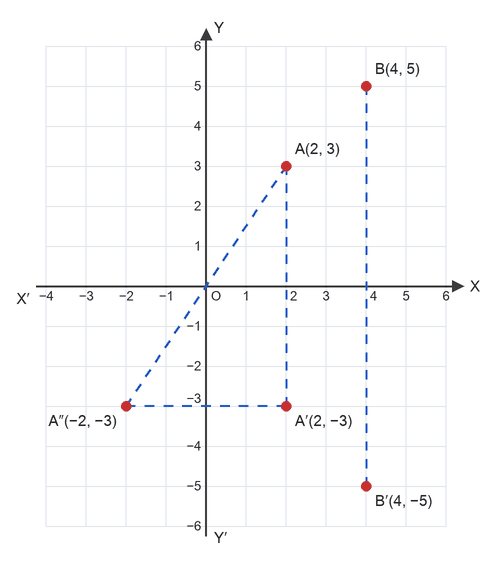
Step 4 — Part (d): name the single transformation.
We compare A(2, 3) with A″(−2, −3): the signs of both co-ordinates have changed. That is the rule (x,y)→(−x,−y), reflection in the origin. (A reflection in the x-axis followed by a reflection in the y-axis always acts like one reflection in the origin.)
Check: The mid-point of AA″ is (22+(−2),23+(−3)), which is (0, 0); the origin is the mid-point, as it must be for a reflection in the origin.
Watch out: In part (c) reflect A′, not A; reflecting A in the y-axis would give (−2, 3).
Therefore, (b) A′ = (2, −3) and B′ = (4, −5); (c) A″ = (−2, −3); (d) the single transformation is reflection in the origin.
