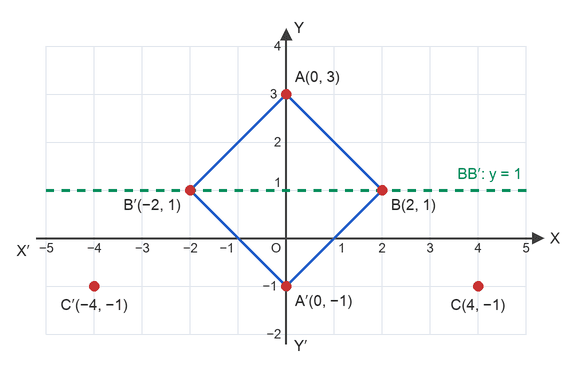
(b) Reflect point B and C in y-axis and name their images as B' and C' respectively. Plot and write coordinates of the points B' and C'.
(c) Reflect point A in the line BB' and name its images as A'.
(d) Plot and write coordinates of point A'.
(e) Join the points ABA'B' and give the geometrical name of the closed figure so formed.
Solution:
Concept: Reflection in the y-axis (the line x=0) keeps the y-co-ordinate and changes the sign of the x-co-ordinate: (x,y)→(−x,y). When a point is reflected in a line, the line is the perpendicular bisector of the segment joining the point to its image. So the image is as far behind the line as the point is in front of it, and the segment joining them is perpendicular to the line. A quadrilateral whose diagonals are equal and bisect each other at right angles is a square.
Given: A(0, 3), B(2, 1) and C(4, −1).
Step 1 — Part (a): plot the points.
We mark each point by moving along the x-axis first (by its x-co-ordinate) and then parallel to the y-axis (by its y-co-ordinate). A lies on the y-axis.
Step 2 — Part (b): reflect B and C in the y-axis.
Each point keeps its y-co-ordinate and the sign of its x-co-ordinate changes.
B(2,1)→B′(−2,1)
C(4,−1)→C′(−4,−1)
Step 3 — Part (c): find the line BB′.
B(2, 1) and B′(−2, 1) both have y-co-ordinate 1, so BB′ is the horizontal line y=1.
Step 4 — Parts (c) and (d): reflect A in the line y = 1.
First we find how far A is from the line.
distance of A from y=1=3−1=2 units
A is 2 units above the line, so its image is 2 units below it. The line is horizontal, so the x-co-ordinate stays 0.
y-co-ordinate of A′=1−2=−1
A(0,3)→A′(0,−1)
Step 5 — Part (e): name ABA′B′.
The diagonals are AA′ and BB′. AA′ is vertical, from (0, 3) to (0, −1), so it is 4 units long; BB′ is horizontal, from (2, 1) to (−2, 1), so it is also 4 units long. Both have the mid-point (0, 1), so they bisect each other, and one is vertical and the other horizontal, so they cross at right angles. Hence ABA′B′ is a square.
Check: Each side is the same length; for example:
AB=(2−0)2+(1−3)2=22+(−2)2=4+4=8=22 units
Watch out: Reflect A in the line BB′ (y=1), not in the x-axis; reflecting in the x-axis would wrongly give (0, −3).
Therefore, (b) B′ = (−2, 1) and C′ = (−4, −1); (d) A′ = (0, −1); (e) ABA′B′ is a square.