Solution:
Concept: Reflection in the y-axis (the line x=0) keeps the y-co-ordinate and changes the sign of the x-co-ordinate: (x,y)→(−x,y). A closed figure with straight sides is named by counting its sides: 6 sides make a hexagon, 7 a heptagon, 8 an octagon and 10 a decagon.
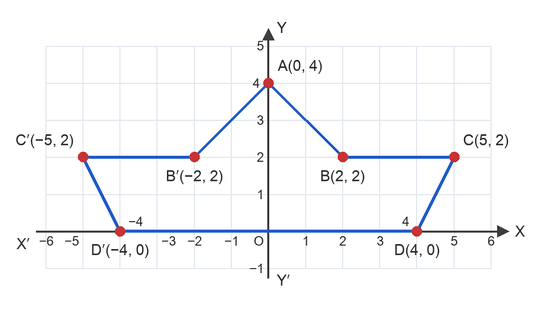
Given: A(0, 4), B(2, 2), C(5, 2), D(4, 0) and the origin E(0, 0), with 2 cm = 1 unit.
Step 1 — Part (a): plot the points.
We mark each point by moving along the x-axis first (by its x-co-ordinate) and then parallel to the y-axis (by its y-co-ordinate). A and E lie on the y-axis.
Step 2 — Part (b): reflect B, C and D in the y-axis.
Each point keeps its y-co-ordinate and the sign of its x-co-ordinate changes.
B(2,2)→B′(−2,2)
C(5,2)→C′(−5,2)
D(4,0)→D′(−4,0)
Step 3 — Part (c): join and count the sides.
We join A, B, C, D, D′, C′, B′ and back to A. The sides are AB, BC, CD, DD′, D′C′, C′B′ and B′A, and no two neighbouring sides lie on one straight line. So there are 7 sides.
Step 4 — Part (c): name the figure.
A closed figure with 7 sides is a heptagon. It is a concave heptagon (it has dents at B and B′) and it is symmetrical about the y-axis. E(0, 0) lies on the side DD′, so it is not a corner.
Watch out: Join the points in exactly the order given and close the figure back to the first point; a different order gives a different figure.
Therefore, (b) B′ = (−2, 2), C′ = (−5, 2) and D′ = (−4, 0); (c) the closed figure ABCDD′C′B′ is a heptagon.
