
Opening your dashboard
Class 10 Biology Chapter 3 Genetics – Some Basic Fundamentals: Previous Year Questions
39 questions on Chapter 3, each solved step by step. Class 10 Biology, ICSE 2026-27.
39 questions with solutions
1–5 marks · Mixed difficulty
- 11 mark
Question 1
In each set of terms given below, there is an odd one and cannot be grouped in the same category to which the other three belong. Identify the odd term in each set and name the category to which the remaining three belong.
Example: Ovary, Fallopian tube, Ureter, Uterus. Odd term: Ureter Category: Parts of female reproductive system.
Typhoid, Haemophilia, Albinism, Colour blindness.
Solve with AIWritten solution
Solution:
Concept: A genetic (hereditary) disorder is caused by a faulty gene and is passed on from parents to children; an infectious disease is caused by a germ (virus, bacterium or protozoan) and is caught, not inherited.
Step 1 — Sort the four terms.
We ask of each term whether it is caught from a germ or inherited through genes.
- Typhoid — caused by a bacterium (Salmonella Typhi) spread through contaminated food and water; caught, not inherited.
- Haemophilia — a genetic disorder caused by a recessive gene on the X chromosome.
- Albinism — a genetic disorder caused by a recessive gene; the body cannot make the pigment melanin.
- Colour blindness — a genetic disorder caused by a recessive gene on the X chromosome.
Step 2 — Name the odd term and the category.
Typhoid is the only infection, so it is the odd term; the other three are genetic disorders.
Therefore, the odd term is Typhoid, and the category of the other three is Genetic (hereditary) disorders.
- 21 mark
Question 2
Give the Biological / technical term for the following:
An alteration in the genetic material that can be inherited.
Solve with AIWritten solution
Solution:
Concept: A mutation is a sudden change in one or more genes, or in the number or the structure of chromosomes. A change in the genetic material of the gametes is passed on to the next generation.
Step 1 — Recall the term.
An alteration in the genetic material that can be inherited is a mutation.
Step 2 — Give an example.
Sickle cell anaemia is caused by a gene mutation: one base of the haemoglobin gene changes, the red blood cells become sickle-shaped, and the changed gene is inherited.

Therefore, the term is mutation.
- 31 mark
Question 3
Give scientific reasons for the following statements:
Colour blindness is more common in men than in women.
Solve with AIWritten solution
Solution:
Concept: Colour blindness and haemophilia are caused by recessive alleles on the X chromosome; the Y chromosome has no matching gene. A male (XY) shows the disorder with ONE such X; a female (XX) shows it only with TWO, and with one she is a normal carrier. A son always gets his X from his mother and his Y from his father.
Step 1 — A man has only one X.
A male is XY. If his single X carries the defective allele, written , there is no second X to cover it, so he is colour-blind.
Step 2 — A woman has two X chromosomes.
A female is XX. With one defective X () the normal allele on her other X is dominant, so she has normal vision and is only a carrier. She is colour-blind only if both her X chromosomes carry the defective allele (), which is much rarer.

Step 3 — Compare the chances.
One defective allele is enough to make a man colour-blind, but a woman needs two, one from each parent.
Watch out: The Y chromosome carries NO gene for colour vision, so nothing on it can cover the defect.
Therefore, colour blindness is more common in men because the recessive gene is on the X chromosome: a man, with a single X, is colour-blind with one defective allele, while a woman needs two.
- 45 marks
Question 4
A homozygous tall plant (T) bearing red coloured (R) flowers is crossed with a homozygous dwarf (t) plant bearing white (r) flowers :
(i) Give the genotype and phenotype of the plants of generation.
(ii) Mention the possible combinations of the gametes that can be obtained from the hybrid plant.
(iii) State the Mendel's law of Independent Assortment.
(iv) Mention the phenotypes of the offspring's obtained in F_2 generation.
(v) What is the phenotypic ratio obtained in F_2 generation?
Solve with AIWritten solution
Solution:
Concept: This is a dihybrid cross: two pairs of contrasting characters (height and flower colour) are followed together. Tall (T) and red (R) are dominant; dwarf (t) and white (r) are recessive. Law of Independent Assortment: when there are two pairs of characters, the distribution of the alleles of one character into the gametes is independent of the distribution of the alleles of the other character.
Step 1 — Part (i): the F₁ generation.
The parents are TTRR (tall, red) and ttrr (dwarf, white). Their gametes are TR and tr, so every F₁ plant has the genotype TtRr. T and R are dominant, so every F₁ plant is tall with red flowers.
Step 2 — Part (ii): gametes of the F₁ hybrid.
Each gamete gets one allele of each pair, in every possible combination, so TtRr forms four kinds of gametes in equal numbers: TR, Tr, tR, tr.
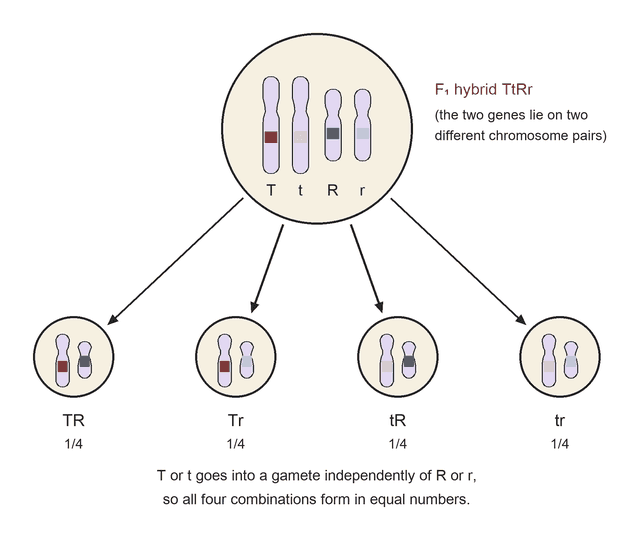
Step 3 — Part (iii): the law of independent assortment.
When there are two pairs of characters, the distribution of the alleles of one character into the gametes is independent of the distribution of the alleles of the other character. That is why T or t can go into a gamete with R or with r.
Step 4 — Part (iv): phenotypes in F₂.
Crossing two F₁ plants (TtRr × TtRr) gives four kinds of plants: tall with red flowers, tall with white flowers, dwarf with red flowers and dwarf with white flowers. Two of them (tall white, dwarf red) are new combinations not seen in either parent.
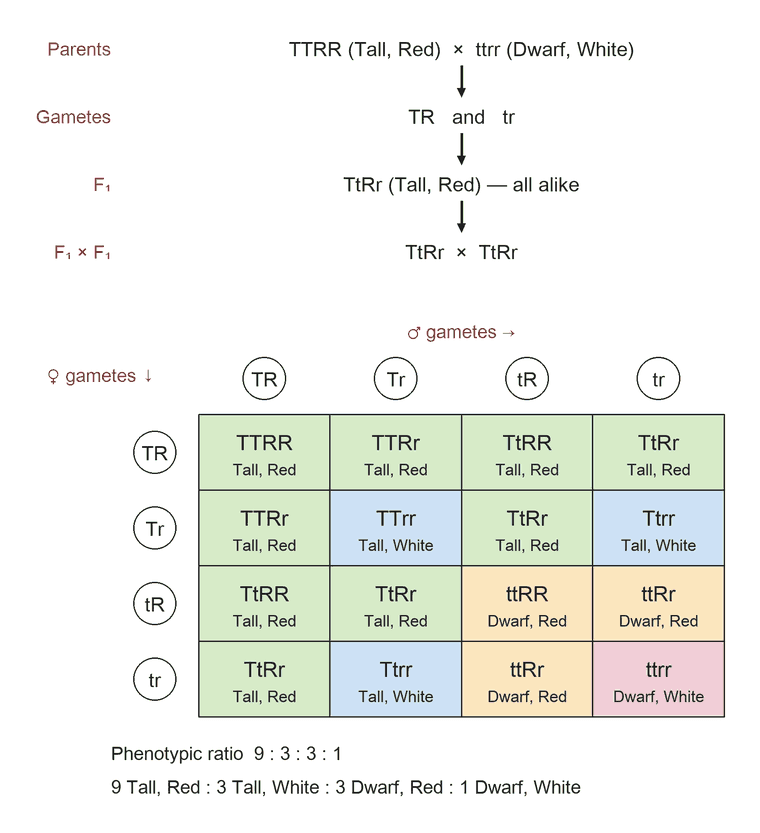
Step 5 — Part (v): phenotypic ratio in F₂.
Counting the 16 boxes of the Punnett square gives 9 tall red, 3 tall white, 3 dwarf red and 1 dwarf white.
Watch out: In F₂ count PHENOTYPES (what the plants look like), not genotypes; 9 + 3 + 3 + 1 = 16 boxes.
Therefore, (i) F₁: genotype TtRr, phenotype tall with red flowers; (ii) gametes TR, Tr, tR, tr; (iii) the law as stated in Step 3; (iv) tall red, tall white, dwarf red, dwarf white; (v) 9 : 3 : 3 : 1.
- 51 mark
Question 5
Given below are groups of terms. In each group the first pair indicates the relationship between the two terms. Rewrite and complete the second pair on a similar basis.
Example: Oxygen : Inspiration : : Carbondioxide : Expiration
TT : Homozygous : : Tt : ...............
Solve with AIWritten solution
Solution:
Concept: Alleles are the alternative forms of a gene. They occupy the same position (locus) on a pair of homologous chromosomes and affect the same character in different ways, e.g. T (tall) and t (dwarf).
Step 1 — Find the relation in the first pair.
TT has two similar alleles of the gene, so it is homozygous.
Step 2 — Complete the second pair.
Tt has two dissimilar alleles, one dominant (T) and one recessive (t), so it is heterozygous. Such a plant is tall but can pass on either allele.
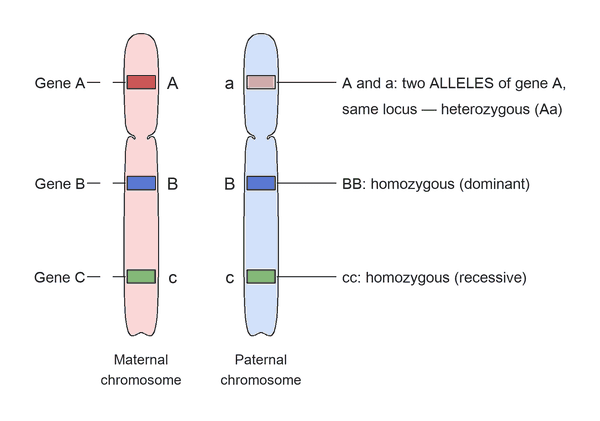
Therefore, TT : Homozygous : : Tt : Heterozygous.
- 61 mark
Question 6
Give appropriate biological / technical terms for the following:
The suppressed allele of a gene.
Solve with AIWritten solution
Solution:
Concept: Alleles are the alternative forms of a gene. They occupy the same position (locus) on a pair of homologous chromosomes and affect the same character in different ways, e.g. T (tall) and t (dwarf). Law of Dominance: out of a pair of contrasting characters present together, only one is able to express itself while the other remains suppressed. The one that expresses itself is the dominant character and the one that stays unexpressed is the recessive character.
Step 1 — Recall the term.
The allele whose expression is suppressed when the other allele is present is the recessive allele (recessive gene).
Step 2 — Give an example.
In a Tt pea plant the dwarf allele t is suppressed by T, so the plant is tall; t shows itself only in a tt plant, which is dwarf.
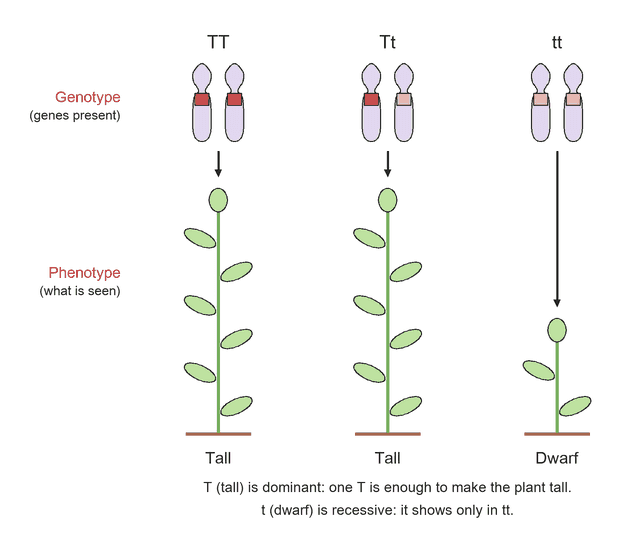
Therefore, the term is recessive allele.
- 75 marks
Question 7
In a homozygous pea plant, axial flowers (A) are dominant over terminal flowers (a).
(i) What is the phenotype and genotype of the generation if a plant bearing pure axial flowers is crossed with a plant bearing pure terminal flowers?
(ii) Draw a Punnett square board to show the gametes and offsprings when both the parent plants are heterozygous for axial flowers.
(iii) What is the phenotypic ratio and genotypic ratio of the above cross shown in (ii).
(iv) State Mendel's Law of Dominance.
(v) Name two genetic disorders commonly seen in human males.
Solve with AIWritten solution
Solution:
Concept: Axial flowers (A) are dominant over terminal flowers (a). A pure axial plant is AA and a pure terminal plant is aa. One character is followed, so this is a monohybrid cross. Law of Dominance: out of a pair of contrasting characters present together, only one is able to express itself while the other remains suppressed. The one that expresses itself is the dominant character and the one that stays unexpressed is the recessive character.
Step 1 — Part (i): the F₁ generation.
The gametes are A (from AA) and a (from aa), so every F₁ plant is Aa (heterozygous). A is dominant, so all F₁ plants bear axial flowers.
Step 2 — Part (ii): Punnett square for Aa × Aa.
Each heterozygous parent forms two kinds of gametes, A and a, in equal numbers. We combine every gamete of one parent with every gamete of the other.
♀ gametes ↓ / ♂ gametes → A a A AA (axial) Aa (axial) a Aa (axial) aa (terminal) 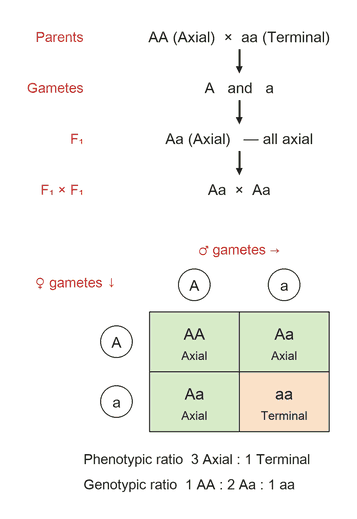
Step 3 — Part (iii): the ratios.
Three of the four boxes (AA, Aa, Aa) have axial flowers and one (aa) has terminal flowers, so the phenotypic ratio is 3 axial : 1 terminal. The genotypes are 1 AA : 2 Aa : 1 aa, so the genotypic ratio is 1 : 2 : 1.
Step 4 — Part (iv): Mendel's law of dominance.
Out of a pair of contrasting characters present together, only one is able to express itself while the other remains suppressed; the one expressed is dominant and the other recessive.
Step 5 — Part (v): two disorders common in human males.
Haemophilia and colour blindness (red–green). Both are caused by recessive genes on the X chromosome; a male has only one X, so a single defective allele shows up in him.
Watch out: The F₁ shows only the dominant character, but it CARRIES the recessive allele, which reappears in F₂.
Therefore, (i) F₁: genotype Aa, phenotype axial flowers; (ii) the Punnett square in Step 2; (iii) phenotypic ratio 3 : 1, genotypic ratio 1 : 2 : 1; (iv) the law as stated in Step 4; (v) haemophilia and colour blindness.
- 81 mark
Question 8
Give appropriate biological or technical terms for the following:
The condition in which a pair of chromosomes carry similar alleles of a particular character.
Solve with AIWritten solution
Solution:
Concept: Alleles are the alternative forms of a gene. They occupy the same position (locus) on a pair of homologous chromosomes and affect the same character in different ways, e.g. T (tall) and t (dwarf).
Step 1 — Recall the term.
When the two chromosomes of a pair carry similar alleles of a character (both dominant, TT, or both recessive, tt), the condition is homozygous.
Step 2 — See what it means.
A homozygous plant breeds true: a TT pea plant forms only T gametes, so selfing it gives only tall plants.
Therefore, the term is homozygous.
- 95 marks
Question 9
A pea plant which is homozygous for Green pods which are inflated [GGII] is crossed with a homozygous plant for yellow pods which are constricted [ggii]. Answer the following questions:
(i) Give the phenotype and genotype of the generation. Which type of pollination has occurred to produce generation?
(ii) Write the phenotypic ratio of the generation.
(iii) Write the possible combinations of the gametes that can be obtained if two hybrid plants are crossed.
(iv) State Mendel's law of 'Segregation of Gametes'.
(v) What is the scientific name of the plant which Mendel used for his experiments on inheritance?
Solve with AIWritten solution
Solution:
Concept: Green pod (G) is dominant over yellow (g), and inflated pod (I) is dominant over constricted (i). Two characters are followed together, so this is a dihybrid cross. Law of Segregation: the two members of a pair of factors (alleles) separate during the formation of gametes, so each gamete receives only one factor of the pair; the gametes then combine at random at fertilisation.
Step 1 — Part (i): the F₁ generation and the pollination.
The gametes are GI (from GGII) and gi (from ggii), so every F₁ plant has the genotype GgIi and, both dominant traits showing, has green, inflated pods. The two different parents were crossed, so this is cross-pollination, done by hand: the stamens of one flower are removed and pollen from the other parent is dusted on its stigma.
Step 2 — Part (ii): phenotypic ratio of F₂.
Selfing GgIi gives 16 combinations: 9 green inflated, 3 green constricted, 3 yellow inflated and 1 yellow constricted.
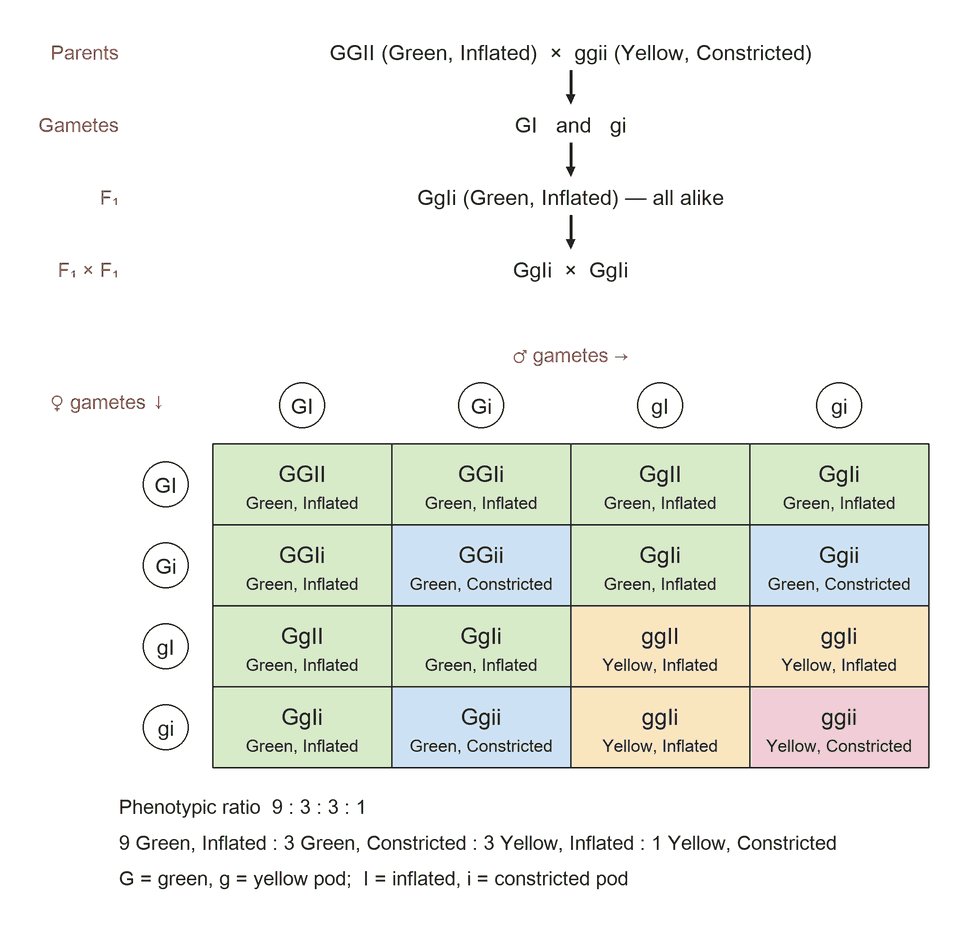
Step 3 — Part (iii): gametes of the F₁ hybrids.
Each GgIi plant forms four kinds of gametes in equal numbers: GI, Gi, gI, gi. In the cross these combine at random in 4 × 4 = 16 ways.
Step 4 — Part (iv): the law of segregation.
The two members of a pair of factors separate during the formation of gametes; they do not blend, so each gamete carries only one factor of the pair. The gametes combine at random at fertilisation.
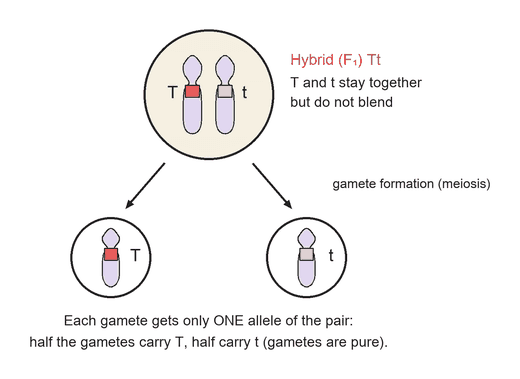
Step 5 — Part (v): Mendel's plant.
Mendel used the garden pea, Pisum sativum.
Watch out: Each gamete has ONE letter of each pair (GI, not GG or Gg).
Therefore, (i) F₁: GgIi, green inflated pods, by cross-pollination; (ii) 9 : 3 : 3 : 1; (iii) GI, Gi, gI, gi; (iv) the law as stated in Step 4; (v) Pisum sativum.
- 101 mark
Question 10
Choose the correct answer from the four options given below:
In a human male, a sperm will contain:
Solve with AIAnswer
(A) Both X and Y chromosomes
(B) Only Y Chromosomes
(C) Only X chromosome
- Correct
(D) Either X or Y Chromosomes
Answer: (D) Either X or Y Chromosomes
Concept: A human body cell has 44 autosomes and 2 sex chromosomes: XX in a female and XY in a male. Every ovum gets 22 + X; half the sperms get 22 + X and half get 22 + Y.
Step 1 — Write the male's chromosomes.
A body cell of a man has 44 + XY.
Step 2 — Halve them for a sperm.
In meiosis the X and Y separate, so each sperm receives one of them: 22 + X or 22 + Y. Half the sperms carry X and half carry Y.

Why the other options are wrong:
- (A) Both X and Y chromosomes: a sperm cannot carry both X and Y; the pair separates when sperms are formed.
- (B) Only Y Chromosomes: the sperms are not all Y-bearing; half of them carry X.
- (C) Only X chromosome: the sperms are not all X-bearing; half of them carry Y. It is the ovum whose sex chromosome is always X.
Therefore, a human sperm contains either an X or a Y chromosome, option (D).
- 111 mark
Question 11
Identify the ODD term in each set and name the CATEGORY to which the remaining three belong :
Example: Glucose, starch, cellulose, calcium Odd term: Calcium. Category: Others are different types of carbohydrates
Chicken pox, Colour blindness, Haemophilia, Albinism.
Solve with AIWritten solution
Solution:
Concept: A genetic (hereditary) disorder is caused by a faulty gene and is passed on from parents to children; an infectious disease is caused by a germ (virus, bacterium or protozoan) and is caught, not inherited.
Step 1 — Sort the four terms.
We ask of each term whether it is caught from a germ or inherited through genes.
- Chicken pox — caused by a virus (varicella-zoster) and caught from an infected person; not inherited.
- Colour blindness and haemophilia — X-linked recessive genetic disorders.
- Albinism — a recessive genetic disorder; the body cannot make the pigment melanin.
Step 2 — Name the odd term and the category.
Chicken pox is the only infection, so it is the odd term.
Therefore, the odd term is Chicken pox, and the category of the other three is Genetic (hereditary) disorders.
- 125 marks
Question 12
In Mendel's experiments, tall pea plants (T) are dominant over dwarf pea plants (t).
(i) What is the phenotype and genotype of the generation if a homozygous tall plant is crossed with a homozygous dwarf plant?
(ii) Draw a Punnett square board to show the gametes and offspring when both the parents are heterozygous for tallness.
(iii) What is the Phenotypic ratio and genotypic ratio of the above cross in (ii)?
(iv) State Mendel's Law of Dominance.
(v) What is a Dihybrid Cross?
Solve with AIWritten solution
Solution:
Concept: Tall (T) is dominant over dwarf (t). A homozygous tall plant is TT and a homozygous dwarf plant is tt. One character is followed, so this is a monohybrid cross. Law of Dominance: out of a pair of contrasting characters present together, only one is able to express itself while the other remains suppressed. The one that expresses itself is the dominant character and the one that stays unexpressed is the recessive character.
Step 1 — Part (i): the F₁ generation.
The gametes are T (from TT) and t (from tt), so every F₁ plant is Tt, and since T is dominant, all are tall.
Step 2 — Part (ii): Punnett square for Tt × Tt.
Each heterozygous parent forms two kinds of gametes, T and t, in equal numbers; we combine every gamete of one parent with every gamete of the other.
♀ gametes ↓ / ♂ gametes → T t T TT (tall) Tt (tall) t Tt (tall) tt (dwarf) 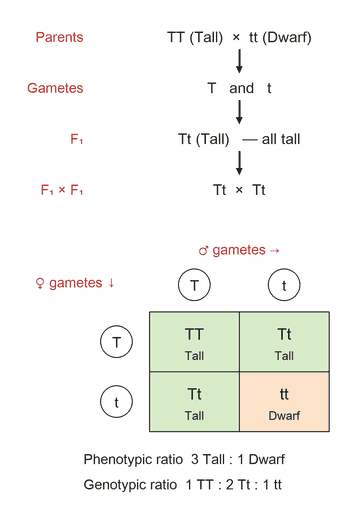
Step 3 — Part (iii): the ratios.
Three boxes (TT, Tt, Tt) are tall and one (tt) is dwarf: phenotypic ratio 3 tall : 1 dwarf. Genotypic ratio 1 TT : 2 Tt : 1 tt.
Step 4 — Part (iv): Mendel's law of dominance.
Out of a pair of contrasting characters present together, only one is able to express itself (tall, the dominant) while the other remains suppressed (dwarf, the recessive).
Step 5 — Part (v): a dihybrid cross.
A dihybrid cross is a cross between two parents that differ in two pairs of contrasting characters, both followed together. For example, Mendel crossed round yellow-seeded plants (RRYY) with wrinkled green-seeded plants (rryy); the F₂ showed the ratio 9 : 3 : 3 : 1.
Watch out: The F₁ shows only the dominant character, but it CARRIES the recessive allele, which reappears in F₂.
Therefore, (i) F₁: genotype Tt, phenotype tall; (ii) the Punnett square in Step 2; (iii) phenotypic ratio 3 : 1, genotypic ratio 1 : 2 : 1; (iv) the law as stated in Step 4; (v) a cross in which two pairs of contrasting characters are studied together.
- 131 mark
Question 13
Explain the following terms:
(i) Allele
Solve with AIWritten solution
Solution:
Concept: A gene usually exists in two alternative forms; a child gets one form from each parent.
Step 1 — Define the term.
Alleles are the alternative forms of a gene, occupying the same position (locus) on homologous chromosomes and affecting the same character in different ways.
Step 2 — Give an example.
For height in the garden pea, T (tall) and t (dwarf) are two alleles of the same gene.
Therefore, alleles are the alternative forms of a gene that occupy the same locus on homologous chromosomes, such as T and t.
- 141 mark
Question 14
Explain the following terms:
(iv) Phenotype
Solve with AIWritten solution
Solution:
Concept: The phenotype is what we can see; the genotype is the set of genes behind it.
Step 1 — Define the term.
The phenotype is the observable characteristic of an organism, the character that is expressed and shown, which is controlled by its genes.
Step 2 — Give an example.
TT and Tt pea plants both have the phenotype tall, though their genotypes differ; a tt plant has the phenotype dwarf.
Therefore, the phenotype is the observable (expressed) character of an organism, such as tall or dwarf.
- 151 mark
Question 15
In a human female, ovum consists of:
Solve with AIAnswer
(A) 23 pairs of autosomes
(B) 22 pairs of autosomes and 1 pair of sex chromosomes
(C) 22 autosomes and 1 Y-chromosome
- Correct
(D) 22 autosomes and 1 X-chromosome
Answer: (D) 22 autosomes and 1 X-chromosome
Concept: An ovum is a gamete, so it is haploid: it has one chromosome from each of the 23 pairs. a human body cell has 44 autosomes and 2 sex chromosomes: XX in a female and XY in a male. Every ovum gets 22 + X; half the sperms get 22 + X and half get 22 + Y.
Step 1 — Write the female's chromosomes.
A female body cell has 46 chromosomes: 22 pairs of autosomes and one pair of sex chromosomes, XX.
Step 2 — Halve them for the ovum.
Meiosis halves the number, so the ovum gets 22 autosomes and one sex chromosome. Both sex chromosomes of a female are X, so it is always X: the ovum is 22 + X (23 chromosomes).
Why the other options are wrong:
- (A) 23 pairs of autosomes: 23 pairs (46 chromosomes) is the number in a body cell, not in a gamete.
- (B) 22 pairs of autosomes and 1 pair of sex chromosomes: 22 pairs of autosomes and a pair of sex chromosomes is again the full body-cell set of 46.
- (C) 22 autosomes and 1 Y-chromosome: a female has no Y chromosome, so her ovum cannot carry one; a Y comes only from the father's sperm.
Therefore, an ovum has 22 autosomes and 1 X chromosome, option (D).
- 161 mark
Question 16
Give appropriate biological technical terms for the following:
(ix) A sudden inheritable change in one or more genes.
Solve with AIWritten solution
Solution:
Concept: A mutation is a sudden change in one or more genes, or in the number or the structure of chromosomes. A change in the genetic material of the gametes is passed on to the next generation.
Step 1 — Recall the term.
A sudden inheritable change in one or more genes is a mutation (gene mutation).
Step 2 — Give an example.
Sickle cell anaemia is caused by a gene mutation: one base of the haemoglobin gene changes, so the body makes sickle-shaped red blood cells.
Therefore, the term is mutation.
- 175 marks
Question 17
A homozygous dominant tall pea plant bearing red flowers (TTRR) is crossed with a homozygous recessive dwarf pea plant bearing white flowers (ttrr).
(i) What is the phenotype and genotype of individuals?
(ii) Write the possible combination of gametes that are obtained when two hybrid plants are crossed.
(iii) Mention the phenotypic ratio of the generation.
(iv) State Mendel's Law of Independent Assortment.
(v) Name two X-linked disorders found in humans.
Solve with AIWritten solution
Solution:
Concept: Two characters, height and flower colour, are followed together, so this is a dihybrid cross. Tall (T) and red (R) are dominant over dwarf (t) and white (r). Law of Independent Assortment: when there are two pairs of characters, the distribution of the alleles of one character into the gametes is independent of the distribution of the alleles of the other character.
Step 1 — Part (i): the F₁ individuals.
The gametes are TR (from TTRR) and tr (from ttrr), so every F₁ plant has the genotype TtRr and the phenotype tall with red flowers.
Step 2 — Part (ii): gametes when two F₁ hybrids are crossed.
Each TtRr plant forms four kinds of gametes in equal numbers: TR, Tr, tR, tr. They combine at random in 16 ways.
Step 3 — Part (iii): phenotypic ratio of F₂.
The 16 boxes give 9 tall red, 3 tall white, 3 dwarf red and 1 dwarf white.
Step 4 — Part (iv): the law of independent assortment.
When there are two pairs of characters, the distribution of the alleles of one character into the gametes is independent of the distribution of the alleles of the other character, as the four kinds of gametes of the F₁ hybrid show.
Step 5 — Part (v): two X-linked disorders.
Haemophilia and colour blindness. In haemophilia a clotting factor is missing, so the blood clots very slowly and even a small cut can go on bleeding for a long time.
Watch out: Each gamete has ONE allele of each pair; TT or Rr can never be a gamete.
Therefore, (i) F₁: genotype TtRr, phenotype tall with red flowers; (ii) TR, Tr, tR, tr; (iii) 9 : 3 : 3 : 1; (iv) the law as stated in Step 4; (v) haemophilia and colour blindness.
- 181 mark
Question 18
The sex chromosome in a human ovum is:
Solve with AIAnswer
- Correct
(A) X chromosome
(B) Y chromosome
(C) Both X and Y chromosomes
(D) Either X or Y chromosome
Answer: (A) X chromosome
Concept: A human body cell has 44 autosomes and 2 sex chromosomes: XX in a female and XY in a male. Every ovum gets 22 + X; half the sperms get 22 + X and half get 22 + Y.
Step 1 — Write the female's sex chromosomes.
A female body cell has 44 + XX.
Step 2 — Find the ovum's.
After meiosis every ovum gets 22 + X; all ova are alike in this.
Why the other options are wrong:
- (B) Y chromosome: a female has no Y chromosome, so no ovum can carry Y.
- (C) Both X and Y chromosomes: a gamete gets one sex chromosome, not two, so an ovum with both X and Y is impossible.
- (D) Either X or Y chromosome: 'either X or Y' describes the sperms, which are of two kinds; ova are all X-bearing.
Therefore, the sex chromosome in a human ovum is X, option (A).
- 191 mark
Question 19
Name the following:
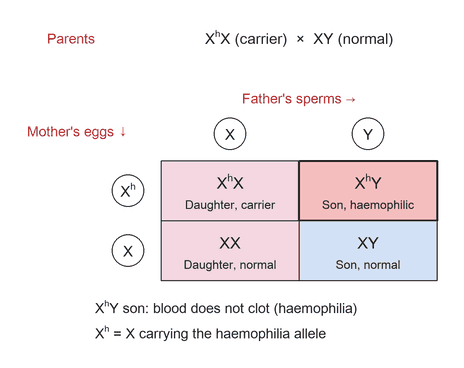
(b) A genetic disorder in which the blood does not clot.
Solve with AIWritten solution
Solution:
Concept: Colour blindness and haemophilia are caused by recessive alleles on the X chromosome; the Y chromosome has no matching gene. A male (XY) shows the disorder with ONE such X; a female (XX) shows it only with TWO, and with one she is a normal carrier. A son always gets his X from his mother and his Y from his father.
Step 1 — Name the disorder.
The genetic disorder in which the blood does not clot properly is haemophilia (bleeder's disease).
Step 2 — See why it happens.
In haemophilia a clotting factor is missing, so the blood clots very slowly and even a small cut can go on bleeding for a long time. The recessive gene is on the X chromosome, so the disorder is far more common in males.
Therefore, the disorder is haemophilia.
- 202 marks
Question 20
State Mendel's 'Law of Segregation'.
Solve with AIWritten solution
Solution:
Concept: The two factors (alleles) of a character stay together in an individual but separate when its gametes are formed, so each gamete is 'pure' (law of purity of gametes).
Step 1 — State the law.
The two members of a pair of factors separate during the formation of gametes. They do not blend, but go into different gametes, so each gamete carries only one factor of the pair. The gametes combine at random at fertilisation.
Step 2 — Give an example.
A hybrid tall pea plant (Tt) forms two kinds of gametes, T and t, in equal numbers. That is why a tt dwarf plant can appear again in the F₂ generation.
Therefore, the law of segregation states that the two factors of a pair separate when gametes are formed, so each gamete receives only one of them.
- 211 mark
Question 21
Define the term Mutation.
Solve with AIWritten solution
Solution:
Concept: A mutation changes the hereditary material itself, so the change can pass to the next generation.
Step 1 — Define the term.
A mutation is a sudden change in one or more genes, or in the number or the structure of chromosomes.
Step 2 — Give an example.
Sickle cell anaemia is caused by a gene mutation: a change of one base in the haemoglobin gene makes the red blood cells sickle-shaped.
Therefore, a mutation is a sudden change in one or more genes, or in the number or structure of chromosomes.
- 222 marks
Question 22
A pure breeding red flower variety of pea plant (RR) is crossed with a pure breeding white flower variety of pea plant (rr). Draw a Punnett square to find out the Phenotypic and Genotypic ratios of the progeny belonging to the generation.
Solve with AIWritten solution
Solution:
Concept: Red (R) is dominant over white (r). Crossing two pure lines gives a hybrid F₁; crossing two F₁ plants gives the F₂.
Step 1 — Parents and the F₁.
The parents are RR (red) and rr (white), with gametes R and r. Every F₁ plant is Rr, and since R is dominant, all are red.
Step 2 — Punnett square for F₁ × F₁ (Rr × Rr).
Each F₁ plant forms R and r gametes in equal numbers; we combine every gamete of one parent with every gamete of the other.
♀ gametes ↓ / ♂ gametes → R r R RR (red) Rr (red) r Rr (red) rr (white) 
Step 3 — Read the ratios.
Three boxes (RR, Rr, Rr) are red and one (rr) is white. The white colour, hidden in F₁, reappears in a quarter of the F₂ plants.
Watch out: The F₁ shows only the dominant character, but it CARRIES the recessive allele, which reappears in F₂.
Therefore, in F₂ the phenotypic ratio is 3 red : 1 white and the genotypic ratio is 1 RR : 2 Rr : 1 rr.
- 231 mark
Question 23
A zygote which has Y chromosome inherited from the father will develop into a:
Solve with AIAnswer
(A) Will depend on the chromosome inherited from the mother
(B) Girl
(C) Either boy or a girl
- Correct
(D) Boy
Answer: (D) Boy
Concept: The mother always gives an X chromosome. The father's sperm gives either X or Y, and that decides the sex: XX is a girl and XY is a boy.
Step 1 — The egg.
The egg from the mother carries X.
Step 2 — The sperm.
The sperm from the father carries Y (given).
Step 3 — The zygote.
The zygote is therefore XY, which develops into a boy.
Why the other options are wrong:
- (A) Will depend on the chromosome inherited from the mother: the mother always gives X, so her chromosome cannot change the result; the father's chromosome settles it.
- (B) Girl: a girl is XX; a zygote with a Y chromosome cannot be XX.
- (C) Either boy or a girl: once the Y chromosome is present the outcome is fixed, a boy, not 'either'.
Therefore, the zygote develops into a boy, option (D).
- 241 mark
Question 24
Four friends P, Q, R and S were discussing the examples of genetic disorders. The examples they quoted were as follows:
P. Colour blindness and Malaria
Q. Albinism and Cholera
R. Haemophilia and Colour blindness
S. Haemophilia and Albinism
Who gave the correct examples?
Solve with AIAnswer
(A) P and Q
- Correct
(B) R and S
(C) P and R
(D) Q and S
Answer: (B) R and S
Concept: A genetic (hereditary) disorder is caused by a faulty gene and is passed on from parents to children; an infectious disease is caused by a germ (virus, bacterium or protozoan) and is caught, not inherited.
Step 1 — Sort the diseases.
We decide for each disease whether it is inherited or caused by a germ.
- Genetic: colour blindness, haemophilia, albinism.
- Infectious: malaria (caused by the protozoan Plasmodium) and cholera (caused by the bacterium Vibrio cholerae).
Step 2 — Check each friend.
A friend is right only if BOTH examples are genetic disorders.
- P: colour blindness and malaria; malaria is an infection, so P is wrong.
- Q: albinism and cholera; cholera is an infection, so Q is wrong.
- R: haemophilia and colour blindness; both are genetic, so R is right.
- S: haemophilia and albinism; both are genetic, so S is right.
Why the other options are wrong:
- (A) P and Q: P and Q each include an infectious disease (malaria, cholera).
- (C) P and R: P is wrong, because malaria is caused by a parasite and is not inherited.
- (D) Q and S: Q is wrong, because cholera is caused by a bacterium and is not inherited.
Therefore, R and S gave the correct examples, option (B).
- 253 marks
Question 25
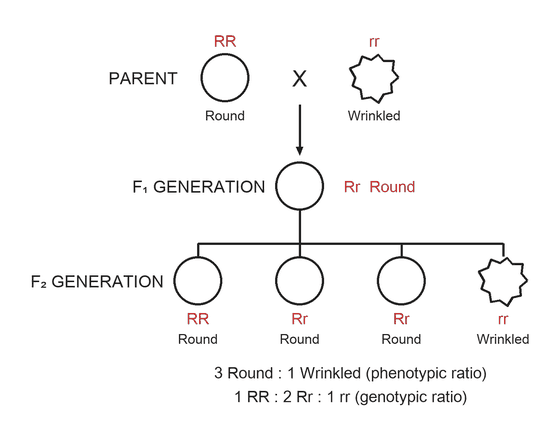
Given below is a schematic representation of the inheritance of the shape of seeds of garden pea. Answer the questions that follow:

(a) Which is the dominant and recessive allele of the trait?
(b) What does the ratio 3 : 1 in the generation represent?
(c) State Mendel’s Law of Dominance.
Solve with AIWritten solution
Solution:
Concept: Law of Dominance: out of a pair of contrasting characters present together, only one is able to express itself while the other remains suppressed. The one that expresses itself is the dominant character and the one that stays unexpressed is the recessive character.
Step 1 — Part (a): dominant and recessive.
Round × wrinkled gives only round seeds in F₁, and wrinkled seeds reappear in a quarter of the F₂. So the allele for round seed (R) is dominant and the allele for wrinkled seed (r) is recessive; every F₁ seed (Rr) is round because R masks r.
Step 2 — Part (b): what 3 : 1 represents.
It is the monohybrid phenotypic ratio: 3 round : 1 wrinkled seeds in F₂. Behind it is the genotypic ratio 1 RR : 2 Rr : 1 rr; the three round seeds are RR, Rr and Rr, and the wrinkled seed is rr.
Step 3 — Part (c): the law of dominance.
Out of a pair of contrasting characters present together, only one is able to express itself while the other remains suppressed; the one expressed is the dominant and the other the recessive.
Watch out: The 3 : 1 ratio is of PHENOTYPES; the genotypes are in the ratio 1 : 2 : 1.
Therefore, (a) round (R) is dominant and wrinkled (r) is recessive; (b) 3 : 1 is the monohybrid phenotypic ratio, 3 round : 1 wrinkled; (c) the law as stated in Step 3.
- 261 mark
Question 26
Ajay and Vijay are siblings. Ajay can roll his tongue while Vijay cannot. What is the genotype of their parents?
Solve with AIAnswer
(A) Both the parents are homozygous dominant.
(B) Both the parents are homozygous recessive.
(C) One parent is homozygous dominant, and the other is homozygous recessive.
- Correct
(D) Both the parents are heterozygous dominant.
Answer: (D) Both the parents are heterozygous dominant.
Concept: In the book's model, tongue rolling (R) is dominant over non-rolling (r). Vijay cannot roll his tongue, so he is rr and received one r from each parent; Ajay can roll, so he has at least one R.
Step 1 — What Vijay tells us.
Each parent must carry r, so that each could give an r to Vijay.
Step 2 — What Ajay tells us.
At least one parent must carry R, so that Ajay could receive it.
Step 3 — Test the options.
Of the options, only Rr × Rr does both. Their Punnett square gives 3 rollers : 1 non-roller.
♀ gametes ↓ / ♂ gametes → R r R RR (roller) Rr (roller) r Rr (roller) rr (non-roller) 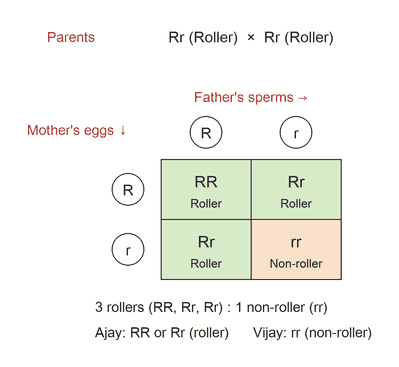
Note: a heterozygous roller with a non-roller (Rr × rr) would also fit the story, but it is not an option. In real life tongue rolling is not controlled by a single gene (identical twins can differ); the question uses the textbook model.
Why the other options are wrong:
- (A) Both the parents are homozygous dominant: RR × RR parents can give only R, so every child would be RR; there could be no non-roller like Vijay.
- (B) Both the parents are homozygous recessive: rr × rr parents can give only r, so every child would be rr; Ajay could not roll his tongue.
- (C) One parent is homozygous dominant, and the other is homozygous recessive: RR × rr parents give only Rr children, all rollers; again there could be no Vijay.
Therefore, both parents are heterozygous, option (D).
- 271 mark
Question 27
Define the term Allele.
Solve with AIWritten solution
Solution:
Concept: Every gene usually exists in two alternative forms; a child gets one from each parent.
Step 1 — Define the term.
Alleles are the alternative forms of a gene, occupying the same position (locus) on homologous chromosomes and affecting the same character in different ways.
Step 2 — Give an example.
T (tall) and t (dwarf) are two alleles of the gene for height in the garden pea.
Therefore, alleles are the alternative forms of a gene that occupy the same locus on homologous chromosomes.
- 283 marks
Question 28
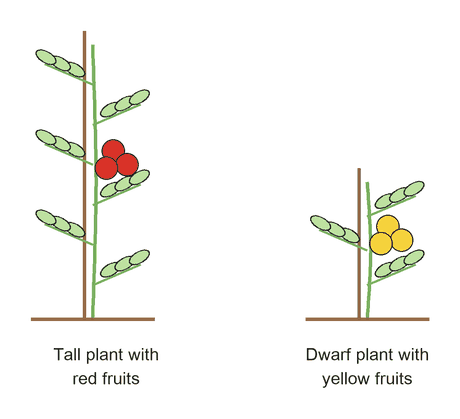
A farmer cultivates a unique species of tomato plants. The two traits selected for breeding were: Colour of the fruits and height of the plants. The farmer initially crosses a homozygous tall plant bearing red fruits (TTRR) with a dwarf plant bearing yellow fruits (ttrr) and the genotype of all the offsprings of the generation was TtRr. Next, he crosses two generation plants (TtRr).
(a) Explain the phenotype of the offsprings of the generation obtained from the initial cross.
(b) Mention the phenotypic ratio of the generation offsprings.
(c) State Mendel's Law of Independent Assortment.
Solve with AIWritten solution
Solution:
Concept: Tall (T) is dominant over dwarf (t), and red fruit (R) is dominant over yellow (r). Two characters are followed together, so this is a dihybrid cross. Law of Dominance: out of a pair of contrasting characters present together, only one is able to express itself while the other remains suppressed. The one that expresses itself is the dominant character and the one that stays unexpressed is the recessive character.
Step 1 — Part (a): the F₁ phenotype.
Every F₁ plant is TtRr. It carries the dominant alleles T and R, which mask t and r, so every F₁ plant is tall with red fruits, like the tall red parent. The recessive characters are hidden, not lost.
Step 2 — Part (b): phenotypic ratio of F₂ (TtRr × TtRr).
The 16 boxes of the Punnett square give 9 tall red, 3 tall yellow, 3 dwarf red and 1 dwarf yellow.
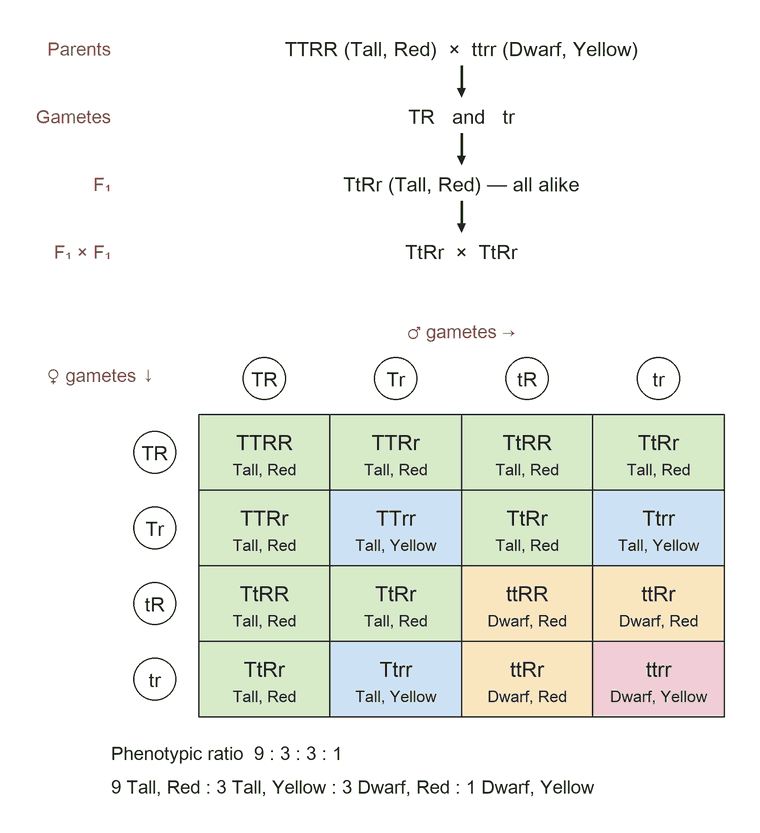
Step 3 — Part (c): the law of independent assortment.
When there are two pairs of characters, the distribution of the alleles of one character into the gametes is independent of the distribution of the alleles of the other character. So each TtRr plant forms four kinds of gametes (TR, Tr, tR, tr) in equal numbers, and new combinations (tall yellow, dwarf red) appear in F₂.
Therefore, (a) all F₁ plants are tall with red fruits, because T and R are dominant; (b) 9 : 3 : 3 : 1 (9 tall red : 3 tall yellow : 3 dwarf red : 1 dwarf yellow); (c) the law as stated in Step 3.
- 291 mark
Question 29
A newly married couple are expecting their first child. What is the probability of them having a daughter?
Solve with AIAnswer
(A) 10%
- Correct
(B) 50%
(C) 75%
(D) 100%
Answer: (B) 50%
Concept: The sex of a child depends on the sperm. Every egg carries X; half the sperms carry X and half carry Y.
Step 1 — A daughter.
An X-sperm fertilising the X-egg gives XX, a daughter.
Step 2 — A son.
A Y-sperm fertilising the X-egg gives XY, a son.
Step 3 — The chance.
The two kinds of sperm are formed in equal numbers, so the chance of a daughter is 1 out of 2, that is 50%.
Why the other options are wrong:
- (A) 10%: 10% has no basis; the two kinds of sperm are equal in number.
- (C) 75%: 75% would need three X-sperms for every Y-sperm, but they are formed half and half.
- (D) 100%: 100% would mean every sperm carries X; half carry Y, so a son is just as likely.
Therefore, the probability of a daughter is 50%, option (B).
- 301 mark
Question 30
Assertion (A): Darwin preferred pea plants for his experiments on genetics as it is a unisexual plant.
Reason (R): Pea plants are normally self-pollinated.
Solve with AIAnswer
(A) (A) is true and (R) is false.
- Correct
(B) (A) is false and (R) is true.
(C) Both (A) and (R) are true.
(D) Both (A) and (R) are false.
Answer: (B) (A) is false and (R) is true.
Concept: In an assertion–reason item, judge the Assertion and the Reason separately as true or false; only when both are true do we ask whether the Reason correctly explains the Assertion.
Step 1 — Judge the Assertion.
The Assertion is false. It was Gregor Mendel, not Darwin, who used pea plants for his experiments on inheritance. Also, the pea flower is bisexual: it has both stamens (male part) and a carpel (female part), so it is not unisexual.
Step 2 — Judge the Reason.
The Reason is true. Pea flowers are normally self-pollinated. This was one of Mendel's reasons for choosing them: self-pollination keeps the varieties pure, and he could still cross them by hand after removing the stamens.
Step 3 — Decide the option.
The Assertion is false and the Reason is true, which is option (B). No link between them needs judging, because the Assertion is false.
Why the other options are wrong:
- (A) (A) is true and (R) is false: the Assertion is not true: it names the wrong scientist and calls the pea plant unisexual.
- (C) Both (A) and (R) are true: both cannot be true, because the Assertion is false.
- (D) Both (A) and (R) are false: the Reason is not false: the garden pea is normally self-pollinated.
Therefore, the Assertion is false and the Reason is true, option (B).
- 311 mark
Question 31
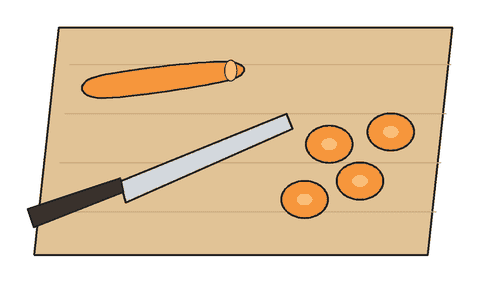
Ravi cuts his finger while chopping vegetables. The bleeding from the injury did not stop immediately. What kind of genetic disorder is he suffering from?
 Solve with AI
Written solution
Solution:
Concept: Colour blindness and haemophilia are caused by recessive alleles on the X chromosome; the Y chromosome has no matching gene. A male (XY) shows the disorder with ONE such X; a female (XX) shows it only with TWO, and with one she is a normal carrier. A son always gets his X from his mother and his Y from his father.
Step 1 — Read the clue.
Bleeding from a small cut that does not stop soon points to blood that does not clot properly.
Step 2 — Name the disorder.
Ravi is suffering from haemophilia (bleeder's disease). In haemophilia a clotting factor is missing, so the blood clots very slowly and even a small cut can go on bleeding for a long time.
Step 3 — See why a boy can have it.
It is a sex-linked disorder: the recessive gene is on the X chromosome. Ravi, a male, has a single X, so one defective allele, received from his mother, is enough to cause it.
Therefore, Ravi is suffering from haemophilia.
- 322 marks
Question 32
A colourblind child is born to a normal couple.
(a) Work out a cross to show how it is possible.
(b) Mention the sex of this child.
Solve with AIWritten solution
Solution:
Concept: Colour blindness and haemophilia are caused by recessive alleles on the X chromosome; the Y chromosome has no matching gene. A male (XY) shows the disorder with ONE such X; a female (XX) shows it only with TWO, and with one she is a normal carrier. A son always gets his X from his mother and his Y from his father.
Step 1 — Part (a): choose the parents.
Both parents have normal vision. The father (XY) cannot carry the defective allele without being colour-blind, so the mother must be a carrier, .
Step 2 — Write the gametes.
The mother forms and X eggs; the father forms X and Y sperms.
Step 3 — Make the Punnett square.
We combine each egg with each sperm.
♀ gametes ↓ / ♂ gametes → X Y (daughter, carrier) (son, colour-blind) X XX (daughter, normal) XY (son, normal) 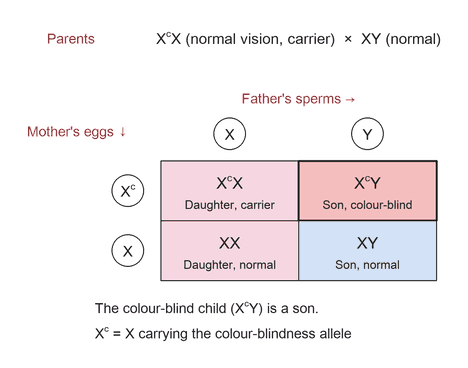
Step 4 — Part (b): the sex of the child.
The colour-blind child is : the defective X came from the mother and the Y from the father, with no second X to cover it. So the child is a son. Every daughter gets a normal X from the father and has normal vision (half of them are carriers).
Therefore, (a) a carrier mother × a normal father XY can have a colour-blind child ; (b) the child is a male (son).
- 331 mark
Question 33
Four friends P, Q, R and S were discussing the examples of genetic disorders. The examples they quoted were as follows:
P. Colour blindness and Malaria
Q. Albinism and Cholera
R. Haemophilia and Colour blindness
S. Haemophilia and Albinism
Who gave the correct examples?
Solve with AIAnswer
(A) P and Q
- Correct
(B) R and S
(C) P and R
(D) Q and S
Answer: (B) R and S
Concept: A genetic (hereditary) disorder is caused by a faulty gene and is passed on from parents to children; an infectious disease is caused by a germ (virus, bacterium or protozoan) and is caught, not inherited.
Step 1 — Sort the diseases.
We decide for each disease whether it is inherited or caused by a germ.
- Genetic: colour blindness, haemophilia, albinism.
- Infectious: malaria (caused by the protozoan Plasmodium) and cholera (caused by the bacterium Vibrio cholerae).
Step 2 — Check each friend.
A friend is right only if BOTH examples are genetic disorders.
- P: colour blindness and malaria; malaria is an infection, so P is wrong.
- Q: albinism and cholera; cholera is an infection, so Q is wrong.
- R: haemophilia and colour blindness; both are genetic, so R is right.
- S: haemophilia and albinism; both are genetic, so S is right.
Why the other options are wrong:
- (A) P and Q: P and Q each include an infectious disease (malaria, cholera).
- (C) P and R: P is wrong, because malaria is caused by a parasite, not by a gene.
- (D) Q and S: Q is wrong, because cholera is caused by a bacterium, not by a gene.
Therefore, R and S gave the correct examples, option (B).
- 341 mark
Question 34
A family has a history of colour blindness. During genetic testing, it was found that the mother is a carrier of colour blindness () and the father has normal vision (). What is the probability of their sons being colour-blind?
Solve with AIAnswer
(A) 25%
- Correct
(B) 50%
(C) 75%
(D) 0%
Answer: (B) 50%
Concept: Colour blindness and haemophilia are caused by recessive alleles on the X chromosome; the Y chromosome has no matching gene. A male (XY) shows the disorder with ONE such X; a female (XX) shows it only with TWO, and with one she is a normal carrier. A son always gets his X from his mother and his Y from his father.
Step 1 — Write the gametes.
The mother forms and X eggs in equal numbers; the father XY forms X and Y sperms.
Step 2 — Make the Punnett square.
We combine each egg with each sperm.
♀ gametes ↓ / ♂ gametes → X Y (daughter, carrier) (son, colour-blind) X XX (daughter, normal) XY (son, normal) 
Step 3 — Look only at the sons.
The sons are (colour-blind) and XY (normal), so 1 out of 2 sons, that is 50%, are colour-blind.
Watch out: The question asks about the SONS only, not about all the children.
Why the other options are wrong:
- (A) 25%: 25% is the chance that ANY child is a colour-blind son (1 of the 4 boxes), not the share among sons.
- (C) 75%: 75% would need three of every four sons to get the defective X; the mother gives it to half of them.
- (D) 0%: 0% would be right only if the mother were not a carrier; here she passes the defective X to half her sons.
Therefore, 50% of their sons are expected to be colour-blind, option (B).
- 352 marks
Question 35
Mention the number of Autosomes and Allosomes in a human body cell.
Solve with AIWritten solution
Solution:
Concept: A human body cell has 46 chromosomes in 23 pairs. 22 pairs are alike in both sexes (autosomes); the 23rd pair decides sex (allosomes, the sex chromosomes).
Step 1 — Autosomes.
There are 44 autosomes (22 pairs). They carry genes for the general body characters.
Step 2 — Allosomes.
There are 2 allosomes (1 pair): XX in a female and XY in a male.
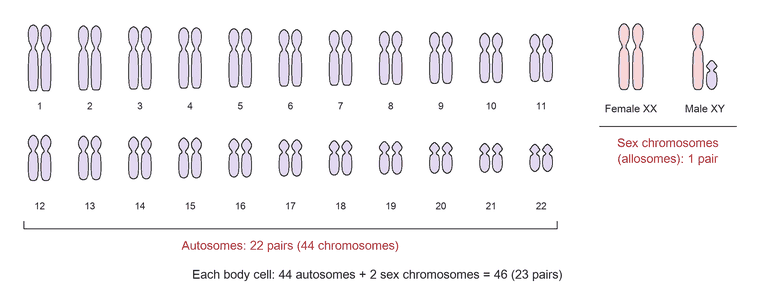
Step 3 — Check the total.
Adding the two gives the full number in a body cell.
Therefore, a human body cell has 44 autosomes and 2 allosomes.
- 361 mark
Question 36
Define mutation.
Solve with AIWritten solution
Solution:
Concept: A mutation changes the hereditary material itself, so the change can be inherited.
Step 1 — Define the term.
A mutation is a sudden change in one or more genes, or in the number or the structure of chromosomes.
Step 2 — Give an example.
Sickle cell anaemia is caused by a gene mutation. Mutations can also be caused by radiations (such as X-rays) and some chemicals.
Therefore, a mutation is a sudden change in one or more genes, or in the number or structure of chromosomes.
- 372 marks
Question 37
Hema, a 25-year-old woman has normal vision, but is a carrier of colour blindness (). Her husband is colour blind ().
(a) What percentage of their sons will be colour blind?
(b) Can a daughter be colour blind in this case?
Solve with AIWritten solution
Solution:
Concept: Colour blindness and haemophilia are caused by recessive alleles on the X chromosome; the Y chromosome has no matching gene. A male (XY) shows the disorder with ONE such X; a female (XX) shows it only with TWO, and with one she is a normal carrier. A son always gets his X from his mother and his Y from his father. A daughter gets one X from each parent.
Step 1 — Write the gametes.
Hema forms and X eggs; her colour-blind husband forms and Y sperms.
Step 2 — Make the Punnett square.
We combine each egg with each sperm.
♀ gametes ↓ / ♂ gametes → Y (daughter, colour-blind) (son, colour-blind) X (daughter, carrier) XY (son, normal) 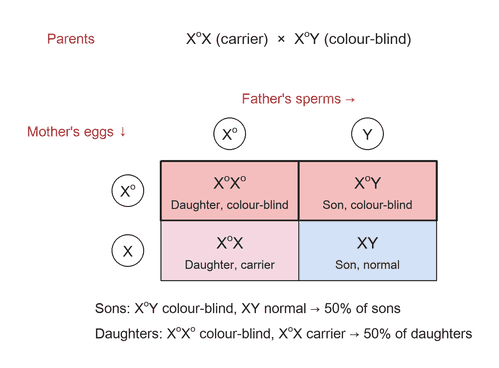
Step 3 — Part (a): the sons.
The sons are (colour-blind) and XY (normal), so 50% of the sons will be colour-blind.
Step 4 — Part (b): the daughters.
Yes. A daughter who receives from Hema and from her father is : both her X chromosomes carry the defective allele, so she is colour-blind. Half the daughters are expected to be colour-blind and half carriers.
Watch out: A colour-blind father passes his to EVERY daughter, so a daughter can be colour-blind here.
Therefore, (a) 50% of their sons will be colour-blind; (b) yes, a daughter can be colour-blind (), and half the daughters are expected to be.
- 381 mark
Question 38
State Mendel’s law of dominance.
Solve with AIWritten solution
Solution:
Concept: When two contrasting alleles are present together, only one of them shows.
Step 1 — State the law.
Out of a pair of contrasting characters present together, only one is able to express itself while the other remains suppressed. The one that expresses itself is the dominant character and the one that stays unexpressed is the recessive character.
Step 2 — Give an example.
A Tt pea plant is tall: tall (T) is dominant, and dwarf (t) stays hidden.
Therefore, the law of dominance states that of two contrasting characters present together, only the dominant one is expressed and the recessive one stays suppressed.
- 393 marks
Question 39
Homozygous pea plant bearing red coloured flowers (R) is crossed with a homozygous pea plant bearing white flowers (r):
(a) Give the phenotype of the generation.
(b) Write the monohybrid ratio of the offsprings of the generation.
(c) What is the genotype obtained in generation?
Solve with AIWritten solution
Solution:
Concept: Red (R) is dominant over white (r). The cross RR × rr is a monohybrid cross.
Step 1 — Part (a): the F₁ phenotype.
The gametes are R and r, so every F₁ plant is Rr. R masks r, so all F₁ plants bear red flowers.
Step 2 — Part (b): the monohybrid ratio of F₂.
Crossing two F₁ plants (Rr × Rr) gives 3 red : 1 white, the 3 : 1 phenotypic ratio.
♀ gametes ↓ / ♂ gametes → R r R RR (red) Rr (red) r Rr (red) rr (white) Step 3 — Part (c): the genotypes in F₂.
The F₂ genotypes are RR, Rr and rr in the ratio 1 : 2 : 1 (1 pure red : 2 hybrid red : 1 white).
Watch out: The F₁ shows only the dominant character, but it CARRIES the recessive allele, which reappears in F₂.
Therefore, (a) all F₁ plants have red flowers; (b) 3 red : 1 white; (c) RR, Rr and rr in the ratio 1 : 2 : 1.