
Question 261 markMCQAsked 2025Medium
Ajay and Vijay are siblings. Ajay can roll his tongue while Vijay cannot. What is the genotype of their parents?
Confirming your payment
Sign up now and get 250 free tokens.
Previous Year Questions · Question 26 of 39
Ajay and Vijay are siblings. Ajay can roll his tongue while Vijay cannot. What is the genotype of their parents?
(A) Both the parents are homozygous dominant.
(B) Both the parents are homozygous recessive.
(C) One parent is homozygous dominant, and the other is homozygous recessive.
(D) Both the parents are heterozygous dominant.
Answer: (D) Both the parents are heterozygous dominant.
Concept: In the book's model, tongue rolling (R) is dominant over non-rolling (r). Vijay cannot roll his tongue, so he is rr and received one r from each parent; Ajay can roll, so he has at least one R.
Step 1 — What Vijay tells us.
Each parent must carry r, so that each could give an r to Vijay.
Step 2 — What Ajay tells us.
At least one parent must carry R, so that Ajay could receive it.
Step 3 — Test the options.
Of the options, only Rr × Rr does both. Their Punnett square gives 3 rollers : 1 non-roller.
| ♀ gametes ↓ / ♂ gametes → | R | r |
|---|---|---|
| R | RR (roller) | Rr (roller) |
| r | Rr (roller) | rr (non-roller) |
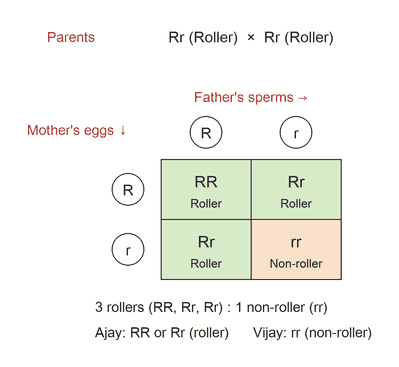
Note: a heterozygous roller with a non-roller (Rr × rr) would also fit the story, but it is not an option. In real life tongue rolling is not controlled by a single gene (identical twins can differ); the question uses the textbook model.
Why the other options are wrong:
Therefore, both parents are heterozygous, option (D).