Solution:
Concept: Colour blindness and haemophilia are caused by recessive alleles on the X chromosome; the Y chromosome has no matching gene. A male (XY) shows the disorder with ONE such X; a female (XX) shows it only with TWO, and with one she is a normal carrier. A son always gets his X from his mother and his Y from his father. A daughter gets one X from each parent.
Step 1 — Write the gametes.
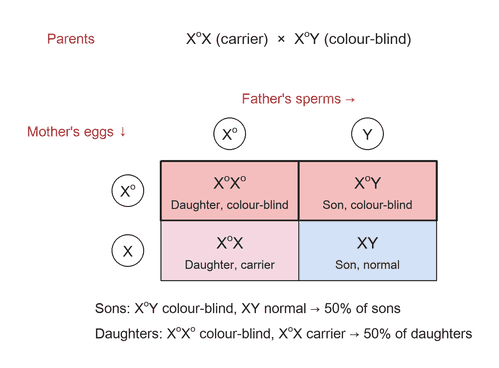
Hema XoX forms Xo and X eggs; her colour-blind husband XoY forms Xo and Y sperms.
Step 2 — Make the Punnett square.
We combine each egg with each sperm.
| ♀ gametes ↓ / ♂ gametes → | Xo | Y |
|---|
| Xo | XoXo (daughter, colour-blind) | XoY (son, colour-blind) |
| X | XoX (daughter, carrier) | XY (son, normal) |
Step 3 — Part (a): the sons.
The sons are XoY (colour-blind) and XY (normal), so 50% of the sons will be colour-blind.
Step 4 — Part (b): the daughters.
Yes. A daughter who receives Xo from Hema and Xo from her father is XoXo: both her X chromosomes carry the defective allele, so she is colour-blind. Half the daughters are expected to be colour-blind and half carriers.
Watch out: A colour-blind father passes his Xo to EVERY daughter, so a daughter can be colour-blind here.
Therefore, (a) 50% of their sons will be colour-blind; (b) yes, a daughter can be colour-blind (XoXo), and half the daughters are expected to be.
