Solution:
Concept: Two characters, height and flower colour, are followed together, so this is a dihybrid cross. Tall (T) and red (R) are dominant over dwarf (t) and white (r). Law of Independent Assortment: when there are two pairs of characters, the distribution of the alleles of one character into the gametes is independent of the distribution of the alleles of the other character.
Step 1 — Part (i): the F₁ individuals.
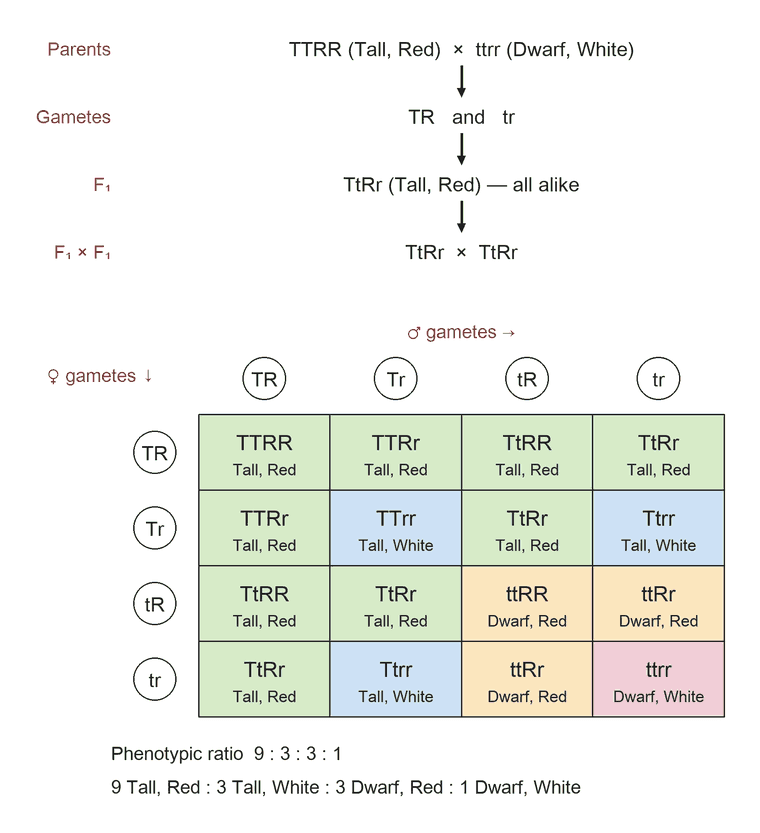
The gametes are TR (from TTRR) and tr (from ttrr), so every F₁ plant has the genotype TtRr and the phenotype tall with red flowers.
Step 2 — Part (ii): gametes when two F₁ hybrids are crossed.
Each TtRr plant forms four kinds of gametes in equal numbers: TR, Tr, tR, tr. They combine at random in 16 ways.
Step 3 — Part (iii): phenotypic ratio of F₂.
The 16 boxes give 9 tall red, 3 tall white, 3 dwarf red and 1 dwarf white.
Step 4 — Part (iv): the law of independent assortment.
When there are two pairs of characters, the distribution of the alleles of one character into the gametes is independent of the distribution of the alleles of the other character, as the four kinds of gametes of the F₁ hybrid show.
Step 5 — Part (v): two X-linked disorders.
Haemophilia and colour blindness. In haemophilia a clotting factor is missing, so the blood clots very slowly and even a small cut can go on bleeding for a long time.
Watch out: Each gamete has ONE allele of each pair; TT or Rr can never be a gamete.
Therefore, (i) F₁: genotype TtRr, phenotype tall with red flowers; (ii) TR, Tr, tR, tr; (iii) 9 : 3 : 3 : 1; (iv) the law as stated in Step 4; (v) haemophilia and colour blindness.
