Solution:
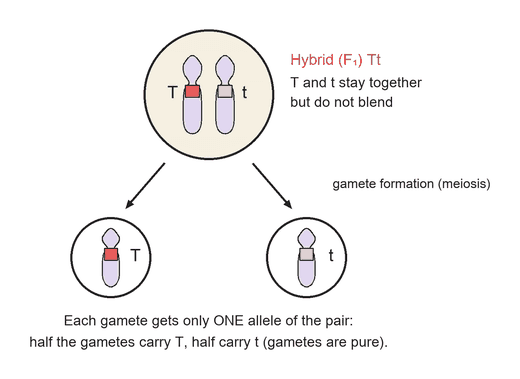
Concept: Green pod (G) is dominant over yellow (g), and inflated pod (I) is dominant over constricted (i). Two characters are followed together, so this is a dihybrid cross. Law of Segregation: the two members of a pair of factors (alleles) separate during the formation of gametes, so each gamete receives only one factor of the pair; the gametes then combine at random at fertilisation.
Step 1 — Part (i): the F₁ generation and the pollination.
The gametes are GI (from GGII) and gi (from ggii), so every F₁ plant has the genotype GgIi and, both dominant traits showing, has green, inflated pods. The two different parents were crossed, so this is cross-pollination, done by hand: the stamens of one flower are removed and pollen from the other parent is dusted on its stigma.
Step 2 — Part (ii): phenotypic ratio of F₂.
Selfing GgIi gives 16 combinations: 9 green inflated, 3 green constricted, 3 yellow inflated and 1 yellow constricted.
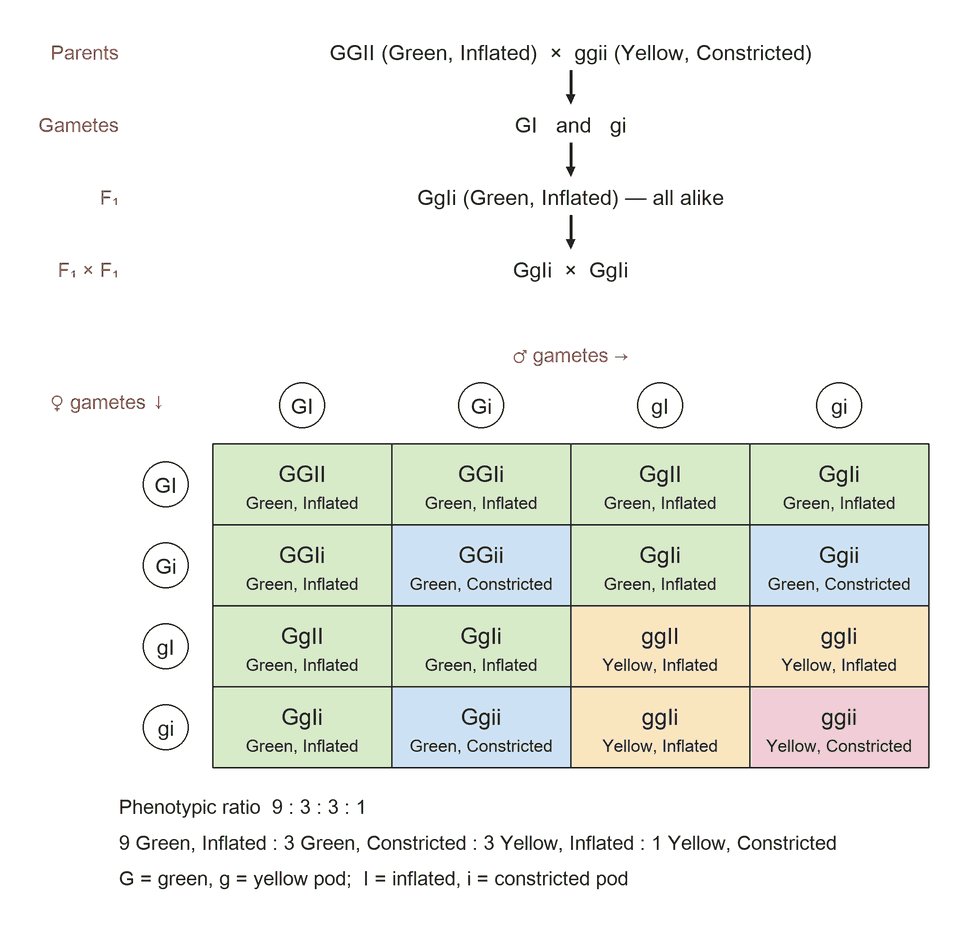
Step 3 — Part (iii): gametes of the F₁ hybrids.
Each GgIi plant forms four kinds of gametes in equal numbers: GI, Gi, gI, gi. In the cross these combine at random in 4 × 4 = 16 ways.
Step 4 — Part (iv): the law of segregation.
The two members of a pair of factors separate during the formation of gametes; they do not blend, so each gamete carries only one factor of the pair. The gametes combine at random at fertilisation.
Step 5 — Part (v): Mendel's plant.
Mendel used the garden pea, Pisum sativum.
Watch out: Each gamete has ONE letter of each pair (GI, not GG or Gg).
Therefore, (i) F₁: GgIi, green inflated pods, by cross-pollination; (ii) 9 : 3 : 3 : 1; (iii) GI, Gi, gI, gi; (iv) the law as stated in Step 4; (v) Pisum sativum.
