Solution:
Concept: Axial flowers (A) are dominant over terminal flowers (a). A pure axial plant is AA and a pure terminal plant is aa. One character is followed, so this is a monohybrid cross. Law of Dominance: out of a pair of contrasting characters present together, only one is able to express itself while the other remains suppressed. The one that expresses itself is the dominant character and the one that stays unexpressed is the recessive character.
Step 1 — Part (i): the F₁ generation.
The gametes are A (from AA) and a (from aa), so every F₁ plant is Aa (heterozygous). A is dominant, so all F₁ plants bear axial flowers.
Step 2 — Part (ii): Punnett square for Aa × Aa.
Each heterozygous parent forms two kinds of gametes, A and a, in equal numbers. We combine every gamete of one parent with every gamete of the other.
| ♀ gametes ↓ / ♂ gametes → | A | a |
|---|
| A | AA (axial) | Aa (axial) |
| a | Aa (axial) | aa (terminal) |
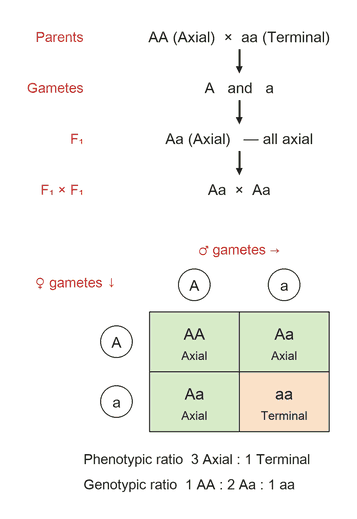
Step 3 — Part (iii): the ratios.
Three of the four boxes (AA, Aa, Aa) have axial flowers and one (aa) has terminal flowers, so the phenotypic ratio is 3 axial : 1 terminal. The genotypes are 1 AA : 2 Aa : 1 aa, so the genotypic ratio is 1 : 2 : 1.
Step 4 — Part (iv): Mendel's law of dominance.
Out of a pair of contrasting characters present together, only one is able to express itself while the other remains suppressed; the one expressed is dominant and the other recessive.
Step 5 — Part (v): two disorders common in human males.
Haemophilia and colour blindness (red–green). Both are caused by recessive genes on the X chromosome; a male has only one X, so a single defective allele shows up in him.
Watch out: The F₁ shows only the dominant character, but it CARRIES the recessive allele, which reappears in F₂.
Therefore, (i) F₁: genotype Aa, phenotype axial flowers; (ii) the Punnett square in Step 2; (iii) phenotypic ratio 3 : 1, genotypic ratio 1 : 2 : 1; (iv) the law as stated in Step 4; (v) haemophilia and colour blindness.
