Solution:
Concept: Tall (T) is dominant over dwarf (t). A homozygous tall plant is TT and a homozygous dwarf plant is tt. One character is followed, so this is a monohybrid cross. Law of Dominance: out of a pair of contrasting characters present together, only one is able to express itself while the other remains suppressed. The one that expresses itself is the dominant character and the one that stays unexpressed is the recessive character.
Step 1 — Part (i): the F₁ generation.
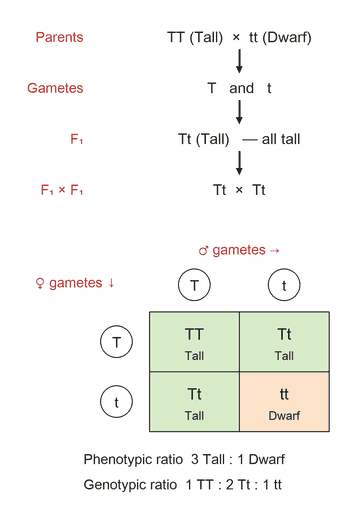
The gametes are T (from TT) and t (from tt), so every F₁ plant is Tt, and since T is dominant, all are tall.
Step 2 — Part (ii): Punnett square for Tt × Tt.
Each heterozygous parent forms two kinds of gametes, T and t, in equal numbers; we combine every gamete of one parent with every gamete of the other.
| ♀ gametes ↓ / ♂ gametes → | T | t |
|---|
| T | TT (tall) | Tt (tall) |
| t | Tt (tall) | tt (dwarf) |
Step 3 — Part (iii): the ratios.
Three boxes (TT, Tt, Tt) are tall and one (tt) is dwarf: phenotypic ratio 3 tall : 1 dwarf. Genotypic ratio 1 TT : 2 Tt : 1 tt.
Step 4 — Part (iv): Mendel's law of dominance.
Out of a pair of contrasting characters present together, only one is able to express itself (tall, the dominant) while the other remains suppressed (dwarf, the recessive).
Step 5 — Part (v): a dihybrid cross.
A dihybrid cross is a cross between two parents that differ in two pairs of contrasting characters, both followed together. For example, Mendel crossed round yellow-seeded plants (RRYY) with wrinkled green-seeded plants (rryy); the F₂ showed the ratio 9 : 3 : 3 : 1.
Watch out: The F₁ shows only the dominant character, but it CARRIES the recessive allele, which reappears in F₂.
Therefore, (i) F₁: genotype Tt, phenotype tall; (ii) the Punnett square in Step 2; (iii) phenotypic ratio 3 : 1, genotypic ratio 1 : 2 : 1; (iv) the law as stated in Step 4; (v) a cross in which two pairs of contrasting characters are studied together.
