
Opening your dashboard
Class 9 Physics Chapter 9: Current Electricity Solutions
101 textbook questions with step-by-step answers, free to read, for ICSE 2026-27.
Get talked through Ch 9, not just shown the answer
Reading a finished solution is not the same as being able to do it. The AI tutor takes one question at a time and works it with you, in your own words, until you can.
- Ask it out loud, in your own words
- It gives you the next step, not the answer
- Stuck on part (ii)? Start there
101 questions with solutions
1–5 marks · Mixed difficulty
- 11 mark
Question 1
A cell is used to :
Solve with AIAnswer
(A) measure current in a circuit
- Correct
(B) provide current in a circuit
(C) limit current in a circuit
(D) prevent current in a circuit.
Answer: (B) provide current in a circuit
Concept: An electric cell is a source of direct current. Inside it a chemical reaction keeps one terminal positive (+) and the other negative (−), and its chemical energy changes into electrical energy while it sends current round a circuit.
Step 1 — Recall what a cell does.
A cell keeps a potential difference between its two terminals. This pushes charge round any closed circuit joined to it, so a current flows.
Step 2 — Match the job to the option.
Supplying (providing) the current is the cell's job. Measuring, limiting and stopping the current are done by other components.
Why the other options are wrong:
- (A) measure current in a circuit: The current is measured by an ammeter, not by a cell.
- (C) limit current in a circuit: The current is limited or adjusted by a rheostat (variable resistance).
- (D) prevent current in a circuit: The current is stopped by opening a key (switch), which breaks the circuit.
Therefore, a cell is used to provide current in a circuit, option (B).
- 21 mark
Question 2
In a cell, ............... energy changes into ............ energy when it sends current in a circuit.
Solve with AIAnswer
(A) mechanical, electrical
(B) heat, chemical
- Correct
(C) chemical, electrical
(D) electrical, chemical
Answer: (C) chemical, electrical
Concept: An electric cell is a source of direct current. Inside it a chemical reaction keeps one terminal positive (+) and the other negative (−), and its chemical energy changes into electrical energy while it sends current round a circuit.
Step 1 — Find the energy stored in a cell.
A cell stores energy in its chemicals (electrodes and electrolyte). So the energy it starts with is chemical energy.
Step 2 — Find the energy it gives out.
When the cell sends a current, the chemical reaction drives charge round the circuit. The energy given out is electrical energy.
Watch out: When a secondary cell is being charged the change goes the other way (electrical to chemical); the question is about a cell sending current.
Why the other options are wrong:
- (A) mechanical, electrical: Mechanical energy changes into electrical energy in a generator (dynamo), not in a cell.
- (B) heat, chemical: A cell neither starts with heat energy nor stores the energy as chemical energy while it sends current.
- (D) electrical, chemical: Electrical to chemical is the change while a secondary cell is being charged, not while it sends current.
Therefore, in a cell chemical energy changes into electrical energy, option (C).
- 31 mark
Question 3
During charging of a secondary cell, the .......... energy changes into .......... energy and gets stored in the cell
Solve with AIAnswer
(A) mechanical, chemical
(B) chemical, electrical
(C) mechanical, electrical
- Correct
(D) electrical, chemical
Answer: (D) electrical, chemical
Concept: In a primary cell the chemical reaction is irreversible, so the cell cannot be recharged. In a secondary cell (accumulator) the reaction is reversible, so the cell can be recharged again and again by passing a current through it.
Step 1 — See what is supplied during charging.
A secondary cell is charged by passing a direct current through it from an outside source. So the energy going in is electrical energy.
Step 2 — See how it is stored.
This current reverses the chemical reaction inside the cell, so the energy is stored as chemical energy. When the cell is used later, it changes back into electrical energy.
Watch out: Charging and discharging are opposite changes: charging is electrical to chemical, discharging is chemical to electrical.
Why the other options are wrong:
- (A) mechanical, chemical: No mechanical energy is supplied to the cell during charging; a current is passed through it.
- (B) chemical, electrical: Chemical to electrical is the change during discharging (use), the opposite of charging.
- (C) mechanical, electrical: No mechanical energy is involved, and the energy is stored as chemical energy, not as electrical energy.
Therefore, during charging electrical energy changes into chemical energy, option (D).
- 41 mark
Question 4
Primary cells provide current as a result of ........... chemical reaction and secondary cells provide current as a result of ........... reaction.
Solve with AIAnswer
(A) reversible, reversible
(B) reversible, irreversible
- Correct
(C) irreversible, reversible
(D) irreversible, irreversible
Answer: (C) irreversible, reversible
Concept: In a primary cell the chemical reaction is irreversible, so the cell cannot be recharged. In a secondary cell (accumulator) the reaction is reversible, so the cell can be recharged again and again by passing a current through it.
Step 1 — Fill the first blank.
A primary cell cannot be recharged, because its chemical reaction cannot be run backwards. So its reaction is irreversible.
Step 2 — Fill the second blank.
A secondary cell can be recharged, because passing a current through it runs its reaction backwards. So its reaction is reversible.
Why the other options are wrong:
- (A) reversible, reversible: A primary cell's reaction is not reversible; that is why it is thrown away after use.
- (B) reversible, irreversible: This has the two cells the wrong way round.
- (D) irreversible, irreversible: A secondary cell's reaction is reversible; that is why it can be recharged.
Therefore, primary cells use an irreversible reaction and secondary cells a reversible one, option (C).
- 51 mark
Question 5
Identify the correct statement(s) :
(i) Primary cell is capable of giving low as well as high current whereas secondary cells provide a weak current only.
(ii) The internal resistance of primary cells is low and that of secondary cells is high.
Solve with AIAnswer
(A) (i)
(B) (ii)
(C) both (i) and (ii)
- Correct
(D) none of the above
Answer: (D) none of the above
Concept: In a primary cell the chemical reaction is irreversible, so the cell cannot be recharged. In a secondary cell (accumulator) the reaction is reversible, so the cell can be recharged again and again by passing a current through it. A secondary cell has a low internal resistance and can give a large as well as a small current; a primary cell has a higher internal resistance and gives only a fairly small current.
Step 1 — Judge the first statement.
It is the secondary cell (for example a car's lead accumulator) that can give a low as well as a high current. A primary cell gives only a weak current. The first statement has the two cells swapped, so it is false.
Step 2 — Judge the second statement.
A primary cell has a high internal resistance and a secondary cell a low one. The second statement again swaps them, so it is false.
Step 3 — Choose the option.
Neither statement is correct, so the answer is 'none of the above'.
Watch out: Both statements sound reasonable at first glance; check which cell each property really belongs to.
Note: the book prints the fourth option as a second '(c)'; it is the (D) option here.
Why the other options are wrong:
- (A) the first statement only: The first statement is false, because it swaps the primary and secondary cells.
- (B) the second statement only: The second statement is false, because a primary cell has the higher internal resistance.
- (C) both statements: Both statements are false, so 'both' cannot be correct.
Therefore, neither statement is correct, option (D).
- 61 mark
Question 6
Current is the rate of flow of charge across a cross-section ............. the flow of current.
Solve with AIAnswer
(A) in any direction of
(B) in a parallel direction to
(C) in the same direction as
- Correct
(D) normal to the direction of
Answer: (D) normal to the direction of
Concept: Electric current is the rate of flow of charge across a cross-section of the conductor taken normal (at right angles) to the direction of flow. In symbols, .
Step 1 — Picture the moving charges.
Charges move along the wire. To count all of them, we need a surface that every moving charge has to pass through.
Step 2 — Choose the direction of the section.
A cross-section cut at right angles (normal) to the flow spans the whole wire, so every charge flowing along the wire crosses it.
Why the other options are wrong:
- (A) in any direction of: A section at any angle is not the definition; the book's definition fixes it as normal to the flow.
- (B) in a parallel direction to: A section parallel to the flow lies along the wire, so the charges slide along it instead of crossing it.
- (C) in the same direction as: 'In the same direction as' the flow is the same as parallel, so the charges would not cross it.
Therefore, current is the rate of flow of charge across a section normal to the direction of flow, option (D).
- 71 mark
Question 7
In metals, current flows due to the movement of :
Solve with AIAnswer
(A) protons
(B) neutrons
- Correct
(C) electrons
(D) electrons and protons
Answer: (C) electrons
Concept: In a metal the positive ions stay fixed in the crystal, and some outer electrons of each atom are free to move through the whole metal. These free electrons carry the current.
Step 1 — Find what can move in a metal.
The protons are locked in the nuclei of the fixed ions, and neutrons are also in the nuclei. Only the free electrons can move through the metal.
Step 2 — Decide what carries the current.
When a cell is joined, the free electrons drift through the wire, and this drift of charge is the current.
Why the other options are wrong:
- (A) protons: Protons are fixed inside the nuclei of the ions, so they cannot move through the metal.
- (B) neutrons: Neutrons have no charge, so even moving neutrons would carry no current.
- (D) electrons and protons: Only the electrons move in a metal; the protons stay fixed.
Therefore, in metals current flows due to the movement of electrons, option (C).
- 81 mark
Question 8
If electrons pass through the cross-section of a conductor in time , the current in conductor I =
Solve with AIAnswer
(A)
(B)
- Correct
(C)
(D)
Answer: (C)
Concept: Electric current is the rate of flow of charge across a cross-section of the conductor taken normal (at right angles) to the direction of flow. In symbols, .
Step 1 — Find the total charge.
Each electron carries a charge of size , and electrons cross the section. So the total charge that passes is times .
Step 2 — Divide by the time.
Current is charge per unit time, so we divide the total charge by .
Watch out: Check the unit: is in coulomb and in second, so is in coulomb per second (ampere).
Why the other options are wrong:
- (A) : multiplies by the time instead of dividing, so its unit is coulomb second, not ampere.
- (B) : gets smaller when more electrons pass, which is the opposite of what a current does.
- (D) : divides by the charge, so its unit is second per coulomb, not ampere.
Therefore, the current is , option (C).
- 91 mark
Question 9
The conventional current is in a direction .......... to the direction of motion of electrons.
Solve with AIAnswer
(A) parallel
(B) normal
- Correct
(C) opposite
(D) none of the above
Answer: (C) opposite
Concept: The conventional current is the direction in which positive charge would move: from the + terminal of the cell, round the outside circuit, to the − terminal. Electrons (negative) actually move the other way.
Step 1 — Recall how the direction was chosen.
The direction of current was fixed, before electrons were discovered, as the direction in which positive charge would move.
Step 2 — Compare with electrons.
Electrons carry negative charge, so they move the opposite way. In the outside circuit electrons go from the − terminal to the + terminal, while the conventional current goes from + to −.
Why the other options are wrong:
- (A) parallel: Parallel (same) direction would mean electrons move from + to −, which they do not.
- (B) normal: The two directions are along the same wire, so they cannot be at right angles (normal) to each other.
- (D) none of the above: This cannot be right, because 'opposite' (option C) describes the relation exactly.
Therefore, the conventional current is opposite to the direction of motion of electrons, option (C).
- 101 mark
Question 10
The S.I. unit of current is :
Solve with AIAnswer
(A) Coulomb
(B) Ampere
(C) Coulomb per second
- Correct
(D) Both (b) and (c)
Answer: (D) Both (B) and (C)
Concept: The S.I. unit of current is the ampere (A). A current is 1 A when 1 coulomb of charge crosses a section of the conductor in 1 second, so 1 A is 1 coulomb per second.
Step 1 — Build the unit from the definition.
Current is charge divided by time, so its unit is the unit of charge divided by the unit of time: coulomb per second.
Step 2 — Give the unit its name.
One coulomb per second has its own name, the ampere.
Step 3 — Match the options.
Both 'ampere' and 'coulomb per second' are therefore correct names for the S.I. unit of current.
Why the other options are wrong:
- (A) Coulomb: The coulomb is the unit of charge, not of current.
- (B) Ampere: Ampere is correct, but it is not the only correct option, because coulomb per second is also correct.
- (C) Coulomb per second: Coulomb per second is correct, but ampere is also correct, so this option alone is incomplete.
Therefore, the S.I. unit of current is both the ampere and the coulomb per second, option (D).
- 111 mark
Question 11
A battery is correctly represented by :
Solve with AIAnswer
(A)

(B)

(C)
- Correct
(D)

Answer: (D) three cells joined in series
Concept: A battery is a combination of cells joined in series: the + terminal of one cell is joined to the − terminal of the next. Its symbol is several long-thin and short-thick plate pairs side by side, with + at the long-plate end and − at the short-plate end.
Step 1 — Count the cells in each symbol.
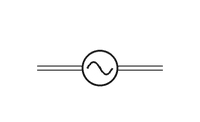
Options (A) and (B) each show one long plate and one short plate, which is a single cell. Option (C) shows a wave inside a circle. Option (D) shows three plate pairs side by side.
Step 2 — Pick the battery.
Only option (D) has several cells joined one after another, with + at the long-plate end and − at the short-plate end, so it is the battery.
Why the other options are wrong:
- (A) one cell, + on the left: This is a single cell (one plate pair), not a battery.
- (B) one cell, + on the right: This is also a single cell, drawn the other way round.
- (C) wave inside a circle: A wave inside a circle is the symbol of an a.c. source (such as the mains), not of a battery.
Therefore, a battery is correctly represented by symbol (D).
- 121 mark
Question 12
A ............ is a device by which resistance in a circuit can be varied continuously.
Solve with AIAnswer
(A) key
(B) switch
- Correct
(C) rheostat
(D) voltmeter
Answer: (C) rheostat
Concept: A rheostat is a long coil of resistance wire with a sliding contact (jockey). Sliding the jockey changes the length of wire in the circuit.
Step 1 — See how the resistance changes.
As the jockey slides, the length of wire in use changes little by little, so the resistance changes smoothly (continuously), not in jumps.
Step 2 — Match the device.
A device that varies the resistance continuously is the rheostat.
Why the other options are wrong:
- (A) key: A key only puts the current on or off; it does not vary the resistance.
- (B) switch: A switch, like a key, only makes or breaks the circuit.
- (D) voltmeter: A voltmeter measures the potential difference; it does not vary the resistance.
Therefore, a rheostat varies the resistance continuously, option (C).
- 131 mark
Question 13
Rheastat is used in a circuit to provide :
Solve with AIAnswer
(A) fixed current
(B) variable voltage
(C) fixed resistance
- Correct
(D) variable resistance
Answer: (D) variable resistance
Concept: A rheostat (symbol Rh) is a resistance that can be changed smoothly by sliding its jockey. It is joined in series in a circuit to adjust the current.
Step 1 — Recall what a rheostat gives.
Sliding the jockey changes the length of wire in use, so what a rheostat provides is a variable resistance.
Step 2 — See why this is useful.
By changing the resistance, the rheostat lets us set the current in the circuit to any value we want.
Note: the book spells the stem's word 'Rheastat'; it means rheostat.
Why the other options are wrong:
- (A) fixed current: A rheostat is used to change the current, not to keep it fixed.
- (B) variable voltage: In the usual series use a rheostat varies the resistance, and the voltage across other parts changes only as a result. (A rheostat wired as a potential divider can give a variable voltage, but that is a different arrangement, not what it 'provides' in a circuit here.)
- (C) fixed resistance: A fixed resistance is given by a resistance wire or a resistance box, not by a rheostat.
Therefore, a rheostat provides a variable resistance, option (D).
- 141 mark
Question 14
An instrument used to measure the magnitude of current flowing in a circuit is :
Solve with AIAnswer
(A) voltmeter
(B) galvanomter
- Correct
(C) ammeter
(D) rheostat
Answer: (C) ammeter
Concept: An ammeter is joined in series so that the whole current passes through it, and its dial is marked in ampere to show the size of the current.
Step 1 — Find what is to be measured.
The question asks for the instrument that measures the magnitude (size) of the current.
Step 2 — Match the instrument.
The ammeter is the instrument calibrated to read the current in ampere.
Why the other options are wrong:
- (A) voltmeter: A voltmeter measures the potential difference between two points, not the current.
- (B) galvanomter: A galvanometer only detects a weak current and shows its direction; its dial is not marked to read the current in ampere.
- (D) rheostat: A rheostat varies the resistance; it does not measure anything.
Therefore, the current is measured by an ammeter, option (C).
- 151 mark
Question 15
A ............ is either used to detect the presence of a weak current or to only know the direction of flow of current in a circuit.
Solve with AIAnswer
(A) ammeter
- Correct
(B) galvanometer
(C) Voltmeter
(D) rheostat
Answer: (B) galvanometer
Concept: A galvanometer has its zero mark at the middle of the dial. Its needle turns to one side or the other depending on the direction of the current.
Step 1 — Read what the device must do.
The device should only detect a weak current or show its direction, without measuring its size.
Step 2 — Match the device.
A centre-zero galvanometer does exactly this: any deflection shows a current is present, and the side of the deflection shows its direction.
Why the other options are wrong:
- (A) ammeter: An ammeter measures the size of the current, which is more than detecting it.
- (C) Voltmeter: A voltmeter measures the potential difference, not the presence or direction of a current.
- (D) rheostat: A rheostat varies the resistance; it does not detect current.
Therefore, a galvanometer detects a weak current and shows its direction, option (B).
- 161 mark
Question 16
Insulators have .......... electrons and conductors have ................ electrons.
Solve with AIAnswer
- Correct
(A) no free, large number of free
(B) large number of free, no free
(C) no free, small number of free
(D) small number of free, no free
Answer: (A) no free, large number of free
Concept: A conductor has a large number of free charges (free electrons in metals, ions in acidulated water) that can move and carry current. An insulator has almost no free charges, so it does not allow current to pass.
Step 1 — Fill the first blank.
An insulator does not let current pass, because it has (almost) no free electrons.
Step 2 — Fill the second blank.
A conductor such as a metal lets current pass easily, because it has a large number of free electrons.
Why the other options are wrong:
- (B) large number of free, no free: This swaps the two: insulators do not have a large number of free electrons.
- (C) no free, small number of free: Conductors have a large, not a small, number of free electrons.
- (D) small number of free, no free: This swaps the two and also gives conductors no free electrons, which would stop all current.
Therefore, insulators have no free electrons and conductors have a large number of free electrons, option (A).
- 171 mark
Question 17
An insulator of electricity is :
Solve with AIAnswer
(A) copper
(B) acidulated water
(C) human body
- Correct
(D) silk
Answer: (D) silk
Concept: A conductor has a large number of free charges (free electrons in metals, ions in acidulated water) that can move and carry current. An insulator has almost no free charges, so it does not allow current to pass.
Step 1 — Check each material for free charges.
Copper has free electrons; acidulated water has free ions; the human body contains salty water with ions. Silk has almost no free charges.
Step 2 — Pick the insulator.
Only silk has no free charges to carry current, so it is the insulator.
Watch out: Never treat the human body as an insulator; it conducts enough current to give a dangerous shock.
Why the other options are wrong:
- (A) copper: Copper is a metal with many free electrons, so it is a good conductor.
- (B) acidulated water: Acidulated water contains free ions, so it conducts.
- (C) human body: The human body contains water with dissolved salts (ions), so it conducts.
Therefore, silk is an insulator of electricity, option (D).
- 181 mark
Question 18
The presence of ............... in the path makes a circuit incomplete and current does not flow.
Solve with AIAnswer
(A) conductor
(B) ammeter
(C) voltmeter
- Correct
(D) insulator
Answer: (D) insulator
Concept: Current flows only round a closed circuit, a complete conducting path from the + terminal of the source, through the components, back to its − terminal. A gap or an insulator anywhere in the path makes it an open circuit, and no current flows.
Step 1 — See what breaks a circuit.
Current needs a complete conducting path. Anything in the path that does not conduct breaks it.
Step 2 — Match the option.
An insulator (for example the air gap when the plug of a key is taken out) does not conduct, so it makes the circuit incomplete and no current flows.
Why the other options are wrong:
- (A) conductor: A conductor completes the path; it does not break it.
- (B) ammeter: An ammeter is joined in series and lets the current pass through it.
- (C) voltmeter: A voltmeter is a measuring instrument that is itself a (high-resistance) conductor, so it does not break the circuit in this sense.
Therefore, an insulator in the path makes the circuit incomplete, option (D).
- 191 mark
Question 19
Select the best insulator among the following :
Solve with AIAnswer
- Correct
(A) Pure water
(B) Human body
(C) Aluminium
(D) Mercury
Answer: (A) Pure water
Concept: A conductor has a large number of free charges (free electrons in metals, ions in acidulated water) that can move and carry current. An insulator has almost no free charges, so it does not allow current to pass.
Step 1 — Check each substance.
Aluminium and mercury are metals with many free electrons. The human body contains salty water with ions. Pure (distilled) water has almost no ions.
Step 2 — Pick the best insulator.
Pure water has the fewest free charges of the four, so it conducts least and is the best insulator here.
Watch out: Pure water is a very poor conductor, but tap or rain water contains dissolved salts and does conduct; that is why wet hands are dangerous near electricity.
Why the other options are wrong:
- (B) Human body: The human body contains ions in its fluids, so it conducts.
- (C) Aluminium: Aluminium is a metal and a good conductor; it is used for power cables.
- (D) Mercury: Mercury is a liquid metal with free electrons, so it is a good conductor.
Therefore, pure water is the best insulator among these, option (A).
- 201 mark
Question 20
Connecting wires are made of substances that have :
Solve with AIAnswer
(A) highly conducting material
(B) negligible resistance
(C) free electrons in a large number
- Correct
(D) all of these
Answer: (D) all of these
Concept: Connecting wires should carry current without changing the resistance of the circuit, so they are made of a metal that conducts very well, such as copper.
Step 1 — Check statement (A).
Copper is a highly conducting material, so (A) is true.
Step 2 — Check statement (C).
Copper conducts well because it has a large number of free electrons, so (C) is true.
Step 3 — Check statement (B).
Because of this, a connecting wire has negligible resistance, so (B) is true.
Step 4 — Choose the option.
All three statements are true, so the answer is 'all of these'.
Why the other options are wrong:
- (A) highly conducting material: This is true, but it is only one of three true statements.
- (B) negligible resistance: This is true, but it is only one of three true statements.
- (C) free electrons in a large number: This is true, but it is only one of three true statements.
Therefore, connecting wires have all three properties, option (D).
- 211 mark
Question 21
Name one d.c. source and one a.c. source.
Solve with AIWritten solution
Solution:
Concept: A direct current (d.c.) flows in one direction only. An alternating current (a.c.) keeps reversing its direction (in India, 50 times each way every second).
Step 1 — Name a d.c. source.
A cell, such as the dry cell in a torch, gives current in one direction only, so it is a d.c. source.
Step 2 — Name an a.c. source.
The mains supply in our homes comes from a.c. generators at power stations, so it is an a.c. source.
Therefore, one d.c. source is a cell (or battery), and one a.c. source is the mains supply (an a.c. generator).
- 221 mark
Question 22
What is an electric cell ?
Solve with AIWritten solution
Solution:
Concept: An electric cell is a source of direct current. Inside it a chemical reaction keeps one terminal positive (+) and the other negative (−), and its chemical energy changes into electrical energy while it sends current round a circuit.
Step 1 — Say what a cell does.
An electric cell is a source of direct current. It changes chemical energy into electrical energy.
Step 2 — Say what it is made of.
It has two conducting rods, called electrodes, placed apart in a solution or jelly, called the electrolyte, inside a vessel.
Therefore, an electric cell is a device made of two electrodes in an electrolyte which changes chemical energy into electrical energy and acts as a source of direct current.
- 231 mark
Question 23
What transformation of energy takes place when current is drawn from a cell ?
Solve with AIWritten solution
Solution:
Concept: An electric cell is a source of direct current. Inside it a chemical reaction keeps one terminal positive (+) and the other negative (−), and its chemical energy changes into electrical energy while it sends current round a circuit.
Step 1 — Find the starting energy.
The energy in a cell is stored in its chemicals, so it starts as chemical energy.
Step 2 — Find the final energy.
When current is drawn, the chemical reaction pushes charge round the circuit, so this energy appears as electrical energy.
Therefore, chemical energy changes into electrical energy.
- 241 mark
Question 24
Name the constituents of a cell.
Solve with AIWritten solution
Solution:
Concept: Every cell is built from the same basic parts, whatever its chemicals.
Step 1 — Name the electrodes.
A cell has two electrodes, conducting rods (or plates) of different materials.
Step 2 — Name the electrolyte.
The electrodes stand in an electrolyte, a solution or jelly that conducts by ions and takes part in the chemical reaction.
Step 3 — Name the container.
The electrodes and the electrolyte are held in a vessel.
Therefore, a cell consists of two electrodes and an electrolyte placed in a vessel.
- 252 marks
Question 25
State the two kinds of cell. Give one example of each.
Solve with AIWritten solution
Solution:
Concept: In a primary cell the chemical reaction is irreversible, so the cell cannot be recharged. In a secondary cell (accumulator) the reaction is reversible, so the cell can be recharged again and again by passing a current through it.
Step 1 — Name the first kind with an example.
A primary cell cannot be recharged. Example: the dry cell (others: the simple voltaic cell, the Leclanché cell, the Daniell cell).
Step 2 — Name the second kind with an example.
A secondary cell (accumulator) can be recharged. Example: the lead–acid accumulator used in cars (others: the nickel–iron (alkali) accumulator, and the lithium-ion cell in mobile phones).
Therefore, the two kinds are the primary cell (for example, the dry cell) and the secondary cell (for example, the lead–acid accumulator).
- 261 mark
Question 26
How much is the charge on an electron ?
Solve with AIWritten solution
Solution:
Concept: The electron carries the smallest amount of negative charge found free in nature. Its size is written .
Step 1 — State the size.
The charge on one electron has size , about coulomb (more exactly C).
Step 2 — State the sign.
The charge is negative, so we write it with a minus sign.
Therefore, the charge on an electron is coulomb.
- 271 mark
Question 27
electrons flow through a cross section of a conductor in time . If charge on an electron is , write an expression for the current in the conductor.
Solve with AIWritten solution
Solution:
Concept: Electric current is the rate of flow of charge across a cross-section of the conductor taken normal (at right angles) to the direction of flow. In symbols, .
Step 1 — Find the total charge.
Each electron carries charge , and electrons cross the section, so the total charge is times .
Step 2 — Divide by the time.
Current is the charge passing per unit time, so we divide by .
Therefore, the current in the conductor is .
- 281 mark
Question 28
Name the instrument used to control current in an electric circuit.
Solve with AIWritten solution
Solution:
Concept: For a fixed potential difference, the current depends on the resistance of the circuit: more resistance gives less current.
Step 1 — See how current can be controlled.
To change the current, we change the resistance in the circuit.
Step 2 — Name the instrument.
A rheostat is a resistance that can be varied smoothly by sliding its jockey, so it is used to control the current.
Therefore, the current is controlled by a rheostat (variable resistance).
- 291 mark
Question 29
What is the function of a key (or switch) in an electric circuit ?
Solve with AIWritten solution
Solution:
Concept: Current flows only round a closed circuit, a complete conducting path from the + terminal of the source, through the components, back to its − terminal. A gap or an insulator anywhere in the path makes it an open circuit, and no current flows.
Step 1 — Closing the key.
When the key is closed (plug in), the conducting path is complete, so current flows.
Step 2 — Opening the key.
When the key is opened (plug out), an air gap breaks the path, so the current stops.
Therefore, a key (or switch) is used to put the current on or off in a circuit.
- 302 marks
Question 30
Select conductors of electricity from the following : Copper wire, silk thread, pure water, acidulated water, human body, glass, mercury.
Solve with AIWritten solution
Solution:
Concept: A conductor has a large number of free charges (free electrons in metals, ions in acidulated water) that can move and carry current. An insulator has almost no free charges, so it does not allow current to pass.
Step 1 — Pick the substances with free charges.
Copper wire and mercury are metals with free electrons. Acidulated water and the human body contain free ions.
Step 2 — Pick the substances without free charges.
Silk thread, pure water and glass have almost no free charges, so they are insulators.
Watch out: Pure water and acidulated water behave differently: the acid supplies ions, which pure water lacks.
Therefore, the conductors are copper wire, acidulated water, the human body and mercury.
- 312 marks
Question 31
What is a primary cell ? Name two such cells.
Solve with AIWritten solution
Solution:
Concept: In a primary cell the chemical reaction is irreversible, so the cell cannot be recharged. In a secondary cell (accumulator) the reaction is reversible, so the cell can be recharged again and again by passing a current through it.
Step 1 — Define a primary cell.
A primary cell gives current as a result of an irreversible chemical reaction. When its chemicals are used up, it cannot be recharged and is thrown away, so it is a 'use and throw' cell.
Step 2 — Name two such cells.
The dry cell (used in torches and clocks) and the Leclanché cell are primary cells. The simple voltaic cell and the Daniell cell are other examples.
Therefore, a primary cell is a cell with an irreversible reaction that cannot be recharged; examples are the dry cell and the Leclanché cell.
- 322 marks
Question 32
What is a secondary cell ? Name one such cell.
Solve with AIWritten solution
Solution:
Concept: In a primary cell the chemical reaction is irreversible, so the cell cannot be recharged. In a secondary cell (accumulator) the reaction is reversible, so the cell can be recharged again and again by passing a current through it.
Step 1 — Define a secondary cell.
A secondary cell (accumulator or storage cell) gives current as a result of a reversible chemical reaction, so it can be recharged again and again.
Step 2 — Describe charging.
During charging, a direct current is passed through the cell. Electrical energy changes into chemical energy, which is stored in the cell.
Step 3 — Describe use.
During use (discharging), the stored chemical energy changes back into electrical energy.
Step 4 — Name one such cell.
The lead–acid accumulator used in cars is a secondary cell. The nickel–iron (alkali) accumulator and the lithium-ion cell of a mobile phone are other examples.
Therefore, a secondary cell is a rechargeable cell with a reversible reaction; one example is the lead–acid accumulator.
- 333 marks
Question 33
What do you understand by the term current ? State and define its S.I. unit.
Solve with AIWritten solution
Solution:
Concept: Electric current is the rate of flow of charge across a cross-section of the conductor taken normal (at right angles) to the direction of flow. In symbols, .
Step 1 — Explain the term current.
When charges (free electrons in a metal) flow through a conductor, the flow of charge is called an electric current. Its size is the charge crossing a section normal to the flow in each second.
Step 2 — State the S.I. unit.
The S.I. unit of current is the ampere (A).
Step 3 — Define the ampere.
The current in a conductor is 1 ampere when 1 coulomb of charge flows through any cross-section of it in 1 second.
Step 4 — See what 1 A means in electrons.
One coulomb is the charge of about electrons (taking C), so a current of 1 A means about electrons cross the section every second.
Therefore, current is the rate of flow of charge, and its S.I. unit is the ampere: 1 A is a flow of 1 coulomb per second.
- 343 marks
Question 34
What are conductors and insulators of electricity ? Give two examples of each.
Solve with AIWritten solution
Solution:
Concept: A conductor has a large number of free charges (free electrons in metals, ions in acidulated water) that can move and carry current. An insulator has almost no free charges, so it does not allow current to pass.
Step 1 — Define conductors.
Substances that allow current to flow through them easily are conductors. They have many free electrons (or free ions) and a very small resistance.
Step 2 — Give two conductors.
Copper and aluminium are conductors (so are silver, iron, mercury, acidulated water and the human body).
Step 3 — Define insulators.
Substances that do not allow current to flow through them are insulators. They have almost no free charges and a very high resistance.
Step 4 — Give two insulators.
Rubber and plastic are insulators (so are dry wood, glass, paper, cotton and pure water).
Therefore, conductors (such as copper and aluminium) let current pass easily, while insulators (such as rubber and plastic) do not.
- 352 marks
Question 35
State two differences between a conductor and an insulator of electricity.
Solve with AIWritten solution
Solution:
Concept: A conductor has a large number of free charges (free electrons in metals, ions in acidulated water) that can move and carry current. An insulator has almost no free charges, so it does not allow current to pass.
Step 1 — Compare them.
The table sets the two side by side. Any two rows answer the question.
Conductor Insulator It allows current to flow through it easily. It does not allow current to flow through it. It has a large number of free electrons. It has almost no free electrons. It offers a very small resistance. It offers a very high resistance. Step 2 — Give an example of each.
Copper is a conductor, while rubber is an insulator.
Therefore, a conductor lets current pass easily because it has many free electrons, while an insulator does not because it has almost none.
- 362 marks
Question 36
Write the condition required for a circuit to be a closed circuit.
Solve with AIWritten solution
Solution:
Concept: Current flows only round a closed circuit, a complete conducting path from the + terminal of the source, through the components, back to its − terminal. A gap or an insulator anywhere in the path makes it an open circuit, and no current flows.
Step 1 — State the path needed.
There must be a complete, unbroken conducting path from the + terminal of the cell, through every component, back to its − terminal.
Step 2 — State what must be avoided.
The key must be closed (plug in), and there must be no gap or insulator anywhere in the path. Only then can charge flow all the way round.
Therefore, a circuit is closed when the key is closed and the conducting path from the + terminal back to the − terminal of the source is complete and unbroken.
- 373 marks
Question 37
How will you obtain a source of large direct current ? Show it with the help of a diagram.
Solve with AIWritten solution
Solution:
Concept: One cell gives only a small potential difference, so it can drive only a small current. Joining cells in series adds their potential differences.
Step 1 — Join cells in series.
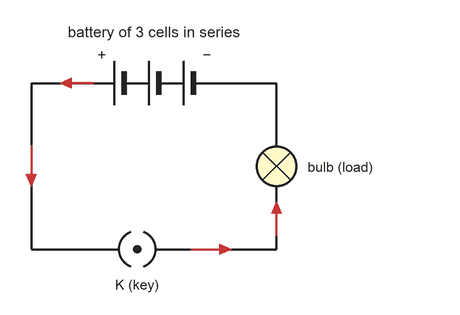
Join several cells in series: the − terminal of one cell to the + terminal of the next. This combination is a battery. The potential differences of the cells add up, so a larger current flows through the same circuit.
Step 2 — Or use a storage cell.
Alternatively, use a secondary (storage) cell such as a lead–acid accumulator. It has a very low internal resistance, so it can give a large current.
Step 3 — Draw the circuit.
In the diagram, three cells are joined in series to form a battery, which sends a large direct current through the bulb when the key K is closed. The arrows show the conventional current, leaving the + end of the battery.
Watch out: Join the cells + to −. If one cell is turned the other way, its potential difference cancels part of the others and the current becomes smaller.
Therefore, a large direct current is obtained from a battery of cells joined in series (or from a storage cell).
- 382 marks
Question 38
Which material is used to make wires for a resistance box ? Why is this particular material used ?
Solve with AIWritten solution
Solution:
Concept: A standard resistance must keep the same value even when it warms up as current passes through it.
Step 1 — Name the material.
The coils of a resistance box are made of the alloy manganin (about 84% copper, 12% manganese and 4% nickel).
Step 2 — Give the main reason.
The resistance of manganin hardly changes with temperature. So each coil keeps its marked value even when it becomes warm.
Step 3 — Give a second reason.
Manganin also has a fairly high resistance, so a short length of wire gives the value needed and the box stays compact.
Therefore, manganin is used, because its resistance hardly changes with temperature (and it has a fairly high resistance).
- 393 marks
Question 39
A galvanometer has an 'O' mark at the middle, while a voltmeter and ammeter has the mark at the left hand corner of the dial. Explain.
Solve with AIWritten solution
Solution:
Concept: Where the zero mark is placed depends on whether the needle has to move both ways or only one way.
Step 1 — Explain the galvanometer.
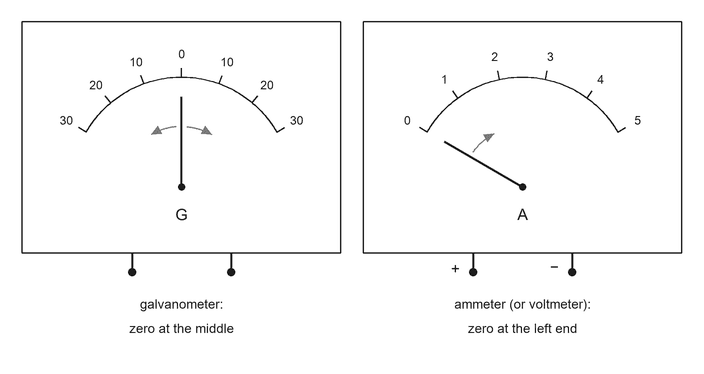
A galvanometer is used to detect a current and find its direction. Its terminals have no + or − marks, so current may enter through either one. The needle deflects to the right for one direction and to the left for the other, so the zero is placed at the middle of the dial.
Step 2 — Explain the ammeter and voltmeter.
An ammeter or a voltmeter has a + terminal and a − terminal, and it is always connected so that current enters at the + terminal. Its needle therefore always deflects the same way, so the zero is at the left-hand end and the whole dial is used for the reading.
Watch out: If an ammeter is joined the wrong way round, its needle tries to move to the left of zero and can be damaged.
Therefore, the galvanometer has a centre zero because its needle must move both ways, while an ammeter and a voltmeter have a left-hand zero because their needles move one way only.
- 402 marks
Question 40
What is meant by load in an electrical circuit ? Give some examples.
Solve with AIWritten solution
Solution:
Concept: The load is the part of a circuit that uses the electrical energy supplied by the source.
Step 1 — Define load.
An appliance connected in a circuit to use the electrical energy is called the load. It may be a single resistance or a combination of components, and in a circuit diagram it may be marked L.
Step 2 — Give examples.
An electric bulb, a heater, an electric iron, a fan and a television are loads.
Therefore, the load is the appliance that uses electrical energy in a circuit, such as a bulb, a heater, an iron or a fan.
- 414 marks
Question 41
Distinguish between d.c. and a.c.
Solve with AIWritten solution
Solution:
Concept: The two kinds of current differ in whether their size and direction stay fixed.
Step 1 — Define d.c.
Direct current (d.c.) has a constant size and flows in one direction only.
Step 2 — Define a.c.
Alternating current (a.c.) changes its size continuously and reverses its direction again and again, repeating itself after a fixed time.
Step 3 — Compare them.
The table sets out the differences.
Direct current (d.c.) Alternating current (a.c.) Its magnitude remains constant. Its magnitude changes continuously with time. It flows in one direction only. Its direction reverses again and again. Source: a cell or a battery. Source: the mains in our house, an a.c. generator. It has no frequency (it does not repeat). It has a frequency; the mains in India is 50 Hz. Symbol of its source: long and short plates (cell). Symbol of its source: a wave inside a circle. Therefore, d.c. has a constant size and one direction, while a.c. changes its size and reverses its direction periodically.
- 425 marks
Question 42
Distinguish between a closed circuit and an open circuit, with the use of suitable labelled diagrams.
Solve with AIWritten solution
Solution:
Concept: Current flows only round a closed circuit, a complete conducting path from the + terminal of the source, through the components, back to its − terminal. A gap or an insulator anywhere in the path makes it an open circuit, and no current flows.
Step 1 — Draw the two circuits.
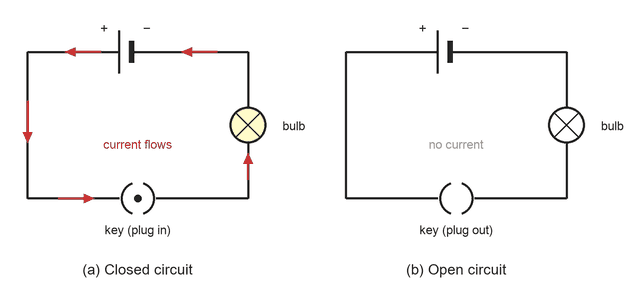
Both circuits have a cell, a bulb and a plug key. In (a) the plug is in; in (b) it is out.
Step 2 — Explain the closed circuit.
In (a) the key is closed, so there is a complete conducting path from the + terminal of the cell, through the bulb, back to the − terminal. Current flows (arrows) and the bulb glows.
Step 3 — Explain the open circuit.
In (b) the key is open, so an air gap (an insulator) breaks the path. The circuit is incomplete, no current flows and the bulb does not glow.
Step 4 — Compare them.
The table sums up the difference.
Closed circuit Open circuit The conducting path is complete. The path is broken somewhere. The key is closed (plug in). The key is open (plug out). Current flows; the bulb glows. No current flows; the bulb does not glow. Therefore, a closed circuit has a complete path and carries current, while an open circuit has a break and carries no current.
- 434 marks
Question 43
State three differences between primary and secondary cells.
Solve with AIWritten solution
Solution:
Concept: In a primary cell the chemical reaction is irreversible, so the cell cannot be recharged. In a secondary cell (accumulator) the reaction is reversible, so the cell can be recharged again and again by passing a current through it.
Step 1 — Compare the two cells.
The table lists the differences; any three answer the question.
Primary cell Secondary cell Chemical reaction Irreversible Reversible Recharging Cannot be recharged Can be recharged again and again Internal resistance High Low Current Gives a fairly small current only Can give a small as well as a large current Weight and cost Light and cheap The lead–acid accumulator is heavy and costly Examples Simple voltaic cell, Leclanché cell, Daniell cell, dry cell Lead–acid accumulator, nickel–iron accumulator, lithium-ion cell Step 2 — Explain the key difference.
All the other differences follow from the first one: because the reaction in a secondary cell can be reversed, a current passed through it stores energy again, so it is rechargeable.
Watch out: 'Heavy and costly' fits the lead–acid accumulator in the book; a modern lithium-ion cell is light, so use the first three rows when in doubt.
Therefore, a primary cell has an irreversible reaction, cannot be recharged and has a high internal resistance, while a secondary cell has a reversible reaction, can be recharged and has a low internal resistance.
- 445 marks
Question 44
Write symbols and state the functions of each of the following components in an electric circuit : (i) key, (ii) cell, (iii) rheostat, (iv) ammeter, and (v) voltmeter.
Solve with AIWritten solution
Solution:
Concept: Every component has a standard symbol, so that circuits can be drawn quickly and read by anyone.
Step 1 — Draw the symbols.
The five symbols are shown below.
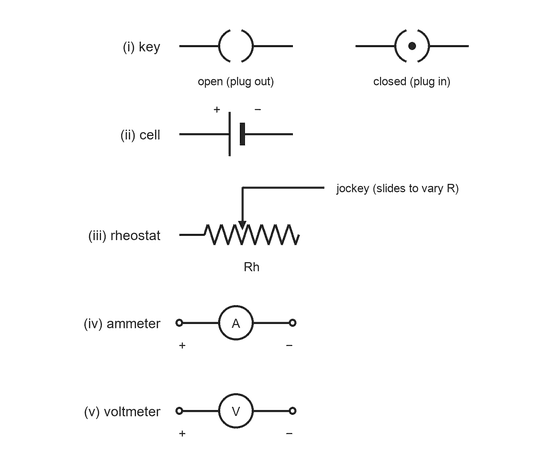
Step 2 — Key.
A plug key is drawn as two curved studs, with a dot (the plug) between them when it is closed. It is used to put the current on or off in a circuit.
Step 3 — Cell.
A cell is drawn as a long thin line (+ terminal) and a short thick line (− terminal). It is a source of direct current: it keeps the charge flowing by changing chemical energy into electrical energy.
Step 4 — Rheostat.
A rheostat (Rh) is drawn as a resistance with a sliding jockey (arrow). It is used to vary the resistance continuously, and so to adjust the current in the circuit.
Step 5 — Ammeter.
An ammeter is the letter A in a circle, with + and − terminals. It measures the current. It is joined in series so that the whole current passes through it, and it has a very low resistance.
Step 6 — Voltmeter.
A voltmeter is the letter V in a circle, with + and − terminals. It measures the potential difference between two points. It is joined in parallel across those points, and it has a very high resistance so that it draws very little current.
Watch out: Do not swap the meters: an ammeter goes in series, a voltmeter in parallel.
Therefore, the key switches the current on or off, the cell supplies it, the rheostat adjusts it, the ammeter measures it and the voltmeter measures the potential difference.
- 455 marks
Question 45
In the electric circuit shown in Fig. 9.16, label the parts A, B, C, D, E, and F. State the function of each part. Show in the diagram the direction of flow of current.
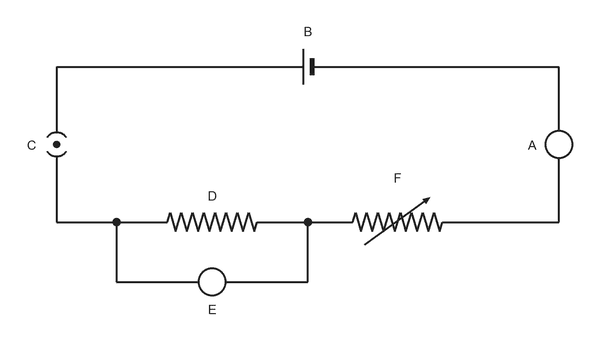 Solve with AI
Written solution
Solution:
Concept: The meter in series with the cell is the ammeter, the meter joined across a resistance is the voltmeter, and the resistance with a slanting arrow is the rheostat.
Step 1 — Name each part.
We read each symbol from the figure and state what it does.
Part Name Function A Ammeter Measures the current in the circuit (joined in series). B Cell Source of direct current; keeps the charge flowing. C Plug key Puts the current on or off. D Resistance R (resistance wire) The resistance (load) through which the current flows. E Voltmeter Measures the potential difference across D (joined in parallel with D). F Rheostat Varies the resistance, and so controls the current. Step 2 — Find the + terminal of the cell.
The long thin plate of B is its + terminal, and it is on the left. So the conventional current leaves B on its left side.
Step 3 — Trace the current.
The current goes left along the top wire, down through the key C, and right along the bottom through D (a very small part goes through the voltmeter E). It then passes through the rheostat F, up through the ammeter A, and back into the − terminal of B. The arrows show this.
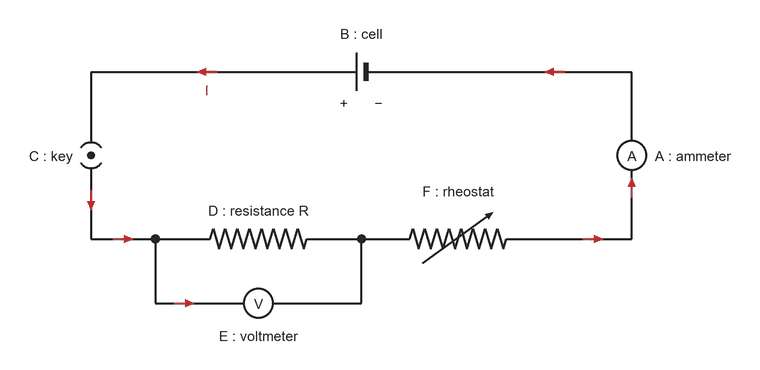
Watch out: The direction comes from the cell's plates, not from the letters: the long thin plate is always +.
Note: the figure is redrawn more clearly: the rheostat F now has both its ends in the circuit and the studs of the key C face along the wire. The parts and their places are as printed.
Therefore, A is the ammeter, B the cell, C the key, D the resistance, E the voltmeter and F the rheostat, and the current flows from the + plate of B through C, D, F and A back to B.
- 465 marks
Question 46
(a) Complete the circuit given in Fig. 9.17 by inserting between the terminals A and C, an ammeter.
(b) In the diagram mark the polarity at the terminals of ammeter and indicate clearly the direction of flow of current in the circuit, when the circuit is complete.
(c) Name and state the purpose of Rh in the circuit.
 Solve with AI
Written solution
Solution:
Concept: The conventional current leaves the + terminal of the cell, goes round the circuit and returns to the − terminal. An ammeter is joined in series, with the current entering at its + terminal.
Step 1 — Find the + terminal of the cell.
The long thin plate of the cell, marked +, is on its left. So the current leaves the cell towards the left, through the key.
Step 2 — Trace the current.
With the key closed, the current flows through the KEY, up the jockey into Rh, along part of Rh to its left end, down through the load, and along the bottom wire to A. It passes through the ammeter from A to C, goes up the right-hand side and returns to the − terminal of the cell.
Step 3 — Mark the ammeter's polarity.
The current enters the ammeter at A, so A is its + terminal and C is its − terminal. The completed circuit, with the current arrows, is shown below.
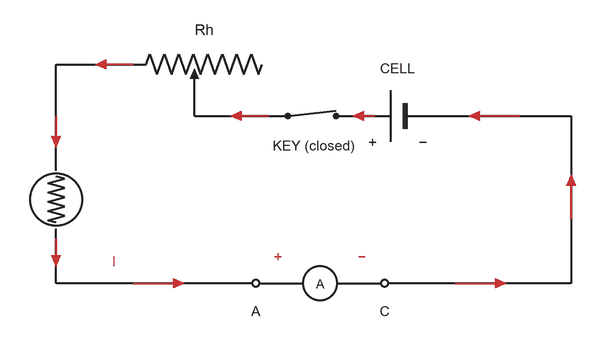
Step 4 — Name Rh and state its purpose.
Rh is a rheostat (variable resistance). Sliding its jockey changes the length of resistance wire in the circuit, so it is used to vary the resistance and so adjust the current.
Watch out: Mark the ammeter's + on the side nearer the + terminal of the cell along the current's path.
Therefore, the ammeter goes between A and C with A marked + and C marked −, the current flows from the + terminal round through the key, Rh, the load and A to C, and Rh is a rheostat used to adjust the current.
- 473 marks
Question 47
A charge 0.5 C passes through a cross section of a conductor in 5 s. Find the current.
Solve with AIWritten solution
Solution:
Concept: Electric current is the rate of flow of charge across a cross-section of the conductor taken normal (at right angles) to the direction of flow. In symbols, .
Given: C and s.
Step 1 — Write the formula.
Current is the charge that passes divided by the time taken.
Step 2 — Substitute and work it out.
We put in the charge and the time.
Therefore, the current is 0.1 A.
- 483 marks
Question 48
A current of 1.5 A flows through a conductor for 2.0 s. What amount of charge passes through the conductor ?
Solve with AIWritten solution
Solution:
Concept: Electric current is the rate of flow of charge across a cross-section of the conductor taken normal (at right angles) to the direction of flow. In symbols, .
Given: A and s.
Step 1 — Write the formula.
Rearranging , the charge is the current times the time.
Step 2 — Substitute and work it out.
We put in the current and the time.
Therefore, the charge that passes is 3 C.
- 493 marks
Question 49
When starter motor of a car is switched on for 0.8 s, a charge 24 C passes through the coil of the motor. Calculate the current in the coil.
Solve with AIWritten solution
Solution:
Concept: Electric current is the rate of flow of charge across a cross-section of the conductor taken normal (at right angles) to the direction of flow. In symbols, .
Given: C and s.
Step 1 — Write the formula.
Current is the charge that passes divided by the time taken.
Step 2 — Substitute and work it out.
We put in the charge and the time.
Watch out: Dividing by a number less than 1 makes the answer bigger: 24 ÷ 0.8 is 30, not 3.
Therefore, the current in the coil is 30 A.
- 501 mark
Question 50
In the given figure, the flow of electrons would be from :
 Solve with AI
Answer
(A) B to A
- Correct
(B) A to B
(C) both A to B and B to A
(D) none of the above
Answer: (B) A to B
Concept: A conductor with an excess of electrons is negatively charged and is at a lower potential; a conductor with a deficit of electrons is positively charged and is at a higher potential. Charge flows between two conductors only when their potentials differ. The (conventional) current flows from the higher potential to the lower potential, and electrons flow the opposite way, from lower to higher potential.
Step 1 — Read the charges from the figure.
Conductor A is surrounded by − signs, so it has an excess of electrons and is at the lower potential. Conductor B is surrounded by + signs, so it has a deficit of electrons and is at the higher potential.
Step 2 — Find the direction of the electrons.
Electrons flow from the lower potential to the higher potential, that is from the body with extra electrons to the body short of them. So they flow from A to B.
Step 3 — Compare with the current.
The conventional current flows the other way, from B (higher potential) to A (lower potential).
Watch out: The question asks for the electrons, not the current; the two directions are opposite.
Why the other options are wrong:
- (A) B to A: B to A is the direction of the conventional current, not of the electrons.
- (C) both A to B and B to A: The electrons flow one way only, from A to B, until the two potentials become equal.
- (D) none of the above: There is a flow, because A and B are at different potentials when they are joined.
Therefore, the electrons flow from A to B, option (B).
- 511 mark
Question 51
An electric cell works :
Solve with AIAnswer
- Correct
(A) as a source of electrons
(B) on deficit of electrons
(C) as a source of protons
(D) none of the above
Answer: (A) as a source of electrons
Concept: Inside a cell, a chemical reaction keeps an excess of electrons at its − terminal and a deficit at its + terminal. Joined to a circuit, the − terminal keeps sending electrons into the outside wire while the + terminal takes them back.
Step 1 — See what the cell keeps doing.
As long as the reaction goes on, the − terminal keeps supplying electrons to the outside circuit, and they flow through the circuit to the + terminal.
Step 2 — Match the book's phrase.
Because it keeps supplying electrons at its − terminal, the book says an electric cell works as a source of electrons.
Watch out: A cell does not create new electrons; it uses chemical energy to push the electrons already in the wires round the circuit.
Why the other options are wrong:
- (B) on deficit of electrons: A deficit of electrons exists only at the + terminal; the cell as a whole works by keeping one terminal with extra electrons and the other short of them.
- (C) as a source of protons: Protons stay in the nuclei and do not move round a circuit, so a cell is not a source of protons.
- (D) none of the above: This cannot be right, because option (A) describes how the cell works.
Therefore, an electric cell works as a source of electrons, option (A).
- 521 mark
Question 52
Current in a circuit flows :
Solve with AIAnswer
- Correct
(A) in direction from high potential to low potential
(B) in direction from low potential to high potential
(C) in direction of flow of electrons
(D) in any direction.
Answer: (A) in direction from high potential to low potential
Concept: Charge flows between two conductors only when their potentials differ. The (conventional) current flows from the higher potential to the lower potential, and electrons flow the opposite way, from lower to higher potential.
Step 1 — Use the analogy.
Heat flows from a higher to a lower temperature, and water from a higher to a lower level. In the same way, current flows from a higher to a lower potential.
Step 2 — Apply it to a circuit.
In the outside circuit, the + terminal of the cell is at the higher potential, so the current flows from the + terminal through the circuit to the − terminal.
Watch out: Inside the cell itself, the chemical reaction pushes the current from the − terminal to the + terminal, that is from low to high potential; the rule here is for the outside circuit.
Why the other options are wrong:
- (B) in direction from low potential to high potential: Low to high potential is the direction in which electrons move, opposite to the current.
- (C) in direction of flow of electrons: The current is opposite to the flow of electrons, not along it.
- (D) in any direction: The direction is fixed by the potentials; it is not random.
Therefore, current flows from high potential to low potential, option (A).
- 531 mark
Question 53
A conductor having an excess of electrons is said to be at .......... potential while a conductor having a deficit of electrons is at .......... potential.
Solve with AIAnswer
(A) lower, lower
- Correct
(B) lower, higher
(C) higher, lower
(D) higher, higher
Answer: (B) lower, higher
Concept: A conductor with an excess of electrons is negatively charged and is at a lower potential; a conductor with a deficit of electrons is positively charged and is at a higher potential.
Step 1 — Fill the first blank.
Extra electrons make a conductor negatively charged, so its potential is lower.
Step 2 — Fill the second blank.
Missing electrons make a conductor positively charged, so its potential is higher.
Why the other options are wrong:
- (A) lower, lower: The conductor short of electrons is at a higher, not a lower, potential.
- (C) higher, lower: This swaps the two conductors.
- (D) higher, higher: The conductor with extra electrons is at a lower, not a higher, potential.
Therefore, excess of electrons means lower potential and deficit means higher potential, option (B).
- 541 mark
Question 54
The force between the two charges is ............, when they are at an infiinie separation.
Solve with AIAnswer
(A) finite
(B) infinite
- Correct
(C) zero
(D) none of the above
Answer: (C) zero
Concept: The force between two charges becomes weaker as the distance between them increases (it varies as ).
Step 1 — Let the distance grow.
As the separation grows larger and larger, the force keeps getting smaller and smaller.
Step 2 — Take the limit.
At an infinite separation the force falls to zero. That is why potential is measured from infinity, where a charge feels no force.
Note: the book prints the fourth option as a second '(c)'; it is the (D) option here.
Why the other options are wrong:
- (A) finite: Any finite non-zero force would still be getting smaller as the distance grows, so it cannot stay finite at infinite distance.
- (B) infinite: The force becomes very large only when the charges come very close, not when they are far apart.
- (D) none of the above: This cannot be right, because the force is zero, which is option (C).
Therefore, the force at infinite separation is zero, option (C).
- 551 mark
Question 55
The unit of potential difference is :
Solve with AIAnswer
(A) ampere
- Correct
(B) volt
(C) ohm
(D) coulomb.
Answer: (B) volt
Concept: The potential difference between two conductors is the work done in moving a unit positive charge from one to the other, . Its unit is the joule per coulomb, called the volt (V).
Step 1 — Build the unit.
Potential difference is work divided by charge, so its unit is joule per coulomb.
Step 2 — Name it.
One joule per coulomb is called one volt.
Why the other options are wrong:
- (A) ampere: The ampere is the unit of current.
- (C) ohm: The ohm is the unit of resistance.
- (D) coulomb: The coulomb is the unit of charge.
Therefore, the unit of potential difference is the volt, option (B).
- 561 mark
Question 56
The S.I. unit of potential is :
Solve with AIAnswer
(A) Joule/coulomb
(B) Volt
(C) Ampere
- Correct
(D) Both (a) and (b)
Answer: (D) Both (A) and (B)
Concept: The potential difference between two conductors is the work done in moving a unit positive charge from one to the other, . Its unit is the joule per coulomb, called the volt (V).
Step 1 — Build the unit.
Potential is work done per unit charge, so its S.I. unit is the joule per coulomb.
Step 2 — Give it its name.
One joule per coulomb is named one volt.
Step 3 — Match the options.
Both 'joule/coulomb' and 'volt' are correct, so the answer is the option naming both.
Why the other options are wrong:
- (A) Joule/coulomb: Joule/coulomb is correct, but volt is also correct, so this option alone is incomplete.
- (B) Volt: Volt is correct, but joule/coulomb is also correct, so this option alone is incomplete.
- (C) Ampere: The ampere is the unit of current, not of potential.
Therefore, the S.I. unit of potential is both the joule/coulomb and the volt, option (D).
- 571 mark
Question 57
On increasing the resistance in a circuit, the current in it :
Solve with AIAnswer
- Correct
(A) decreases
(B) increases
(C) remains unchanged
(D) nothing can be said.
Answer: (A) decreases
Concept: Ohm's law: the current through a conductor is directly proportional to the potential difference across its ends, provided its temperature (and other physical conditions) stay the same. So , where is the resistance in ohm (Ω).
Step 1 — Write the current.
For a fixed potential difference , Ohm's law gives the current.
Step 2 — Increase R.
The resistance is in the denominator, so a larger gives a smaller : the current decreases. This is how a rheostat controls the current.
Why the other options are wrong:
- (B) increases: The current would increase only if the resistance were reduced.
- (C) remains unchanged: The current changes, because it depends on the resistance.
- (D) nothing can be said: Something can be said: for the same potential difference, the current decreases.
Therefore, on increasing the resistance, the current decreases, option (A).
- 581 mark
Question 58
A larger wire offers .......... resistance than a shorter wire.
Solve with AIAnswer
(A) less
(B) equal
- Correct
(C) more
(D) none of the above
Answer: (C) more
Concept: The resistance of a wire is directly proportional to its length and inversely proportional to its area of cross-section , so . It also depends on the material, and for a metal it increases with temperature.
Step 1 — Read 'larger' as longer.
'A larger wire' compared with 'a shorter wire' means a longer wire of the same material and thickness.
Step 2 — Apply R ∝ l.
In a longer wire the electrons suffer more collisions on their way, so the resistance is more.
Why the other options are wrong:
- (A) less: Less resistance would need a shorter (or thicker) wire.
- (B) equal: Equal resistance would need the same length.
- (D) none of the above: Something can be said: since , the longer wire has more resistance.
Therefore, a longer wire offers more resistance than a shorter wire, option (C).
- 591 mark
Question 59
A thicker wire offers ......... resistance than a thin wire :
Solve with AIAnswer
- Correct
(A) less
(B) equal
(C) more
(D) none of the above
Answer: (A) less
Concept: The resistance of a wire is directly proportional to its length and inversely proportional to its area of cross-section , so . It also depends on the material, and for a metal it increases with temperature.
Step 1 — Compare the areas.
A thicker wire has a larger area of cross-section .
Step 2 — Apply R ∝ 1/a.
A larger area gives the electrons a wider path, so the resistance is less.
Why the other options are wrong:
- (B) equal: Equal resistance would need the same thickness.
- (C) more: More resistance belongs to the thinner wire.
- (D) none of the above: Something can be said: since , the thicker wire has less resistance.
Therefore, a thicker wire offers less resistance than a thin wire, option (A).
- 601 mark
Question 60
Upon increasing the temperature, the resistance of a wire :
Solve with AIAnswer
(A) decreases
(B) does not change
- Correct
(C) increases
(D) first increases then decreases
Answer: (C) increases
Concept: The resistance of a conductor is the obstruction it offers to the flow of current. The drifting free electrons keep colliding with the vibrating positive ions of the metal, and this slows their flow.
Step 1 — See what heating does.
When a metal wire is heated, its positive ions vibrate more strongly.
Step 2 — See the effect on the electrons.
The drifting electrons now collide with the ions more often, so the obstruction to their flow grows: the resistance increases. A glowing bulb filament has a much higher resistance than a cold one.
Watch out: This is true of metal wires. Some other materials (for example carbon and semiconductors) lose resistance when heated.
Why the other options are wrong:
- (A) decreases: A metal wire's resistance does not decrease on heating; it increases.
- (B) does not change: The resistance of a metal wire does change with temperature.
- (D) first increases then decreases: A metal wire's resistance keeps rising as the temperature rises; it does not rise and then fall.
Therefore, the resistance of a wire increases with temperature, option (C).
- 611 mark
Question 61
The resistance of a conductor would be ........ if a current of 2 A flows through it when the potential difference across its ends is 2 volt.
Solve with AIAnswer
(A)
(B)
- Correct
(C)
(D)
Answer: (C)
Concept: Ohm's law: the current through a conductor is directly proportional to the potential difference across its ends, provided its temperature (and other physical conditions) stay the same. So , where is the resistance in ohm (Ω).
Step 1 — Write the formula.
From Ohm's law, the resistance is the potential difference divided by the current.
Step 2 — Substitute.
We put in V and A.
Watch out: Divide V by I; multiplying them gives power, not resistance.
Why the other options are wrong:
- (A) : would allow only 1 A at 2 V, not 2 A.
- (B) : A zero resistance would let an unlimited current flow at 2 V, not just 2 A.
- (D) : is written with the wrong unit; at 2 V it would allow only 0.5 A.
Therefore, the resistance is , option (C).
- 622 marks
Question 62
What is the other name for the unit : (a) Joule per Coulomb (b) Coulomb per second?
Solve with AIWritten solution
Solution:
Concept: Joule per coulomb is the unit of work per unit charge (), and coulomb per second is the unit of charge per unit time ().
Step 1 — Part (a).
Work per unit charge is potential difference, and its unit, the joule per coulomb, is named the volt.
Step 2 — Part (b).
Charge per unit time is current, and its unit, the coulomb per second, is named the ampere.
Therefore, (a) joule per coulomb is the volt, and (b) coulomb per second is the ampere.
- 631 mark
Question 63
For what purpose is a battery connected in a circuit ?
Solve with AIWritten solution
Solution:
Concept: Charge flows between two conductors only when their potentials differ. The (conventional) current flows from the higher potential to the lower potential, and electrons flow the opposite way, from lower to higher potential.
Step 1 — See what current needs.
Charge flows through a circuit only while there is a potential difference between its ends.
Step 2 — State the battery's job.
A battery keeps a potential difference between its terminals by its chemical reaction, and so supplies the energy that keeps the charges moving.
Therefore, a battery is connected to maintain a potential difference across the circuit, so that a continuous current flows in it.
- 641 mark
Question 64
How will the resistance of a wire change if it is stretched ?
Solve with AIWritten solution
Solution:
Concept: The resistance of a wire is directly proportional to its length and inversely proportional to its area of cross-section , so . It also depends on the material, and for a metal it increases with temperature.
Step 1 — See what stretching does.
Stretching makes the wire longer and, since its volume stays the same, also thinner (smaller area of cross-section).
Step 2 — Apply both effects.
A longer wire has more resistance, and a thinner wire also has more resistance, so both changes increase the resistance.
Step 3 — See how big the change is.
For example, if the wire is stretched to twice its length, its area becomes half. The length factor doubles and the area factor doubles it again, so becomes 4 times.
Therefore, the resistance of a wire increases when it is stretched.
- 651 mark
Question 65
How does current change with voltage when it is altered across a given resistance ?
Solve with AIWritten solution
Solution:
Concept: Ohm's law: the current through a conductor is directly proportional to the potential difference across its ends, provided its temperature (and other physical conditions) stay the same. So , where is the resistance in ohm (Ω).
Step 1 — Keep R fixed.
For a given resistance (at the same temperature), Ohm's law gives the current.
Step 2 — Change V.
Since is fixed, the current changes in the same ratio as the voltage: doubling the voltage doubles the current.
Therefore, the current is directly proportional to the voltage across a given resistance.
- 662 marks
Question 66
Name the physical quantities whose units are : (a) Coulomb and ampere (b) Volt and ohm.
Solve with AIWritten solution
Solution:
Concept: Each S.I. unit belongs to one physical quantity.
Step 1 — Part (a).
The coulomb is the unit of charge, and the ampere is the unit of current.
Step 2 — Part (b).
The volt is the unit of potential difference (or potential), and the ohm is the unit of resistance.
Therefore, (a) coulomb: charge, ampere: current; (b) volt: potential difference, ohm: resistance.
- 671 mark
Question 67
How is the direction of flow of current between two charged conductors determined by their potentials ?
Solve with AIWritten solution
Solution:
Concept: Charge flows between two conductors only when their potentials differ. The (conventional) current flows from the higher potential to the lower potential, and electrons flow the opposite way, from lower to higher potential.
Step 1 — Compare the potentials.
Find which of the two conductors is at the higher potential.
Step 2 — State the direction.
Current flows from the conductor at higher potential to the one at lower potential, while electrons flow the opposite way. The flow stops when both reach the same potential.
Watch out: The amount of charge does not decide the direction; only the potentials do.
Therefore, current flows from the conductor at higher potential to the conductor at lower potential.
- 681 mark
Question 68
Define the term potential difference.
Solve with AIWritten solution
Solution:
Concept: Work must be done to move a charge from one charged conductor to another, against the electric forces.
Step 1 — Define the term.
The potential difference between two conductors is the work done in transferring a unit positive charge from one conductor to the other.
Step 2 — Write it in symbols.
If work is done in transferring a charge , the potential difference is the work per unit charge.
Therefore, potential difference is the work done per unit positive charge in moving charge from one conductor to the other.
- 692 marks
Question 69
State and define the S.I. unit of potential difference.
Solve with AIWritten solution
Solution:
Concept: The potential difference between two conductors is the work done in moving a unit positive charge from one to the other, . Its unit is the joule per coulomb, called the volt (V).
Step 1 — State the unit.
The S.I. unit of potential difference is the volt (V).
Step 2 — Define it.
The potential difference between two points is 1 volt when 1 joule of work is done in transferring 1 coulomb of charge from one point to the other.
Therefore, the S.I. unit of potential difference is the volt, which is 1 joule of work per coulomb of charge.
- 702 marks
Question 70
State and define the S.I. unit of resistance.
Solve with AIWritten solution
Solution:
Concept: Ohm's law: the current through a conductor is directly proportional to the potential difference across its ends, provided its temperature (and other physical conditions) stay the same. So , where is the resistance in ohm (Ω).
Step 1 — State the unit.
The S.I. unit of resistance is the ohm ().
Step 2 — Define it.
A conductor has a resistance of 1 ohm when a current of 1 ampere flows through it with a potential difference of 1 volt across its ends.
Therefore, the S.I. unit of resistance is the ohm, the resistance that lets 1 A flow under 1 V.
- 711 mark
Question 71
State Ohm's law.
Solve with AIWritten solution
Solution:
Concept: For a metal wire kept at the same temperature, the current and the potential difference rise and fall together in the same ratio.
Step 1 — State the law.
Ohm's law: the current flowing through a conductor is directly proportional to the potential difference across its ends, provided its physical conditions (such as temperature) remain the same.
Step 2 — Write it in symbols.
The constant of proportionality is the resistance of the conductor.
Watch out: Leave out 'temperature stays the same' and the law is incomplete: a glowing filament does not obey a single .
Therefore, Ohm's law says (that is, ) when the physical conditions stay the same.
- 721 mark
Question 72
How are the potential difference (), current () and resistance () related ?
Solve with AIWritten solution
Solution:
Concept: Ohm's law: the current through a conductor is directly proportional to the potential difference across its ends, provided its temperature (and other physical conditions) stay the same. So , where is the resistance in ohm (Ω).
Step 1 — Relate the three quantities.
The potential difference across a conductor equals the current through it times its resistance.
Step 2 — Use it in any form.
The same relation can be written to find any one of the three quantities.
Therefore, .
- 731 mark
Question 73
State whether the resistance of filament of a bulb will decrease, remain unchanged or increase when it glows.
Solve with AIWritten solution
Solution:
Concept: The resistance of a conductor is the obstruction it offers to the flow of current. The drifting free electrons keep colliding with the vibrating positive ions of the metal, and this slows their flow. For a metal, the resistance increases as the temperature rises.
Step 1 — See what happens when it glows.
When the bulb glows, its tungsten filament becomes white hot (well over 2000 °C).
Step 2 — Apply the rule.
At this high temperature the ions vibrate much more, the electrons collide more often, and so the resistance of the filament is much higher than when it is cold.
Therefore, the resistance of the filament increases when the bulb glows.
- 742 marks
Question 74
What do you understand by the term resistance ?
Solve with AIWritten solution
Solution:
Concept: The resistance of a conductor is the obstruction it offers to the flow of current. The drifting free electrons keep colliding with the vibrating positive ions of the metal, and this slows their flow.
Step 1 — State the meaning.
When current flows through a metal wire, the wire opposes it. The obstruction offered by a conductor to the flow of current is its resistance.
Step 2 — Explain its cause.
The free electrons drifting through the wire keep colliding with the vibrating positive ions of the metal. These collisions slow them down, so the wire resists the flow.
Step 3 — Give the formula and unit.
Resistance is the ratio of potential difference to current, and its S.I. unit is the ohm ().
Step 4 — See what it means in practice.
For the same potential difference, a larger resistance allows a smaller current.
Therefore, resistance is the obstruction a conductor offers to the flow of current, measured in ohm.
- 752 marks
Question 75
How is the current flowing in a conductor changed if the resistance of conductor is doubled keeping the potential difference across it the same ?
Solve with AIWritten solution
Solution:
Concept: Ohm's law: the current through a conductor is directly proportional to the potential difference across its ends, provided its temperature (and other physical conditions) stay the same. So , where is the resistance in ohm (Ω).
Step 1 — Write the current before.
With potential difference and resistance , the current is given by Ohm's law.
Step 2 — Double the resistance.
With the resistance doubled and unchanged, we put in place of .
Therefore, the current becomes half of its earlier value.
- 762 marks
Question 76
Fig. 9.26 below shows two conductors A and B. Their charges and potentials are given in the diagram. State the direction of (i) flow of electrons, and (ii) flow of current, when both the conductors are joined by a metal wire.
 Solve with AI
Written solution
Solution:
Concept: Charge flows between two conductors only when their potentials differ. The (conventional) current flows from the higher potential to the lower potential, and electrons flow the opposite way, from lower to higher potential. The direction depends only on the potentials, not on the amounts or signs of the charges.
Step 1 — Read the potentials.
From the figure, A is at 5 V and B is at 10 V, so B is at the higher potential.
Step 2 — Find the flow of electrons.
Electrons flow from the lower potential to the higher potential, so they flow from A to B.
Step 3 — Find the flow of current.
The conventional current flows from the higher potential to the lower potential, so it flows from B to A.
Step 4 — Say when it stops.
The flow continues until A and B reach the same potential.
Watch out: The charges (−10 C and 5 C) are a distraction; compare the potentials.
Therefore, (i) electrons flow from A to B, and (ii) current flows from B to A.
- 773 marks
Question 77
How is the resistance of a wire affected if its (a) length is doubled, (b) radius is doubled ?
Solve with AIWritten solution
Solution:
Concept: The resistance of a wire is directly proportional to its length and inversely proportional to its area of cross-section , so . It also depends on the material, and for a metal it increases with temperature. The area of cross-section of a wire of radius is .
Step 1 — Part (a): double the length.
Since , doubling the length doubles the resistance.
Step 2 — Part (b): find the new area.
Doubling the radius makes the area times as large.
Step 3 — Part (b): find the new resistance.
Since , an area 4 times as large gives one-fourth the resistance.
Watch out: The area depends on the square of the radius, so doubling the radius does not just halve the resistance.
Therefore, (a) doubling the length doubles the resistance, and (b) doubling the radius makes the resistance one-fourth.
- 782 marks
Question 78
'The potential difference between two conductors is 1 volt'. Explain the meaning of this statement.
Solve with AIWritten solution
Solution:
Concept: The potential difference between two conductors is the work done in moving a unit positive charge from one to the other, . Its unit is the joule per coulomb, called the volt (V).
Step 1 — Use the definition.
Potential difference is the work done per unit charge in moving charge from one conductor to the other.
Step 2 — Put in 1 volt.
A potential difference of 1 V therefore means 1 joule of work per coulomb of charge.
Therefore, the statement means that 1 joule of work is done in transferring 1 coulomb of charge from one conductor to the other.
- 792 marks
Question 79
'The resistance of a wire is 1 ohm'. Explain the meaning of this statement.
Solve with AIWritten solution
Solution:
Concept: Ohm's law: the current through a conductor is directly proportional to the potential difference across its ends, provided its temperature (and other physical conditions) stay the same. So , where is the resistance in ohm (Ω).
Step 1 — Use the definition.
Resistance is the potential difference across a conductor divided by the current through it.
Step 2 — Put in 1 ohm.
A resistance of 1 Ω therefore means a current of 1 A for each volt across the wire.
Therefore, the statement means that a current of 1 ampere flows through the wire when a potential difference of 1 volt is applied across its ends.
- 804 marks
Question 80
Explain the concept of electric potential difference in terms of work done in transferring the charge.
Solve with AIWritten solution
Solution:
Concept: Like charges repel and unlike charges attract, so work has to be done to move a charge towards or away from other charges.
Step 1 — Work is needed to move charge.
To give a conductor an excess or a deficit of electrons, charges must be moved against the electric forces of the charges already there. So work has to be done in moving a charge.
Step 2 — Potential at a point.
The force between charges is zero when they are infinitely far apart. So the potential at a point is measured by the work done in bringing a charge from infinity to that point, per unit charge.
Step 3 — Potential difference.
In the same way, the potential difference between two conductors is the work done in transferring a unit positive charge from one conductor to the other (through a metal wire). If work moves charge , then the following holds.
Step 4 — Unit.
The unit is the joule per coulomb, called the volt. The potential difference is 1 V when 1 J of work transfers 1 C of charge. Potential difference is a scalar quantity.
Step 5 — Why it matters.
Charge flows only when there is a potential difference, just as water flows only when there is a difference of level. A cell keeps a potential difference between its terminals, so current keeps flowing in the circuit.
Therefore, the potential difference between two conductors is the work done per unit positive charge in transferring charge from one to the other, measured in volt.
- 814 marks
Question 81
Explain why does a metal wire when connected to a cell offer resistance to the flow of current.
Solve with AIWritten solution
Solution:
Concept: The resistance of a conductor is the obstruction it offers to the flow of current. The drifting free electrons keep colliding with the vibrating positive ions of the metal, and this slows their flow.
Step 1 — Before the cell is joined.
A metal wire has many free electrons moving randomly in all directions, so there is no net flow of charge in any one direction.
Step 2 — After the cell is joined.
The cell's potential difference makes the free electrons drift through the wire, from the end joined to the − terminal towards the end joined to the + terminal.
Step 3 — The collisions.
On their way, the electrons keep colliding with the vibrating positive ions of the metal. At each collision they lose speed and change direction; they are then pulled on again, and collide again.
Step 4 — The result.
So the electrons cannot move freely; they only drift slowly. This obstruction to the flow of electrons, that is to the flow of current, is the resistance of the wire.
Step 5 — What the picture explains.
The same picture explains why a longer wire (more collisions on the way), a thinner wire (narrower path) and a hotter wire (ions vibrate more) all have more resistance.
Therefore, a metal wire offers resistance because its drifting free electrons keep colliding with the positive ions of the metal, which obstructs their flow.
- 825 marks
Question 82
State three factors on which the resistance of a wire depends. Explain how does the resistance depend on the factors stated by you.
Solve with AIWritten solution
Solution:
Concept: A longer, thinner or hotter wire makes it harder for the electrons to drift through, and some materials resist the flow much more than others.
Step 1 — Length of the wire (l).
The resistance is directly proportional to the length, . In a longer wire the electrons make more collisions on their way, so doubling the length doubles the resistance.
Step 2 — Area of cross-section (a).
The resistance is inversely proportional to the area of cross-section, . A thicker wire gives the electrons a wider path, so it has less resistance; a thinner wire has more.
Step 3 — Temperature of the wire.
The resistance of a metal wire increases as its temperature rises, because the ions vibrate more and the electrons collide with them more often. A glowing bulb filament has a much higher resistance than a cold one.
Step 4 — Material (a fourth factor).
The resistance also depends on the material. A nichrome wire has a much larger resistance than a copper wire of the same length and thickness, because the materials differ in their free electrons and in how strongly those electrons are scattered.
Watch out: Resistance falls with a larger area, which goes as the square of the radius; doubling the radius makes the resistance one-fourth, not one-half.
Therefore, the resistance of a wire increases with its length, decreases with its area of cross-section, increases with temperature, and depends on its material.
- 833 marks
Question 83
In transferring 1.5 C charge through a wire, 9 J of work is done. Find the potential difference across the wire.
Solve with AIWritten solution
Solution:
Concept: The potential difference between two conductors is the work done in moving a unit positive charge from one to the other, . Its unit is the joule per coulomb, called the volt (V).
Given: J and C.
Step 1 — Write the formula.
Potential difference is the work done divided by the charge transferred.
Step 2 — Substitute and work it out.
We put in the work and the charge.
Therefore, the potential difference across the wire is 6 V.
- 843 marks
Question 84
A cell of potential difference 12 V is connected to a bulb. The resistance of filament of bulb when it glows, is 24 . Find the current drawn from the cell.
Solve with AIWritten solution
Solution:
Concept: Ohm's law: the current through a conductor is directly proportional to the potential difference across its ends, provided its temperature (and other physical conditions) stay the same. So , where is the resistance in ohm (Ω).
Given: V and .
Step 1 — Write the formula.
From Ohm's law, the current is the potential difference divided by the resistance.
Step 2 — Substitute and work it out.
We put in the potential difference and the resistance of the glowing filament.
Therefore, the current drawn from the cell is 0.5 A.
- 853 marks
Question 85
A bulb draws current 1.5 A at 6.0 V. Find the resistance of the filament of bulb while glowing.
Solve with AIWritten solution
Solution:
Concept: Ohm's law: the current through a conductor is directly proportional to the potential difference across its ends, provided its temperature (and other physical conditions) stay the same. So , where is the resistance in ohm (Ω).
Given: V and A.
Step 1 — Write the formula.
From Ohm's law, the resistance is the potential difference divided by the current.
Step 2 — Substitute and work it out.
We put in the potential difference and the current.
Therefore, the resistance of the glowing filament is .
- 863 marks
Question 86
A current 0.2 A flows in a wire of resistance 15 . Find the potential difference across the ends of the wire.
Solve with AIWritten solution
Solution:
Concept: Ohm's law: the current through a conductor is directly proportional to the potential difference across its ends, provided its temperature (and other physical conditions) stay the same. So , where is the resistance in ohm (Ω).
Given: A and .
Step 1 — Write the formula.
From Ohm's law, the potential difference is the current times the resistance.
Step 2 — Substitute and work it out.
We put in the current and the resistance.
Therefore, the potential difference across the ends of the wire is 3.0 V.
- 871 mark
Question 87
An efficient use of energy results in :
Solve with AIAnswer
(A) increase in the emission of greenhouse gases
(B) a reduction in of cost of energy
(C) a reduction in the emission of greenhouse gases
- Correct
(D) both (b) and (c)
Answer: (D) Both (B) and (C)
Concept: Efficient use of energy means getting the same products and services (light, heat, cooling, transport) while using less energy. Less energy used means a lower cost and less fuel burnt in power stations, so fewer greenhouse gases are released.
Step 1 — Check the cost.
Using less energy for the same service means paying for less energy, so there is a reduction in the cost of energy: statement (B) is true.
Step 2 — Check the emissions.
Less energy needed means less fuel burnt in power stations and engines, so there is a reduction in the emission of greenhouse gases: statement (C) is true.
Step 3 — Choose the option.
Both (B) and (C) are true, so the answer is the option naming both.
Why the other options are wrong:
- (A) increase in the emission of greenhouse gases: Efficient use reduces greenhouse gas emission; it does not increase it.
- (B) a reduction in of cost of energy: This is true, but the reduction in emissions is also true, so this option alone is incomplete.
- (C) a reduction in the emission of greenhouse gases: This is true, but the reduction in cost is also true, so this option alone is incomplete.
Therefore, an efficient use of energy reduces both the cost of energy and the emission of greenhouse gases, option (D).
- 881 mark
Question 88
The most non-polluting and efficient lighting device is :
Solve with AIAnswer
(A) CFL
(B) Fluorescent light
- Correct
(C) LED
(D) Electric bulb
Answer: (C) LED
Concept: An ordinary (incandescent) bulb makes light by heating a filament, so most of its energy is wasted as heat. A CFL makes light by a gas discharge and a glowing coating, and an LED (light emitting diode) makes light directly in a semiconductor, wasting the least energy.
Step 1 — Compare the energy wasted.
An LED changes most of its electrical energy into light and wastes very little as heat, so it needs the least electricity for the same light.
Step 2 — Compare the pollution.
Using the least electricity means the least fuel burnt in power stations. An LED also contains no mercury and lasts much longer, so it is the least polluting.
Why the other options are wrong:
- (A) CFL: A CFL uses more electricity than an LED for the same light, and it contains a little mercury.
- (B) Fluorescent light: A fluorescent tube also uses more electricity than an LED and contains mercury.
- (D) Electric bulb: An ordinary electric bulb wastes most of its energy as heat; it is the least efficient of the four.
Therefore, the most non-polluting and efficient lighting device is the LED, option (C).
- 891 mark
Question 89
IEA is the short form of :
Solve with AIAnswer
(A) Indian Energy Association
(B) Indian Eco Academy
- Correct
(C) International Energy Agency
(D) International Eco Academy.
Answer: (C) International Energy Agency
Concept: The International Energy Agency (IEA) is an intergovernmental body, set up in 1974 and based in Paris, that studies the world's energy use and promotes energy efficiency.
Step 1 — Expand the letters.
I stands for International, E for Energy and A for Agency.
Step 2 — Match the option.
Only option (C) gives this expansion.
Why the other options are wrong:
- (A) Indian Energy Association: The IEA is international, not Indian, and it is an agency, not an association.
- (B) Indian Eco Academy: The IEA is not Indian and is not an academy; 'Eco' does not appear in its name.
- (D) International Eco Academy: The IEA is international, but it is an energy agency, not an 'Eco Academy'.
Therefore, IEA is the short form of International Energy Agency, option (C).
- 901 mark
Question 90
LED stands for :
Solve with AIAnswer
(A) Longlasting electric device
(B) Least efficient diode
- Correct
(C) Light emitting diode
(D) Laser emission device
Answer: (C) Light emitting diode
Concept: An LED is a semiconductor device that gives out light when a current passes through it.
Step 1 — Expand the letters.
L stands for Light, E for Emitting and D for Diode.
Step 2 — Match the option.
Only option (C), light emitting diode, gives this expansion.
Why the other options are wrong:
- (A) Longlasting electric device: 'Longlasting electric device' is not the expansion, even though LEDs do last long.
- (B) Least efficient diode: 'Least efficient diode' is the opposite of the truth: LEDs are the most efficient lighting devices.
- (D) Laser emission device: An LED is not a laser; 'laser emission device' is not the expansion.
Therefore, LED stands for light emitting diode, option (C).
- 911 mark
Question 91
State the first traditional electric device to be used for home lighting.
Solve with AIWritten solution
Solution:
Concept: The oldest electric lamp makes light by heating a thin wire (filament) until it glows.
Step 1 — Name the device.
The first electric device used for lighting homes was the electric (incandescent) bulb, with a filament that glows white hot when current passes.
Step 2 — Note its drawback.
It wastes most of its energy as heat, which is why it is being replaced by CFLs and LEDs.
Therefore, the first traditional electric device for home lighting was the electric (incandescent) bulb.
- 921 mark
Question 92
Which of the following devices is most efficient for lighting purpose : LED, CFL, Fluorescent tube light, Electric bulb.
Solve with AIWritten solution
Solution:
Concept: An ordinary (incandescent) bulb makes light by heating a filament, so most of its energy is wasted as heat. A CFL makes light by a gas discharge and a glowing coating, and an LED (light emitting diode) makes light directly in a semiconductor, wasting the least energy.
Step 1 — Compare the energy wasted.
The ordinary bulb wastes the most energy as heat; the fluorescent tube and the CFL waste less; the LED wastes the least.
Step 2 — Pick the most efficient.
The device that gives the same light with the least electricity is the LED.
Therefore, the LED is the most efficient for lighting.
- 932 marks
Question 93
State two ways to save energy.
Solve with AIWritten solution
Solution:
Concept: Energy is saved by using devices that need less energy for the same job, and by not wasting energy at all.
Step 1 — First way.
Use LED (or CFL) lights instead of ordinary incandescent bulbs, because they give the same light using much less electricity.
Step 2 — Second way.
Switch off lights, fans and other appliances when they are not needed, and buy star-rated (energy efficient) appliances.
Step 3 — Other ways.
Properly insulating the home, and using daylight through well-placed windows and skylights, also save energy.
Therefore, two ways to save energy are using LED lights instead of ordinary bulbs and switching off appliances when they are not in use.
- 942 marks
Question 94
How does proper insulation of home save energy ?
Solve with AIWritten solution
Solution:
Concept: Insulating materials are poor conductors of heat, so they slow down the flow of heat through walls, roofs, doors and windows.
Step 1 — In winter.
Insulation keeps the heat inside the house, so heaters are needed less.
Step 2 — In summer.
Insulation keeps the outside heat out, so coolers and air-conditioners are needed less.
Step 3 — The result.
A comfortable temperature is kept inside with less energy, so the cost of heating and cooling falls.
Therefore, proper insulation saves energy by reducing the flow of heat into and out of the home, so less heating and cooling is needed.
- 952 marks
Question 95
How is CFL better than a usual bulb ?
Solve with AIWritten solution
Solution:
Concept: An ordinary (incandescent) bulb makes light by heating a filament, so most of its energy is wasted as heat. A CFL makes light by a gas discharge and a glowing coating, and an LED (light emitting diode) makes light directly in a semiconductor, wasting the least energy.
Step 1 — Energy used.
A CFL (compact fluorescent lamp) gives the same light as a usual bulb while using only about one-third of the electricity, so it saves roughly two-thirds (about 67%) of the energy.
Step 2 — Lifetime.
A CFL lasts about 6 to 10 times longer than an incandescent bulb.
Step 3 — Heat.
A CFL wastes much less energy as heat, so it stays much cooler.
Step 4 — The benefit.
Less electricity used means a lower bill and fewer greenhouse gases from power stations.
Watch out: A CFL contains a little mercury, so a broken or used CFL must be disposed of safely; an LED is better still.
Therefore, a CFL is better than a usual bulb because it uses about one-third of the energy, lasts 6 to 10 times longer and wastes less heat.
- 962 marks
Question 96
What is indicated by the different number of stars on an electric appliance ?
Solve with AIWritten solution
Solution:
Concept: In India, appliances carry a star label (from the Bureau of Energy Efficiency) that rates how efficiently they use electricity.
Step 1 — Read the stars.
The number of stars shows the energy efficiency of the appliance.
Step 2 — Compare ratings.
More stars mean the appliance uses less electricity for the same work, so it costs less to run. A 5-star appliance uses less electricity than a 1-star or 2-star appliance of the same type and size.
Therefore, the number of stars indicates the energy efficiency of the appliance: the more stars, the less electricity it uses.
- 974 marks
Question 97
What is meant by efficient use of energy ?
Solve with AIWritten solution
Solution:
Concept: Efficient use of energy means getting the same products and services (light, heat, cooling, transport) while using less energy. Less energy used means a lower cost and less fuel burnt in power stations, so fewer greenhouse gases are released.
Step 1 — Meaning.
Efficient use of energy means reducing the amount and the cost of energy used to provide us with products and services, without lowering their quality.
Step 2 — How it is achieved.
It is achieved by adopting more efficient and eco-friendly technologies and processes: LED lights instead of incandescent bulbs, star-rated appliances, well-insulated buildings, advanced boilers and furnaces in industry, and fuel-efficient vehicles.
Step 3 — Results.
It gives (1) a reduction in the cost of energy, and (2) a reduction in the emission of greenhouse gases, since less fuel is burnt.
Step 4 — Long-term benefit.
It also makes the limited energy resources last longer for the future.
Therefore, efficient use of energy means getting the same products and services with less energy, which lowers both the cost and the emission of greenhouse gases.
- 984 marks
Question 98
Explain the role of geographical location and architectural features in reducing the artificial lighting inside a building.
Solve with AIWritten solution
Solution:
Concept: The more daylight a building lets in, the less artificial light it needs during the day.
Step 1 — Geographical location.
A building's location and surroundings decide how much sunlight reaches it and how warm it gets. A building planned with the sun's path in mind (main rooms facing the side with good daylight, not shaded by tall structures) receives plenty of natural light.
Step 2 — Windows and skylights.
Proper placement of windows and skylights lets daylight into the rooms.
Step 3 — Reflecting features.
Light-coloured walls, light shelves and other reflecting surfaces spread the daylight deep inside the building.
Step 4 — White roofs.
White roof systems reflect sunlight and keep the building cool, which also saves energy in summer.
Step 5 — The result.
With good use of daylight, lights need not be switched on during the day, so the need for artificial lighting falls and electricity is saved.
Therefore, a well-chosen location and features such as windows, skylights and reflecting surfaces bring in daylight and reduce the need for artificial lighting.
- 994 marks
Question 99
Give an example to explain that the use of modern eco-friendly technologies is more efficient and less polluting.
Solve with AIWritten solution
Solution:
Concept: A modern device does the same job using less energy and with less harm to the environment.
Step 1 — Choose the example.
Take lighting: LEDs in place of incandescent bulbs. The table compares the devices.
Device How it makes light Efficiency Electric (incandescent) bulb A filament is heated until it glows; most energy is lost as heat Least efficient Fluorescent tube light A discharge in mercury vapour makes the coating on the tube glow More efficient than a bulb CFL A compact fluorescent lamp; uses about one-third of a bulb's energy More efficient than a bulb LED A light emitting diode; very little energy is wasted as heat; no mercury Most efficient Step 2 — Why it is more efficient.
An ordinary bulb turns most of the electrical energy into heat and only a little into light. An LED turns much more of it into light, so it gives the same light while using far less electricity, and it lasts much longer.
Step 3 — Why it is less polluting.
Since less electricity is used, less fuel is burnt in power stations, so less greenhouse gas is released, which helps to limit global warming. Unlike fluorescent lamps, LEDs also contain no mercury.
Step 4 — Other examples.
Advanced boilers and furnaces reach high temperatures while burning less fuel, and lighter vehicles with advanced tyres and computer-controlled engines use less fuel.
Therefore, replacing incandescent bulbs by LEDs shows that a modern eco-friendly technology gives the same service with much less energy and much less pollution.
- 1005 marks
Question 100
Describe three ways for the efficient use of energy.
Solve with AIWritten solution
Solution:
Concept: Efficient use of energy means getting the same products and services (light, heat, cooling, transport) while using less energy. Less energy used means a lower cost and less fuel burnt in power stations, so fewer greenhouse gases are released.
Step 1 — Efficient lighting.
Use LED bulbs or CFLs, and daylight through skylights, instead of incandescent bulbs. A CFL uses about one-third of a bulb's energy and lasts 6 to 10 times longer; an LED saves even more and contains no mercury.
Step 2 — Proper insulation of buildings.
Insulating the walls and roof keeps the house warm in winter and cool in summer, which reduces the use, and the cost, of heaters and air-conditioners.
Step 3 — Energy-efficient appliances.
Modern star-rated refrigerators, ovens, washing machines and so on use much less energy than older ones. Choosing appliances with more stars saves electricity.
Step 4 — Other ways.
Industry can use advanced boilers and furnaces; vehicles can be made lighter, with advanced tyres and computer-controlled engines, to use less fuel.
Therefore, three ways for the efficient use of energy are efficient lighting (LEDs), proper insulation of buildings and the use of star-rated appliances.
- 1015 marks
Question 101
What social initiatives must be taken for the sensitive use of energy ?
Solve with AIWritten solution
Solution:
Concept: Energy resources are being used up quickly and their use harms the environment, so people must be made aware and encouraged to use energy carefully.
Step 1 — Develop and promote efficient technology.
Encourage the development of energy-efficient machines and technologies that reduce energy use and environmental harm.
Step 2 — Create public awareness.
Use mass media (newspapers, television, the internet) to make people aware of the need to use resources wisely and to keep the demand for electricity as low as possible.
Step 3 — Involve children.
Run campaigns and eco-club activities in schools, so that habits like switching off unused lights and fans begin early.
Step 4 — Involve the community.
Community programmes help to reduce the misuse of electricity in homes and public places.
Step 5 — Use NGOs.
Non-governmental organisations can spread social awareness about the sensitive use of energy.
Therefore, the social initiatives are promoting efficient technology, creating public awareness through the media, involving children and communities, and using NGOs to spread awareness.
What Class 9 Physics Ch 9 covers
The sections of the chapter, in the order the book takes them. Every question above comes from one of these.
- 01Sources of Direct Current
- 02Electric Current
- 03Symbols Used in Circuit Diagrams
- 04Insulators and Conductors
- 05Closed and Open Circuits
- 06Flow of Electrons Between the Conductors
More ways to study this chapter
The same chapter asked three other ways. Practise it, revise it, and see what the board has set on Ch 9 before.
Class 9 Physics Ch 9 questions students ask
How many questions are there in Class 9 Physics Ch 9?
101 questions. Every one is solved step by step on this page.
Are these Class 9 Physics solutions free?
Yes. Every question and its full working is free to read, with no account needed.
Can I download the Class 9 Physics Ch 9 solutions as a PDF?
There is no PDF to download. Every solution is on this page instead, which means it is searchable, always the current syllabus, and readable on a phone. Use your browser's print option if you want it on paper.