Solution:
Concept: The conventional current leaves the + terminal of the cell, goes round the circuit and returns to the − terminal. An ammeter is joined in series, with the current entering at its + terminal.
Step 1 — Find the + terminal of the cell.
The long thin plate of the cell, marked +, is on its left. So the current leaves the cell towards the left, through the key.
Step 2 — Trace the current.
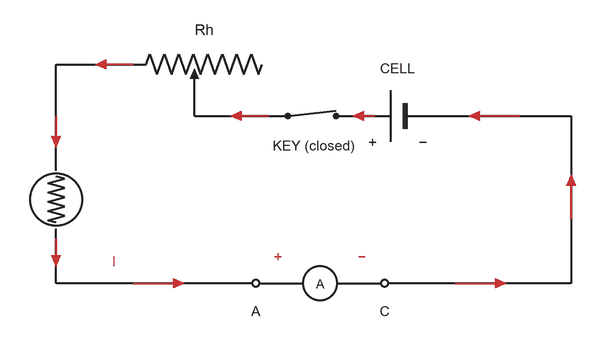
With the key closed, the current flows through the KEY, up the jockey into Rh, along part of Rh to its left end, down through the load, and along the bottom wire to A. It passes through the ammeter from A to C, goes up the right-hand side and returns to the − terminal of the cell.
Step 3 — Mark the ammeter's polarity.
The current enters the ammeter at A, so A is its + terminal and C is its − terminal. The completed circuit, with the current arrows, is shown below.
Step 4 — Name Rh and state its purpose.
Rh is a rheostat (variable resistance). Sliding its jockey changes the length of resistance wire in the circuit, so it is used to vary the resistance and so adjust the current.
Watch out: Mark the ammeter's + on the side nearer the + terminal of the cell along the current's path.
Therefore, the ammeter goes between A and C with A marked + and C marked −, the current flows from the + terminal round through the key, Rh, the load and A to C, and Rh is a rheostat used to adjust the current.

