
Question 455 marksMedium
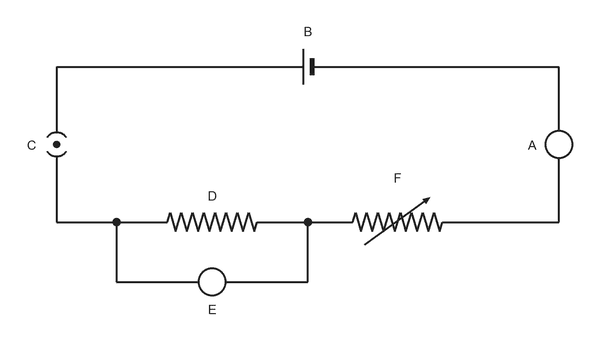
In the electric circuit shown in Fig. 9.16, label the parts A, B, C, D, E, and F. State the function of each part. Show in the diagram the direction of flow of current.
Confirming your payment
Sign up now and get 250 free tokens.
Current Electricity · Question 45 of 101
In the electric circuit shown in Fig. 9.16, label the parts A, B, C, D, E, and F. State the function of each part. Show in the diagram the direction of flow of current.
Solution:
Concept: The meter in series with the cell is the ammeter, the meter joined across a resistance is the voltmeter, and the resistance with a slanting arrow is the rheostat.
Step 1 — Name each part.
We read each symbol from the figure and state what it does.
| Part | Name | Function |
|---|---|---|
| A | Ammeter | Measures the current in the circuit (joined in series). |
| B | Cell | Source of direct current; keeps the charge flowing. |
| C | Plug key | Puts the current on or off. |
| D | Resistance R (resistance wire) | The resistance (load) through which the current flows. |
| E | Voltmeter | Measures the potential difference across D (joined in parallel with D). |
| F | Rheostat | Varies the resistance, and so controls the current. |
Step 2 — Find the + terminal of the cell.
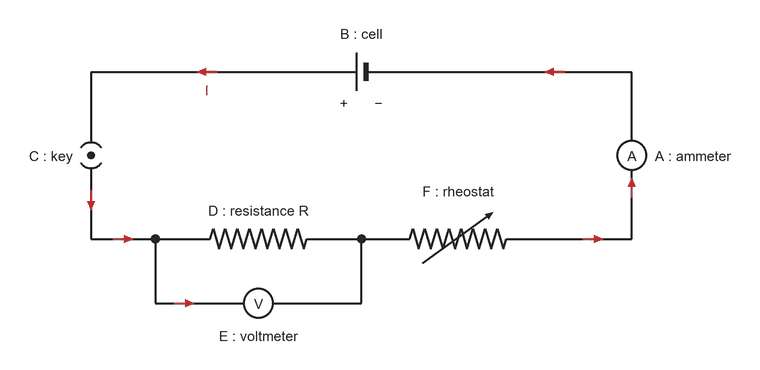
The long thin plate of B is its + terminal, and it is on the left. So the conventional current leaves B on its left side.
Step 3 — Trace the current.
The current goes left along the top wire, down through the key C, and right along the bottom through D (a very small part goes through the voltmeter E). It then passes through the rheostat F, up through the ammeter A, and back into the − terminal of B. The arrows show this.
Watch out: The direction comes from the cell's plates, not from the letters: the long thin plate is always +.
Note: the figure is redrawn more clearly: the rheostat F now has both its ends in the circuit and the studs of the key C face along the wire. The parts and their places are as printed.
Therefore, A is the ammeter, B the cell, C the key, D the resistance, E the voltmeter and F the rheostat, and the current flows from the + plate of B through C, D, F and A back to B.