
Question 445 marksEasy
Write symbols and state the functions of each of the following components in an electric circuit : (i) key, (ii) cell, (iii) rheostat, (iv) ammeter, and (v) voltmeter.
Confirming your payment
Sign up now and get 250 free tokens.
Current Electricity · Question 44 of 101
Write symbols and state the functions of each of the following components in an electric circuit : (i) key, (ii) cell, (iii) rheostat, (iv) ammeter, and (v) voltmeter.
Solution:
Concept: Every component has a standard symbol, so that circuits can be drawn quickly and read by anyone.
Step 1 — Draw the symbols.
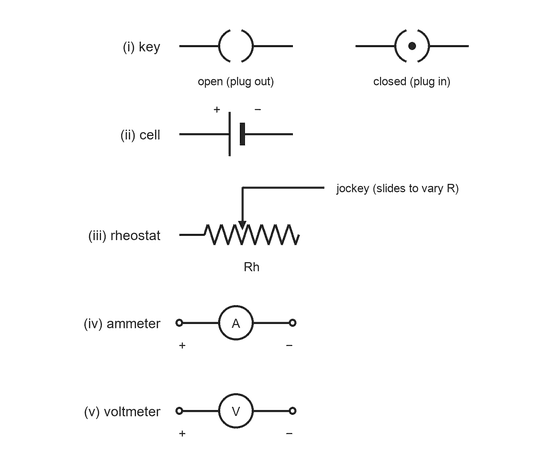
The five symbols are shown below.
Step 2 — Key.
A plug key is drawn as two curved studs, with a dot (the plug) between them when it is closed. It is used to put the current on or off in a circuit.
Step 3 — Cell.
A cell is drawn as a long thin line (+ terminal) and a short thick line (− terminal). It is a source of direct current: it keeps the charge flowing by changing chemical energy into electrical energy.
Step 4 — Rheostat.
A rheostat (Rh) is drawn as a resistance with a sliding jockey (arrow). It is used to vary the resistance continuously, and so to adjust the current in the circuit.
Step 5 — Ammeter.
An ammeter is the letter A in a circle, with + and − terminals. It measures the current. It is joined in series so that the whole current passes through it, and it has a very low resistance.
Step 6 — Voltmeter.
A voltmeter is the letter V in a circle, with + and − terminals. It measures the potential difference between two points. It is joined in parallel across those points, and it has a very high resistance so that it draws very little current.
Watch out: Do not swap the meters: an ammeter goes in series, a voltmeter in parallel.
Therefore, the key switches the current on or off, the cell supplies it, the rheostat adjusts it, the ammeter measures it and the voltmeter measures the potential difference.