
Opening your dashboard
Class 9 Physics Chapter 9 Current Electricity: Competency-Based Questions (CBQ)
40 questions on Chapter 9, each worked through on its own page with the AI tutor. Class 9 Physics, ICSE 2026-27.
40 questions
1–5 marks · Mixed difficulty
- 11 mark
Question 1
Competency: Application & Analysis
Two phone chargers are compared. Charger P sends a charge of 90 C through a phone in 1 minute. Charger Q sends a charge of 600 C through the same phone in 5 minutes. Each current is steady. Which charger sends the larger current, and how large are the two currents ?
- 21 mark
Question 2
Competency: Analysis
In the circuit shown, X, Y and Z are three bulbs in working order. The plug of key K1 is in and the plug of key K2 is out.

Which of the bulbs glow ?
- 31 mark
Question 3
Competency: Analysis
Asha makes a tester by joining two cells, a torch bulb and two wires with free ends. When the two free ends are touched together, the bulb glows brightly. When the free ends are dipped, without touching each other, into a beaker of tap water, the bulb does not glow.
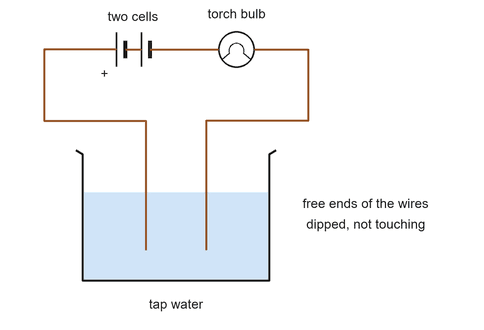
She then replaces the bulb by an LED, which glows even with a very small current, and dips the free ends into the tap water again. Now the LED glows. Which conclusion do these observations support ?
- 41 mark
Question 4
Competency: Application
A cell does 6 J of work in sending a charge of 4 C through a torch bulb. A car battery does 48 J of work in sending the same amount of charge through a headlamp bulb. The potential difference across the headlamp bulb is :
- 51 mark
Question 5
Competency: Understanding
Assertion (A): The starter motor of a car is run by a lead accumulator and not by a battery of dry cells.
Reason (R): A lead accumulator has a low internal resistance, so it can supply a large current.
- 61 mark
Question 6
Competency: Understanding & Analysis
Assertion (A): When two positively charged conductors are joined by a metal wire, electrons always flow from the conductor that has the smaller charge to the conductor that has the larger charge.
Reason (R): Electrons flow from a conductor at a lower potential to a conductor at a higher potential.
- 72 marks
Question 7
Competency: Application
In one flash of lightning, a charge of 16 C passes from a cloud to the ground in 0.0008 s. Taking the flow to be steady and the charge on an electron as C, find :
(a) the current in the flash,
(b) the number of electrons that pass in the flash.
- 82 marks
Question 8
Competency: Evaluation
A shop sells a wall clock, which draws a very small current and is expected to run for a year without attention, and a cordless drill, which draws a large current and is used for a few minutes every day. The shopkeeper says, "Dry cells are the right source of current for both of them." Judge this advice for (a) the clock and (b) the drill, giving a reason in each case.
- 92 marks
Question 9
Competency: Application
An LED (light emitting diode) lets a current pass in one direction only : the conventional current must enter through its longer leg and leave through its shorter leg. Ria joins the longer leg of an LED to the negative terminal of a cell, and the shorter leg, through a closed key, to the positive terminal.
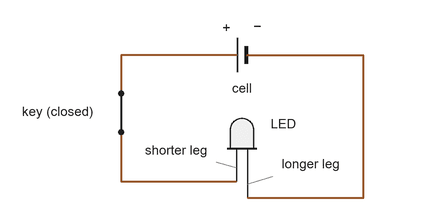
(a) Will the LED glow ? Give a reason.
(b) Ria now connects the LED correctly and it glows. State the direction in which the electrons move through the LED, and give a reason.
- 102 marks
Question 10
Competency: Analysis
The figure shows a circuit set up by a student. Its six components are numbered 1 to 6, and the bulb is glowing.
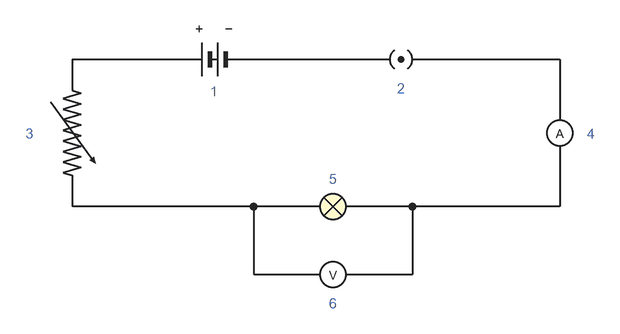
(a) The bulb is to be made dimmer without switching it off. Which numbered component should be adjusted, and how ? How does the reading of component 4 change ?
(b) The plug of component 2 is now taken out. What do components 4 and 6 read ? Give a reason.
- 114 marks
Question 11
Competency: Application & Analysis
Case study: A technician has two wires, A and B, made of the same material and of the same length, but she does not know which one is thicker. She connects each wire in turn to a variable source, keeps the wire at room temperature, and measures the current for different potential differences. Her results are shown in the graph.
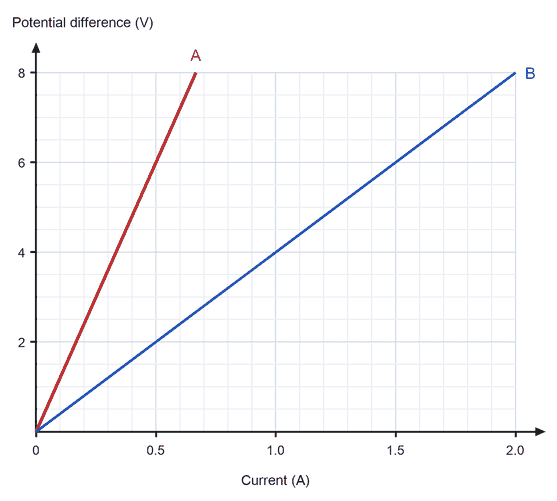
(a) Use the graph to find the resistance of wire A and of wire B.
(b) Which wire is thicker ? Give a reason for your answer.
(c) The technician needs a current of 0.75 A in wire A. What potential difference must she apply across it ? State the assumption you make.
- 124 marks
Question 12
Competency: Analysis & Evaluation
Case study: The motor of an electric scooter is worked by a battery, and the potential difference across the motor stays at 48 V. A display on the scooter records the current during two stretches of a ride, as given in the table.
Stretch Current in the motor Time taken Level road 15 A 10 minutes Uphill road 25 A 4 minutes (a) Calculate the charge that passes through the motor on each stretch.
(b) Calculate the work done by the battery in sending this charge through the motor on each stretch.
(c) The rider says, "The uphill stretch took more energy from my battery, because the current was larger." Judge this statement.
- 133 marks
Question 13
Competency: Analysis & Evaluation
Case study: A housing society lights its staircases with 20 filament bulbs, and each bulb is on for 1000 hours in a year. The secretary collects the data below for three kinds of lamp that give the same amount of light. The electrical energy is in kWh, the 'unit' in which an electricity bill is made, and the society pays ₹8 for each kWh.
Kind of lamp Electrical energy used in 1000 hours Life of one lamp Filament bulb 60 kWh 1000 hours CFL 15 kWh 8000 hours LED 9 kWh 25000 hours (a) Which lamp makes the most efficient use of energy ? Justify your answer from the table.
(b) Calculate the electrical energy and the money that the society will save in one year if it replaces all 20 filament bulbs by LEDs.
(c) The secretary says, "A CFL is almost as good as an LED, so let us buy whichever is cheaper in the shop." Judge this advice.
- 144 marks
Question 14
Competency: Analysis
Case study: Kabir's phone charger does not send a steady current for the whole time of charging. It starts with a large current and lowers it in steps as the battery fills up. The graph shows the current sent by the charger during one charging, which lasts 120 minutes.

(a) Find the charge sent to the phone in the first 30 minutes.
(b) Find the total charge sent to the phone in the 120 minutes.
(c) Another charger sends a steady current of 1.5 A. How long will it take to send the same total charge ? How much time does it save ?
- 154 marks
Question 15
Competency: Creation
A student reads that "doubling the length of a wire doubles its resistance" and wants to test it. She has a thin, uniform nichrome wire 1 m long stretched along a metre scale, a battery, a key, a rheostat, an ammeter, a voltmeter, connecting wires and two crocodile clips. Plan the experiment for her :
(a) Describe, or show in a labelled circuit diagram, how the components should be connected.
(b) State the readings she should take, and draw the table in which she should record them.
(c) Explain how she should use the readings to decide whether the statement is true, and give one precaution that makes the test fair.
- 161 mark
Question 16
Competency: Application
The ammeter in the circuit of a heater shows the reading in the figure. The current is steady, and the heater stays switched on for 40 s.
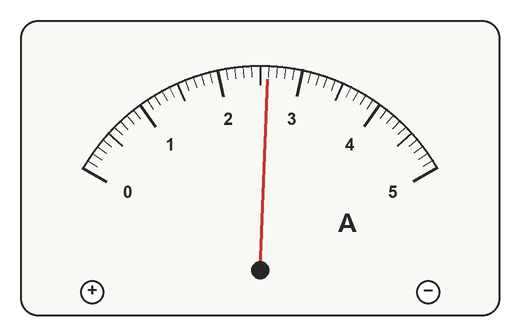
How much charge passes through the heater in this time ?
- 171 mark
Question 17
Competency: Analysis
Two wires X and Y are made of the same material and are kept at the same temperature. Wire Y is twice as long as wire X, and the radius of Y is also twice the radius of X. Each wire is joined in turn to the same cell, which keeps a potential difference of 1.5 V across the wire. The current in wire X is 0.30 A. What is the current in wire Y ?
- 181 mark
Question 18
Competency: Application
A small LCD (digital) wall clock runs on one dry cell and draws a steady current of , where . How much charge does the cell send through the clock in one day of 24 hours ? (Hypothetical data.)
- 191 mark
Question 19
Competency: Understanding
Assertion (A): A voltmeter joined across a bulb draws almost no current from the circuit.
Reason (R): A voltmeter is joined in parallel with the part of the circuit across which the potential difference is to be measured.
- 201 mark
Question 20
Competency: Application
A corridor light has to work for 12 000 hours. A filament bulb lasts 1000 hours, and a compact fluorescent lamp (CFL) lasts 6 to 10 times longer than a filament bulb. How many lamps are needed in the two cases, whichever value in this range is true ?
- 211 mark
Question 21
Competency: Analysis
The unit of potential difference is 1 volt joule per coulomb, and the unit of current is 1 ampere coulomb per second. Resistance is the ratio of potential difference to current. Starting only from these facts, the ohm can be written as :
- 221 mark
Question 22
Competency: Application
In a solution of common salt, positive ions pass through a cross-section of the solution towards the left in 2 s, and negative ions pass through the same cross-section towards the right in the same 2 s. Each ion carries a charge of magnitude . What is the current in the solution ?
- 231 mark
Question 23
Competency: Application
In an office, 40 desktop computers are left switched on, though nobody uses them, for 14 hours every night. Each computer uses 0.05 kWh of electrical energy in every hour that it stays on. The office decides to switch all of them off at the mains before leaving each evening. How much electrical energy does this save in 30 days ? (Hypothetical data.)
- 241 mark
Question 24
Competency: Understanding
Assertion (A): Copper wires that carry current in a house are covered with rubber or plastic.
Reason (R): Rubber and plastic have almost no free electrons, so they offer a very high resistance to the flow of current.
- 251 mark
Question 25
Competency: Analysis
In the circuit shown, the key K is closed and the current flows steadily. P is a point on the upper wire, between the cell and the key, and S is a point on the lower wire.

Which statement gives the correct directions at the points P and S ?
- 262 marks
Question 26
Competency: Application
The small lamp inside a refrigerator is joined to the mains supply through a switch fixed in the door frame. When the door is shut, it presses the button of the switch in; when the door is opened, the button pops out. The lamp is off while the door is shut, and it glows as soon as the door is opened.
(a) Is the circuit of the lamp open or closed when the door is shut ? Give a reason.
(b) What name is given to the lamp in this circuit, and what does the switch do to the circuit when the door is opened ?
- 272 marks
Question 27
Competency: Evaluation
The dry cell of Rishi's wall clock has run down and the clock has stopped. Rishi says, "I will join this cell to a mobile charger overnight to charge it again. That will save the cost of a new cell."
(a) Judge Rishi's plan, giving a reason from the kind of chemical reaction in a dry cell.
(b) Name one kind of cell that can be recharged, and state one disadvantage of such a cell compared with a dry cell.
- 282 marks
Question 28
Competency: Application
An electrician repairs a switch using a screwdriver with a plastic handle, and she stands on a rubber mat. Before starting she tells her helper, "Never touch a switch or an appliance with wet hands."
(a) Why are the handle of the screwdriver and the mat made of plastic and rubber ?
(b) Why is it more dangerous to touch a live wire with wet hands than with dry hands ?
- 292 marks
Question 29
Competency: Application & Evaluation
A farmer wants to run a water pump from a solar panel fixed 60 m away. A shopkeeper has two copper wires of the same quality, a thin one that is cheaper and a thick one that is dearer. He says, "Take the thin wire; the current is the same in either wire."
(a) Which wire would you advise the farmer to buy ? Give a reason using the factors on which resistance depends.
(b) The farmer later shifts the pump to a place 120 m away from the panel. By what factor does the resistance of the same kind of wire change, and why ?
- 302 marks
Question 30
Competency: Application
Anita makes a lemon cell by pushing a copper strip and a zinc strip into a lemon. When she joins her ammeter to the two strips, the needle hardly moves.
(a) Name the instrument that she should use instead to find out whether the lemon cell sends a very weak current, and give one reason why it suits this job.
(b) With this instrument joined, the needle moves to the right of the zero mark. She then interchanges the two wires at the terminals of the instrument. What will she see now, and what does this show about the current from the lemon cell ?
- 312 marks
Question 31
Competency: Application & Analysis
Two identical metal spheres A and B stand on insulating stands. Compared with their neutral state, A has an excess of electrons and B has a deficit of electrons. The spheres are joined by a metal wire, and electrons flow until both spheres have the same concentration of electrons. (Take .)
(a) How does each sphere stand after the flow has stopped ?
(b) How many electrons flow through the wire, in which direction, and how much charge is this ?
- 323 marks
Question 32
Competency: Analysis
Three wires X, Y and Z are made of the same material and have the same length. Each wire is joined in turn across a source that keeps the potential difference at 3.0 V, and the current is read from an ammeter. The area of cross-section of a wire is proportional to the square of its radius. (Hypothetical data.)
Wire Radius (in mm) Current (in A) X 0.20 0.10 Y 0.40 0.40 Z 0.60 0.90 (a) Find the resistance of each wire.
(b) Show from the data that the resistance is inversely proportional to the area of cross-section.
(c) Predict the current in a wire of the same material and length with radius 0.80 mm.
- 333 marks
Question 33
Competency: Application & Analysis
In a school model of an egg incubator, a battery sends a steady current of 0.25 A through a short nichrome heating wire for 2 minutes, and the wire stays at the same temperature. During this time the battery does 90 J of work in moving the charge through the heating wire. (Hypothetical data.)
(a) Find the charge that passes through the heating wire.
(b) Find the potential difference across the heating wire.
(c) Find the resistance of the heating wire.
- 343 marks
Question 34
Competency: Analysis
A decorative LED draws a current of 20 mA and is kept on for 3 minutes. A torch bulb draws a current of 100 mA and is kept on for 30 s. Both currents are steady. Take and . (Hypothetical data.)
(a) Find the charge that passes through the LED and through the bulb.
(b) Through which one does more charge pass, and how many more electrons is this ?
(c) Which one carries the larger current, and how many times larger is the number of electrons passing per second through it ?
- 353 marks
Question 35
Competency: Analysis
A student joins a cell, a torch bulb and an ammeter in series and leaves two free ends. She touches the free ends in turn to the two ends of different samples of the same size, and notes the ammeter reading each time. (Hypothetical data.)
Sample Ammeter reading (in mA) Copper wire 250 Iron nail 240 Pencil lead (graphite) 90 Salt solution 12 Distilled water 0 Plastic scale 0 Dry cotton thread 0 (a) Arrange the samples that conduct in the order from the best to the poorest conductor, and give a reason for the order.
(b) Which samples are insulators ? Explain why they allow no current.
(c) Choose a sample from the table for a connecting wire, and another for the cover of an electrical plug. Give a reason for each choice.
- 363 marks
Question 36
Competency: Application
A student studies a rheostat. Its resistance wire is 40 cm long and has a total resistance of 20 , the wire being uniform. She joins a battery, which keeps a potential difference of 12 V across the wire in use, between the terminal A, at one end of the wire, and the terminal C of the jockey, so that only the part of the wire between A and the jockey is in the circuit. The resistance of the ammeter and the connecting wires is negligible. (Hypothetical data.)
(a) The jockey touches the wire at a point 16 cm from A. Find the resistance in the circuit and the ammeter reading.
(b) The jockey is moved to a point 30 cm from A. Find the new ammeter reading.
(c) In which direction should the jockey be moved to increase the current ? Give a reason.
- 374 marks
Question 37
Competency: Creation
Case study: Aarav's younger sister says, "A bulb uses up some of the current, so the current that comes back to the cell is smaller than the current that goes out from the cell." Aarav feels that this is not true and wants to test it. He has a cell, a plug key, a torch bulb, two identical ammeters A₁ and A₂, and connecting wires.
(a) Plan the circuit for him. Show, in a labelled sketch, how the components should be joined so that A₁ measures the current going into the bulb and A₂ measures the current coming out of it. Mark the polarity of each ammeter.
(b) What readings of the two ammeters should he expect with the key closed ? Draw a table in which he can record the readings.
(c) What conclusion should he draw ? State one precaution that he should take.
- 384 marks
Question 38
Competency: Evaluation
Case study: Meena's toy car runs on one cell, and she plays with it so often that the cell is used up every week. Her family wants to know which kind of cell costs less in the long run. A shopkeeper sells two kinds of cells of the same size. A cell of the first kind is thrown away once it is used up. The second kind can be recharged, but needs a charger. The data are in the table. (Hypothetical data.)
Kind of cell Cost of one cell Number of times one cell can be used Charger Dry cell ₹15 1 not needed Rechargeable cell ₹150 about 200 ₹450, bought once (a) Find the cost of each use of a dry cell, and the cost of each use of one rechargeable cell and its charger over 200 uses.
(b) After how many uses does the total cost of the dry cells become equal to that of the rechargeable cell with its charger ? After how many weeks is this for Meena's toy car ?
(c) Meena's mother says, "A rechargeable cell costs ten times as much as a dry cell, so it can never be worth buying." Judge her statement by finding the money saved over 200 uses, and state why a rechargeable cell can be used again and again.
- 394 marks
Question 39
Competency: Evaluation
Case study: A town library is rebuilt. The new building has large windows and skylights placed to let daylight into the reading hall, a white roof, and LED lamps for the evenings. The library is open from 9 a.m. to 8 p.m. every day, and its staff noted the electrical energy used for lighting and for cooling in one year before the rebuilding and in one year after it. (Hypothetical data.)
Use Old building (kWh per year) New building (kWh per year) Lighting 12 000 4 800 Cooling 18 000 13 200 (a) Find the percentage reduction in the energy used for lighting.
(b) The IEA states that better energy efficiency could reduce the world's energy need in 2050 by one-third. Does the library's total reduction reach this target ?
(c) Name two features of the new building that save energy, and explain how each one does so.
- 405 marks
Question 40
Competency: Analysis
Case study: A teacher compares an electric circuit with a closed water system. A pump lifts water from a low tank to a high tank. From the high tank, the water runs back to the low tank through a narrow pipe fitted with a tap. No water is lost on the way, and the same amount flows past every point of the pipe in each second. A higher pump lift, with a larger difference of levels, pushes more water through the same pipe in each second.
(a) Match each of these parts of the water system with its counterpart in a circuit: the pump, the difference between the levels of the two tanks, the water that flows past a point in one second, the narrow pipe, the closed tap.
(b) Two tanks standing on the same floor hold water to different heights. They are joined near their bottoms by a pipe with a tap, and there is no pump. Describe what happens when the tap is opened. Use this to explain why electrons flow only for a moment when two conductors at different potentials are joined by a metal wire, but flow steadily in a closed circuit with a cell.
(c) In the circuit, a wire at a constant temperature carries a current of 0.20 A when it is joined to a 3.0 V cell. The teacher now doubles the difference of levels and, at the same time, fits a pipe of the same width but twice as long. The matching change in the circuit is a 6.0 V battery joined across a wire of the same material and thickness, at the same temperature, but twice as long. Find the resistance of each wire and the current in the second wire, and say how the flow of water changes.