
Question 425 marksEasy
Distinguish between a closed circuit and an open circuit, with the use of suitable labelled diagrams.
Confirming your payment
Sign up now and get 250 free tokens.
Current Electricity · Question 42 of 101
Distinguish between a closed circuit and an open circuit, with the use of suitable labelled diagrams.
Solution:
Concept: Current flows only round a closed circuit, a complete conducting path from the + terminal of the source, through the components, back to its − terminal. A gap or an insulator anywhere in the path makes it an open circuit, and no current flows.
Step 1 — Draw the two circuits.
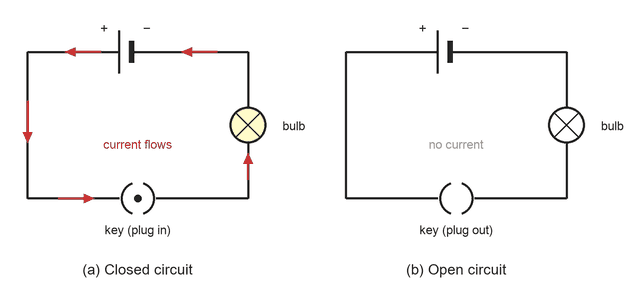
Both circuits have a cell, a bulb and a plug key. In (a) the plug is in; in (b) it is out.
Step 2 — Explain the closed circuit.
In (a) the key is closed, so there is a complete conducting path from the + terminal of the cell, through the bulb, back to the − terminal. Current flows (arrows) and the bulb glows.
Step 3 — Explain the open circuit.
In (b) the key is open, so an air gap (an insulator) breaks the path. The circuit is incomplete, no current flows and the bulb does not glow.
Step 4 — Compare them.
The table sums up the difference.
| Closed circuit | Open circuit |
|---|---|
| The conducting path is complete. | The path is broken somewhere. |
| The key is closed (plug in). | The key is open (plug out). |
| Current flows; the bulb glows. | No current flows; the bulb does not glow. |
Therefore, a closed circuit has a complete path and carries current, while an open circuit has a break and carries no current.