
Opening your dashboard
Class 9 Physics Chapter 9 Current Electricity: Practice Questions
42 questions on Chapter 9, each worked through on its own page with the AI tutor. Class 9 Physics, ICSE 2026-27.
42 questions
1–5 marks · Mixed difficulty
- 11 mark
Question 1
Bloom's level: Remember
Which one of the following is a secondary cell ?
- 21 mark
Question 2
Bloom's level: Remember
A current of constant magnitude that flows in one direction only is called :
- 31 mark
Question 3
Bloom's level: Understand
An instrument is joined across a bulb in a circuit. It has a very high resistance, so it draws hardly any current from the circuit, and its dial has a + mark at one terminal. The instrument is :
- 41 mark
Question 4
Bloom's level: Apply
A steady current of 0.4 A flows through the heating coil of a small iron for 2 minutes. The charge that passes through any cross-section of the coil is :
- 51 mark
Question 5
Bloom's level: Apply
A current of 3.2 mA flows in a wire. Taking the charge on an electron as C, the number of electrons passing a cross-section of the wire in one second is :
- 61 mark
Question 6
Bloom's level: Apply
A wire draws a current of 0.5 A when a potential difference of 4 V is applied across its ends. If the potential difference is raised to 10 V and the temperature of the wire does not change, the current becomes :
- 71 mark
Question 7
Bloom's level: Understand
A positively charged metal sphere A is joined by a copper wire to an identical uncharged metal sphere B. Which statement describes what happens ?
- 81 mark
Question 8
Bloom's level: Analyse
Three conductors are at the potentials : P at +15 V, Q at +5 V and R at −5 V. They are joined in pairs by a metal wire, one pair at a time. Which statement is correct ?
- 91 mark
Question 9
Bloom's level: Evaluate
A shopkeeper tells a customer, "Do not buy an LED bulb to replace your old filament bulb. It costs more, so it is a waste of money." Which is the best judgement of this advice ?
- 101 mark
Question 10
Bloom's level: Understand
Read the Assertion (A) and the Reason (R) and choose the correct option.
Assertion (A): A lead accumulator can be recharged and used again and again.
Reason (R): In a secondary cell, the chemical reaction that produces the current is reversible.
- 111 mark
Question 11
Bloom's level: Understand
Read the Assertion (A) and the Reason (R) and choose the correct option.
Assertion (A): Pure (distilled) water is a good conductor of electricity.
Reason (R): The human body allows an electric current to flow through it.
- 121 mark
Question 12
Bloom's level: Analyse
Read the Assertion (A) and the Reason (R) and choose the correct option.
Assertion (A): The resistance of the filament of a bulb is more when it is glowing than when it is cold.
Reason (R): The resistance of a metal wire decreases when its temperature increases.
- 132 marks
Question 13
Bloom's level: Remember
(a) What is an alternating current (a.c.) ?
(b) What is the frequency of the a.c. supplied by the mains in our homes ?
- 142 marks
Question 14
Bloom's level: Understand
Explain why an ammeter must have a very low resistance while a voltmeter must have a very high resistance.
- 152 marks
Question 15
Bloom's level: Apply
A copper strip in a toy carries a steady current. A counter shows that electrons cross one section of the strip every 4 s. Taking C, calculate (a) the charge carried across the section in those 4 s, and (b) the current in the strip.
- 162 marks
Question 16
Bloom's level: Apply
A 9 V battery sends a charge of 25 C through a toy motor.
(a) How much work does the battery do on this charge ?
(b) If the charge flows in 50 s, what is the current ?
- 172 marks
Question 17
Bloom's level: Apply
A current of 0.3 A flows through a resistor when the potential difference across it is 4.5 V. Find (a) its resistance, and (b) the potential difference needed to send a current of 0.8 A through it (temperature unchanged).
- 182 marks
Question 18
Bloom's level: Analyse
Ravi puts two new cells in his torch and switches it on, but the bulb does not glow. Suggest three possible reasons, using the idea of a closed circuit.
- 192 marks
Question 19
Bloom's level: Understand
In the filament of a glowing torch bulb, the free electrons move from the end joined to the negative terminal of the cell towards the end joined to the positive terminal. Yet we show the current going from the positive terminal to the negative terminal. Explain.
- 201 mark
Question 20
Bloom's level: Remember
State one harmful substance used in fluorescent tube lights that is avoided by using LED bulbs.
- 212 marks
Question 21
Bloom's level: Analyse
Two wires P and Q are connected, one at a time, to the same 3 V cell. The current through P is 0.5 A and through Q is 0.2 A.
(a) Which wire has more resistance, and by how many ohm ?
(b) If both wires are of the same material and the same thickness and at the same temperature, which wire is longer ? How many times as long ?
- 222 marks
Question 22
Bloom's level: Apply
A student puts each of these, one at a time, between the two free ends of a circuit containing a cell and a bulb : aluminium foil, a rubber eraser, a steel spoon, a glass rod, salt water, a dry wooden stick.
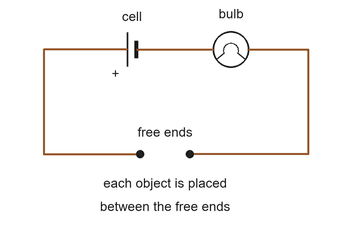
Predict which ones will make the bulb glow, and give the reason.
- 234 marks
Question 23
Bloom's level: Apply
Case study: Meera's father turns the key of his car. The starter motor, worked by the car's lead accumulator, draws a current of 120 A for 1.5 s and the engine starts. While the car runs, the engine recharges the accumulator.
(a) Is the lead accumulator a primary or a secondary cell ? Why is it used in a car instead of dry cells ?
(b) What energy change takes place in the accumulator (i) while it runs the starter motor, (ii) while it is being recharged ?
(c) Calculate the charge that flows through the starter motor, and the number of electrons this charge contains (charge on an electron C).
- 244 marks
Question 24
Bloom's level: Analyse
A student applies different potential differences across a wire and measures the current each time, keeping the wire at room temperature.
Potential difference (in V) 0 2 4 6 8 Current (in A) 0 0.08 0.16 0.24 0.32 (a) Find the ratio for each non-zero reading. What do you notice, and which law does this show ?
(b) What is the resistance of the wire ?
(c) The student now uses a wire of the same material and thickness but twice as long. What current will flow when 8 V is applied ?
(d) Why was it important to keep the wire at room temperature ?
- 254 marks
Question 25
Bloom's level: Evaluate
A student wants to measure the current through a resistor R and the potential difference across it. She connects the circuit shown.

(a) Check her circuit and state the two mistakes.
(b) What will the two meters show when the key is closed ? Give a reason.
(c) Draw the correct circuit, marking the + terminals of the meters and the direction of the current.
- 265 marks
Question 26
Bloom's level: Create
Design a simple conduction tester that you could use to find out whether an object is a conductor or an insulator. Include :
(a) a circuit diagram using the standard symbols,
(b) how you will use it and how you will decide, giving the reason in terms of closed and open circuits,
(c) a results table for any four objects of your choice,
(d) one precaution.
- 275 marks
Question 27
Bloom's level: Create
Case study: Your school's eco-club notices that the classrooms use old filament bulbs, the fans and lights are often left on in empty rooms, and the corridors are dark during the day although they have walls facing open ground.
(a) Propose three changes to the lighting and appliances, giving a reason for each.
(b) Suggest two changes to the building itself that would reduce the need for artificial light or cooling.
(c) Plan a one-week awareness campaign in the school, with two activities, and say how the club could check whether the campaign worked.
- 283 marks
Question 28
Bloom's level: Understand
When a negatively charged conductor A is joined to an uncharged conductor B by a metal wire, electrons flow only for a moment. Explain
(a) why the electrons flow and why the flow stops, comparing this with water flowing between two vessels, and
(b) how an electric cell keeps the electrons flowing continuously in a circuit.
- 294 marks
Question 29
Bloom's level: Evaluate
Check each statement written by a student. Say whether it is correct or incorrect, and rewrite each incorrect one correctly.
(i) A potential difference of 1 volt means that 1 coulomb of charge flows in 1 second.
(ii) In a metal wire the current is carried by free electrons, and the conventional current is in the same direction as the electrons move.
(iii) A thick wire offers less resistance than a thin wire of the same length and material.
(iv) A voltmeter is always joined in series with the component whose potential difference is to be measured.
- 304 marks
Question 30
Bloom's level: Apply
A torch has three cells, each of potential difference 1.5 V, joined in series. The bulb draws a current of 0.25 A.

(a) What is the potential difference across the bulb (ignore the resistance of the wires and cells) ?
(b) Find the resistance of the filament while it glows.
(c) The torch is kept on for 2 minutes. Find the charge that flows and the work done by the battery in moving this charge through the bulb.
- 312 marks
Question 31
What is the minimum possible charge on a body ?
- 322 marks
Question 32
A current of 4.5 A flows through a conductor for one minute. Calculate the charge that passes through the conductor.
- 331 mark
Question 33
The work done in moving a charge of 0.5 C from one point to another point in an electric circuit is 6 J. The potential difference between the two points is :
- 341 mark
Question 34
Four wires made of the same material are kept at the same temperature. Which of them has the least resistance ?
- 351 mark
Question 35
Assertion (A): In a metal wire joined to a cell, the direction of the current is opposite to the direction in which the electrons move.
Reason (R): The direction of the current is taken as the direction of flow of positive charge, and electrons carry negative charge.
- 362 marks
Question 36
(i) State the energy change that takes place in a secondary cell while it is being charged.
(ii) Give one example each of a primary cell and a secondary cell, and state one difference between the two kinds of cell other than recharging.
- 372 marks
Question 37
electrons pass through a cross-section of a wire in 1 minute. (Charge on an electron C.) Calculate :
(i) the charge that passes through the cross-section in this time,
(ii) the current in the wire.
- 382 marks
Question 38
(i) Explain, in terms of free electrons, why copper is a conductor of electricity while rubber is an insulator.
(ii) Pick out the two conductors from the following : ebonite, graphite, dry wood, mercury, glass.
- 392 marks
Question 39
A conductor A at a potential of 40 V is joined by a copper wire to a conductor B at a potential of 15 V.
(i) State the direction in which the electrons flow in the wire, and the direction of the current.
(ii) State when the flow of electrons stops.
- 404 marks
Question 40
A student has a battery of two cells, a plug key, a bulb, an ammeter and a voltmeter.
(i) Draw a labelled circuit diagram, using the standard symbols, in which the ammeter measures the current through the bulb and the voltmeter measures the potential difference across the bulb. Show the key closed.
(ii) Mark the direction of the current in your diagram. State how the ammeter and the voltmeter are connected with respect to the bulb.
(iii) The plug of the key is now taken out. State what happens to the bulb and to the reading of the ammeter, and name the kind of circuit obtained.
- 414 marks
Question 41
A current of 0.4 A flows through a wire when a potential difference of 6 V is applied across its ends. The temperature of the wire remains constant.
(i) Calculate the resistance of the wire.
(ii) Calculate the current in the wire when the potential difference across it is raised to 9 V.
(iii) The wire is replaced by another wire of the same material and the same length, but of twice the area of cross-section. Find the resistance of the new wire and the current in it when the potential difference across it is 6 V.
- 423 marks
Question 42
A family replaces the filament bulbs in its house by LED bulbs and buys a refrigerator that carries a five-star label.
(i) Explain why an LED bulb uses less electrical energy than a filament bulb to give the same amount of light.
(ii) What does the five-star label on the refrigerator tell the buyer ?
(iii) State two other habits by which the family can reduce the wastage of electrical energy at home.